The End of Mexican Folk Art
Real Solutions to Mexican Cartels & the Narcostate
The End of Mexican Folk Art
Real Solutions to Mexican Cartels & the Narcostate

In the mind of every United States citizen, there is some jaded whisper of a thought about there being a drug war. As if trying to recall a dream that’s faded beyond recognition and memory, people know there’s something wrong somewhere south of the border, but they can’t really conjure up any significant response or understanding. At most, in their minds, there’s a “gang problem down there.” The current war in Ukraine or Iran receives far more acknowledgment. The 24/7 media reports of foreign wars overseas keep everybody’s hearts and minds looking away from the closest problem to home. People take passionate, ill-conceived political positions and post Ukrainian flags or Palestinian flags above their social media profiles from their iPhones. Hell, even citizens of Mexico do the same (more on that later).
Most have “heard it’s bad” but haven’t conceptualized what “bad” actually is. They don’t have any perspective, let alone real-life experience. Mexico is the only place in the world that has casualty numbers rivaling a war zone, yet isn’t considered one. The war in Afghanistan produced around 1,900 American casualties and an estimated 26,000 civilian casualties over 20 years. By comparison, Mexico averages 40,000 homicides every year as a result of cartel activity — and even that statistic is vastly inaccurate due to government propaganda. One of the leading outlets doing any meaningful, real journalism on this is Demoler. They use data provided by the government, but know it to be entirely inaccurate based on their own reporting alone. Sources who work in anti-narco units estimate the numbers to be double the official government reports. The incentive for misleading statistics is straightforward: accurate reporting doesn’t make the Mexican government look good. Further, the people who gather data — daring journalists and a handful of politicians — are routinely killed by narcos.
American veterans of the war in Afghanistan are baffled by some of the things that happen right across the border, far worse than anything they’ve ever encountered in terms of violence. They may have seen the gruesome aftermath of improvised explosive devices, but even those results pale in comparison to the reality of cartel violence.
To paint a picture: they routinely find mass graves filled with hundreds of adults and children, ice chests filled with human body parts left as terror tactics, designated narco kitchens with 50-gallon drums of diesel used to burn bodies already cut into cubes, mass execution of journalists, daily kidnappings for extortion, a epidemic of rape and murder of women so severe it has been classified as femicide, small-scale trench warfare, drones carrying explosives and chemical weapons, aircraft being shot down, bodies hanging from bridges, and decapitated heads rolled against the curb like lost basketballs.
Most aren’t even aware of something known as Mexican Folk Art — the practice of dismembered, mutilated bodies publicly displayed with deliberate artistic intent in order to intimidate people. Victims’ faces are carefully peeled off (sometimes while alive) with razors or knives and then stitched onto objects like a soccer ball as a taunting message. Mouths or eyes are sewn shut with wire, cartel initials carved into skin, and bodies posed in humiliating positions. They cut the genitals off their victims and stuff them in their mouths. Other times, they remove their entrails and hang them ornamentally. Sometimes they fly decapitated heads around with drones. Mexican Folk Art usually appears in town centers or in front of buildings belonging to those in opposition to the ‘artists.’ They typically build their exhibit overnight and attract long lines of onlookers the following morning.
So, while US citizens are busy engaging in culture wars and having their attention redirected by mainstream media, our closest neighbor and one of our greatest trade partners is on fire. It’s like a fire crew in Texas debating Canadian wildfires while there’s a house fire next door. This disconnect occurs not only among foreign populations but also among many Mexican citizens themselves. Many Mexicans I’ve met have embodied the large-scale brainwashing and distraction at work here. I had friends in Mexico who were afraid to visit the United States because of mass shootings, despite the fact that shootings, arson, homicides, and rape rates across Mexico are several times higher. Some Mexican towns rank among the top five most dangerous cities in the world for homicide — places where you can’t even trust local law enforcement. Yet the media covers the occasional shooting over here as if it’s a war front — an epidemic, they call it — while mass graves are being dug up just miles across the border.
This unawareness and distortion breeds complacency and apathy, lending themselves nicely to creating pliable, easily manipulated populations. Most of this is done intentionally by governments on both sides (more on that later). Others are aware but choose not to notice — to look away.
However, even with vague awareness, more and more Americans and Europeans seeking freedom and adventure, or simply cheaper costs of living, are migrating to Mexico. Safety is relative. Typically, they’re staying in areas perceived to have less crime and less risk. Areas not prone to as intense violence, away from border towns and cartel scrimmages, such as inside Mexico City or the Yucatan Peninsula. Beautiful cities full of culture, vibrancy, and food to die for.
I, too, originally wanted to move to Northern Mexico instead of the Southern Cone. I love the people, I love Norteño music, I love the culture in general, including how norteños dance. But the government and cartel violence, along with the strategic disadvantage of being near the likely hot zone of WW3, made me reconsider. I don’t want to raise a family somewhere I have to worry about being abducted for driving into the wrong area.
People who are aware of the crime levels face the duality of love for Mexico, and awareness of its danger. It’s like an ex-partner you know might be a problem for you one day, but you believe you can work through it. You love the crazy Latina with all your heart, but sometimes she tries to stab you. Make no mistake: I don’t want to discourage people from traveling and appreciating Mexico. In fact, the opposite is true; I want to fix the problems so it’s easier to travel.
More importantly and central to the topic of this essay, there’s no government agency or organized group that offers any realistic solutions, let alone comprehensive, multistep plans to eliminate cartels and the narcostate. This isn’t isolated to foreign affairs; most people lack perspective in all areas of life. Even those who do talk about cartel issues, both American and Mexican citizens offer their “perfect” solutions ranging from “jail all the addicts,” or “legalize all drugs,” and even “take over Mexico by military force.” None seem to have an in-depth perspective, and most of what I see online is just regurgitated politician talking points. These morons don’t understand that cartel violence is cyclical, predictable, and determined by many geopolitical factors. Here, I’ll be laying out a comprehensive plan for eliminating cartels and creating a flourishing, prosperous Mexico.
To understand how to solve the problem, you have to analyze human nature and how the problem came to be. What people don’t realize is that the evolution of narco culture is merely a civilian adaptation. A civilian response to their environment that has evolved through various economic and social pressures, but which now can’t be solved by economic means alone. You can read more scholarly articles detailing the history of events, but I’ve condensed it all down into 5 big picture mistakes that were made over time, resulting in the formation of organized crime groups. If you’re already well-versed on the origins of cartels, you can skip down to The Blame Game section and start there as I lay out the strategy.
1.) Poor Economics & Foreign State Interference
In the mid-1800s, British and American traders exploited the illegal opium trade to reverse China’s trade surplus, flooding Chinese markets with addictive opium sourced from India and Turkey. This weakened the Qing Dynasty economically and socially, and ultimately culminated in the Opium Wars, where British forces militarily conquered key ports and territories to enforce unequal treaties.
In the late 1800s and early 1900s, opium poppy farming began in Sinaloa’s Sierra Madre mountains, driven by poverty among rural peasants and demand from Chinese immigrants in Mexico. The effect was so distinct that U.S. scholarly literature traces the origin of modern-day cartels and their territories back to where Chinese immigrants farmed poppies. Chinese influence remains embedded in Mexican culture today — most notably as the origin of the infamous “Dog Tacos” found in Tijuana. (Though uncommon, they did exist and still pop up every now and then.)
Though a large part of the Chinese opium trade in Mexico began as an economic opportunity born from migrants utilizing the skills they brought with them, many Chinese also considered it payback for the decades of destruction caused by the earlier Opium Wars. This sense of payback continues to this day as China continues helping modern cartels. (More on that later.)
Around 1910–1920, the Mexican Revolution brought widespread political instability and economic disruption, creating lawless regions that enabled early smuggling networks for alcohol and later drugs, all amid widespread poverty.
From 1920–1933, the U.S. Prohibition Era created a huge market for impoverished rural regions of Mexico. Drug trafficking provided jobs and income where legitimate economies failed, especially given high demand from the United States, whose prohibitionist policies inflated black-market prices. Prohibition was opportunity — a seed round of venture capitalism, mainly dealing in alcohol and marijuana, that would later fuel far more significant operations.
This was followed by the Great Depression of the 1930s, which devastated the global economy and hit Mexico especially hard. Again — no jobs, no food on the table. The allure of drug trafficking became impossible to resist, like dangling a carrot before a pig that had been left to starve.
Then, in 1940, the U.S. Federal Bureau of Narcotics imposed a medical embargo on critical medicine entering Mexico. The embargo was one of several coercive tools deployed alongside threats of trade restrictions and diplomatic pressure, all aimed at forcing** Mexico to revert to stricter prohibitionist policies and reverse existing addiction treatment programs. The total ban meant no effective treatment centers could be developed — which, at the time, required low doses of the drug to wean patients off of it. In effect, the embargo created more addicts by outlawing the only available treatment, driving demand even further. Prohibition, just as it did in America with alcohol, sent marijuana and opium sales skyrocketing.
Embargos and sanctions were the seeds that created corruption within the Mexican government. Every government naturally wants autonomy of its laws; it wants control. But if they have to make something illegal in order to lift trade embargoes and sanctions on their economy, they will do that, while continuing to profit from and encourage whatever policy was originally in place. It’s playing the political game.
And that’s exactly what happened. Elements within the Mexican government discontinued pursuing anti-drug enforcement beyond official legal changes. Other academics note that in 1942 and 1947, there were discussions of imposing another drug embargo on Mexico in the U.S., specifically amid suspicions that Mexican authorities were not sufficiently combating opium poppy cultivation. Official Mexican documents prove that officers never implemented the policy in full.1
It’s like when parents try to force their kid to stop doing something without providing a reason or an incentive– the kid agrees to a rule their parents make to avoid punishment, but goes behind their parents’ back and breaks it anyway. Especially if it’s easy to get away with when they’re thousands of miles away. You’re provoking a response and creating an environment ripe for certain behavior, then expecting them not to have that response. It turns the kid into a liar, and governments into corrupt shells.
In the process, this drives trade and behaviors underground, into illegitimacy. In this case, families had mouths to feed, and government officials didn’t want to be under the thumb of the United States. So, they found workarounds. They accepted US laws formally, on paper, but not in practice.
This forces them to break their own laws, which has psychological and systemic consequences. When a government violates its own laws without reprimand, the mindset and political culture begin to shift. The very base seeds of corruption sprout under those conditions because there’s no longer any line in the sand dividing what you can and can’t do. Corruption spreads in other ways as well, such as accepting money from businesses, which occurs even in the most stable governments. In fact, all governments move towards corruption and concentration of power. But the circumstances described were one of several key factors that amplified and drastically accelerated corruption in Mexico, increasing generation after generation. It was the catalyst that took it to a whole other level, after an economy already weakened by hardship. Maybe this is to be blamed on the Mexican politicians of the era, maybe America is to blame, but it doesn’t really matter now. This is what happened.
Like a perfect soup, the ingredients had been added and now sat simmering, melding, deepening, becoming something greater than their parts. Later, the 1982 debt crisis marked a pivotal turning point: Mexico defaulted on its foreign debt amid soaring U.S. interest rates (driven by Federal Reserve policies to combat inflation). Manufacturing dropped significantly, mainly hitting the impoverished rural areas the hardest. They turned up the heat. The soup was no longer simmering, it was boiling, and about to be dished the fuck out.
As a result of the mismanagement and economic interference described above, the perfect growing conditions for black market activity were created. A weak economy promotes violence and drives people toward the most profitable trades — the illegal kind. The illegal trades don’t need infrastructure or foreign investment to thrive. By this point, nearly all control was lost. What remained were puppet politicians serving as shells for foreign countries or cartel leadership, and a lot of heartache.
This environment gave rise to patriotic hero types attempting to gain control. Narcos are the heroes in their own story (at least, originally). They saved the day. They fed their kids, fought authoritarianism, and built something from nothing while Wall Street ravaged average civilians and Mexican politicians grappled for control and raised taxes. They were part of the original cowboys. Admirable, by all means. But what these organizations turned into is something else entirely. Like the Ship of Theseus — if you replace every part of the boat, it’s still the boat in concept and theory, but not in practice.
2.) Incompetent Stabilization Attempts
Narco Folk Heroes were not the only ones attempting to gain control in this timeframe. After the rise of an illegitimate market (a few rural families mainly selling low-grade weed to Americans), governments began trying to squash an entire market sector. In doing so, they created stronger black markets and underground trade networks that unified against a common enemy.
The crackdowns began in the late 1960s and escalated through the 1970s. Precursory operations like Operation Canador (1969–1975) and Trizo (1976) involved militarized tactics, including checkpoints, raids, and initial aerial herbicide spraying, which harassed rural peasants and disrupted small-scale farming operations. Not to mention, the herbicide used (Paraquat) likely caused widespread cancer and chronic illness, further fueling opposition. These efforts were driven by U.S. pressure amid rising drug demand north of the border and aimed at eradicating opium poppy and marijuana cultivation in regions like the Golden Triangle (Sinaloa, Durango, and Chihuahua).
Remember, this is all unfolding at the same time as economic conditions were worsening significantly, in the late 1970s and early 1980s. The effect of this harassment was a unified people. Seeing their livelihood being attacked from multiple angles, scattered family groups and businessmen decided that what little livelihood they scratched out of a broken country should be defended at all costs. Especially with no legitimate economic prosperity outside of black market economics in almost all rural regions of Mexico. Just as workers form unions, drug traffickers form cartels. And so the first cartel was born: The Guadalajara Cartel. Banding together to protect business and trade routes was the only logical conclusion these people had in rural Mexico at the time.
Imagine you’re in their shoes– You have crying babies with mouths to feed, a corrupt government that doesn’t give a fuck about its citizens, and U.S. agitators running raids in your hometown, abusing the population daily. They cornered an entire group of people, leaving them with no other options. While that can’t be said today, and these groups all absolutely need a bullet in their head for the mass murders they carry out today, you have to appreciate how these groups came to be, in order to eliminate them. Know your enemy better than they know themselves. The next step in foreign influence changed everything.
As part of their War on Drugs, the US government, in combination with a handful of people in the Mexican government, made their first attempt with a very ineffective “cut the head off the snake strategy.” Since they can’t fight an entire population on their native land, operatives would locate and capture/execute high ranking cartel leaders.
This led to a critical historical event in the timeline of Mexico’s cartels that happened in 1989: The Arrest of Félix Gallardo. Gallardo was the leader of the Guadalajara Cartel, the singular, unified trafficking group. His life achievement was transforming and consolidating the disparate Mexican trafficking networks into Mexico’s first major centralized drug trafficking federation that dominated marijuana, heroin, and especially cocaine routes to the United States. By this point, it was already expanding far beyond a little pot.
His capture fractured the cartel, creating successor groups like the Sinaloa and Tijuana cartels, marking the end of the first unified group. This created a power vacuum, amplifying violence as new groups fought for territory and trade routes. Scholars find 1989 to be the same time multiple other groups started forming.2
Even after reconsolidating into three main cartels, the larger groups then continued to fracture into multiple smaller factions fighting for control because the Snake Head Strategy continued to be used. For every cartel leader they killed, two more rose up. The downward spiral began.
The initial attempt to squash the market not only created the cartels, but it also armed them once they fractured. Both the American and Mexican governments dismantled the unity of a single peaceful organization that didn’t kill people, didn’t torch cities, none of that… and replaced it with hyper-violent armed groups.
This variable in the story is taking that earlier mentioned boiling soup and adding chili peppers to it. Adding the world’s hottest ghost peppers at such high levels that the acid starts burning the tongue right off anybody who tries it. Even if the early family cartel should have been handled, and if early drug trafficking should have been stopped, they did so in the most inefficient way, thereby creating a larger enemy. That’s the point of this section, not who was right and wrong, but illuminating how it all came to be.
3.) Political Interference
As mentioned earlier, Mexico has been politically influenced and bullied by its bigger brother, the United States. The American government’s Central Intelligence Agency (CIA) played a heavy role in Mexico’s story, ensuring it was never really an independent nation.
Adolfo López Mateos, Gustavo Díaz Ordaz, Luis Echeverría, and José López Portillo — presidents of Mexico from 1958 to 1982 — were confirmed as CIA assets through declassified U.S. documents. It’s well known that Chief of Station Winston Scott also influenced Mexican government officials through a secret spy network code-named “LITEMPO.”3 And that’s only from CIA documents that have been revealed to the public. CIA implants operate without the best interests of the country in mind, and it shows. A lot of this was justified as “defense against communism” and “stabilizing” the region. In reality, they were simply plants serving the national interests of a foreign country. Whether or not America should have been using the CIA to influence Mexico is besides the point. The point is that the end results of this are self-evident. In no way did this minimize cartels or drug trafficking; it amplified it.
The CIA was documented to be intimately involved in the opium trade in the Middle East and Latin America.4 ‘5 Of the many operations they did, they facilitated covert alliances with anti-communist fighters whose funding streams included opium profits in the Golden Crescent during the Soviet-Afghan War. They used a similar strategy in Latin America. The CIA protected some of Mexico’s leading drug traffickers in exchange for their financial support of anti-communist regimes, as leveled by government witnesses at the trials of DEA agent Camarena’s accused killers.6
Congressional records show the U.S. backed drug eradication, but used selective enforcement, letting DFS protect fields tied to anti-communist assets.7 The whole thing was muddy and bloody. Some groups benefited, others were suppressed; some government officials allowed it, some did not. All of this aligned with America’s Realpolitik foreign relations policy; they aimed to keep all surrounding nations weak so that they could be strong. Obviously, this backfired.
Again, when you have internal CIA plants helping the Mexican government break its own laws, it’s like putting a rotting apple in the sun. It speeds everything up. Note that this is a dumbed-down, simplified version of events. The history is much more intricate and corrupt. There were/are other foreign adversaries impacting Mexico beyond America. China is using Mexico as a front to attack the United States, sending fentanyl precursor chemicals and helping with distribution, continuing their Opium War.
The real-world effects of this are simple: Mexico never had the sovereignty or the power to heal itself. To fix its problems. When every single power is benefiting from the situation, there is no savior coming. Elite businessmen profiting, government officials profiting, foreign countries benefitting… There’s nobody left to make a difference. They took the perfect soup of circumstances to create a drug trafficking empire and started dishing it out to everybody. And… well, everybody liked it. Everybody except the hundreds of thousands of civilians dying from the drug war violence.
Stable societies are rare. It’s very difficult to fix an unstable society; it’s like trying to stop the sway of something massive and heavy. Once momentum takes over, there’s very little one can do to change it’s course. Everybody’s hungry, and the soups on the table. But there is indeed a way to solve this colossal cluster fuck of corruption and profit.
The Blame Game
People blame America’s drug consumption for the problems in Mexico. The drug crisis is a serious problem; however, if Mexico were as economically prosperous as America, there likely would be a strong drug demand in Mexico itself, as we see in every developed country. There is always a market for drugs; it’s human nature. However, the opioid crisis was created by pharmaceutical companies and physicians mass-prescribing pain medications, and so the opioid crisis hit America disproportionately.
Others, namely politicians, use the family argument. That is, cartels stem from broken family dynamics. Family issues do cause cultural problems; however, family culture is stronger in Mexico than even in America. Further, Western anti-family values have spread all over the world, without the added drug consumption or cartel issues in every other country. I find politicians use these arguments mainly to justify inaction. To keep everything status quo.
Perhaps the most routinely blamed are America’s gun laws. While it’s true that Mexico gets the majority of firearms from America, this is only half the story. Most of the time, explosive devices are homemade. The gasoline they use to burn buildings comes from the gas station. The armored vehicles they use are homemade. And the rocket launchers, anti-aircraft weapons, and grenades they use are not being bought from local gun stores across state lines.
They also buy firearms from European manufacturers using shell companies. Besides, half the Mexican government is a part of the cartels, so they get what firearms they want regardless. Even further, a large percentage of these guns were given to the cartels by the CIA under Operation Fast and Furious. In fact, many elements of these cartels were trained with the US military and with the Mexican government. Some factions are composed of soldiers from elite groups with high-qualifying skill sets who defected from governments to earn a better wage. So it’s not as simple as blaming American gun laws.
Remember, cartels are not an issue in America proper. When prohibition started in America, organized crime grew considerably, just like it did in Mexico, and the Americans had access to far more weapons. This was before the 1980s machine gun ban, so gangsters had easy access to a wider variety of firearms. Yet, America recovered, and Mexico did not. This means the primary driver of cartels is not and was not firearms alone.
Though they’re an influencing factor, firearms themselves are not a direct cause. It’s like blaming inflammation and swelling instead of the broken bone. I have another essay on gun violence I’ll release later this year, properly debunking every single myth from the right and the left of politics. Even if you’re not in favor of firearms, eliminating firearms does not solve the cartel problem. It places blame on somebody else, without taking any real action or responsibility.
Solutions: Refuse and Resist
All of the initial problems stem from unmet economic needs and an incompetent government. All mistakes in fixing the subsequent problems arise from a fundamental misunderstanding of human nature and human behavior. Even the corruption directly caused by CIA interference is a basic misunderstanding of geopolitics. Rather than using Realpolitik theories and shady backdoor deals to align groups with shared enemies, it would have been much more fruitful to help create a very strong, economically gifted neighboring country. It would have helped to boost the American economy through trade, thereby reducing drug addiction and poverty in both America and Mexico. Meanwhile, it would have boosted the security and stability of the entire region. You attract more bees with honey than with shit. But instead, all parties did what they normally do: Political grappling for power and infighting amongst incompetent state actors.
As a result of the listed 4 key mistakes, there’s no simple solution to Mexico’s cartel problem, nor can we just fix the economy and expect these problems to go away. The corruption runs so deep that the government backs removing certain leaders of certain cartel factions in order to give more favorable (likely higher paying) cartels the advantage. They put on a show while they do it, too. They use their military to boast and act like they’re trying to crack down on cartels and violence, while in actuality, they’re dancing hand in hand with cartels. This probably explains why the government is equally willing to cause full-scale wars out in public by using Snake Head strategies. The results of prior efforts are so clear that there is no chance that the continued mismanagement is out of ignorance (like it was in the past).
So, why not direct a U.S. military intervention? Why not put U.S. boots on the ground and clean them out, then start over? This may work in theory, but not in practice. It’s important to remember how difficult it is for even the best military forces in the world to fight guerrilla warfare with local populations. The American military has lost several wars to people with improvised weapons wearing flip-flops.
If the United States decided to physically occupy and battle against the cartels, I would expect it to go similarly to how it did with the Middle East. Cutting off heads creates new snakes, and their antagonistic presence causes the rise of new opposition groups. The Mexican government would then side with cartels even more, in a fight for autonomy and power. It’d be a total shit show. Americans absolutely suck at stabilizing any country, as history shows they almost always make the situation worse.
And lest we forget, even when operations are going well, and America is taking out strategic targets at rapid speed, as soon as they leave, the whole structure comes back. We seen this all over the Middle East. It creates an economic void that never gets filled until organized crime groups and politicians arrive back on the scene. The United States spent 20 years fighting the Taliban, only to replace it with… the Taliban.
So, suggesting that brute force and a well-structured military are needed to win wars against terrorism or idealist groups is simply not realistic whatsoever. Approaching any conflict with the “big bad military” mindset is like a super muscular boxer walking into the ring, blindfolded by his own ignorance and lack of training. The American government is not competent enough to handle this.
Solving Mexico’s cartel problem is much more complicated than a simple revolution or military campaign. There are many moving variables, and simply legalizing drugs or voting in new politicians won’t result in any kind of stability. I created a 7-step process to regain control, designed to minimize violence. I’m very comfortable with violence, but the Mexican people have suffered enough. We need to keep casualties and chaos at an absolute minimum. To fight the octopus with no head, you must grab all its arms.
1.) Freedom of the Media
2.) Implementing effective substance abuse treatments in America
3.) Legalization of a few key drugs (Legitimization)
4.) Economic Boosts
5.) Fire Extinguisher Theory
6.) Leyzaola’s Last Stand
7.) Roman Style Raids
I’ll cover each of these briefly in the following subsections. While the initial steps may seem naive, unhelpful, or not aggressive enough, I suggest you continue reading to understand how this strategy is effectively implemented. The first step to building a house is laying the foundation.
Freedom of Media
The people of Mexico are in no way less intelligent than the rest of the world. But, unfortunately, Mexican citizens are humans. Therefore, very easily manipulated and made complacent. One of the core means of controlling any population is through leveraging media. Even before the days of the internet or even TV, newspaper articles sculpted public opinion. The core issue here is that the cartels, the US, and the Mexican government funnel propaganda through the media.
The media intentionally does an extremely poor job of doing any sort of journalism on politics and cartel activity because they are both bought off and threatened by both groups. In Mexico City, people protest over feminism and gender pronouns when there are mass graves being found every day and bodies being burned in barrels full of diesel. What people don’t hear about, they don’t care about. The more you repeat certain news articles, the more it becomes accepted by the general population. They become distracted with day-to-day life and other entertaining news stories. Mexican news often mimics American news outlets over gender pronouns and celebrity drama effectively warps what people actually care about, by causing irritation. Similarly, the more you poke a wound, the more irritated it gets, even if there was no wound to begin with. It’s a distraction. City people have become more concerned about what their government tells them to be concerned about (abortion, trans rights, etc) instead of the literal blood bath war happening in the next town over. This total lack of organic media ultimately leads to a gullible population, ripe for the political raping.
In the rural regions that aren’t brainwashed, there is a different kind of problem. Without the influence of their more urban counterparts, they experience the violence firsthand in significant ways. Families are torn apart, and everybody loses somebody, usually in the worst ways imaginable. But their economic disadvantage creates a layer of complexity hard to unravel. These cartel groups are sometimes seen as heroes, as they donate to the towns and help build hospitals. They give local people jobs and provide some sort of stability where the government has never been able to. They build relationships with the public. Often, when Mexican government forces show up, they are protested while civilians throw rocks at them to show their disapproval.
Kids growing up see these cartel figures and idolize them. They are free, they have a little money, they have a group of people protecting them in a way they never experienced, and they can do whatever the fuck they want. They are heroes– they are ideal aspirations for kids who have never known any different. But it’s not just the youth enamored with narco culture; it’s all of Mexico.
Narco culture shapes fashion with ostentatious displays of luxury (alligator boots, flashy jewelry, and “narco” aesthetics). Language develops with new slang tied to violence and trafficking, and even religion is shaped via syncretic practices like devotion to narco-saints (e.g., Santa Muerte or folk figures offering protection), blending Catholic traditions with cartel symbolism. Even the entire genre of Norteno music is based largely on ballads that glorify drug lords as rebellious heroes rising from poverty, much like traditional American western music.
This subculture normalizes violence and wealth through crime, often portraying traffickers as providers or Robin Hood-like figures in marginalized communities where economic opportunity is scarce. Despite many Mexicans rejecting it, narco culture has permeated media, music, and social imaginaries. Thus, there really is no overall resistance against cartels from citizens. Mexican culture is narco culture.
All of these factors keep the entirety of the population complacent and powerless. Even the select few who are aware of what’s going on, like the courageous journalists over at Demoler, experience impassable mountains quickly placed in their path. If they aren’t outright killed, the government will arrest them or use bureaucracy to block any progress from being made. The only allowed form of opposition is gentle, quiet, peaceful protesting that usually consists of grieving mothers. Even that gets people killed sometimes. Cartels recruit through propaganda, governments pacify citizens with fake news, passionate speeches, and culture wars. Thus, the media is not free by any means except by legal definitions. It’s not free culturally, and certainly not in practice.
The result is a fractured opinion amongst the population. There’s a large portion of Mexicans are in favor of narco culture, a large portion of docile, weak Mexicans who accept incapacitating victimhood narratives that their government pushes, a handful of rebels who get executed yearly, and the rest, who are just trying to survive and live a good life, either unaware, apathetic, or hopeless. Change can only come from the people, as evidenced by the repeated failure of all government agencies. So, one of the first steps is waking them up.
All of the necessary steps to beat back cartels and purify the government of corruption require a media presence. Right now, the media in America and Mexico are heavily against every single step on this list. Thus, controlling the narrative is imperative for winning any battle where the population is engulfed in propaganda. You have to make people care, and that’s not an easy task. There aren’t many ways to do this, and I am not a media expert. If I were, I’d have a much larger reader base. But I have a few ideas.
The first is redirecting media usage away from mainstream outlets and controlled vector points. Using apps like Session and BitChat to communicate, and creating targeted, widespread campaigns pushing for cartel awareness. Platforms like X (formerly Twitter) have thus proved excellent for this, however, they still suffer from organized bot attacks and misinformation campaigns. Politicians coordinate with influencers to promote their agenda.
This is why I believe going back to paper and pencil will serve this country well. Sending out written media campaigns that can’t be manipulated or algorithmically demoted, in order to promote the core message of fighting cartels. To change the mindset of the community, just like church activists do going door to door. This has to be grass roots. Alternatively, organized groups could use the same bot strategies and algorithmic manipulation as their political counterparts.
Further facilitating and helping this cause would be temporarily shutting down all media outlets and cable TV, to quietly and naturally promote an alternative media source. To turn people away from the popular mind-numbing media. It would hypothetically happen over several short-term “blackout periods,” which would cause citizens to switch to other sources and read from there. Over time, citizens would start to tune into alternative media more and more.
It doesn’t need to be complete: the goal isn’t to create another authoritarian regime. But just getting enough momentum, enough belief that change can indeed happen, might stimulate the average citizen just enough to take action. Right now, there’s nothing but hopeless apathy from those who do recognize the problem.
Substance Abuse
While giving Mexicans the spark of light back in their eyes and spreading hope, there must be a simultaneous change in the cartels’ biggest customers: the United States.
If America can implement effective substance abuse treatments, it will significantly curb demand. The current American way is highly ineffective, as relapse rates range from 60–90% depending on the study and drug. I outline effective addiction treatment protocols in my upcoming book, The Alice Protocol. This step needs to be done regardless of its impact on cartels, but it does further help weaken them. Always play the long game.
However, American healthcare is unlikely to change. Remember, it was American companies that did an entire marketing campaign, pushing OxyContin into the hands of every American, creating the opioid epidemic. Don’t blame Mexico; they just filled the demand that Americans created for themselves. I never said any of these steps would happen, just that they need to happen.
Legalization
Legalization of a few common drugs in Mexico and America is not a full solution by any means. But it’s still an important step because it helps to reduce cartel control and power overall. Again, history shows what works and what doesn’t.
Cartels are well established as an economic force. They routinely diversify their crime portfolio in creative ways when one avenue of income is hindered or eliminated. Primarily, extorting businesses through racketeering. In fact, every avocado America eats passes through the hands of cartel-extorted businesses. They also extort opposing government officials and kidnap regular people for money, alongside their thriving human trafficking branch. As history shows, they will always fight for control over every business– legal or illegal. They have their hands in every element of the economy. Cartels are a multi-headed snake of opportunity. When you cut off one head, it grows two more to make sure it can still feed. Thus, when legalization of marijuana started in the United States, cartels simply adapted.
With the half-legalization the U.S. has now, many cartels simply moved their operations from Mexico to California and other states, still running half-illegally due to federal laws and the inability to use banks. In fact, half-legalization helped enable some of these Mexican cartels, who are now trafficking high grade marijuana from California into Tijuana and other markets. It didn’t fundamentally change the market– it just changed the flow. There are full-on grow farms being controlled by cartels inside the United States in multiple states.
Corruption runs so deep in Mexico, legalization would simply mean the government would deny business licenses and use bureaucracy to crack down on entrepreneurs who compete with the cartels– just like they do currently, by targeting specific cartels and turning a blind eye to others. Just as U.S. corporations killed all the small grow shops during the Weed Boom by consolidating power and pushing for heavy, expensive regulations that small businesses couldn’t keep up with. Make no mistake, the Mexican government has never been for the people. Politicians, cops, and narco’s are all equally abusers and manipulators.
But it’s still important to lay down the legal framework for legalizing popular drugs that will never go away (Marijuana, Cocaine, Psychedelics) to avoid future black markets from being created after control is gained. You should never begin solving a problem without first preventing it from happening again in the future. Thus, legalization is an important step, but not a total solution. It doesn’t solve the problem; it’s more about preventing the problem from popping back up.
Further, while legalization will only mean these cartels get more money through extorting legal operations within Mexico, it decreases overall violence in the long run by preventing black market opportunities. Additionally, in foreign countries where legalization exists, it helps destroy their external income streams. It’s much harder for cartels to extort companies within Europe and the United States. Even if they can rearrange some business practices and continue making money, they do so without violence in a totally legal environment. It condenses and consolidates the web of cartel revenue sources.
In a way, this step is about making the enemy come to you. Shaping the battlefield in your favor. Doing push-ups and training before throwing a drunken, half-assed swing at some dude in the bar.
Economics
The idea of boosting economics is to disincentivize illegitimacy through prosperity. It involves growing Mexico’s economy by making contracts with other nations for trade/production. The goal is to make it easy for people to make money without the help of illegal activities, and to have enough job opportunities so that people never even consider joining a cartel. To give them the means and access to live fruitful, successful lives without having to turn to running drugs across the border or extorting. It must become more appealing to find a job that pays more than what a low-ranking cartel soldier earns. Cartel involvement must be far less rewarding and more unappealing than the available job opportunities.
Economic prosperity will help Mexicans gain dignity and resources to make their lives safer. People have grown emotionally complacent and used to dealing with extortion like a corrupt boss who abuses his employees. A good economy helps build up the public’s distaste for cartels. It gives people a reason to fight by giving them the opportunity for a better job. This helps alleviate the earlier discussed mixed feelings people have about the cartels. Slowly but surely, rural Mexicans will start turning against the cartels more than they already are. Many businesses, small and large, are sick of being extorted and abused, but they lack other options, so there’s yet to be a catalyst for change.
Many prominent cartel researchers and influential people believe that economics is the key to the cartels’ downfall. While this was certainly true in the past, the rapidly changing global economic system suggests that economics alone are not enough. I’ll elaborate on this later, but regardless, economics remains an absolutely critical step in dissolving cartels.
Fire Extinguisher Theory
In the recent operation to take down kingpin El Mencho, they found accounting evidence that entire government branches are on the cartel payroll. (Namely, the Guardia Nacional and various police districts.) You can’t fight a war unarmed, especially when your government is part of the enemy. These cartels pay officials to maintain territory without interference. It’s moronic and unintelligent to think that Mexican government forces can effectively defeat cartels, on principle. They are part of the cartels themselves.
Even if the corruption didn’t exist, or was solved… There is no way for governments to protect against chaos and armed groups without turning into a Salvadorian dictatorship. Without controlling every single aspect of society. In my essay “Future Threats,” I describe how authoritarian force is often needed to regain control over the government, like in the case of El Salvador. But what people forget is that this often creates something just as bad, eventually leading to dictatorship. Governments never give back the power they take. So even if the government could be used, it shouldn’t. The cartel problem is too deeply ingrained, too intricate. Beyond that, it’s logistically impossible for a country the size of Mexico, and certainly economically impossible.
Having already explained why centralized government action from both the Mexican and American government is inadequate, incompetently carried out, and often used for political leverage in such a way that’s counterproductive, this leaves one single group responsible for cleaning up the cartels: The Common Man.
Once the opposition is established on all sides, and people have enough wealth, dignity, and inspiration to fight, they must be given the necessary tools to do so. The fifth step commences. Just as when Ukraine was invaded, they passed out firearms to every single able-bodied man and woman to defend their home. Right now, mass graves and constant rape, extortion, and all-out war in some areas are enough to consider this a war zone. There are even places in Mexico using trench warfare tactics and drones to deliver bombs. Thus, the common man must take up arms. I call this the Fire Extinguisher Theory. To reference a sarcastic social media post:
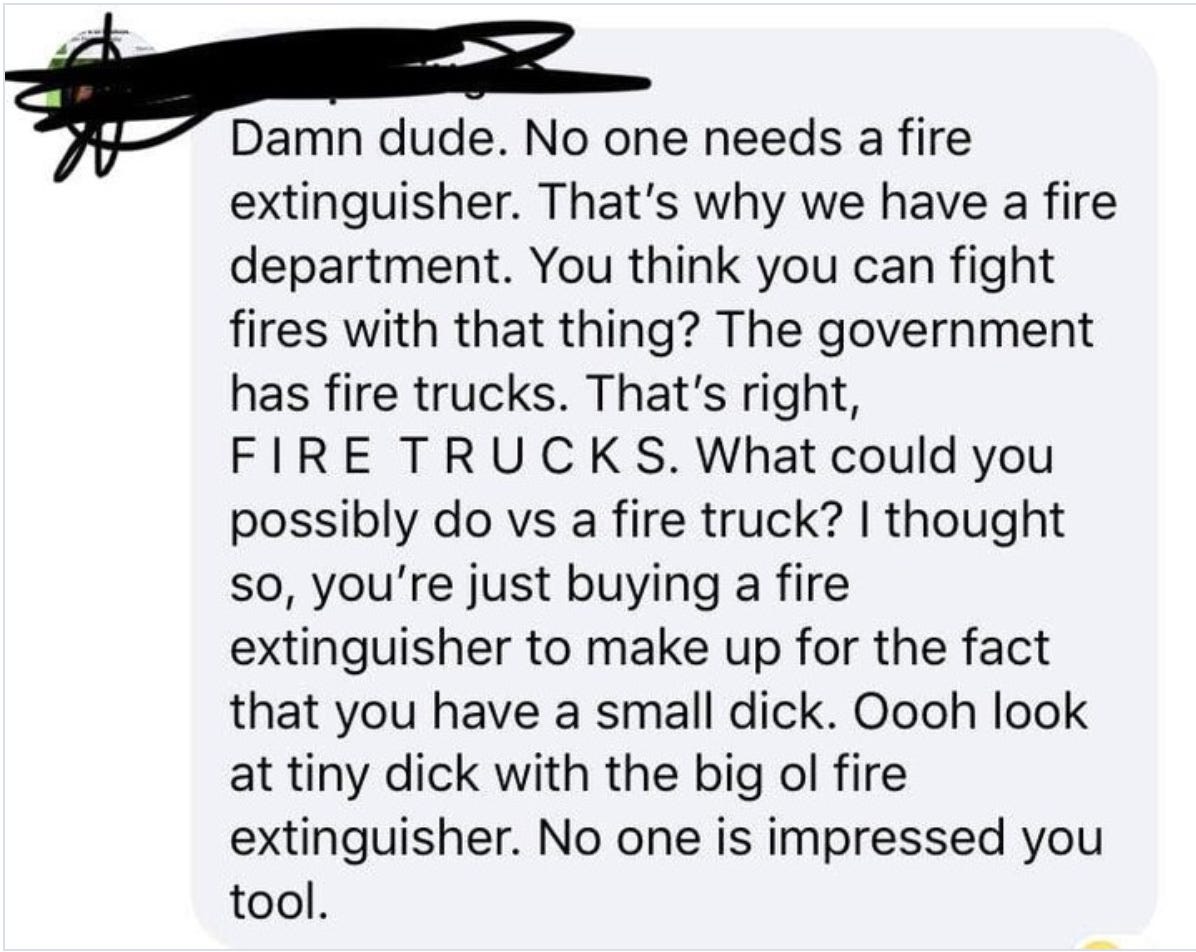
The situation now is dire. Citizens are defenseless, and the government is paid off by the cartels. Every time a vehicle is stopped to be robbed, kidnapped, or set on fire, there’s no resistance whatsoever. Citizens need to use their fire extinguishers to put out the small fires happening all around them. These groups literally execute mothers of search parties trying to find the remains of their children.8 And the government does absolutely nothing. Fuck all.
There is no other option. Nobody is coming to save them. Wars are fought with weapons, and Mexico is at war.
In another super common, recent example: A small town of 80 people was forced to leave their homes due to cartel violence.9 They received no government protection or help. They loaded what they could into the back of pick-ups and drove off to find a safer place to live while they recovered from the financial loss. When there’s no immediate resistance, the cartels do whatever they want simply cause they own guns. Firearms are nicknamed Equalizers for a reason.
Arming citizens is especially important for handling racketeering and threats of kidnapping. It must be easier and more profitable to work a legitimate business than to fight off armed citizens. Otherwise, they will continue with the most lucrative path of least resistance. The only way businesses, families, and individuals fight back is if they have the tools to do so. Without this crucial step, cartels continue as they have been. Arming the people gives them control over their nation’s future– not cartels and governments.
This isn’t even about gun politics in general, because Mexico is at literal war. Average crime statistics in stable countries don’t factor into the context here. But it’s one thing to legalize firearm ownership in Mexico; it’s entirely something different to make citizens take up arms themselves. If they won’t do it when their life is threatened already, then there’s something else that needs to change.
The Mexican government has extremely strict gun control. Police are well known for arresting and incarcerating individuals (and anybody around them at the time of the incident) simply for having a single bullet. Of course, not the cartel members, though. The government’s idiotic gun policy is so strict that it enables bullies by deliberately weakening the victims. They are in a literal war zone, and the government suggests they stay unarmed. No matter your view on owning firearms, you can’t ban them into nonexistence. You can’t walk up to a group of armed men who cut people’s heads off for fun, and politely inform them they can no longer own their firearms. The resources are already owned– they aren’t going anywhere, even if they could no longer buy them.
And I should remind people, if they didn’t buy them from America, they would buy them from other countries or flat out start manufacturing their own. If they theoretically didn’t have guns, they’d make homemade bombs just like we’ve seen militia groups in the Middle East use for the past few decades. A great example of this is the documented black markets that open during French riots. Hand grenades and firearms are purchased illegally from private sellers looking to profit from conflict, even in Western Europe. We are also seeing very effective, modern weapons being mass 3D printed to support militia groups in unstable regions. (Research warfare in Myanmar). The cartel’s trillion-dollar operation will not be fazed by firearm restrictions in either Mexico or the United States.
The issue here is that the Mexican people (in general) are very anti-firearm and very accustomed to being checked for weapons when entering public places like restaurants, while the cartel members are allowed free entrance to sell cocaine and go totally unchecked. It’s complete and utter bullshit, and has zero effect on the cartel members. And there’s no rage- I’ve seen nothing but passivity and acceptance in my trips to Mexico. They might as well thank the cartel for every person they kidnap. For these reasons, I find myself disgusted. They are no different than people anywhere else- most all people are stupid, weak, and more importantly, uninspired. Accepting their chains and banishing those who question it. Succumbing to manipulation is therapeutic for them. Standing in the street protesting with handwritten signs gets you absolutely nowhere.
This mindset was cultivated and promoted by both the Mexican government and the American government, who intentionally keep Mexican citizens weak and docile, using Western liberal politics, to continue the cartel game.
Without the threat of violence, bullies thrive. While schools and governments around the world teach children to be passive, bullies capitalize on that. I used to be bullied by this kid in middle school. His relentless torment impacted me daily until I finally stood up for myself and kicked his ass. If I had listened to the teachers and weak, cowardly schoolmates (now composing the general population), I would have been reduced to nothingness. This is not unlike Mexican citizens and their cartel-CIA-led government.
There is only one place to purchase firearms in Mexico, and it’s an extremely controlled process. Meanwhile, criminals don’t respect the laws and get guns from other nations. Civilians try to respect the laws and end up being defenseless victims. This initial misstep in gun policy allowed for corruption to spin out of control further. The legalization of firearm ownership would slowly change people’s mindsets about firearms and allow them to start standing up for themselves. The people would adopt different mentalities toward firearms than they do now, and would be more willing to start defending themselves.
This is also why step #1 is influencing the media. You have to change the culture and mindset around firearms in Mexico from one of victimization to one of rugged self-reliance. And it has to start early, as part of the process of getting legalization for firearms and modest drugs. This step also happens after boosting the economy, to disincentivize and discourage illegal markets from developing, overall reducing violence.
I’m so sick of the endless suffering of this world, which has easily implemented solutions. The only difficulty is arguing with dumb fucks to make it happen. They need to pass out an AK with 1k rounds and a Glock 19 to every single Mexican citizen and make them take a training course. Mindless massacres could not happen if Mexican citizens weren’t brainwashed by cultural marxist asshats to be anti-firearm.
Leyzaola’s Last Stand: Government Restructuring and Purification
It’s only common sense to acknowledge the need to kick out all foreign influence; it’s a conflict of interest to have it any other way. More on this later, but in addition to regaining sovereignty, this 6th step is about eliminating corruption within the government. This is done after greatly reducing the cartels via all previous methods, because otherwise, you’re fighting perverse incentives. It’s ineffective, as shown by history, to try to clear the weeds of corruption when the roots and water it grows from still exist in abundance.
People like Ed Calderon and Julian Leyzaola (Mexico’s bravest man) have made significant progress in the areas they were involved in, but their strategies lacked long term changes that would prevent cartels from starting all over again. Once new politicians were elected, all the crime returned. You can’t work against human nature; you must always work with it. Rule by incentive, not an iron fist.
Some of the strategies used include mass firing of police officers or transferring them to different regions. Since these officers had cartel ties, rival cartels in other regions would kill them, so many police officers simply quit their jobs. This purified the police force, eliminating corruption. The same must be done with politicians, who are slimier and trickier to get rid of. People with known previous cartel ties, people who stood complacent, and people who pushed for making firearms or drugs illegal must all be ousted. Get with the program, or get lost.
I don’t believe this has to be bloody. There are tons of people who want to make a difference in their community, who honestly want change. But these people aren’t very smart. It’s honestly deeply funny how dumb people are. Politicians, lawyers, journalists, and anybody who opposes cartel/narcostate rule get executed daily. Thousands and thousands of lives lost.
Countless mayors and governors are assassinated yearly after they begin building a populist campaign against the bad guys. It’s a feature of democracy- politicians win by appealing to the dumb masses via populism. Naturally, the democratic system purges any competent actors from being involved, and then the incompetent existing actors get executed by stronger forces. So, of course, they never achieve any goals.
If you are going to fight against the most organized, dangerous cartels on earth AND the federal government behind them, you have to do so anonymously. From the inside, slowly destroying and manipulating. Just being an outspoken small-town politician gets you killed. It paints a target on your back. They wipe these politicians off like bugs on the windshield. Then everybody mourns and cries, as if it wasn’t expected. As if there weren’t decades of history with the same exact thing happening over and over again. Thus, in part to prevent this from turning into a bloody revolution, the purification process happens after cartels are significantly weakened.
Roman Style Raids
Only after corruption is mostly eliminated can there be further state-led operations to stamp out any remaining factions. Again, when you pull weeds, you make sure there’re no roots, or they just grow back. This must be the last step, which avoids spreading chaos and creating power vacuum chambers.
Without fixing the corruption first, we get more of the same results… America and Mexico have been doing exactly this since the 70’s and only making the problem worse. Military campaigns have to be the last step. Use organized force only once the enemy is cornered, weak, unable to financially support itself, and no longer has friends in the government. You crush the bowl when it’s empty, or the soup splatters all over the walls and stains everything around it. Fight when your enemy is weakest. But this time, do so with a different strategy.
Instead of cutting off the head of the snake (targeting high-ranking leadership) as all previous failed military efforts did, you start at the tail. You start with sicarios and foot soldiers in order to weaken their forces before the final execution, rather than scatter and divide them by attacking with a top-down strategy. Indeed, it’s gradual attrition, but that’s why it’s done after weakening existing forces. Besides, if snake head strategies lead to more enemies and a lack of control, that’s even more gradual and resource-diminishing. Case in point, the War on Drugs has been going on for 54 years. So, after all prior steps are carried out effectively, I propose copying the Romans.
The primary goal of Roman Raids was to make raiding unprofitable and dangerous for enemies. If a tribe raided Roman territory, killed settlers, or stole livestock, Rome responded disproportionately to show that attacks would bring severe consequences. This created a strong deterrent effect: “raid us and we’ll burn your world.” This is essentially what cartels do now– once a strike has been made against them, they go on to burn down cities, block roads, and execute officials. We just witnessed this with the latest fiasco, where government forces killed cartel leader El Mencho, which turned cities into war zones. The idea here is that government military forces will carry out similar attacks.
All of this would be facilitated using rapid crossing and deep penetration in enemy areas. Roman forces moved quickly across the border or frontier zone, using roads, rivers, or surprise routes. Speed was key to preventing the enemy from mustering a full tribal response. In modern day, this means let expert military teams and private contractors handle raids against whatever weak remnants of cartels still exist. SEALS and other groups can do what they do best: high-speed, low-drag operations with specific objectives. In and out, quick and quiet, targeting cartel strongholds and individual sicarios instead of leadership positions. They won’t have the economic means, the cultural influence, nor the logistical means to regrow their forces at this point.
Another valuable reason for using this method is that it targets the individuals responsible for civilian murder. It puts civilian safety first, as the cartels leave violent jobs to low-ranking sicarios and footsoldiers. The upper ranks dealing with financials and extortion are just white-collar bullies. They’re nothing. Reducing violence is the primary goal; thus, this Tail First strategy achieves this.
Anti-Revolution Realism: Kill the Romantic
This entire process has to be carried out carefully and strategically. Despite populist rhetoric and young, eager elements ready to defend their liberty, revolution is almost never a beautiful thing. As romantic as it is to scream “Revolution!” and share a deep sense of camaraderie… revolutions are much uglier in reality. Immense amounts of rape, public killing, torture, and other gruesome acts of human nature when fighting for hierarchy.
In fact, revolutions usually devolve into something worse than what they were fighting. When all power structures are dissolved at once, it creates the same type of problems as we see in cartels- power vacuums and grappling for power. This usually churns out governments worse than the prior. As I said earlier, the first step to building a house is laying the foundation. If you just go and rip up the current foundation before anything else is built, you’re gonna have serious problems.
Entire nations end up in a seemingly never-ending power struggle involving a constant cycle of coups, public executions, rigged elections, and dictatorships. While the current status quo shouldn’t be acceptable, stability should be cherished for what it’s worth. You don’t want destructive riots and group-think mob mentality. The goal is to choke the opponent (cartel and current government) into submission. They should never see the nation maneuvering behind them.
For this reason, the distribution of firearms should not be a coup, or a call to action. It should be a slow change of the Mexican mindset while giving them the tools they need to take back their country. This shifts the dynamic of war from trench warfare and clearly defined front lines, to individual battles between robbers and store clerks.
Cartels and governments will outwardly oppose this, which is where private arms dealers come in. The arms dealer is a true hero in places like these, providing weapons to disadvantaged populations who are beaten down and kept in control by the men with guns. Never forget– firearms are the great equalizer. Arms dealers must be funded and motivated to begin giving a rifle and a pistol to every person over the age of 15. If the CIA was prperly led, they could fill this role excellently. They already have; they just armed the wrong group.
When the Mexican people are unified and resisting, a poorly structured and weakly funded cartel group wouldn’t last. Over time, the cartels would weaken, and governments would no longer be fueled by corruption when their cartel funds dry up.
An Apathetic Prognosis
Achieving every step I’ve laid out isn’t even the most challenging barrier in creating a safe, stable Mexico. The strategic problems have been solved many times over by many extremely qualified, passionate people smarter than I am. The biggest impediment is that there are too many people who don’t want the problem solved. Too many people making sure solutions don’t arise.
Many of these steps are impossible to achieve when they are actively blocked by foreign nations. If Mexico were to legalize certain drugs, it would cut off trade with other countries via embargo’s and sanctions. Further interference from foreign governments perpetuates the problem rather than letting it heal naturally on its own. Any country in this position becomes stuck in a perpetual cycle of violence, like spreading bad seeds in a luscious garden. It’s incredibly difficult to weed them out and clean it up, though it definitely can be done.
The exact same situation is happening in North Korea to an even worse extent. You have mass brainwashing, mass starvation, executions, terror… Why does nobody do anything about it? Media from all nations, including their own, ignore it. The reason is that North Korea has made alliances with powerful countries (mostly China), who benefit from their presence and who have absolutely no regard for the North Korean people as a whole. These allegiances make it hard for any outsiders (or insiders) to make any change, since their “big brother” country will put the beat down on them economically or with military power. So, any nation that even half gives a shit must stand by idly and watch people suffer, but mostly the surrounding nations ignore the problem just like they do in Mexico. Media covers culture wars and overseas events as a distraction.
When it comes to Mexico, the most likely path to liberation is not in fighting the Mexican government or the many cartels. It’s in the eventual dissolving of surrounding countries that enables them. Here, I’m not rooting for the downfall of any country, only speculating from an objective point of view. These problems are so deeply ingrained, so deeply complex, that they most likely will never be solved until there’s a change in the power dynamic of the world. Realistically, it will take the dissolution of the United States, China, and any other country that is vital to the cartel, in order for Mexico to be primed for change. Cutting off water to the weeds until they dry up and shrivel away, so new grass can grow after proper seed planting & fertilization. The same will happen when China finally falls. North Korea will fall, and hopefully, its neighbors to the south will be able to take control and prevent another regime from taking over. But this is doubtful, given that South Korea is demographically doomed due to infertility.
Though global power dynamics are indeed changing, it may be a while before these hegemonic forces finish their natural lifecycle of a nation. Until then, the world is primed for significant technological changes coming from AGI. These will likely worsen the cartels, as economies continue to struggle severely. This is my primary argument for why I don’t believe private businesses and foreign investment will ultimately break cartel power.
As the world inches closer to post-scarcity economics, more and more jobs are lost to artificial intelligence and robotics. Even if Mexico is currently moving to become the next China (a manufacturing hub) with a stable peso, and massive foreign direct investment… The economy is changing. All of these major companies are laying off workers by the thousands, more every year. These are the old rules, the old standards. Capitalism itself is not going to last a whole lot longer under the weight of robotics and artificial intelligence. I discuss this more in my essay, Future Threats Part 3.
So where does that leave cartels? It leaves them where they’ve always been– surviving an impossible economic environment. This is their forte, their native habitat, their natural existence. Drugs and racketeering are the perfect stable income source, while governments continue to crumble. Especially in the context that what jobs will be available will be close to human slave labor, with significantly reduced wages. Since there aren’t enough jobs to go around, it creates competition amongst workers and businesses to see who will do the work for the least amount of money. We’re seeing this already with wages failing to keep up with rising living costs and inflation.
This is why I didn’t put time and effort into outlining an economic plan– the world is changing so fast, technological development is preventing the necessary economic boost Mexico needs to solve its cartel problem. It’s just not gonna happen. This singular factor–technological advancements destroying current economic models– outweighs every geopolitical factor currently being analyzed. It outweighs an expanding industrial base, it laughs at people speculating on peso stabilization, and it sighs at the lunatics voting for new politicians. It’s the tsunami while everybody looks at the ripples in the puddle.
Even when there’s a notable decrease in overall cartel presence, people lose perspective. Cartels, like governments, have natural life cycles. Cartel groups rise and fall, new ones are created, and in between, there are decades where the crime wave is pacified and significantly decreased. I believe what we’re seeing now isn’t the end of cartels as a whole, but rather a dip in the wave. The beginning of a new cycle. Though perhaps this cycle will be less violent as technology changes and America weakens, there may be less opposition by rival groups.
Maybe, in the fall of modernity and the greater West, a single united narco-cartel state may emerge, rivaling that of their early origins. The current sentiment in Mexico seems to be one of resentment, which is not uncommon: all major countries have a rapidly expanding rebellious population, rejecting the abuse and struggles of modernity. The government has lost the narrative, and the youth will not tolerate the same amount of bootlicking their parents did. This may translate to idealizing narcos even more– once again, they become the folk hero. It’s hard to predict how the dynamic will play out, but we know one thing for certain: They will continue to exist.
But… maybe this isn’t all bad?
The world is rapidly expanding into authoritarianism, as governments leverage new technologies to further consolidate power. In Mexico’s case, Mexico City (CDMX) is the most surveilled city in North America, 2nd in the world overall. It has over 83,000 public government-operated CCTV cameras as of late 2025, expanding rapidly toward 113,000 by year-end and 150,000 by 2030 under Mayor Clara Brugada’s “Eyes That Take Care of You” program. It can’t be said that the cause of this is the fight against cartel violence, as cities across America free from cartels are following the same route, using Flock security cameras.
Mexico’s president, Sheinbaum, has accelerated militarization, assigning the armed forces expansive civilian roles — including public security via the National Guard (now formally under SEDENA control), operating ports, airports, customs, major infrastructure projects like the Maya Train, and even banking branches. She’s been awarding lucrative government contracts and revenue streams to military-run ventures like these, fostering a growing dependency on the military. This is a clear slide toward authoritarian governance by eroding civilian oversight and concentrating power in unelected institutions.
The last remaining force of resistance in this world comes from outlaws. From Cowboys, Narcos, and Outsiders. A weak government is the only defense against technocracy building a panopticon. In the fight against authoritarianism, narco’s may actually be the only saving grace. Perhaps this is the silver lining, if it can be called that. The violence is not justified by the proposed upsides to narco trafficking, and I doubt it makes it sting any less to those who have lost loved ones.
It’s similar to how doctors used malaria to cure syphilis. The malaria induced a fever high enough to kill the syphilis, then they killed the malaria with quinine. This was known as malariotherapy. Narcos are the necessary malaria, preventing over taxation and mass control. The people are the quinenine. But those who died from malaria aren’t going to see much good in it.
I mentioned earlier the duality of Mexico, the constant strife between freedom and violence that foreigners love. If you solve the crime, half of what makes Mexico, Mexico, is erased. It would be flooded by tourists and developers even more than it already is. Crime is like the wolf population that keeps the rabbit population at bay. It’s a natural buffer for the corporatism and consumerism decaying the West.
I want Mexican Folk Art to be a lost medium. I do. But we live in a complex world where solutions are disincentivized, good ideas are suppressed, and rapid change shakes the country like a kid with a snow globe. There are many good solutions to the cartel problems, but I don’t see any of them realistically playing out. Any future of Mexico free from cartel violence comes decades down the line as a result of massive global changes. It comes as the new world grows, after these next dark ages. Just as dead life fertilizes a new garden and as cow shit grows the best tomatoes, Mexico will rise from the ashes only after the death of the old world.
If you enjoyed this essay, please consider following me on Substack, where I post more regularly. amabernathy.substack.com
1- Pérez Ricart, Carlos. “El Papel Del Federal Bureau of Narcotics En El Diseño de La Política de Drogas En México (1940–1968).” Frontera Norte, vol. 31, no. 1, Aug. 2019. DOI.org (Crossref), https://doi.org/10.33679/rfn.v1i1.2045
2- Saldaña, J. D., & Payan, T. (2016). Timeline of cartel activity in Mexico. Mexico Center, Baker Institute for Public Policy. https://www.bakerinstitute.org/sites/default/files/MEX-doc-Timeline_Cartel_0.pdf
3-https://web.archive.org/web/20260207113219/https://nsarchive2.gwu.edu/NSAEBB/NSAEBB204/
CIA Connection, NCJ Number 133614
Journal Progressive Volume: 55 Issue: 7 Dated: (July 1991) Pages: 20–26
Author: A W McCoy
Date Published: 1991
5- McCoy, A. W. (1972). The Politics of Heroin in Southeast Asia: CIA Complicity in the Global Drug Trade. Harper & Row.
6- U.S. Central Intelligence Agency, Office of Inspector General. (1998, October 8). Report of investigation: Allegations of connections between CIA and the Contras in cocaine trafficking to the United States (Document №06974497). CIA FOIA Electronic Reading Room.https://www.cia.gov/readingroom/document/06974497?
7- U.S. Congress. (1998, May 7). Intelligence Authorization Act for Fiscal Year 1999. Congressional Record, 144(54), H2944–H2957. https://web.archive.org/web/20250329231040/https://www.congress.gov/congressional-record/volume-144/issue-56/house-section/article/H2944-1
8- https://www.instagram.com/p/DVSHlzNjzQn/?utm_source=ig_embed
9- https://www.instagram.com/p/DVNR8hmEcFB/?utm_source=ig_embed
메타데이터
- post_id
- 011c285cb8ba
- slug
- the-end-of-mexican-folk-art-011c285cb8ba
- url
- https://medium.com/@alixemedia/the-end-of-mexican-folk-art-011c285cb8ba
- canonical_url
- https://medium.com/@alixemedia/the-end-of-mexican-folk-art-011c285cb8ba
- author_url
- https://medium.com/@alixemedia
- status
- ok
- fetched_at
- 2026-06-17 08:20:12