ARCH OF NERO
“… the Golden House. Its size and splendour will be sufficiently indicated by the following details. Its vestibule was large enough to…
ARCH OF NERO

“… the Golden House. Its size and splendour will be sufficiently indicated by the following details. Its vestibule was large enough to contain a colossal statue of the emperor (Nero) a hundred and twenty feet high, and it was so extensive that it had a triple colonnade a mile long… In the rest of the house all parts were overlaid with gold and adorned with gems and mother-of-pearl.” [Suetonius — Life of Nero 31]
At a White House briefing on 15 April 2026 the Press Secretary Karoline Leavitt announced plans for a 250 foot ‘United States Triumphal Arch’ on Columbia Island in Washington D.C. to honour the nation’s 250th anniversary.
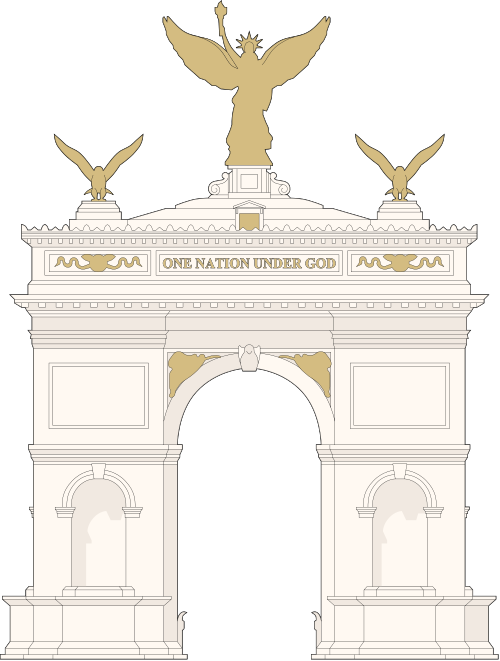
The plans show that the monumental triumphal arch is is on a scale much larger than the Arc de Triomphe in Paris. It would be 250 feet tall, a numeral reflecting the 250 year anniversary celebrations taking place in the U.S. this year. From the base of the arch to the torch of the Liberty statue on top of the arch therefore measures 250 feet. This gilded Liberty figure is flanked by gilded eagles on either side. At the base of the arch four gilded lions guard the entrance. Gold letters at the top of the arch communicate the messages “One Nation Under God” on one side and “Liberty and Justice for All” on the other.
A striking aesthetic correlation exists between the arch, the redecorated Oval Office and the visualisation of the new White House ballroom. All feature gilded motifs against a whitish or neutral pale background. There is therefore a consistent aesthetic style, reminiscent of the Empire style, referencing imperial arches in Europe and ultimately drawing its inspiration from the ancient Roman empire. This aesthetic correlation reflects an increasingly imperial policy outlined in the 2025 U.S. National Security Strategy.
Triumphant arches have clear historic associations with the imperial ambitions of the European countries constructing them during the Napoleonic era and its aftermath. The Arc de Triomphe is associated with Napoleonic expansion in Europe, with the Wellington Arch in London constructed during an era celebrating British imperial ambitions.
Extending the concept into the twentieth century, Albert Speer envisaged a monumental arch dwarfing its European counterparts that would dominate the axis of the new Germania, the renamed Berlin. This triumphant arch would symbolize German domination of Europe. Within these contexts the proposed triumphal arch in Washington, titled the United States Triumphal Arch, celebrates the proposed dawn of the new American empire.
The closest aesthetic style to the Washington arch, the visualisations of the new White House ballroom, and the gilded redecorations of the Oval Office, is the Empire style. Named after the First French Empire, incorporating European territories under Napoleonic French domination, the name resonates with the imperial aspirations of the Trump administration. An initial inspiration for the Washington arch was the Arc de Triomphe which exemplifies the Empire style.
London triumphant arches such as the Wellington Arch and Marble Arch were also inspirational especially in their use of a whitish base material as opposed to the grey Arc de Triomphe. Ultimately all these triumphant arches take their inspiration and symbolism from the triumphant arches of ancient Rome. The Arch of Titus in Rome remains intact and its white marble form and sculptural relief elements can be seen as the template for this form of architecture. Hence this arch becomes the original inspiration for the Washington arch.
Commentators have described the gold embellishments in the Oval Office as being inspired by the Rococo style. Likewise the ballroom interior visualisations are described as Rococo inspired. But neither are Rococo in the true sense of the term which involves a complete excess of adornment. By describing them as Rococo a narrative is developed of privileged excess and indulgence which fails to see any intent beyond the celebration of excess and luxury. A more accurate recognition that this is a renewed or neo-Empire style allows the underlying intention to become apparent.
The 2025 U.S. National Security Strategy (NSS) features a ‘Trump Corollary’ to the Monroe Doctrine, defining the Western Hemisphere as a zone of U.S. pre-eminence. Unlike earlier strategies, this approach focuses on using economic and military power to enforce hemispherical dominance.
This policy of hemispherical dominance is seen most recently in the decapitation of the Venezuelan regime and in the demand for the annexation of Greenland. It is also evident in the expressed desire by Trump to incorporate Canada into this new empire, in the dispute over the management of the Panama Canal, and in the renaming of the Gulf of Mexico as the Gulf of America. All these make sense if seen in the context of a new drive for imperial expansion that reflects the 250th anniversary of the U.S. that is celebrated this year. It is within this context that a triumphant arch is planned for Washington modelled from an ancient Roman template.
The arch is explicitly inspired by the Arch of Titus in Rome constructed in 81 AD. The connection is therefore only tangentially to the Napoleonic era and the Arc de Triomphe but explicitly to ancient Rome. Nero, reigning from 54 AD until his death in 68 AD, represents an archetype of imperial excess during the first century AD. As such his infamous reputation ensures his imprint on the public imagination, unlike Titus, or Domitian who ordered the construction of the Arch of Titus.
The Washington arch exhibits the restrained neoclassical quality of the Arch of Titus being almost identical in its stylistic features. This reflected the post-Nero era where the extravagance of Nero was condemned. There is a significant departure from this stylistic conformity in that the Washington arch displays a 60 foot statue of Liberty. The gilded statue holds a torch aloft and is flanked by two large gilded eagles. These elements are comparable to the dominating theatrical excess of the Nero era.
“… he (Zenodotus) was sent for by Nero to Rome, where he made a colossal statue intended to represent that prince (Nero), one hundred and ten feet in height. In consequence, however, of the public detestation of Nero’s crimes, this statue was consecrated to the Sun.” [Pliny — Natural History 34.18]
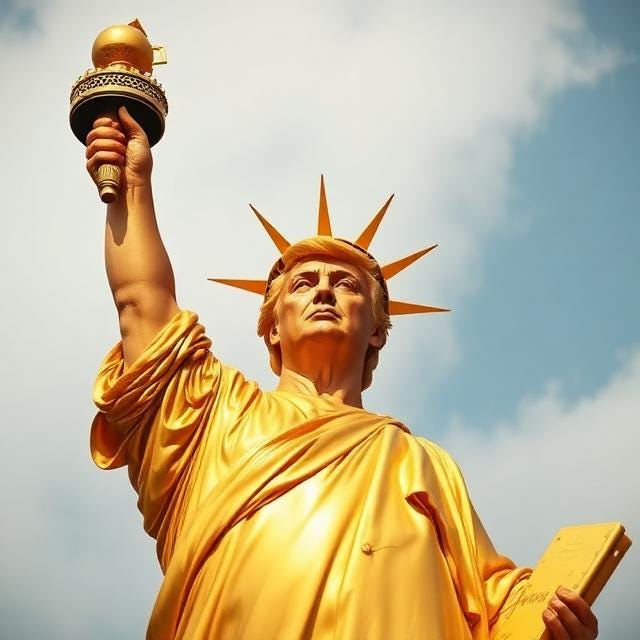
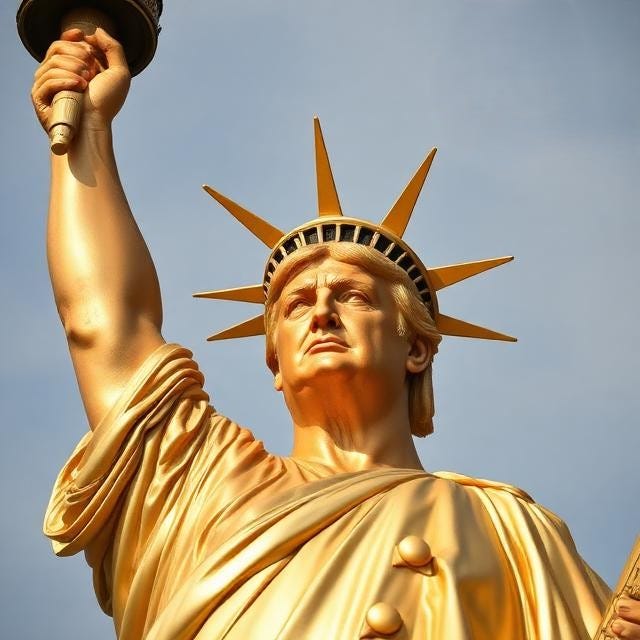
The addition of the gilded Liberty statue to the neoclassical restraint and symmetry of the arch is comparable in its dominating position to the Colossus of Nero. After Nero’s death the Emperor Vespasian added a radiate crown to the Colossus of Nero and renamed it Colossus Solis, after the deified Sun. The radiate crown, as shown on Roman coins, is stylistically the same as the crown worn by the Statue of Liberty.
These coins establish a symbolic linkage between the Colossus of Nero, the Statue of Liberty and the gilded Liberty statue on top of the Washington arch. The gilded Liberty statue reflects the same symbolism as the Colossus of imperial power linked to the power of the all-conquering Sun.
Nero remains more famous than any other Roman emperor for self-aggrandisement and extravagance, and is most associated with the use of gold to enhance his image. Gold has always been related to the Sun and at least one coin shows the Colossus of Nero with a radiate crown during his reign. Trump and his administration is deliberately invoking ancient Rome by planning a triumphant arch modelled on the Arch of Titus.
Therefore the context is the symbolism of gold within this specific context. Nero is not just associated with excess and extravagance, he is also associated with the Domus Aurea — the Golden House. Even by Roman standards Nero was associated with the extravagant use of gold to project imperial power.
If a design explicitly draws on the Arch of Titus, then the Trump administration is clearly operating within a Roman symbolic frame. Extensive usage of gilding is not neutral in this context — it is part of a historically loaded visual language. Nero, through the Domus Aurea, became the most famous exemplar in Roman history of gold as a symbol of power and dominance.
The form of the Roman triumphal arch symbolizes victorious Roman triumphs and imperial expansion. Extensive gold embellishment adds a heightened, theatrical and propagandistic projection of power. A monumental gilded figure at the apex of the Washington triumphal arch further adds to the visual spectacle of imperial power.
Within a Roman context that symbolism correlates with Nero’s infamous reputation for extravagant gold-enhanced excess and aggrandisement. Nero, as the archetype of gold-infused imperial spectacle, is invoked by the Washington triumphal arch.
메타데이터
- post_id
- 028f468d5f74
- slug
- arch-of-nero-028f468d5f74
- url
- https://medium.com/@bennettdns/arch-of-nero-028f468d5f74
- canonical_url
- https://medium.com/@bennettdns/arch-of-nero-028f468d5f74
- author_url
- https://medium.com/@bennettdns
- status
- ok
- fetched_at
- 2026-06-20 20:29:01