Describe the growth of education and press in modern Bihar and also, describe the role of education…
2005, 46th BPSC, History, 38 marks
Describe the growth of education and press in modern Bihar and also, describe the role of education and press in National movement.
2005, 46th BPSC, History, 38 marks
Education in Bihar grew in sync with its growth in India. Though Vernacular education existed in Indian subcontinent before colonial era, Britishers introduced western education starting in 19th century with schemes like Charter Act 1813, Macaulay’s Minute 1835 etc.
Also, press in Bihar became prominent since late 19th century with newspapers like Bihar Bandhu (first Hindi Weekly since 1872 by Madan Mohan Bhatt) or Bihar Herald (English newspaper in Bihar since 1875).
Context/Factors for growth of education & press in Bihar
- Britishers wanted a section of Indians who were Indian by blood but English by taste. So, to prepare such people, policies like downward filtration theory were introduced.
- Agitations by educated Indians like Rajaram Mohan Roy
- Spread of Christian missionaries, specially after 1813 Charter Act.
- Low infrastructure and development lag with respect to Bengal — newspapers like Bihar Times emerged to raise voice for separate Bihar.
- Establishment and prevalence of press in India — spread in Bihar as well.
Growth of Education in Bihar
Phase I (1800–50s)
- 1813 Charter Act: EIC to sanction Rs. 1 lakh per year for science, literature in India
- 1835 Macaulay’s Minute — favored Anglicist view & downward-filtration theory. (e.g. Zila Schools in Patna, Purnia)
- 1854: Wood’s Despatch (Magna Carta of English Education) — primary schools to follow vernacular medium.
Phase II (1860–1900s)
- 1863: Patna College (Bihar’s 1st institute for higher education)
- Other colleges like BN College, Patna (1889), Langat Singh College, Muzaffarpur (1899), Research Farm, Pusa (1875, later became Agriculture University, Pusa — India’s 1st Agri. University)
- Survey Training School (1886, later became NIT Patna).
Phase III (1901-Present):
- 1917 Saddler Commission — urged for applied Science & technology, vocational courses, diploma courses etc.
- Patna University (1917), Prince of Wales Medical College (1925, later became Patna Medical College), ISM Dhanbad (1926, now in Jharkhand), NIT Patna (2004), IIT Patna (2008)
Growth of Press in Bihar
Phase I (till 1880s)
a. Bihar Bandhu (1872 — First Hindi Weekly):
- Founded by Maharashtrian Brahmins domiciled in Bihar: Madan Mohan Bhatt and Keshava Ram Bhatt.
- Moved from Calcutta to Patna in 1874. Munshi Hasan Ali was its first editor.
- Role: Staunch supporter of Bihari interests. Advocated preference for Biharis in government service.
- Major Achievement: Launched a successful movement for the introduction of Hindi (Devnagri) in civil courts in January 1881.
b. Bihar Herald (1872/1875 — First English Newspaper):
- Founded by Sri Guru Prasad Sen (1875).
- Became the chief organ of domiciled Bengalis.
- Highlighted agrarian issues (e.g., plight against white indigo-planters) and masses’ illiteracy. Provided training opportunities for Biharis in modern journalism.
c.Others: The Indian Chronicle (English, 1881), Bihar Patriot (English, 1884), Kayasth Gazette (1889), focused on social reform.
Phase II (1890–1900s)
The Bihar Times (1894 — English Weekly): by Mahesh Narayan (first editor) and Sachchidanand Sinha
- Its founding is cited as the beginning of the renaissance period in Bihar — Exposed discrimination against Biharis (e.g., low representation among subordinate judges).
- Primary Focus: separate province.
Post-Separation Growth (1911–1970s)
Searchlight (1918 — English): by Sachidanand Sinha with forward nationalist outlook
- Known for its bold journalism, including taking on corruption in high places (e.g., reports on K.B. Sahay government in the 1960s).
Others: Pradeep (1947, Patna), Indian Nation (1930 — English)
- Indian Nation (1930 — English): Founded by Maharaja of Darbhanga. Focused heavily on the Mithila region of Bihar.
Role of education and press in National movement
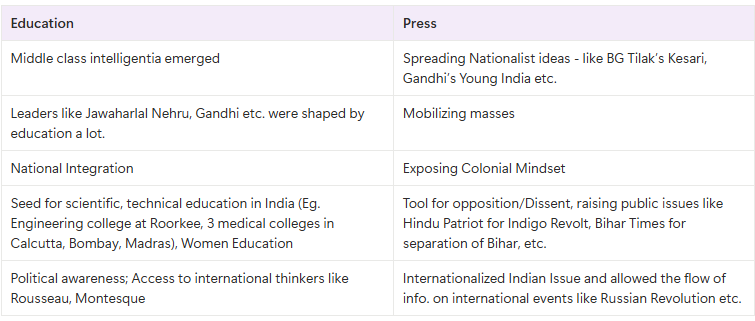
Therefore, we see that Education enlightened the minds of people in India & Bihar, while the press gave them a voice. Together, they awakened political consciousness, inspired reform, and played a vital role in shaping Bihar’s and India’s struggle for freedom.
메타데이터
- post_id
- 052d321c8d0e
- slug
- describe-the-growth-of-education-and-press-in-modern-bihar-and-also-describe-the-role-of-education-052d321c8d0e
- url
- https://medium.com/@bpscrepository/describe-the-growth-of-education-and-press-in-modern-bihar-and-also-describe-the-role-of-education-052d321c8d0e
- canonical_url
- https://medium.com/@bpscrepository/describe-the-growth-of-education-and-press-in-modern-bihar-and-also-describe-the-role-of-education-052d321c8d0e
- author_url
- https://medium.com/@bpscrepository
- status
- ok
- fetched_at
- 2026-06-15 20:49:13