From DevOps to GenAI Cloud Architect # 2: Building Production-Ready Enterprise RAG Systems
Previously, I published my journey from DevOps to GenAI Cloud Architect and explored concepts such as AI Gateways, Embeddings, Vector…
From DevOps to GenAI Cloud Architect # 2: Building Production-Ready Enterprise RAG Systems
Previously, I published my journey from DevOps to GenAI Cloud Architect and explored concepts such as AI Gateways, Embeddings, Vector Databases, and Token Governance.
From DevOps to GenAI Cloud Architect # 1: Building Enterprise AI Systems Beyond Chatbots
One question kept coming back:
“Okay, but how do enterprises actually build Retrieval-Augmented Generation (RAG) systems in production?”
Because let’s be honest.
Most RAG tutorials on the internet look like this:
PDF → Embeddings → Pinecone → OpenAIAnd while that helps explain the idea, real enterprise systems are far more complex.
Banks. Healthcare organizations. Telecom providers. Media platforms.
They require governance, observability, security, and reliability.
This article explores what production-ready RAG systems actually look like.
Why RAG Exists
Large Language Models are powerful.
However, they suffer from several limitations:
❌ They don’t know your company’s internal knowledge.
❌ Their training data becomes outdated.
❌ They can hallucinate.
❌ They cannot provide source attribution.
Retrieval-Augmented Generation solves these problems by combining retrieval systems with generative models.
The result? — — — Grounded AI.
Production RAG Architecture
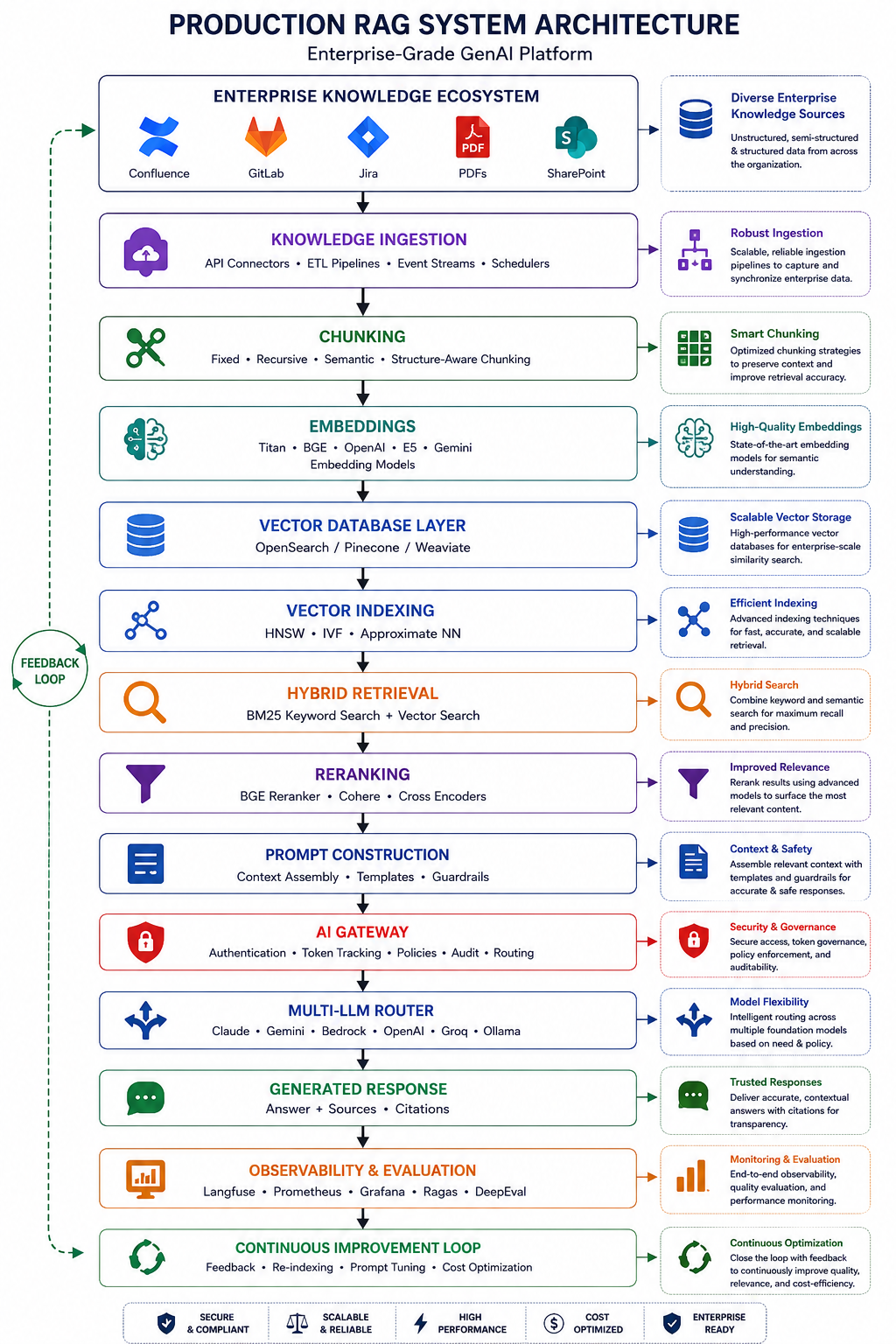
Confluence
GitLab
Jira
PDFs
SharePoint
Runbooks
Logs
       ↓
Data Ingestion
(API Connectors)
       ↓
Document Parsing
(PyPDF / Unstructured / Tika)
       ↓
Chunking
(Recursive / Semantic)
       ↓
Embeddings
(Titan / BGE / OpenAI)
       ↓
OpenSearch Vector Store
(HNSW Index)
       ↓
Retrieval
(Hybrid Search: BM25 + Vector)
       ↓
Reranking
(BGE Reranker / Cohere)
       ↓
Prompt Construction
(LangChain / LlamaIndex)
       ↓
AI Gateway
(Authentication + Governance)
       ↓
LLM Router
(Cost / Capability Routing)
       ↓
Claude / Gemini / Bedrock / GPT
       ↓
Guardrails
(Presidio / Prompt Guard)
       ↓
Answer + Sources
       ↓
Observability
(Langfuse / Grafana)
       ↓
Evaluation
(Ragas / DeepEval)
       ↓
Continuous Improvement
🏗️ Production RAG Architecture
Methods & Technologies Used at Each Stage
Understanding RAG conceptually is easy.
Building it in production is where things become interesting.
Most demonstrations stop at:
PDF → Embeddings → Vector Database → LLMReal enterprise systems involve significantly more engineering.
Let’s break down the major stages of a production-grade RAG architecture.
Step 1: Knowledge Ingestion
Enterprise knowledge lives everywhere.
Examples include:
- Confluence documentation
- GitLab repositories
- Jira tickets
- Operational runbooks
- Security standards
- PDFs and Word documents
- Internal wiki pages
- SharePoint sites
The first challenge is building pipelines capable of continuously ingesting this information.
The objective is simple:
Keep the AI system synchronized with organizational knowledge.
Common Methods
- API Connectors
- ETL Pipelines
- Event-driven ingestion
- Scheduled synchronization jobs
Enterprise Examples
- Confluence REST APIs
- GitLab APIs
- Jira APIs
- Microsoft Graph APIs
- Kafka
- Amazon S3
Step 2: Chunking — The Hidden Superpower
One of the biggest misconceptions about RAG is assuming that embeddings determine retrieval quality.
In reality:
Good chunking often matters more than good models.
Chunking determines how information is divided before embedding.
Fixed Chunking
Simple.
Fast.
May break context unexpectedly.
Recursive Chunking
Preserves logical document structure.
Most commonly used in production systems.
Examples:
- Headings
- Paragraphs
- Sentences
Semantic Chunking
Groups information based on meaning.
Higher retrieval quality.
Higher computational cost.
Structure-Aware Chunking
Preserves the layout of:
- Markdown documents
- HTML pages
- Tables
- Technical documentation
Enterprise Favorite
✅ Recursive Chunking
Step 3: Embeddings — Converting Language into Mathematics
Computers don’t understand language.
They understand mathematics.
Embeddings transform text into numerical vectors.
Example:
Restart Jenkins Service

↓

[0.21, -0.47, 0.88, ...]
Because embeddings capture semantic meaning:
Restart Jenkinscan match:
Reboot Jenkinsdespite using different words.
Popular Embedding Models
- Amazon Titan Embeddings
- BGE Large
- OpenAI Embeddings
- E5 Models
- Gemini Embeddings
Step 4: OpenSearch as a Vector Database
Many engineers know OpenSearch through:
- SIEM workloads
- Observability platforms
- Log analytics
- Security monitoring
Fewer realize that OpenSearch also supports vector search.
Documents are stored alongside their embeddings.
When a user submits a question:
- The query is embedded.
- OpenSearch performs similarity search.
- Relevant chunks are retrieved.
This enables semantic retrieval across enterprise knowledge systems.
Enterprise Advantages
✅ Existing operational expertise
✅ Unified search platform
✅ Security and access controls
✅ Cost efficiency
Step 5: HNSW — The Engine Behind Retrieval
Searching millions of vectors efficiently is difficult.
Comparing every vector against every query isn’t practical.
Modern vector databases rely on Approximate Nearest Neighbor (ANN) algorithms.
The most common is:
HNSW (Hierarchical Navigable Small Worlds)
Benefits include:
✅ High retrieval speed
✅ Excellent accuracy
✅ Scalability
Alternative Approaches
- IVF (Inverted File Index)
- Flat Search (Brute Force)
Enterprise Favorite
✅ HNSW
Step 6: Hybrid Search — The Best of Both Worlds
Semantic search is powerful.
Keyword search remains essential.
Consider these examples.
Query:
INC12345Requires exact matching.
Query:
How do I restore Kubernetes worker nodes?Requires semantic understanding.
Hybrid Search combines both approaches:
BM25

+

Vector Search
Benefits
✅ Exact matching
✅ Semantic understanding
✅ Improved recall
Enterprise Favorite
✅ Hybrid Search
Step 7: Reranking — Improving Precision
Initial retrieval often prioritizes recall.
Reranking improves precision.
The process typically looks like this:
Retrieve Top 50↓Rerank↓Return Top 5Cross-encoders evaluate the relationship between queries and retrieved chunks more accurately.
Popular Rerankers
- BGE Reranker
- Cohere Rerank
- Jina AI Reranker
The outcome:
✅ Higher precision
✅ Better answers
✅ Reduced hallucinations
Step 8: AI Gateways — The Control Plane of Enterprise AI
As GenAI adoption scales, enterprises face new challenges.
Questions emerge:
- Who manages API keys?
- Which models should applications use?
- How are tokens tracked?
- How do we implement cost controls?
- How do we audit prompts?
AI Gateways solve these problems.
Core Capabilities
✅ Authentication
✅ Model routing
✅ Token governance
✅ Rate limiting
✅ Prompt policies
✅ Audit logging
✅ Cost visibility
AI Gateways are rapidly becoming the control plane of enterprise AI.
Step 9: Observability for AI
DevOps taught us an important lesson:
You cannot improve what you cannot observe.
The same applies to AI systems.
Modern AI platforms require visibility into:
- Retrieval quality
- Hallucination rates
- Token consumption
- Model latency
- Prompt effectiveness
- User satisfaction
This discipline is now known as:
LLMOps
Popular Tooling
- Langfuse
- Arize Phoenix
- Prometheus
- Grafana
- Ragas
- DeepEval
The future of Platform Engineering increasingly includes operating intelligent systems.
What Production RAG Really Looks Like
It’s not:
PDF → Pinecone → OpenAIIt’s this:
Enterprise Knowledge Sources↓Knowledge Ingestion↓Chunking↓Embeddings↓OpenSearch (HNSW)↓Hybrid Retrieval↓Reranking↓Prompt Construction↓AI Gateway↓Claude / Gemini / Bedrock↓Observability↓Evaluation↓Continuous Improvement
The Future of Platform Engineering
Traditional Platform Engineers managed:
• Kubernetes
• Terraform
• CI/CD
• Observability
Tomorrow’s Platform Engineers will additionally manage:
• AI Gateways
• Vector Databases
• RAG Pipelines
• Token Governance
• LLM Observability
• Agentic Workflows
The foundations remain the same.
Automation.
Reliability.
Security.
Platform Thinking.
The systems we operate are simply becoming intelligent.
Final Thoughts
Over the past few months, my own journey has expanded from cloud-native engineering into GenAI infrastructure.
I’ve found that the most successful AI practitioners aren’t abandoning DevOps principles. They’re extending them.
Because building enterprise AI systems isn’t just about choosing an LLM. It’s about building the infrastructure around intelligence.
And I believe this intersection of DevOps, Platform Engineering, and GenAI will define the next generation of cloud architects.
And I believe that may become one of the most important engineering disciplines of the next decade.
If you’re also navigating the transition from DevOps, SRE, or Platform Engineering into GenAI Infrastructure, I’d love to hear what you’re learning and building.
Let’s grow together.
Part 3: From RAG to Agentic AI: The Next Evolution of Platform Engineering (Coming Soon)
메타데이터
- post_id
- 064ce9370673
- slug
- from-devops-to-genai-cloud-architect-2-building-production-ready-enterprise-rag-systems-064ce9370673
- url
- https://medium.com/@vikash.jaiswal/from-devops-to-genai-cloud-architect-2-building-production-ready-enterprise-rag-systems-064ce9370673
- canonical_url
- https://medium.com/@vikash.jaiswal/from-devops-to-genai-cloud-architect-2-building-production-ready-enterprise-rag-systems-064ce9370673
- author_url
- https://medium.com/@vikash.jaiswal
- status
- ok
- fetched_at
- 2026-06-15 22:55:51






