The Engineering Behind the Governance: A Deep Dive into Apache Ranger + Trino
Recently, my team and I successfully deployed a Data Virtualization layer using Trino to unify our data access as highlighted by my…
The Engineering Behind the Governance: A Deep Dive into Apache Ranger + Trino
Recently, my team and I successfully deployed a Data Virtualization layer using Trino to unify our data access as highlighted by my teammate Nourmadi in her article “How Data Virtualization moved From Concept to Production at Scale (and Why It Changed Everything) | by Nourmadi | Dec, 2025 | Medium”
While the business value of a Lakehouse is clear, the reality of securing it is where the real challenge lies. As the engineer responsible for the Apache Ranger implementation, We spent weeks navigating version compatibility, infrastructure stability, and auditing gaps.
In this post, I will share the “Missing Manual” for integrating Ranger with Trino — from the critical installation steps to the architectural choices that ensured our system remains stable and performant.
1. The Compatibility Secret (Trino 476 + Ranger 2.6.0)
One of the biggest hurdles in the Trino ecosystem is dependency hell. Official documentation often lags behind the fast-paced Trino release cycle.

Through extensive testing, We found that Apache Ranger 2.6.0 is the “sweet spot” for Trino 476. Using older Ranger versions often leads to classpath conflicts or missing support for newer Trino SQL syntax.
Pro-Tip: If you are using Trino 476, skip the headache of older versions and go straight to Ranger 2.6.0 for the most stable integration.
2. Installation: Building the Security Backbone
Setting up Ranger isn’t just about running a script; it’s about establishing a resilient infrastructure. Here is the architecture I implemented:
A. The Metadata Store (Persistence)
Ranger requires a relational database to store its policies.
- Choice: We used a dedicated Database instance.
- Key Step: You must ensure the JDBC driver is placed correctly in the Ranger
ews/libfolder before runningsetup.sh. Without this, the schema initialization will fail silently, leading to cryptic "Admin not found" errors.
B. Local Identity Management (Fault Isolation)
While many organizations rush to LDAP/AD, we made a strategic choice to start with Local User Management.
- The Logic: By keeping user definitions local to Ranger, we decoupled the security layer from the availability of our central IAM. This ensures that even during a network glitch or LDAP maintenance, our Data Lakehouse remains accessible to authorized users.
3. The Trino-Ranger Plugin: Connecting the Dots
The real magic happens at the Plugin level. Here’s how to ensure a smooth handshake:

ranger-trino-plugin
- Extract the Plugin: Download the
ranger-trino-pluginand extract it into the Trinoplugin/directory. - Configuration (
ranger-trino-security.xml): This is the heart of the connection. You must point the plugin to your Ranger Admin URL. - Policy Synchronicity: I configured a short sync interval (e.g., 30 seconds) so that any policy changes made in the Ranger UI are propagated to the Trino Coordinator almost instantly.
4. Rethinking Auditing: Performance over Complexity
The “standard” recommendation for Ranger auditing is Elasticsearch (ES) or Solr. However, for a Data Platform Engineer, managing an entire ES cluster just for logs often introduces more risk than reward.
The “Persistent Sink” Pattern
Trino’s internal query history is volatile — it disappears once the buffer is full. To solve this without the overhead of Elasticsearch, I architected a custom Audit Extraction Service:
- The Process: We developed a service that polls the Trino
/v1/queryAPI. - The Result: We pull high-fidelity data (Query SQL, Status, User, Memory Usage, Rows Scanned) and persist it into a Relational Database.
- The Advantage: Unlike the flat logs in ES, storing audits in a DB allows us to run SQL-based FinOps reports, joining query costs directly with department metadata.
5. The User Gateway (SQL UI)
Security shouldn’t be a barrier to entry. To bridge the gap between “Locked Down” and “Usable,” developed a custom SQL UI that acts as a governed entry point.
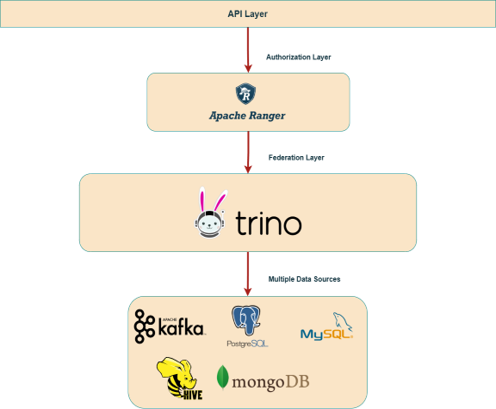
Layers of Data Virtualization Platform (Trino + Ranger)
Governance-Aware Exploration
By utilizing the official Trino Python library, the app passes user credentials directly to the coordinator. The UI is privilege-aware: it only displays the catalogs and schemas that Apache Ranger has authorized for that specific user.
Engineered for Big Data Scale
Working at Enterprise-scale, a single SELECT * can be dangerous. We implemented three critical guardrails:
- Session-Based Caching: Using caching, the app prevents redundant cluster hits for identical queries within the same session.
- “Sample-First” Rendering: To prevent browser crashes, the UI renders only a sample of the data for inspection.
- Streaming Downloads: For full exports, the app streams results directly from Trino to the local machine. This keeps the web server’s memory footprint low and prevents lag.
- Embedded Limits: I embedded hard logical limits in the code to prevent accidental “million-row fetches,” protecting our cluster resources.
Summary & Key Takeaways
Building a production-ready Trino + Ranger stack is more than just checking boxes. It’s about making choices that balance security with operational ease.
- Prioritize Version Harmony: Trino 476 + Ranger 2.6.0 is a proven winner.
- Persistence is Key: Don’t rely on Trino’s volatile memory; build a permanent sink for your audits.
- Decouple where possible: Using local users and custom audit flows reduces your system’s “blast radius” when external services fail.
By focusing on these engineering details, we’ve built a platform that isn’t just “virtualized” — it’s enterprise-hardened.
Conclusion: The Power of End-to-End Ownership
As a Data Platform and DevOps Engineers, our focus was to ensure that “Open Data” doesn’t mean “Unsecured Data.” As we’ve moved beyond simple virtualization to a complete, governed ecosystem that empowers our analysts while protecting our infrastructure.
메타데이터
- post_id
- 0e032ae4b461
- slug
- the-engineering-behind-the-governance-a-deep-dive-into-apache-ranger-trino-0e032ae4b461
- url
- https://medium.com/@mahmoudhassanen99/the-engineering-behind-the-governance-a-deep-dive-into-apache-ranger-trino-0e032ae4b461
- canonical_url
- https://medium.com/@mahmoudhassanen99/the-engineering-behind-the-governance-a-deep-dive-into-apache-ranger-trino-0e032ae4b461
- author_url
- https://medium.com/@mahmoudhassanen99
- status
- ok
- fetched_at
- 2026-07-28 04:33:19