AI and Multilingualism Q2: Forced Migration and the Survival of Languages
Question 2: How Language Physically Transforms During Forced Migration, and What Structures Survive Imperial Erasure
AI and Multilingualism Q2: Forced Migration and the Survival of Languages
Question 2: How Language Physically Transforms During Forced Migration, and What Structures Survive Imperial Erasure
When populations are displaced through conquest, enslavement, colonization, or economic desperation, language rarely survives intact. It becomes compressed, fractured, mixed, and rebuilt under pressure. Yet certain deeper structures endure because they are not stored merely in vocabulary. They exist within cognition itself, in the neurological and social patterns through which communities organize meaning and sound. Even deeper within existential situations through which any newborn must grow to integrate their community and survive with the help of communication.
The clearest modern example can be found in Creole languages.
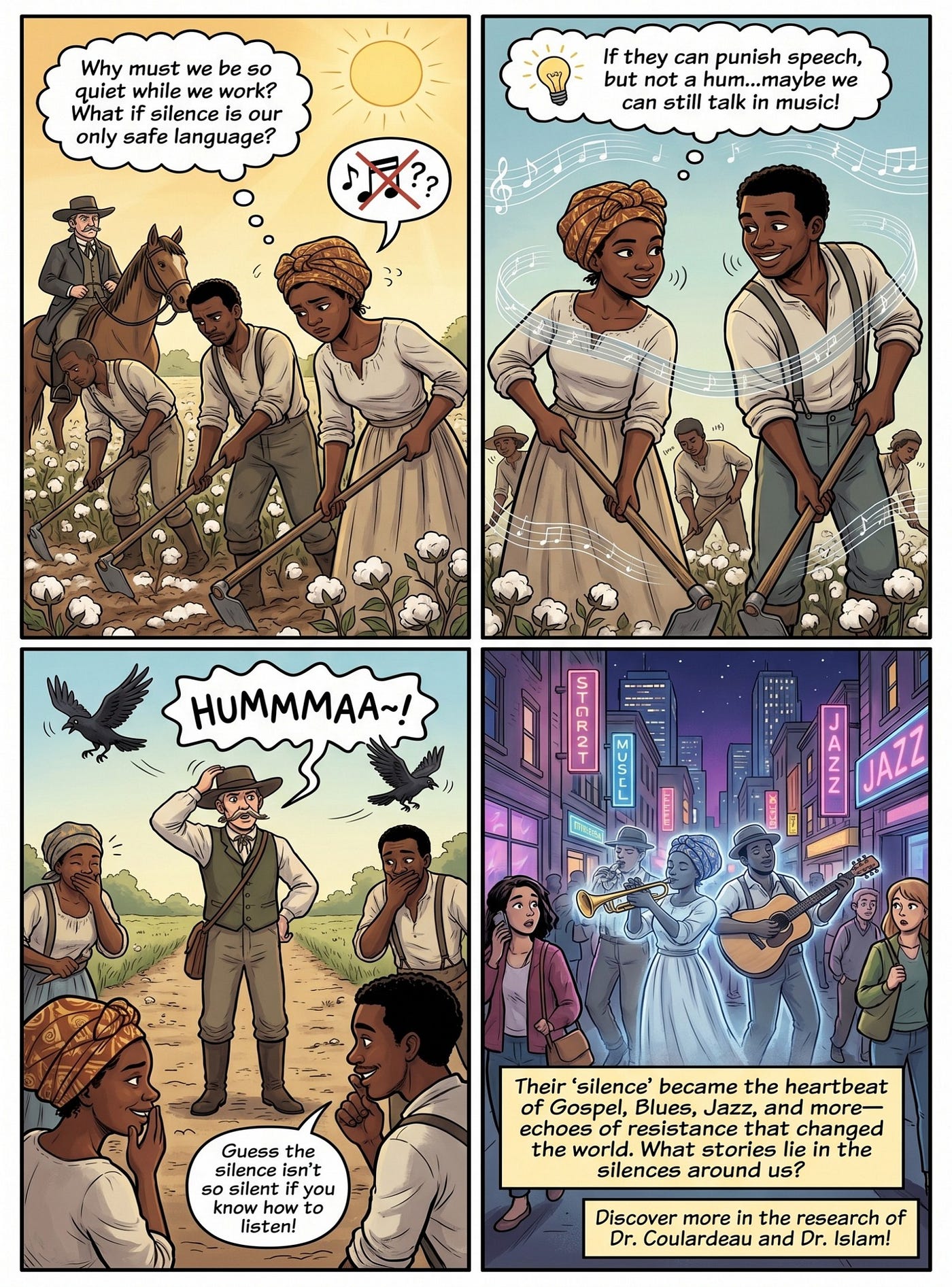
Enslaved Africans from numerous linguistic communities were deliberately separated and mixed, so that organized resistance would become difficult. In many cases, individuals placed beside one another shared no common tongue. Out of this imposed fragmentation emerged not silence, but creation. Haitian Creole, Jamaican Patois, and Louisiana Creole or Kouri-Vini, and Cajun, were born from the wreckage of suppressed languages, shaped by grammatical structures stored in the slow growth of the body, before and after birth, within a human environment. This long and ancient process could not be fully — if any at all — erased by colonial systems.

Linguists have repeatedly observed that Creole languages across different regions often retain structural similarities linked to the underlying African language families of enslaved populations, even when much of the vocabulary was drawn from European colonial languages. Some lexicon and a little morphology changed. But most morphology and a lot of syntax survived with endurance.
A similar pattern can be seen in the history of the Romani people. Dispersed across Europe over centuries through persecution, forced migration, exclusion, and state violence, Romani communities lost and absorbed countless local lexical resources depending on where they settled. Yet the deeper Indo-Aryan grammatical and phonetic structures in Romani remained detectable across geographically fragmented populations. Even after centuries of displacement, the linguistic skeleton endured beneath layers of adaptation.
The same principle appears across far longer historical timescales. The tri-consonantal root system found in Afro-Asiatic languages such as Arabic, Hebrew, Amharic, and Tigrinya has survived since the migration of the people in Black Africa who expanded circa 250,000 BCE from Black Africa to Northern Africa, despite their having left their linguistic nest so long ago, and after the Peak of the Ice Age, thousands of years of empire, conquest, religious transformation, and colonization.
This persistence is not cosmetic. It is a civilizational architecture, embedded deeply within linguistic cognition. Empires may impose rulers, borders, and official vocabularies, but they struggle to overwrite the deeper grammatical frameworks through which communities think and organize meaning.
A ruler’s language can dominate public space. A people’s grammar can survive centuries beneath it. Think of the Maya glyphs, languages, and cultures that defy the Maya Train’s travelers.
PhD-Student Mohammad Merajul ISLAM & Dr. Jacques COULARDEAU
메타데이터
- post_id
- 18a617b38d14
- slug
- ai-and-multilingualism-q2-forced-migration-and-the-survival-of-languages-18a617b38d14
- url
- https://medium.com/@jacquescoulardeau/ai-and-multilingualism-q2-forced-migration-and-the-survival-of-languages-18a617b38d14
- canonical_url
- https://medium.com/@jacquescoulardeau/ai-and-multilingualism-q2-forced-migration-and-the-survival-of-languages-18a617b38d14
- author_url
- https://medium.com/@jacquescoulardeau
- status
- ok
- fetched_at
- 2026-06-09 15:37:30