Method: The Improvement Kata
general framework. 1. understand direction 2. grasp current condition 3. establish target condition. 4. iterate towards target condition
Method: The Improvement Kata
“…teams do not become agile by adopting a methodology. Rather, true agility means that teams are constantly working to evolve their processes to deal with the particular obstacles they are facing at any given time.” p.120 Lean Enterprise
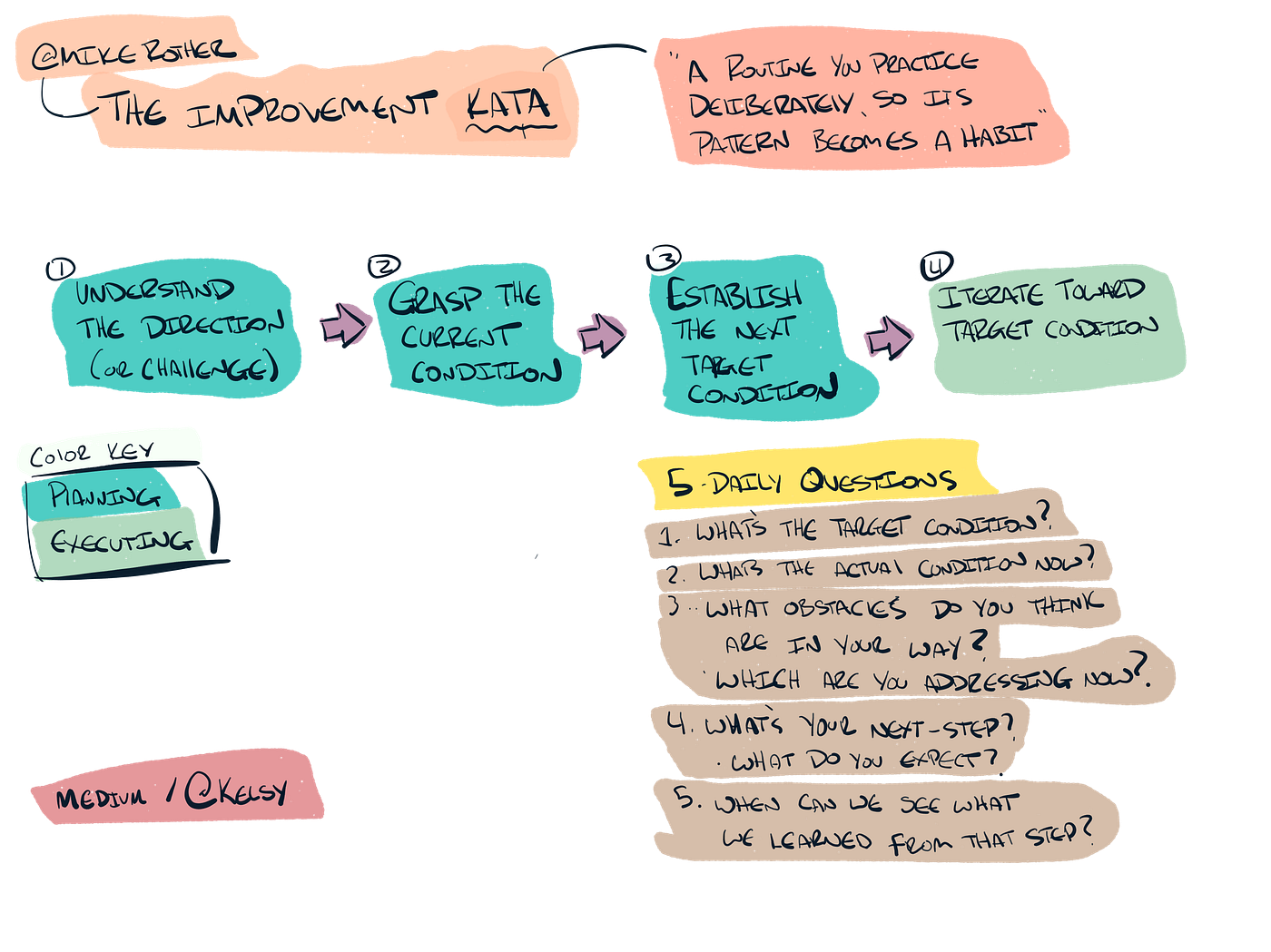
Understand direction, grasp current condition, establish target condition, iterate towards target condition
Mike Rother describes a 4-step framework for reaching goals that have an uncertain path to them.
The Improvement Kata is a way to help teams evolve their current practices (instead of replacing them with new ones). As with most cool process-improvement techniques, you can find managers at Toyota doing it.
Kata = a routine you practice deliberately, so its pattern becomes a habit.
Evolution in practices & processes is expected.
Method Overview
- understand the direction (or challenge)
- grasp the current condition
- establish the next target condition
- iterate toward the target condition
Rother recommends 1-week to 3-months for a target-condition (shorter timelines for those new to the process).
Keep the iterations to whatever length the current development cycle is (e.g., 2-week sprint).
During this process, the team doesn’t plan on how to move to the target condition — a series of experiments move towards the target conditions.
With experimentation front of mind, the team goes through answering a set of questions.
5 Daily Questions
- What is the target condition?
- What is the actual condition now?
- What obstacles do you think are preventing you from reaching the target condition? Which one are you addressing now?
- What is your next step? What do you expect?
- When can we go & see what we learned from taking that step?
I really like the structure of this framework and the mindset of improvement being a direction & not a destination.
But what is really catching my attention is the chrome-background pattern & how much useful information is put onto one website through a series of presentations.
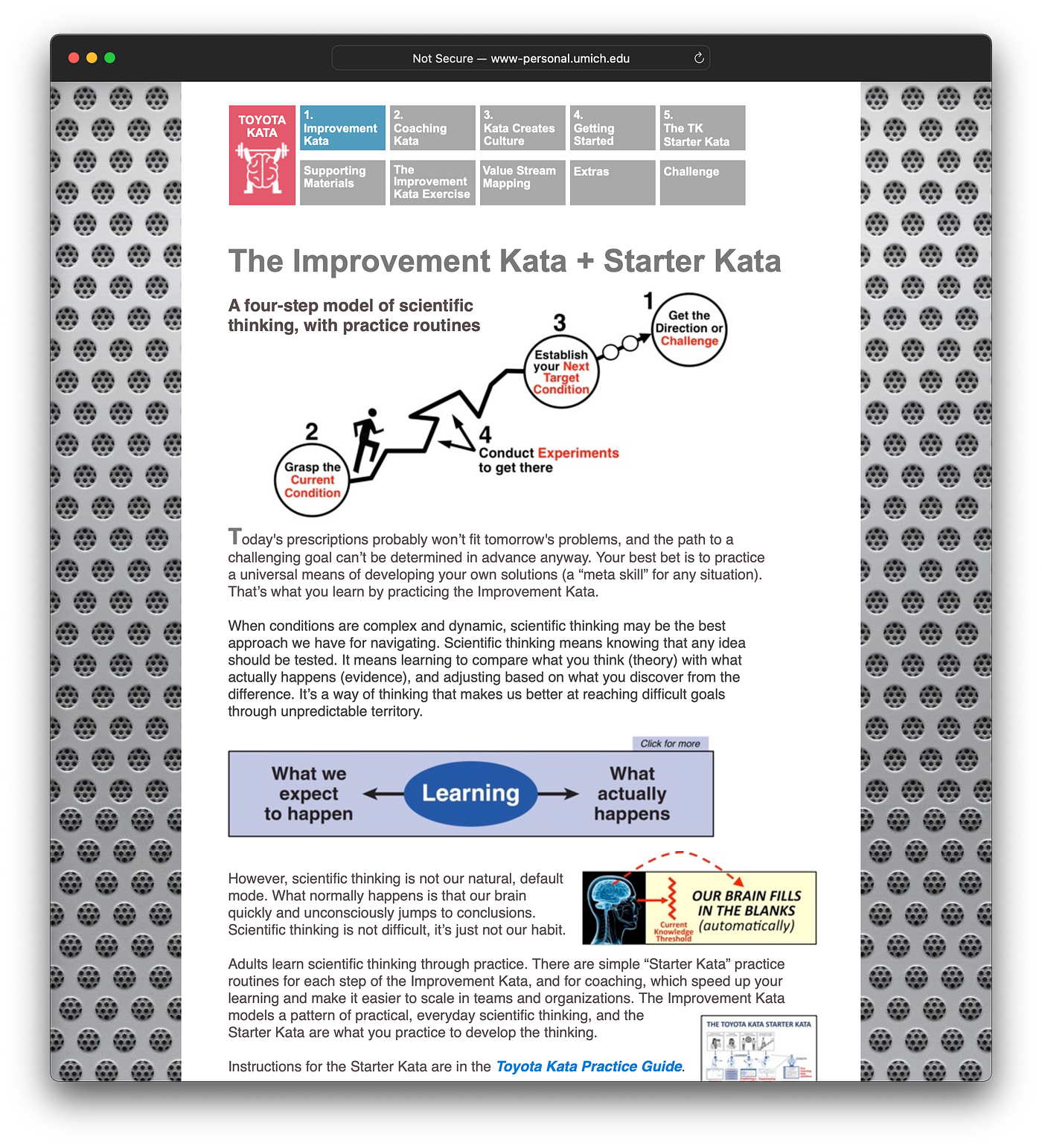
when you visit this page, scroll down and go through the slides — great info
I hope you enjoyed this short 4-step framework & that you get a chance to read through the website. It is an inspiration in getting ideas expressed clearly, in a format that you wouldn’t see on the front of Dribbble.
Best,
Kelsy
Links
- 🌐 The Improvement Kata website — http://www-personal.umich.edu/~mrother/The_Improvement_Kata.html
메타데이터
- post_id
- 1b96b020138b
- slug
- method-the-improvement-kata-1b96b020138b
- url
- https://medium.com/@kelsy/method-the-improvement-kata-1b96b020138b
- canonical_url
- https://medium.com/@kelsy/method-the-improvement-kata-1b96b020138b
- author_url
- https://medium.com/@kelsy
- status
- ok
- fetched_at
- 2026-07-19 05:11:48