Google’s Web Bucket Hides the Revenue Leak Founders Miss
Search Central counts AI Overviews and AI Mode inside Web reporting; Pew’s 2025 click study shows why traffic can lie.
Click Risk
Google’s Web Bucket Hides the Revenue Leak Founders Miss
Search Central counts AI Overviews and AI Mode inside Web reporting; Pew’s 2025 click study shows why traffic can lie.
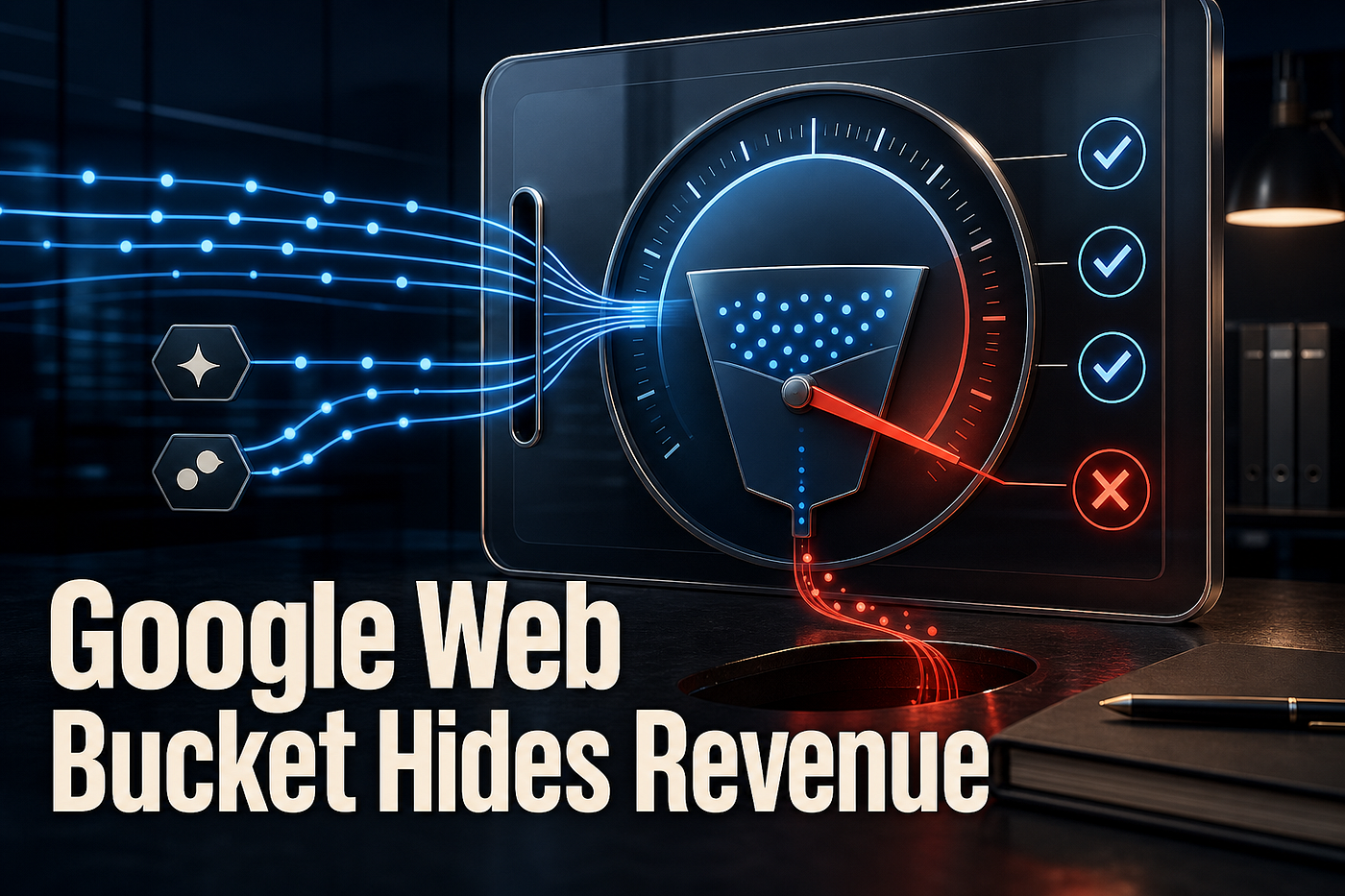
Google’s Web Bucket Hides the Revenue Leak Founders Miss. Image created by the author with diffusion-synthesis and Python post-processing.
Google’s Search Central page tucks the founder’s content bet into a field most teams already scan without ceremony: the “Web” search type in Search Console. That sounds like housekeeping, but it changes where next quarter’s education budget can disappear. If you judge those pages only by that bucket, you may keep funding work that teaches the answer engine, helps the buyer decide, and still never earns the visit.
On its AI features and your website page, Google says AI Overviews and AI Mode are reported in the Performance report under the “Web” search type. In a June 3, 2026 update, Google said AI Overviews had more than 2.5 billion monthly active users, and AI Mode had passed 1 billion.
The bucket did not leak. It got promoted.
The Web Bucket Got Too Big
For founders and growth operators, the reporting problem is not philosophical. It is sitting in the next budget meeting, usually between a Search Console line chart and a content calendar with too many polite green cells.
Google’s page makes the accounting clear. If a site appears in AI Overviews or AI Mode, that performance rolls into Search Console’s overall Web reporting. The same page says both features can use query fan-out, issuing related searches across subtopics and data sources to build a response.
One buyer question no longer maps cleanly to one keyword, one rank, one page, and one click.
That breaks the old bargain behind education content. A company writes the answer, Google ranks the page, the buyer visits, and the visit gets measured. The new bargain is stranger.
Your page can help ground an answer, your dashboard can still show Web impressions, and the buyer can leave with enough information to delay the click, skip the visit, or compare vendors without touching your site.
Google says clicks from search pages with AI Overviews can be higher quality, meaning users spend more time on the site. That can be true and still incomplete. Higher-quality clicks do not explain the demand that was satisfied upstream.
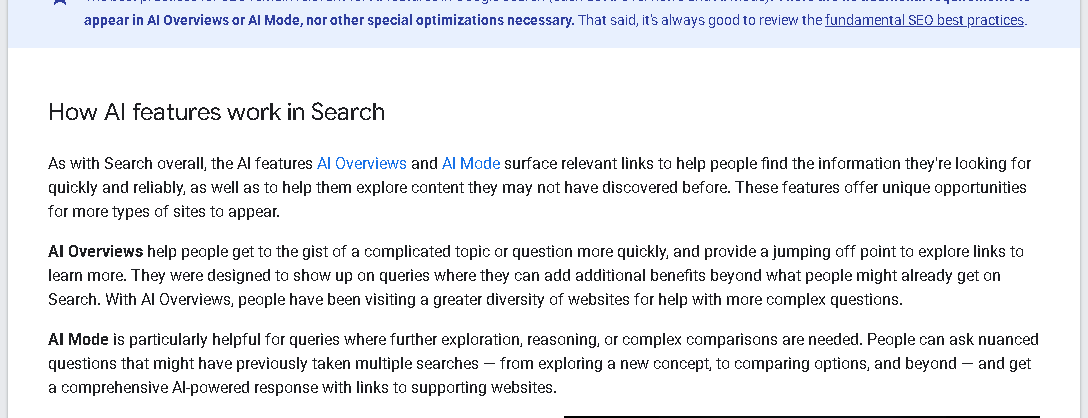
Figure 2. Proof of operating detail: The cited source, AI features and your website, gives the article the implementation surface teams must design around. Source: Google
A cashier can brag about larger baskets while the front door quietly loses half its foot traffic.
The incentive map is blunt. Google wants Search to feel useful enough that users ask more questions there. Publishers and founder-led companies want revenue, subscribers, leads, or trusted demand.
Those incentives can cooperate, but they do not share the same scoreboard.
A Source Link Is Not Demand
The uncomfortable evidence comes from the click gap. Pew Research Center’s July 2025 analysis tracked browsing behavior from 900 U.S. adults and examined Google searches from March 2025. Users clicked a traditional search result on 8% of visits when an AI summary appeared, versus 15% when it did not.
They clicked a link inside the AI summary in just 1% of visits.
That does not prove every AI Overview kills every page. It does prove a source link is not the same thing as demand. The buyer can see your brand, absorb your explanation, and still never become a session, lead, or subscriber.
The research problem gets sharper when source selection changes. A 2026 arXiv study, Measuring Google AI Overviews, issued 55,393 trending queries across 19 categories and found that 29.8% of AI Overview-cited domains did not appear in co-displayed first-page results. The same study found unsupported or unaddressed claims across part of the answer set, which is a reminder that being cited is not the same as being represented cleanly.
For operators, the main takeaway is practical: ranking and being used are now different events. Classic SEO treated the result page like shelf space. AI search treats the result page like a kitchen.
Your ingredients can enter the dish without your store getting the sale.
That is why a Web traffic report can look calm while the revenue path gets noisy. The founder sees impressions. The growth lead sees fewer clean landing-page sessions.
The sales team hears prospects repeating language from the market, but not necessarily from the company’s site. Everyone is looking at the same object and seeing a different loss.
Reprice the Pages That Teach Buyers
The first correction is to stop pricing education pages by traffic alone. A page that explains a commodity concept can still earn citations, but citation without post-answer revenue is rent paid to someone else’s interface.
Start with a plain audit. Pull your top education pages by Search Console impressions. Next to each page, add GA4 landing sessions, assisted conversions, CRM-created opportunities, demo requests, email captures, and branded search lift.
Do not smooth the ugly parts. The messy data is the point.
Then give each page one job:
-
Keep the page when it creates post-answer revenue, assisted pipeline, sales enablement, or branded demand that your CRM can see.
-
Prove the page when it earns visibility but lacks downstream evidence; add original data, screenshots, benchmarks, named customer context, or a tool that cannot be copied into a generic answer.
-
Cut or consolidate the page when it is commodity explanation, has weak conversion support, and mostly gives Google clean material for a response.
This is not anti-Google. It is anti-fantasy accounting.
The strongest pages in this environment have proprietary proof. They show pricing history, teardown screenshots, implementation details, calculators, first-party benchmarks, real product constraints, or field notes a model cannot invent without a source. A plain definition page can be swallowed.
A documented proof page has bargaining power.
Google’s June 2026 Search Console toggle also turns opt-out language into a traffic decision. Google says owners in a UK test can manage how links and content appear in generative AI Search features, and sites that opt out will not receive traffic or impressions from those features. That is not a simple visibility switch.
It is a revenue tradeoff wearing a settings-panel shirt.
Measure After the Answer
Search Console should become a clue, not the scoreboard. It can tell you where Google still sees you. It cannot tell you which buyer was satisfied before the visit, which comparison moved into AI Mode, or which answer borrowed your explanation and left no session behind.
The replacement is not one magic metric. It is a tighter chain. Keep Search Console for query and page visibility.
Use GA4 or your warehouse to connect landing pages with engaged sessions and assisted conversion. Push page-level influence into the CRM, even if the first version is rough. Then compare pages by revenue behavior, not just by traffic slope.
The test is simple enough to run this week. Pick ten high-impression education pages. For each one, ask whether a buyer who reads the AI answer still has a reason to click.
If the answer is yes, strengthen that reason with proof, product specificity, a calculator, a dataset, or a next step that belongs on your site. If the answer is no, stop treating the page as demand generation.
The end-state is a smaller, more honest content portfolio. Some pages exist to be discovered. Some exist to convert.
Some exist because nobody had the courage to delete a keyword relic from 2021. AI search makes that difference expensive.
Return to the proof object. Google’s own Search Central page puts AI Overviews and AI Mode inside Web reporting, while the market keeps moving buyer decisions into the answer itself. The page either proves revenue after the answer, or it becomes Google’s free footnote; thank you for reading.
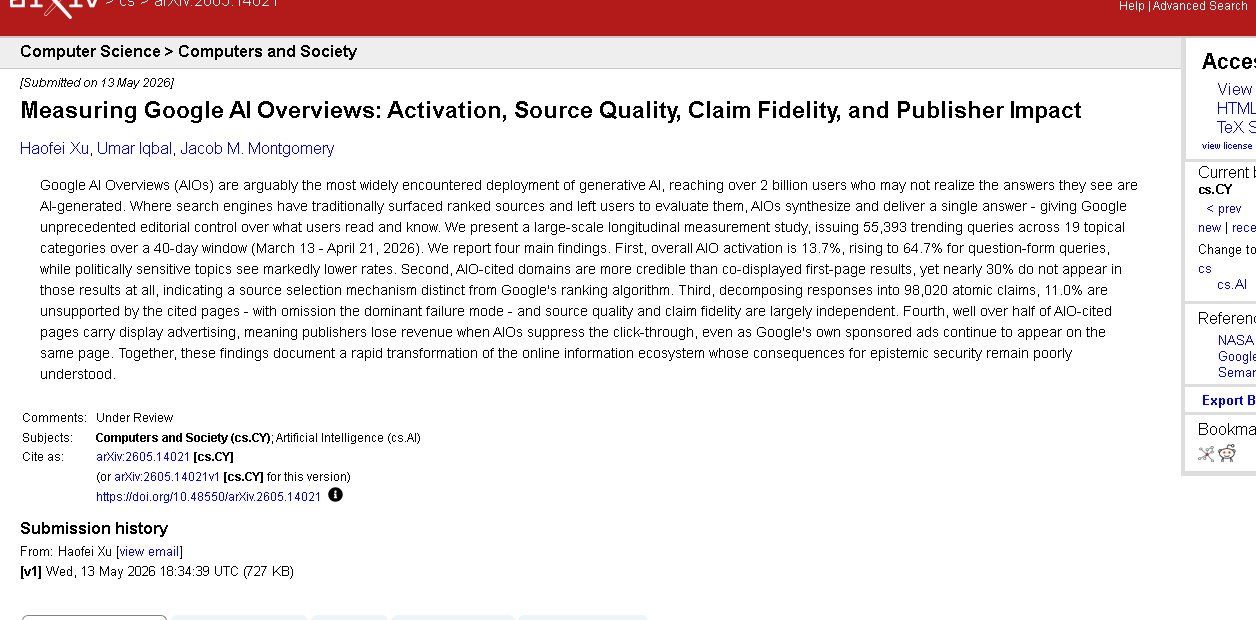
Figure 3. Proof of source-backed strategy: The cited source, Measuring Google AI Overviews, gives the article a primary source readers can inspect. Source: Google
Related reading
메타데이터
- post_id
- 26a9decfd086
- slug
- googles-web-bucket-hides-the-revenue-leak-founders-miss-26a9decfd086
- url
- https://medium.com/kairi-ai/googles-web-bucket-hides-the-revenue-leak-founders-miss-26a9decfd086
- canonical_url
- https://medium.com/kairi-ai/googles-web-bucket-hides-the-revenue-leak-founders-miss-26a9decfd086
- author_url
- https://medium.com/@james.kuhman
- status
- ok
- fetched_at
- 2026-07-09 13:13:48