Ecco’s Campaign for new families as new form of oppression
Ecco’s Campaign for new families as new form of oppression
Keywords: Superego — Fashion — Family — Capitalism — Jouissance
The fashion brand Ecco are in these days running a campaign about “Families”. The tagline runs something like “every family is different”. One is tempted to add, with a Freudian twist, the classical bon-mot of Tolstoj: “Happy families are all alike; every unhappy family is unhappy in its own way”. — Doesn’t Ecco’s campaign, then that all families are different, then mean, in a return of the repressed, precisely, that each is unhappy in its own way? Let us recall what a family is for Freud. Freud is not, as some of his critics claim, ‘reducing everything to the family romance’, so that behind every social problem we find for example some version of the father’s prohibition on the small child. Freud is saying the exact opposite. Not that the family is the explanation behind all social problems, but that the family is itself “a social problem”. Nothing similar happens in the animal kingdom, where a cat gives births to its kitten, takes care of them for a while — and that’s the end of it. In the human animal, we find instead, as Freud points out, this tragic fate, like that of Oedipus, where a family is never simply a “family unit”, but pervaded by an internal otherness. There is no “reproductive” reason, why for example the little boy should take his mother as a love-object, an object, that he can never acquire (and not simply because the father says “NO!”). This is the Freud’s scandalous discovery. Against the contemporary claim about ‘queer-families’ versus the nuclear family, Freud is entirely on the side of ‘queer-families’. Only he would say, that by the end of the day, the socalled nuclear family is the most ‘queer’ of all.
We only need to think about this a second to discover the “unnatural” other side of the human family. Where in nature do we find this queer striving. Have we ever heard of a dog’s puppy going to live it’s life dreaming about the jouissance of the sexual union with the mother, or of usurping the father’s place? As Freud points out, this desire in both boys and girls are constitively misplaced. Due to the lack of reproductive organs in the children, do fantasize about having a child with the parent of the opposite sex is totally uncalled for. We do not find this weirdness in nature. We see in these years a lot of different “post-humanist” studies, trying to emphasize that the human subject is an object like any other. Not true. In fact this ‘democracy’ of objects is really just a new way to try and repress this dangerous other side of the socalled nuclear family. Freud, much more than critics of the nuclear family, undermines this from within. As psychoanalytical philosopher Mladen Dolar writes:
“It is not that Freud reduces everything to relations to father and mother; he rather deprives them of their “natural” roles and presents them as functions laden with structural conflict and instability. Freud — and this is a rather massive hypothesis — discerns the function of the father and its vicissitudes precisely at the time when this traditional account has historically lost its sway.” (Dolar 2008: 24).
Freud is not a defender of the family or of “family values”, of paternal authority, of tradition. Rather he uncovers the conflict inherent to the human family as such.
So, what to do about this Ecco-campaign, that openly tries to do a kind of ‘rainbow’-washing, that is Ecco has certainly sensed that a commercial about a boring nuclear family will not sell. It has to be a dynamic, hypercreative and ‘contractual’ family, almost like the vision of the hacker’s unit, where each brings their own imp of perversity to create a more lively and vibrant atmosphere. Where does that leave us ideologically?
If we try to abstract from the commercial purposes (which we will come back to), what is this campaign about. In a series of articles, they are trying to define, what a “modern family is”. Each family is supposedly different, the concept of family should be broadened out. Family, so the articles seem to say, should not be identified with the classical “nuclear family” — of father, mother and child or children. That is the family on which Freud based his oedipal triangle. Families no longer have such a fixed structure, with the the husband as the breadwinner and “head of the household”, and the mother either as a house-wife, or in a part-time job. In Eccos campaign, family is even broadened out, to include “friends as family”, as in their article “Meet the Pantheresses”.
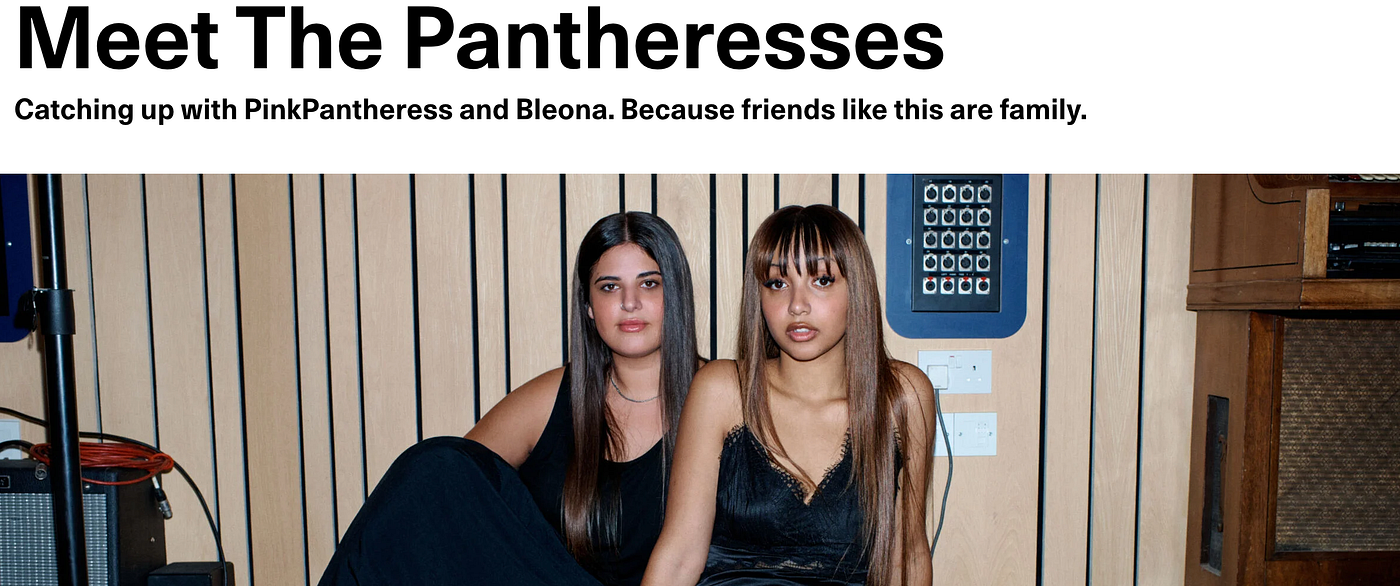
https://us.ecco.com/meet-pantheress-family.html. Here is how the article begins:
“Tell me about yourselves.
Hi! We are Pink and Bleona and we’ve been friends for 10 years! One decade!
At ECCO, we wanted to make our definition of “family” as broad as possible, to include friends. Do you believe that friends can be family?
Pink: I feel like family is the best way to describe our relationship. There’s an unspoken kind of level of how much we value each other, because only we know how much value we’ve bought it each other in the past, so there’s no part of me that wants to leave you in the past.” (https://us.ecco.com/meet-pantheress-family.html.).
Another series is called Meet the Pastranas, we also hear how the old nuclear family is a fossil of the past.

https://global.ecco.com/en/trending/meet-the-pastranas. Here we can also read:
2What is a modern family to you? A modern family to me is a very fun and different mix of people. It’s not just your standard mom, dad, and kids anymore.
What makes Pastranaland special? Pastranaland used to be a place where the world’s best did the craziest stuff ever on action sports, and it’s turned into a modern family playground.
What does Pastranaland look like? Popsicles, trampoline, what else? Crazy cards? Crazy cars. Scooters, foam pit, rock climbing wall. What else? It’s better with popsicles!”
So, how to approach this from a Freudian perspective? It is clear, that the traditional family has declined, which already Freud pointed out, and emphasized the ambivalence about. Freud was not lamenting the decline of symbolic authority vested in the father’s symbolic role, (the ‘head of the household’, the ‘one with the final word’), but diagnosticing, how his decline lead to other forms of tyranny and oppression. Technically speaking, what Freud pointed out, was the symbolic authority of the father was not identical to the superego. The superego is not like an outward authority. The superego is not like the stern father, who says “you have to go to bed at 9!”. The superego is more like the agency of conscience and therefore “internal authority”. The superego is like you being free to go to bed when you want, but that you should yourself know when it is time to go to bed. Freud thinks first of the superego as an internalization of the stern father. When you are a small kid, you don’t know how to behave. So your father or the mother lays down the law: “Don’t touch that old vase”, “stop bothering me!”, “go to bed at 9”. If the child complains, this has no effect on the parents. If the child asks why, the parents would say: “because we say so”. In traditional families of Freud’s time, even if the mother made a restriction it was in what Jacques Lacan calls the Name-of-the-Father. That is she referred to an authority outside herself, such as “behave or I will tell your father when he comes home”. Now, the entire point of the superego is that, it cannot be reduced to this kind of authority. It is “internalized”, but also made more “vigilant”. The stern father cannot see all. The child knows it has to obey, but whatever the father doesn’t see doesn’t hurt him. There is therefore a space of maneuver. The child can transgress the law, when the parents are not looking. (like touching ‘that old vase’) and so on. With the superego a different kind of agency is set up within the child. This is the by way of conscience. This means, that you feel prohibited from transgressing the law, even when the parental figure is not looking. You feel ‘watched all the time’, in Freud’s words, it is like a “garrison in an occupied city’”. (XXI: 122). It is like a camera installed inside you, that watches you every move, and makes you guilty in advance. To be sure, the stern father is bad enough, but Freud and later Lacan’s point is that the superego is even worse, because there is no prohibition to transgress. One is watched all the time.
Now, what does all this have to do with Ecco’s campaign? We seem as far as possible from any kind of superego. Looking at the pictures, everyone seems happy, creative. They are even just defining what they think families should be like. They are precisely putting their own label on it. Nothing could be less oppressive. Yet, the Freudian-Lacanian thesis is, as Lacan puts it in a slogan: “From father to worse”. How can this be worse? The point is that there is a different kind of authority emerging, which is, as Lacan says in seminar XX the “duty to enjoy oneself”. It is true that there is no stern father, or law telling you what to do — but there is a duty to enjoy yourself and express yourself, for you yourself to put a label on it. If you can’t find creativity and enjoyment you only have yourself to blame. Freud noticed a very peculiar logic in the superego: the more one obeys it, the more sacrifices it demands. So it is precisely those that obey it the most, that feels the most guilty.
In the ideological climate of Ecco, there is definitely a “duty to enjoy”. Not to enjoy instead of duty, but duty to enjoy. The paradox is, that the more one tries to obey this duty, the more one feel like we are not enjoying enough. That one is constantly lacking behind. This is probably the feeling of most viewers of the articles: that you lack behind these cool modern families, that look even too cool for catwalks. It is clear, that this incentive to enjoy is also a very powerful neoliberal manouvre that makes enjoyment itself very profitable. Many sociologists call this postfordist capitalism, fordist referring to the traditional view of the hard-working labourer at the assembly line. Post-fordist refer to the stage in capitalism where “cultural values”, “identies” are themselves much more powerful commodities. If we think about it, Ecco’s shoes can be worn out, there is a limited field to exploit in their production. But the subject’s psyche is an unlimited field. It is always possible to generate a surplus there.
The philosopher Alain Badiou has written in his book on St. Paul and universalism of exactly this kind of logic in neoliberalism, where the creation of new identities, the creation of difference is itself the most adapt tool to fit with contemporary capitalism:
“Capital demands a permanent creation of subjective and territorial identities in order for its principle of movement to homogenize its space of action; identities, moreover, that never demand anything but the right to be exposed in the same way as others to the uniform prerogatives of the market. The capitalist logic of the general equivalent and the identitarian and cultural logic.” (Badiou, 2003: 10–11).
We can see this in the Ecco-families. Far from simply liberating us from the nuclear, rigid family, it is also “permanent creation of subjective and territorial identities” — the “uniform prerogative of the market”, to make yourself something different. While each family is presenting itself as different, it still follows the “general equivalent”. Symbolic markers, life-style is the present mode of oppression. In this light the right-wing reactionaries, is not so much a symptom of a remainder of the past, but itself a product of this logic. This is why it is not surprising, when we look at for example advocates of ‘family values’, often do so in a news stations such as Fox News, or some major rally with a tv-preacher. They command precisely even more enjoyment, than the Ecco-campaigns. Of course as a psychoanalytical thinker, if you are forced to choose between the right wing fundamentalist and the Ecco-family style neoliberal cultural consumer, you have to go with the latter. yet, the point is precisely to step back and see what other options this frame, this ‘Catch 22’ represses.
To put it differently, the return of the primordial father in the right-wing fundamentalism of ‘family values’ is not a direct result of the decline of the symbolic ‘stern’ father of Freud’s time. It is rather a result of the university discourse, chain of knowledge, of the ‘open democractic field’. This field generates a lot of “psychosis” because there is no way to anchor the floating signifiers, to orient oneself. This is why it can feel as a ‘relief’ with right-wing reactionary, that simply tells you what to do. A typical tv-preacher commands family values, but in the way he presents this he also gives his followers a mode to enjoy without barriers (like the ‘barriers’ of mutual respect, human rights…). But he doesn’t simply provide a welcome master for his followers, but also for the democratic-liberal-cultural left, that now find an easy figure to attack. In this way, such a right-wing fundamentalist preacher provides a welcome patriarch against which one can asserts one’s opennes. The problem seems not to have anything to do with oneself or to be of more systematic character. (notice the enjoyment of pseudo-leftist in sharing videos of Trump’s outrageous statements about this or that…).
The logic of the campaign of Ecco is that of the typical “democratic” post-patriarchal permissiveness. The articles give you a sense of providing the answer (read what the Parenthesses do, read what the Pastranas do…), yet the neoliberal manouvre is not to be exactly like them (that would be boring and fit too much with rigid uniformity), but rather the pervasive DIY-logic, so that ultimately the slogan is, “try to more like yourself”, as though there was some secret that could b unlocked through inspiration from reading the article.
In psychoanalytical language, what the current capitalism does, like the Ecco-campaign is however, in its very openness to reject any formulation of a new master-signifier, that is something that could go beyond the ‘right to enjoyment’. It is true you get to formulate a lot of new signifiers (define YOUR family), but only in so far as they are not truly ‘evental’ to use Badiou’s word, in so far as they do not really rock the boat of what he calls the “human animal”, by which he means an a mode of being, that is only dedicated to enjoyment and work within the “uniform prerogative” of capital. Psychoanalysis is not a political movement, but it can help us detect, precisely how political movements function, and how capitalism itself has become more and more “political” (like every product should signal your political attitudes), but of course this represses the possibility of a proper political alternative.
Bibliography:
Alain Badiou: Saint Paul: The Foundation of Universalism, trans. Ray Brassier (California: Stanford University Press, 2003).
메타데이터
- post_id
- 27f96c5ea1ec
- slug
- eccos-campaign-for-new-families-and-the-new-forms-of-the-superego-27f96c5ea1ec
- url
- https://medium.com/@akineo/eccos-campaign-for-new-families-and-the-new-forms-of-the-superego-27f96c5ea1ec
- canonical_url
- https://medium.com/@akineo/eccos-campaign-for-new-families-and-the-new-forms-of-the-superego-27f96c5ea1ec
- author_url
- https://medium.com/@akineo
- status
- ok
- fetched_at
- 2026-07-24 22:56:45





