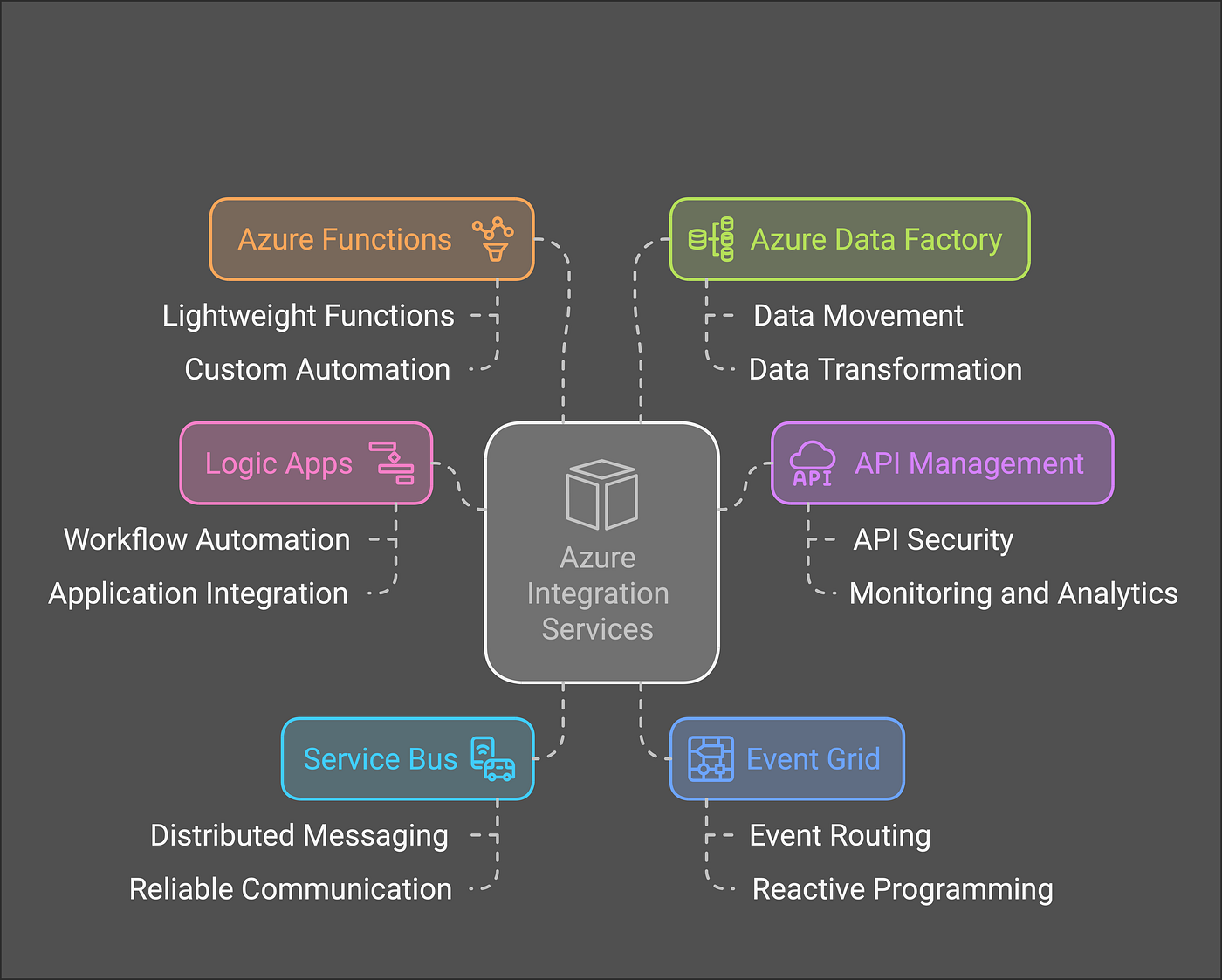
Migrating from BizTalk to Azure Integration Services
Choosing the Right Path to Azure Integration Services
Migrating from BizTalk to Azure Integration Services
Choosing the Right Path to Azure Integration Services
Introduction
Migrating from BizTalk Server to Azure Integration Services is a crucial step for organizations looking to modernize their integration landscape. This migration provides scalability, flexibility, and cost efficiency by leveraging cloud-native services. This guide covers migration strategies, reusable artifacts, best practices, design patterns, B2B integration, AI benefits, and on-premises data connectivity.
Why Organizations Are Migrating from BizTalk?
Organizations are actively migrating from BizTalk due to several key reasons:
BizTalk 2020 End of Life : BizTalk Server 2020 is the last planned release, with mainstream support ending in 2028. Organizations must plan for future-proof integration strategies.
Cloud-Native Benefits : Reduce infrastructure costs and leverage PaaS scalability.
Enhanced Monitoring & Logging : Built-in monitoring via Application Insights.
Improved Security & Compliance : Azure security features, role-based access control (RBAC), and managed identities.
Modernized Development Experience : Low-code/no-code workflows with visual designers and API-first architecture.
Seamless B2B and Hybrid Integration : Azure offers built-in B2B connectors and on-prem connectivity options.
AI & Automation Advantages : Built-in AI-powered features and connectors enhance automation and decision-making.
Migration Approaches
When transitioning from BizTalk to Azure Logic Apps, organizations typically follow industry-standard migration approaches. These include:
1. Refactoring
· Partially migrates BizTalk components to Azure Logic Apps while retaining some on-premises elements.
· Suitable for hybrid scenarios where a full transition is not feasible immediately.
· Allows phased migration while maintaining business continuity.
2. Rebuilding
· Fully modernizes integrations by re-architecting workflows using Azure Logic Apps, API Management, and Service Bus.
· Eliminates legacy constraints, enabling cloud-native scalability and maintainability.
· Best suited for organizations seeking long-term digital transformation.
3. Hybrid Coexistence
· Maintains BizTalk and Azure Logic Apps side by side, integrating gradually over time.
· Ideal for enterprises with complex integration landscapes that require a phased migration.
· Ensures minimal disruption while evaluating Azure’s capabilities.
BizTalk vs. Azure Integration Services:
When moving from BizTalk to Azure Integration Services, it’s important to understand how BizTalk artifacts map to Azure Integration Services components.
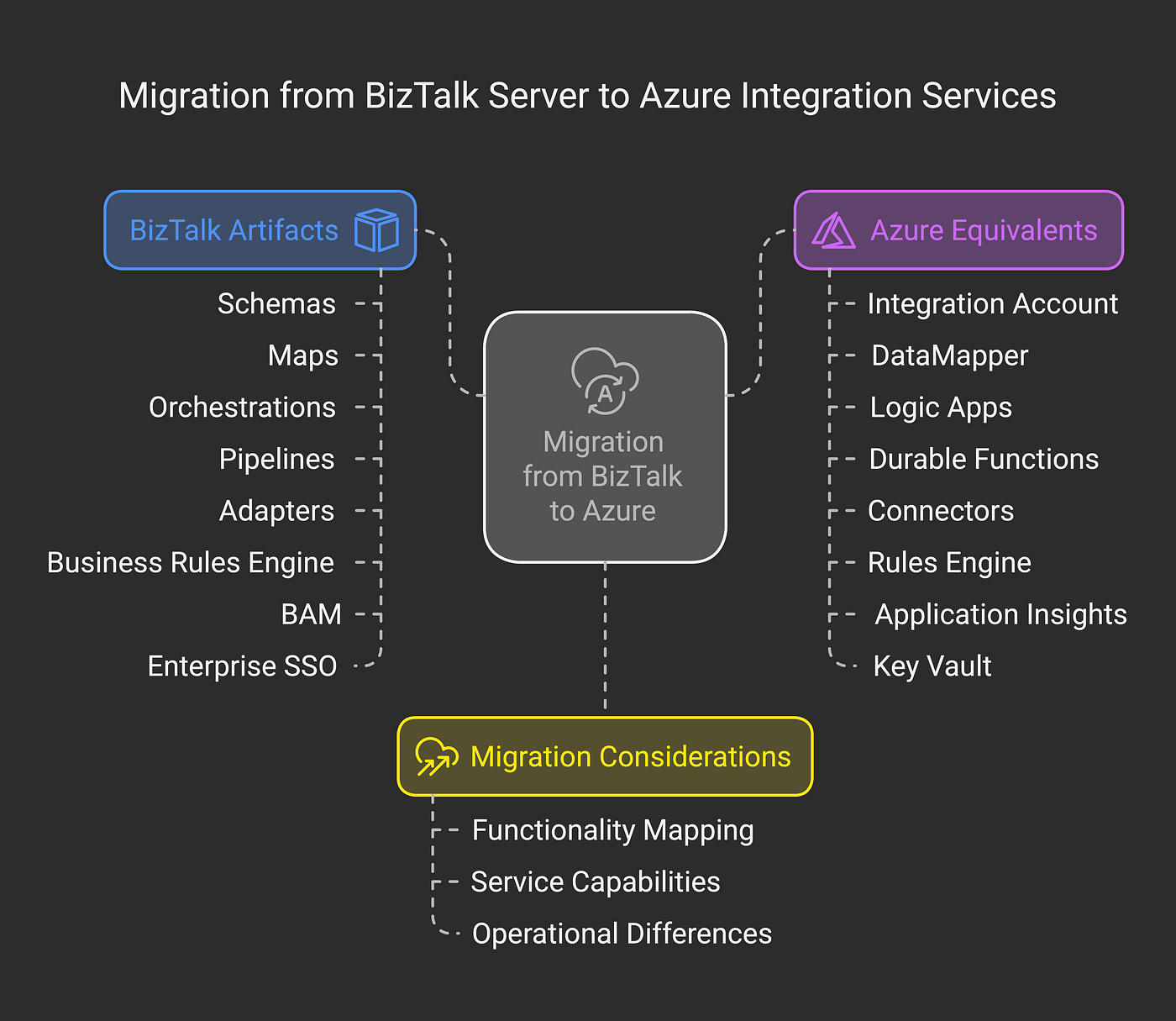
Common Design Patterns in BizTalk and Azure Integration Services
Understanding how BizTalk design patterns translate to Azure Integration Services is essential for a smooth migration.

B2B Integration in Azure
BizTalk Server has strong support for B2B/EDI integrations, and Azure provides similar capabilities via Integration Accounts and Logic Apps :
Integration Accounts : Store artifacts like schemas, maps, trading partners, and agreements.
EDI Processing : Supports X12, EDIFACT, and AS2 B2B transactions.
API Management for Partner Onboarding : Securely expose APIs for B2B partners.
Azure Storage & Event Grid : Handle large-scale batch file transfers with event-driven processing.
Connecting to On-Premises Data
For organizations that need to integrate with on-premises applications, Azure provides multiple options:
On-Premises Data Gateway : Allows secure, direct connectivity between on-prem databases, file systems, and Logic Apps.
Hybrid Connections : Enables connectivity for specific application services without requiring a VPN.
ExpressRoute & VPN Gateway : Secure networking options for high-throughput and private connectivity.
BizTalk Hybrid Connections : Facilitates phased migrations while keeping some BizTalk components running on-premises.
AI and Automation Advantages in Azure Logic Apps
Migrating to Azure Logic Apps opens up opportunities to leverage AI-powered integrations:
AI-Powered Decision Making : Use Azure AI services within workflows.
Natural Language Processing : Enhance customer interactions with AI-driven chatbots.
Automated Document Processing : Extract data from invoices, contracts, and forms using AI models.
Intelligent Error Handling : Predict failures and automatically reroute or retry transactions.
HighTail AI Connectors : Leverage pre-built AI connectors in Logic Apps for advanced automation and insights.
Conclusion
Migrating from BizTalk to Azure Logic Apps unlocks significant modernization benefits while reducing infrastructure complexity. With BizTalk 2020 reaching its end of life, organizations should proactively transition to cloud-based integration solutions. Leveraging Integration Accounts, Data Mapper, AI-powered automation , and the right design patterns ensures a smooth migration. A well-planned migration with a phased approach minimizes disruption and maximizes efficiency in adopting Azure Integration Services.
For more details about Logic Apps, read my blog: https://medium.com/@vignesh.gurumoorthy/azure-logic-apps-the-future-of-cloud-integration-and-automation-681af3be164a.
메타데이터
- post_id
- 2b7cf70d7953
- slug
- migrating-from-biztalk-to-azure-integration-services-2b7cf70d7953
- url
- https://medium.com/@vignesh.gurumoorthy/migrating-from-biztalk-to-azure-integration-services-2b7cf70d7953
- canonical_url
- https://medium.com/@vignesh.gurumoorthy/migrating-from-biztalk-to-azure-integration-services-2b7cf70d7953
- author_url
- https://medium.com/@vignesh.gurumoorthy
- status
- ok
- fetched_at
- 2026-07-21 17:51:44