The Epistemic Symbiosis: Elevating AI from a Digital Tool to a Neuro-Cognitive Research Partner
Beyond Automation — Mapping Co-Hypothesis Generation, Shared Synaptic Frameworks, and the Bio-Digital Interface of Modern Scientific…
The Epistemic Symbiosis: Elevating AI from a Digital Tool to a Neuro-Cognitive Research Partner
Beyond Automation — Mapping Co-Hypothesis Generation, Shared Synaptic Frameworks, and the Bio-Digital Interface of Modern Scientific Inquiry.
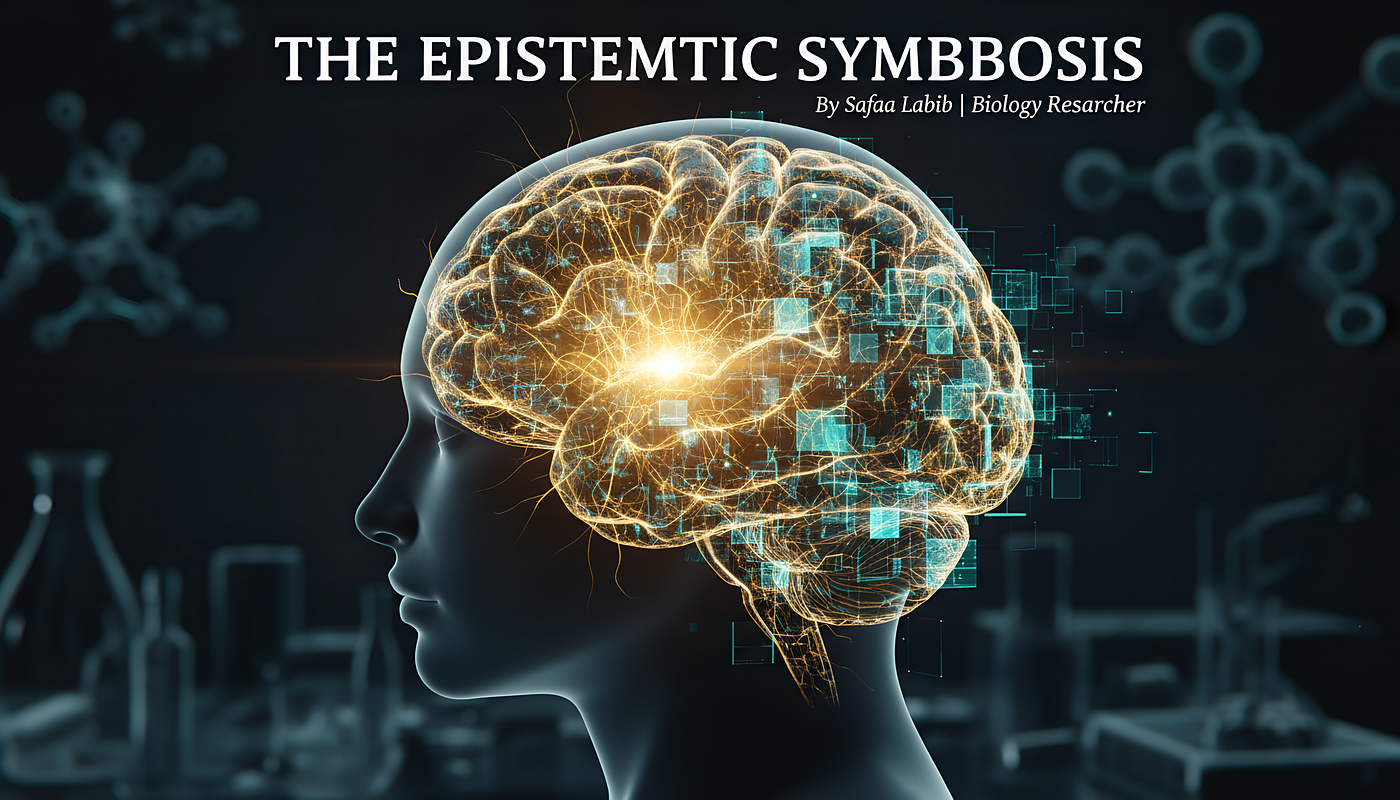
This AI-generated image conceptualizes the “Epistemic Symbiosis,” visualizing the neuro-cognitive interface where human biological pathways couple with synthetic data networks to optimize co-hypothesis generation. Conceptual Design: Safaa Labib, Biology Researcher.
The New Frontier of Post-Human Discovery
For centuries, scientific discovery has been viewed through a strictly anthropocentric lens. The human mind was the sole crucible where raw observation was forged into elegant hypothesis. However, we have quietly crossed a historical threshold: we have moved from using machines to compute data, to collaborating with artificial intelligence to synthesize concepts.
In the modern laboratory, generative AI models are no longer just passive calculation engines or digital text-formatters; they have evolved into Epistemic Partners. Every prompt issued by a modern researcher initiates a sophisticated, bi-directional feedback loop — a cognitive dance where human biological intuition guides, and machine statistical entropy accelerates.
As a biology researcher, I have observed that this transition is altering the very architecture of scientific thought. To fully harness this revolution, we must move beyond treating AI as a mere efficiency tool. We must understand the Neuro-Cognitive Symmetries of this partnership, manage the “Cognitive Dissonance” of algorithmic suggestions, and establish a framework for a true bio-digital symbiosis.
The Metabolic Architecture of Co-Hypothesis Generation
In neurobiology, the formulation of a novel scientific hypothesis is one of the most metabolically exhausting tasks the human brain can execute. It requires the Prefrontal Cortex (PFC) — the seat of executive function and critical thinking — to operate at maximum capacity — consuming vast amounts of glucose and adenosine triphosphate (ATP) to perform complex pattern recognition, map distant causal relationships, and suppress cognitive biases.
When a researcher partners with an advanced AI model, they are essentially creating an Extended Cognitive Network. The human brain works through the prism of **Predictive Coding and the Energetics of the Brain**, continuously generating internal models of the world to minimize surprise and conserve metabolic energy. AI models, working on deep neural network architectures, act as an external “Entropy Generator.”
By processing billions of data points and drawing cross-disciplinary correlations that are statistically invisible to a single human mind, the AI presents alternative configurations of reality. When the AI proposes a non-obvious biological pathway or a novel molecular interaction, it forces the researcher’s PFC out of its habitual predictive tracks. This external prompting significantly lowers the human metabolic cost of ideation; instead of burning through energy trying to generate random permutations, the human brain focuses its expensive cognitive reserves entirely on validation, ethical discernment, and deep qualitative synthesis.
Algorithmic Serendipity vs. Cognitive Anchoring
Human scientific breakthroughs have historically relied heavily on Serendipity — the accidental discovery of something valuable while looking for something else. However, human serendipity is limited by our sensory boundaries and our inherent cognitive biases.
AI introduces what I term Algorithmic Serendipity. By mapping data into high-dimensional vector spaces, an AI partner can bridge the gaps between completely unrelated scientific disciplines. For instance, it can cross-reference an obscure botanical paper from 1994 with a recent breakthrough in material sciences, revealing a hidden structural symmetry.
This deep bio-digital crossover aligns perfectly with the foundational concepts of the Extended Mind Thesis, which argues that human cognition is not strictly bound by the skull but can actively intertwine with external technological artifacts to build a superior, coupled cognitive system. Yet, this partnership is not without biological risk. Researchers must guard against Cognitive Anchoring Dissonance. Because generative AI outputs are formulated with statistical confidence, the human brain can subconsciously experience a form of cognitive laziness. This psychological vulnerability is deeply examined in recent behavioral frameworks tracking **Cognitive Anchoring and Human-AI Decision Dynamics*, which illustrate how easily our executive filters accept automated outputs as absolute truth. To maintain a healthy epistemic symbiosis, the researcher must utilize their Default Mode Network (DMN)* to daydream, question, and apply existential skepticism to the AI’s structural perfection. The AI provides the statistical landscape, but the human must provide the conceptual spark.
Visualizing the Unseen: The Neural Processing of Bio-Illustrations
A critical facet of the modern bio-digital partnership is the co-creation of visual data. Complex biological mechanisms — such as the intricate, sub-cellular dance of neural pathways or the metabolic dynamics of mitochondrial decay — are often too complex for linear text alone. Here, AI image generators act as a direct extension of the researcher’s visual cortex.
When we use AI to design a scientific illustration or infographic, we are translating abstract mathematical or biological concepts into immediate, spatial architecture. This process reduces the “Cognitive Load” for both the researcher and the eventual reader.
From a neuro-visual perspective, a well-structured biological illustration activates the ventral stream of our visual cortex (the “what” pathway), allowing for instantaneous pattern recognition before the slower text-processing centers of the brain even engage. By utilizing AI as an artistic proxy, the independent researcher can bypass the technical limitations of graphic design and focus entirely on structural accuracy, transforming raw data into intuitive, bio-authentic visual metaphors.
The Neuro-Ethics of Outsourcing Discernment
As we stand at this unprecedented technological crossroad, we must establish a rigorous framework for Neuro-Hygiene in AI-assisted research. Outsourcing data processing is efficient; outsourcing cognitive discernment is a biological regression.
If a researcher relies entirely on AI to read, summarize, and critique scientific literature, they risk inducing a form of cognitive atrophy within their own neural architecture. Over-reliance on algorithmic filtration softens the critical analytical faculties of the Prefrontal Cortex.
A well-nourished, highly trained human brain must always remain the ultimate firewall and the primary filter for reality. The ethical imperative of modern science is to treat AI as a collaborator that expands our horizon, not as an oracle that replaces our judgment. As outlined in comprehensive philosophical risk frameworks like Nick Bostrom’s [Superintelligence: Paths, Dangers, Strategies,](https://en.wikipedia.org/wiki/Superintelligence:_Paths,_Dangers,_Strategies) the critical challenge lies in establishing proactive multi-layered control mechanisms before cognitive dependency limits human agency. Therefore, we must maintain our Neural Sovereignty — ensuring that our biological intuition and qualitative depth remain the guiding forces behind every automated discovery.
The Future of the Bio-Aware Researcher
History has proven that the human mind is remarkably plastic. Just as our ancestors’ neural frameworks adapted to the invention of the printing press and the telescope, our modern neural architecture is currently undergoing a rapid evolutionary shift to accommodate the presence of digital intellects.
We are moving away from the era of the isolated genius toward the era of the Bio-Aware Research Symbiont. In this new epoch, the ultimate scientific breakthrough will not be authored by a human alone, nor will it be generated by a solitary machine. It will emerge from the fertile, cross-pollinated space where human biological complexity meets synthetic computational speed.
By honoring our physiological intuition, protecting our cognitive resources, and treating artificial intelligence not as a threat, but as an intellectual mirror, we ensure that as our tools become more synthetic, our collective scientific wisdom remains authentically profound.
References
- American Psychological Association (APA). (2027). Cognitive Anchoring, Automation Bias, and Human-AI Collaborative Decision Dynamics. APA PsycNet.
- Friston, K. (2023). Predictive Coding and the Energetics of the Brain. Journal of Neuroscience Research.
- Bostrom, N. (2014). Superintelligence: Paths, Dangers, Strategies. Oxford University Press.
- Clark, A., & Chalmers, D. (1998). The Extended Mind. Analysis & Cognitive Architecture.
Support My Research & Stay Connected
If you found this biological deep dive valuable, I invite you to join my growing community of science-driven readers. My work is dedicated to exploring the intersection of neurobiology, psychoanalysis, and physical health to help you reclaim your Biological Sovereignty.
Subscribe to My Substack: Join the “Biological Sovereignty” newsletter for exclusive research updates, in-depth biological protocols, and nuanced insights delivered directly to your inbox. 👉[ Join the Community on Substack](https://safaalabib.substack.com/)
Support My Independent Work: If you’d like to fuel my research and help me create more high-quality, evidence-based content, consider supporting me. You can join my paid tiers on 👉 Patreon, or send a direct contribution due to regional subscription limitations via 👉 PayPal.
Connect Professionally: For professional networking, updates on my academic research, and industry discussions, let’s connect on 👉[ LinkedIn](https://www.linkedin.com/in/safaa-labib-8121a43a0/)
Explore More: You can find a collection of my published work and curated stories here: 👉[ Safaa Labib on Digitalmehmet](https://digitalmehmet.com/author/labibsafaa641/)
Thank you for being part of this journey toward mastering your internal ecosystem.
메타데이터
- post_id
- 2ed116ccb538
- slug
- the-epistemic-symbiosis-elevating-ai-from-a-digital-tool-to-a-neuro-cognitive-research-partner-2ed116ccb538
- url
- https://medium.com/illumination-scholar/the-epistemic-symbiosis-elevating-ai-from-a-digital-tool-to-a-neuro-cognitive-research-partner-2ed116ccb538
- canonical_url
- https://medium.com/illumination-scholar/the-epistemic-symbiosis-elevating-ai-from-a-digital-tool-to-a-neuro-cognitive-research-partner-2ed116ccb538
- author_url
- https://medium.com/@labibsafaa641
- status
- ok
- fetched_at
- 2026-06-14 13:58:26