COMPLICATED INTRICACY IS NOT HUMANISTIC VISIONARY
DAN BROWN — ANGELS AND DEMONS — 2003
COMPLICATED INTRICACY IS NOT HUMANISTIC VISIONARY

DAN BROWN — ANGELS AND DEMONS — 2003
**Maybe cynical, disquieting for sure! — 2006**
The success of The Da Vinci Code was a miracle in a way that can be explained but has little to do with the literary value of the novel, but it has a lot to do with the new demand from people to be introduced to some spirituality. Since then, Dan Brown has been trying to relaunch his previous novels. This one is such a re-launch, and it shows how The Da Vinci Code is different. The subject is the Catholic church again, and the Vatican again. But you need to suspend your disbelief quite a lot to accept this plot in the Vatican. The plot is breathtaking, and the suspense is astonishing. You cannot predict the end ahead of time, though you can feel from the very start that one of the characters, despite the author’s misleading you among various people and events, is not exactly what he seems to be.
But you are taken by surprise when you reach the last leg of the story. The book is trying to analyze a very old conflict between religion and science, from the Catholic point of view. The book shows very clearly how science is a permanent miracle but also how irresponsible scientists are, and first of all, because ethics is not their problem. They do not consider the long-term and human consequences of their inventions. This is very true, and yet very false because science, no matter how pure it can or could be, always answers a social order, a social demand, a social want or need. « Strangely » and « luckily » enough society does not speak with only one voice: it is divided into several groups and science is under several demands, which means any invention is systematically turned into a weapon on one side and a life-saving or life-improving device on the other side, at least because we could and should also consider the third demand which is to produce an explanation of the world and its existence.
Maybe even some other demands like discovering dark forces, surreal forces, and also producing some kind of artistically elegant and even beautiful vision of the world or spying-glasses necessary to look at the world’s strange phenomena. On the other side, religion is supposed to provide humanity with spirituality, a vision in the unknown, an identification for the wider force that animates the world (God), solace in front of hardships and catastrophes, etc. The novel is based on Galileo’s conflict with the church and the famous scientific sect known as the Illuminati. The research is important and interesting, though it is systematically oriented towards the satanic despite the identity of the scientific and artistic founding fathers.
The question of the ethical responsibility of science and scientists is constantly present but never solved of course. The question of the religious dimension of life in our modern 21st century is also constantly present and answered in two successive ways. One is to go back to the sacred texts of the Bible and reenact the tragedy of Jesus. The other is to take a benevolent attitude towards the modern world and accompany people with their angst or fears. The book chooses a final solution and yet the question remains unsolved. It cannot come to any inspiration in those two fields because it is a thriller and nothing else: ethical questions are nothing but a wrapping that finds no roots in our consciousness or intellectual culture. There are even some anachronic elements. P. 243 for example.
The practice of `God-eating’ in the Holy Communion cannot have been borrowed from the Aztecs because when Paul invented it, or when Jesus spoke of it in the Last Supper, the Aztecs were plainly unknown of them and could not be known in any way. Yet this book, published originally in 2000, shows the emergence of the spiritual question among people, but I would advise Dan Brown to do his research about Buddhism in more authentic depth, even if he needs to learn Pali, the original language of the basic texts of Buddhism, to avoid assertions about Buddhism being a religion, for one example, even if this distortion is common among American Buddhists who are over-influenced by the religious brand of Buddhism that grew in Tibet and has emigrated after the arrival of the Communists in Beijing in 1949.
The Buddha is absolutely clear in the Dhammapada for example, there is no God, and we do not need any God because if God answers the question of the creation of the world, then who created God? In the book, this is an important scientific shortcoming: antimatter is declared created from nothing neglecting the fact that enormous quantities of energy are necessary to create that antimatter. So, in the Big Bang, where did the energy come from? That makes the book slightly unbalancing: our disbelief comes back fast with such elements.
Dr Jacques COULARDEAU
TOM HANKS — DAN BROWN — ANGELS AND DEMONS — 2009
The success of The Da Vinci Code was a miracle in a way that can be explained but has little to do with the literary value of the novel, but it has a lot to do with the new demand from people to be introduced to some spirituality. Since then, Dan Brown has been trying to relaunch his previous novels. This one is such a re-launch, and it shows how The Da Vinci Code is different. The subject is the Catholic church again, and the Vatican again. But you need to suspend your disbelief quite a lot to accept this plot in the Vatican, and that suspension has nothing to do with faith and affiliation. And the film, since here we are watching the film, is even more critical at this level: do we need to believe in God, or to be a Catholic, to see that in an organization like the Catholic Church, so long-lasting and so influential, there must be, and there must have been, some inner fights from the very start. For example, the rivalry between the Apostle James, the first bishop of Jerusalem, the brother of Jesus, on one hand, and the self-proclaimed Apostle of the Gentiles (a reference to Judaism that is iconoclastic in a way), Saul who became Paul on the road to Damascus. And we could discuss for a long time how Peter dropped away from James to follow Paul. Nothing new under God’s sun. The book makes conflicts enigmatic and intellectual, if not mental. The film makes conflicts visual, hence suspenseful, and graphic. In fact, we could practically forget the text. The images are quite clear. The conflicts of interest are purely visual, like a bubble-free comic strip on the funny page of a newspaper.

The plot is breath-taking, and the suspense is astonishing. You cannot predict the end ahead of time, though you can feel from the very start that one of the characters, despite the author’s misleading you among various people and events, is not exactly what he seems to be, even if you might give him communion without previous confession. But you are taken by surprise when you reach the last leg of the story. The book is trying to analyze a very old conflict between religion and science, from the Catholic point of view. The book shows very clearly how science is a permanent miracle but also how irresponsible scientists are, and first of all, because ethics is not their problem. They do not consider the long-term and human consequences of their inventions. The film makes this argument even more powerful by taking most of the intellectual arguments and research and elaboration away from the dialogue, at least most of it, and scientific jargon is uttered so fast in such an effete language that you cannot follow what they say.
This is very true, and yet very false because science, no matter how pure it can or could be, always answers a social order, a social demand, a social want or need. “Strangely” and “luckily” enough, society does not speak with only one voice: it is divided into several groups and science is under several demands, which means any invention is systematically turned into a weapon on one side, and a life-saving or life-improving device on the other side, at least, since there can be other situations like only the sake of knowing or explaining something that has no direct utilitarian or destructive or productive implementation possible like why German has three genders when French only has two. Then what about the third demand which is to produce an explanation of the world and its existence? Maybe even some other demands like discovering dark forces, surreal forces and also produce some kind of artistically elegant and even beautiful vision of the world or the spying-glasses necessary to look at the world’s strange phenomena, and at the other levels of reality that are not visible to human eyes.

On the other side religion is supposed to provide humanity with spirituality, a vision in the unknown, an identification for the wider force that animates the world (God or what you may favor to call it), a solace in front of hardships and catastrophes (God again or some other supernatural being that can dry up your tears and pacify your nervous laughter), etc. The novel is based on Galileo Galilei’s conflict with the church and the famous scientific sect known as the Illuminati (even if some might say they are the figment of some twisted perverted imagination). The research is important and interesting, though it is systematically oriented towards the satanic despite the identity of the scientific and artistic founding fathers. The film is very light on that level of inquiry and discovery. The question of the ethical responsibility of science and scientists is constantly present, but never solved of course in the book, whereas in the film, it is practically entirely absent, though one intervention of the camerlengo calling for some pacification of the debate or conflict, in full contradiction with what we learn at the end of the film.
The question of the religious dimension of life in our modern 21st century is also constantly present and answered in two successive ways. One is to go back to the sacred texts of the Bible and reenact the tragedy of Jesus, and the faith we have to have in all that. The other is to take a benevolent attitude towards the modern world and accompany people in their angst or fears and God becomes some kind of refuge against the changing world. The book chooses a final solution and yet the question remains unsolved. The film evades the question completely and we go back to a well-ordered surface with some brilliant and powerful announcements that kill the debate: the Illuminati is practically sanctified so that no one will speak of it anymore.
It cannot come to any inspiration in those two fields because it is a thriller and nothing else: ethical questions are nothing but a wrapping that finds no roots in our consciousness or intellectual culture. The film expurgates some anachronic elements of the book like page 243 for example, the practice of `god-eating’ in the Holy Communion cannot have been borrowed from the Aztecs because when Paul invented it, or when Jesus spoke of it in the Last Supper, the Aztecs were plainly unknown of them and could not be known in their time, even though they did not exist over there in Mesoamerica, anyway at the time, even if the Mayas and some others did exist. Yet the book, originally published in 2000, shows the emergence of spiritual questions among people whereas the film is far from this spiritual emergence: only masses of people in Saint Peter’s square and mass reactions, but very little piety and fervor and spiritual enlightenment.

I would advise Dan Brown to do his research about Buddhism in more authentic depth, even if he needs to learn Pali, the original written language of the basic texts of Buddhism, to avoid assertions about Buddhism being a religion, which is understood by a Western audience as being based on the belief in the existence of a god and a creator, whereas Buddhism negates this simple fact, for one example, even if this distortion of meaning is common among American Buddhists who are over-influenced by the religious brand of Buddhism that grew in Tibet and has emigrated after the arrival of the Communists in Beijing in 1949. The Buddha is absolutely clear in the Dhammapada for example, there is no God, and we do not need any God because if God is the answer to the question of the creation of the world, then who created God? The film is quite well-inspired to avoid this debate or such an assertion. In fact, the film is more agnostic than spiritual.
In the book, there is an important scientific shortcoming: antimatter is declared created from nothing neglecting the fact that enormous quantities of energy are necessary to create that antimatter from particles and energy is in itself particles of some sort. The film easily avoids the question and shows us antimatter inside some kind of device. It is nice, brilliant, visual, undeniable, but it is also totally antiscientific. So, in the Big Bang, where did the energy come from, and what “particles” of what “matter” did that energy work on? That makes the book slightly unbalanced: our disbelief comes back fast with such elements. But the film is picturizing this scientific “truth,” and it cannot be denied since it is visible. We can practically touch it.
But the film is enjoyable and if you know Rome well, I guess you will find some geographical discrepancies, but that does not count at all with a film: you can move from here to the other side of the universe in just one cut in the editing. It is called an ellipse.
Dr Jacques COULARDEAU


DAN BROWN — DECEPTION POINT — 2001
I was skeptical about reading that early book by Dan Brown and I was wrong. This book is a real entertainment. It brings together two levels. Political fiction on one side and cosmic science on the other. The cosmic science of the book is based on a false scientific debate about the efficiency and honesty of NASA and state research in that agency. The message is contradictory. The best scientists and yet the worst bureaucrats and that gives financial waste and inefficiency. How can NASA recapture the imagination of the public? By finally discovering the proof of extra-terrestrial life, no less, no more. And then we have there a real thriller about the authenticity of a so-believed meteorite. But this is only the tip of the iceberg visible beyond the Arctic Circle. The real stuff is a plot around a coming presidential election with the confrontation of a weak but honest incumbent president and an ambitious senator who aims at privatizing NASA, because he gets kickbacks from private spatial contractors. The plot is to give a scientific and cosmic push to the incumbent and to save the public agency known as NASA. There the plot runs into and against scientific resistance and even resistance from the daughter of the senator, who is an important agent in the secret security services. But the various stakes are to bring the truth to the public after stopping the plot, then to make the revelation beneficial to the incumbent president and hence save NASA, and finally destroy the dangerous senator who is ready to do anything to win the election, even against the best interest of the country. Stephen King in The Dead Zone had done a beautiful novel with the same aim of destroying a dangerous senator trying to get the presidency under his control. But here Dan Brown goes further, and I must admit his solution is a lot sexier. But Dan brown has always liked sexy situations emerging from deeply sadistic crises. Quite an entertaining book altogether.
Dr Jacques COULARDEAU, University Paris 1 Panthéon Sorbonne, University Paris 8 Saint Denis, University Paris 12 Créteil, CEGID

DA VINCI CODE — DVD — 2003
ROSE EST LA LIGNE DE SON SANG. S’il vous plait, votez pour ce DVD avec vos pieds puisque tous les médias français ont voté contre le film en une unanimité touchante et inquiétante parfaitement démentie par le public. Ce DVD, plus que le film encore, car à un rythme moins infernal du fait des 25 minutes supplémentaires qui ralentissent confortablement le tempo, ose nous tenir en haleine, pas le moins fétide ni essoufflée du monde, pendant plus de deux heures. Ce film ose nous faire gravir, à l’endroit et à l’envers, autant de pyramides de verre que nous avons d’yeux pour les voir et d’oreilles pour les sonder. Ce film ose nous faire descendre au plus profond d’un mystère insondable autour duquel plus de trente siècles d’histoire sémite et chrétienne tournent. Il ose visualiser tous nos fantasmes bibliques et évangéliques, et pour nous Français, il nous donne le tournis à force de ne pas manger la tranche de curé que nous dégustons chaque matin au petit-déjeuner. Et ce n’est pas le pain bis d’un albinos qui n’a pas les yeux rouges qui satisfera notre faim boulimique et calotine. Nous avons du ventre pour plus de silice que cela. Encore faut-il que nous ayons le courage de ne plus cacher ce sein catholique, pas sain du tout, mais après tout tous les saints ne sont pas en paradis, que nous ne saurions voir. Epoustouflant ! Enivrant ! Fascinant ! Aucun qualificatif ne sera jamais assez fort pour ce DVD qui enfin nous arrive après que le livre puis le film aient ouvert, grand ouvert, les portes d’un sujet tabou. Et j’ai honte de la presse et des médias français qui crachent dans la soupe depuis plus d’un an ou presque, en y allant même d’un refrain anti-Tautou qui ressemble fort à du Canigou pour toutou ingrat et phallocrate. Il est vrai qu’elle n’est pas la nouvelle Brigitte Bardot, ni Marylin Monroe. Mais qui voudrait n’être qu’une de ces icônes pour adolescents boutonneux ? Profondément la question n’est pas de savoir si les Saint Clairs sont les descendants des Mérovingiens et de Jésus Christ. La question n’est pas de savoir si l’Opus Dei est une secte catholique extrémiste et ultra-conservative, conservatoire et conservatrice. La question n’est pas de savoir si Jésus était marié et si son épouse était enceinte et si sa descendance était une fille et si le Saint Graal est une femme et si même il est enterré ou non en Roussillon (question que ne pose pas ce film mais que bien d’autres auteurs posent). La question n’est pas de savoir si Constantin était chrétien ou païen ni si les Templiers étaient des pervers enrichis ou des riches gardiens du Temple. La question n’est pas de savoir si l’étoile de David et ses six branches, et ses deux coupes, et l’étoile à cinq branches, le pentacle de la vie charnelle, sexuelle et immortelle de l’âme, sont des sœurs, des frères, des cousins ou des cousines, tous et toutes incestueux et incestueuses. La question est de simplement savoir si on ose regarder un film pour le plaisir qu’il peut apporter, pour la richesse de son intrigue et le feu de ses poursuites, pour les surprises qu’il nous révèle benoîtement, pour les cogitations hirsutes et farfelues, donc toujours pleines de poils, dont il nous caresse les oreilles et titille les pupilles. Si nous savions quitter un instant nos a priori anti-religieux qui en reviennent à hyperprotéger l’église catholique en en faisant un tabou indiscutable, donc indéniable et imparable, incontournable et indéfendable, nous serions aussi capables de simplement nous dire que les cameramen de ce film savent prendre des images, que les doublages des voix sont admirables, j’entends en anglais, même si le film évite l’accent écossais à la fin, bien qu’il utilise magistralement les accents finement français de l’anglais des acteurs et actrices de chez nous en contraste avec les accents américain ou britannique des acteurs de chez les autres. Enfin un film qui draine à Saint Sulpice et au Louvre, pour ne parler que de chez nous, déjà des centaines de milliers de touristes par son simple mesmérisme médiatique et cinématographique — ce qui est normal pour un film — et nous crachons dans la soupe sous prétexte qu’elle est parfumée un peu à l’encens et à l’eau bénite, ou devrais-je dire benoîte. Et le DVD va relancer la mécanique pour un tour. Quand arriverons-nous, nous les Français, à enfin sortir de notre soutane soi-disant laïque et qui n’est que du pire sectarisme anti-religieux prétendument rationaliste ?
The CIA occupies Prague in the Czech Republic: Better than Trump in Greenland

This DVD, like the film, might not be a masterpiece. This DVD, like the film, might not be everlasting. This DVD, like the film, might not be like a good wine that improves with decades of aging or a good cheese that gets finer and finer with weeks and months of patient loving care in some cool cave or cellar. But this film is the most inevitable and unfathomable film of many years, just like the book it has grown out of, just like the DVD now with its extra 25 minutes and its two hours of extra resources. Don’t ever try to watch it in French. It has to be watched and enjoyed in English, i.e., in its multilingual version: English, French, Italian and Latin. It has to be appreciated in its shooting language to enjoy the subtle finesse of the contrasting accents of the actors and actresses. The French actors and actresses are nicely airing some kind of light French flavoring, while the Americans and English actors and actresses are mesmerizing and hypnotizing us with the two mid-Atlantic and British linguistic brothers, though avoiding the Scottish cousin that could have sprinkled the end with its gravelly roughness. You will enjoy the scenery : the Louvre of course, but also Westminster Abbey, which is revealed in the DVD as being nothing but Lincoln’s cathedral (a film is the ultimate illusion but a DVD is the ultimate revelation), Saint Sulpice’s and Rosslyn’s Chapel, Place de la Concorde and various Triumph Arks (an allusion to the albino Noah’s ark ?), the Eiffel Tower and Big Ben, the French police and their distant cousins from Scotland Yard, the nicely sectarian Opus Dei and the just as much sectarian anti-religious French spirit. You will let yourself dive and delve deep into the mysteries and the riddles, the enigmas and the secret codes, just for the fun of a nice red apple that you will get at the end of the game and present to your teacher in divinities, Dan Brown or Tom Hanks who are benedictally brown nosing with us and maybe with the catholic church. You will discover a crypt under Rosslyn Chapel that the Saint Clair owners refuse to acknowledge. Maybe it does not exist. You will imagine a crypt under the Louvre’s inverted pyramid that President Mitterrand secretly buried as a homage to the Merovingian kings (since he believed he was the new King of France), to Jesus Christ who has always inspired French politicians who are obviously sacrificing their many lives to the cross of politics, to the masonic pyramid of the famous greenback dreamt by Benjamin Franklin when he was strolling along the Seine river as the first US ambassador to Paris a couple of centuries ago, and Mitterrand has always imagined himself as being God in person, the father of that poor Jesus. You will in your turn dream of Mary Magdalene, the chalice of a promise, Jesus Christ, the silice of a Passion, and Leonardo Da Vinci, the most ambiguous vision and smile of a Mona Lisa who has forever captivated the attention of the world’s past present and future innumerable generations. You will probably never get an answer to all your questions but at least you will get the questions and be able to store them in the back of your mind in some drawer in the portmanteau of your brain. Enjoy the trip and intensify it with a dose of claustrophobia, if you can get one from some street dealer of quick extra-terrestrial pleasures in some Parisian park or garden for the pathetic sum of fifty euros (I defy you to find a junky ready to sell you his equipment for the miserable sum of fifty euros, even in the Bois de Boulogne). And the DVD will not answer any question but will add some more mysteries and secrets to the list of all those you have already accumulated through the book, the film and now the extended version of the DVD.
Dr Jacques COULARDEAU, University of Paris Dauphine & University of Paris I Panthéon-Sorbonne
La CIA occupe Prague en République Tchèque. Mieux que Trump au Groenland.

DAN BROWN — TOM HANKS — INFERNO — 2016
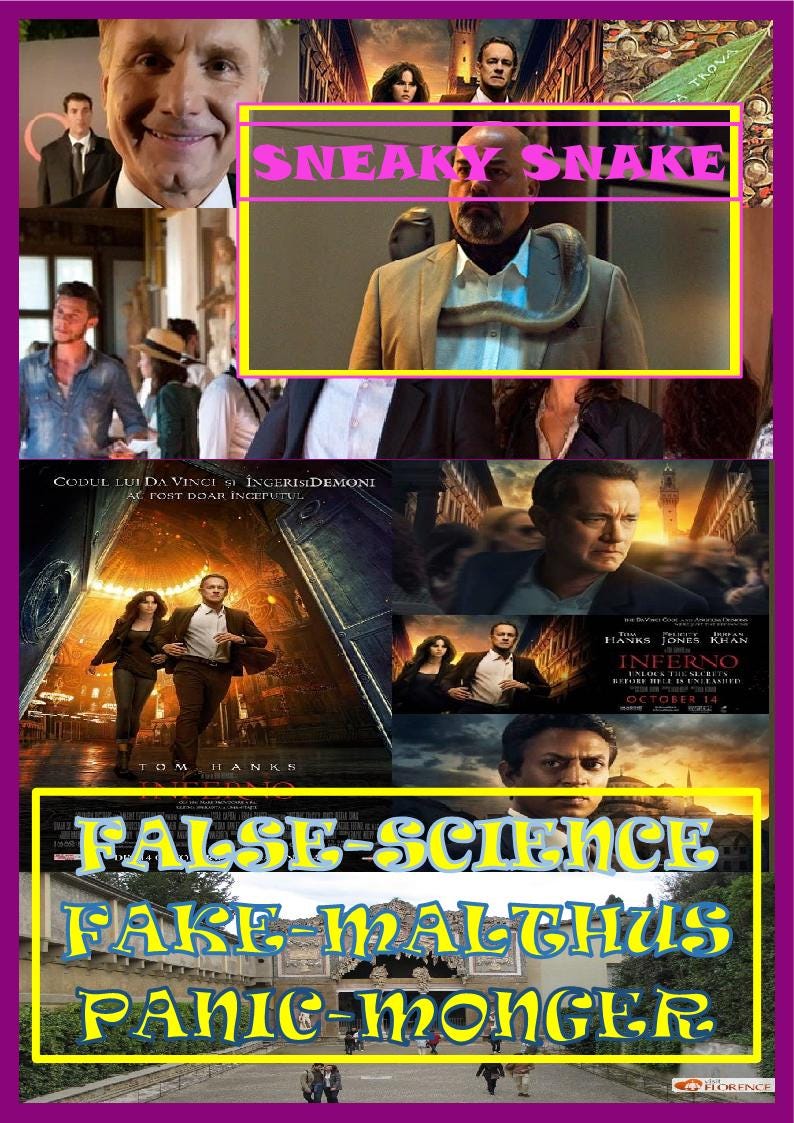
When the book came out in 2013, we were expecting a book by Dan Brown with Dante and his Inferno as the central piece. Definitely. But it finally came out and it left us totally aghast. It was made into a film with Tom Hanks as Professor Langdon and I just wonder here if the film corrected the surprising non-scientific — not say anti-scientific — discourse of the book. I am afraid not because the action is visual, and it covers up the scientific discourse that is reduced to as little as possible. It becomes the danger of a pandemic and since then we have been experiencing, for now, more than one full year such a pandemic and we know everything about it. The other day, a couple of months ago, a Jehovah Witness militant contacted me on the phone and started quoting the Old Testament to prove science was right, and pretty soon we were going to live forever. That discourse was totally anti-Christian because for the Christian religion death is an essential step in our lives, both on earth and beyond. It is the possibility to enter the procedure that might bring us to the Messianic Jerusalem. Death is necessary for Christians. And death is ever-present in the Old Testament, at least as much as in the New Testament, though without the possibility for ALL humans to be saved and to have eternal life in the Messianic Jerusalem. In the Old Testament that promotion after death is only open to the Jews since God is the God the elected people, exclusively thus the Jews.

I told the Jehovah Witness militant that the earth is already overcrowded since it overconsumes about forty percent of earthen resources every year, meaning that the Earth will only regenerate 60% of all the resources we consume. That is the formula for a catastrophe, to the famous apocalypse. What can we do about it? But we must remember all we consume, no matter how we produce it, artificially, in labs, in fields, or simply by gathering and hunting it will always come from resources we find on earth and if we consume more than the earth can regenerate the earth will end up dying and us along with it and probably in dire straits, in long years of mutual and reciprocal slaughtering and genocide, and with a big nuclear bang that will explode the earth itself, like the 63-year-old man did in Nashville Tennessee on Christmas Day 2020.
But to cover the stakes of this film we have to look at them in detail even if the film is skimpy on these scientific elements. Our verdict will be that either the terrorists in the film are amateurs, and badly trained ones at that, or Professor Langdon and his associates are pretty genial and superhuman. Actually, it is the last qualifying adjective the film wants us to come to as the concluding characteristic, and this is of course absurd. WHO or no WHO, to prevent such terroristic act from mad scientists there is only one solution: to solve the real problem at stake here, hence, to start reducing the pollution created by humanity and to start taking the strict measures we need to take to stop the growth of the population and try even to start reducing it? I must say that a pandemic is an easy solution. Unluckily with human science, we can slow it down and probably stop it within just a couple of years. But let us examine the case of this “Inferno” that is casually linked to Dante but just for fun since the code and the enigma is shown so fast that we cannot actually capture it, except in the various locations it brings up. This is a case of touristic terrorism.
But let’s get into some simple questions.
The case — as exposed in the book and echoed in the film — is fast, multiple as for the point of view, very dynamic, sliced into so short chapters that have a high taste of TV series with some of them sliced up a second time like split hairs, that in the end we are confronted with a scattered jigsaw puzzle. I don’t really like that kind of massive loaf of bread chopped up so thin we don’t have time to assess a situation before it is already gone, since there never — or nearly never — is a fully developed situation. Just titbits you have to sort out and assemble the way you want if you are not particular about the storyline, or the way you can or should if you want to keep up with some storyline. With the book, you can stop and go back. With the film, you cannot really do that, and you would need the subtitles to make sure you catch everything, particularly the scientific jargon.

At the same time, the story is multiple with many points of view and that gives a real dynamism to the tale that a more consistent or continuous story-telling technique would not necessarily produce, would even very probably not produce. Especially when you know it all plays on the eyes that are used to seeing a character and speaking about her or him, the eyes of another character, and not always the same. Some kind of inner voyeurism from one voyeur into another voyeur who pays the same homage to the first one: reciprocal and crisscrossing voyeur’s points of view. One of these voyeurs is struck by some important loss of memory and some other characters are just superficially identified by this or that momentary and transient voyeur, mostly Langdon who is under complete delusion due to his loss of memory, but several others too. That voyeuristic voyeurism — sorry for the redundancy — is becoming literally vertiginous or vertigo-engendering in the audience. If it got collective it would mean panic.
Then the story is complicated. Just the way we like them with multiple riddles, I mean real riddles, to be solved, multiple places and multiple discoveries though some are not credible in the case of Robert Langdon, a top global art specialist and symbologist. For one example let’s consider his lack of competence in the following situation. As soon as he knew about the severed heads of some horses and the context they came up in he should have known they were in Venice, which he did, and that the doge who brought them there was Henricus Dandolo and that his tomb they were looking for was not in Venice but in “Hell on Earth,” one foot in the water and the other underground and the whole thing in Greek and another non-Indo-European language. And that should have been enough for him to know exactly in what city and in what building the whole riddle was to find its solution. We suspend our disbelief, and we understand it is a story told to dummies and that the main character, the author of a hot-selling book on Christian symbology in Muslim countries (after a long period of Orthodox Christianity), or something like that, can also be a dummy, though he is asserted as the best in his field. I just wonder what the worst could be.
We would be ready to forgive such sloppy moments if the book were not a dystopia so much committed to the famous Malthus, who has an extremely bad reputation, that it becomes a sort of prediction that is actually realized and accepted. We can already see ourselves in our minds’ eyes being a 35-billion humanity. And the acceptation of this dramatic prediction about the future of the world tampered with by a crazy mad scientist is fulfilled in less than five hours at the global level implying that the world is in the hands of a mad scientist and a few, very few people who have all powers and can decide of what is good or bad for the whole world, what is acceptable or not for the whole planet, on their own accord and absolute unquestioned power in their isolated minds that are fantasized as giants in a world of midgets. They are like secularized almighty lords or gods. We are reinventing the Greek mythology in which the world was governed by a band of half-crazy sexually perverse and obsessed liars, cheaters, assassins, and criminals of all sorts for whom humanity was nothing g but the backyard of their house of games and casino of sexual phantasies.

But what is this Malthusian dystopia?

Since the population of the earth will soon reach or jump over nine billion people, the planet will have reached its maximum population and this overpopulating species known as Homo Sapiens will come to an end, will get extinct like so many other species. Full stop. No discussion, please. Me and I, Zeus, am telling you that is what is going to happen, and I will not do anything to prevent it. It is mathematical, mathematics being the new religion of the modern Pharaohs. At least “my” mathematics, says the mad scientist.
His solution is a whim of his genial mind that is preventing the extinction of the species by managing its fertility. The solution is a viral vector that in eight days contaminates the whole planet from one single point at full Internet speed. This viral vector modifies the DNA of the human beings who are infected, in fact, all of them, in order to make them haphazardly sterile, one out of three. The two non-sterile human beings left are not at all seen as being able to take advantage of the situation. Note it concerns both men and women and apparently it is the same viral vector that is used for both though the fertility of man and that of woman are not at all genetically identical hence carried out by the same genes which would require two different viral vectors The number of children of a society is determined as an average per fertile women but within what this society considers as a total possible feasible maximum, consciously like in China or France in antagonistic directions, or unconsciously like in most other countries. If some women or some men are sterile the total number of children will be the same anyway because it is some unconscious biological rule governed by some ideological vision of what is necessary for the species to survive that is at work, there.

Dan Brown should know that apart from the strictly Muslim countries and some sections of the American society, the number of children is going down, even in Africa though he seems to say the reverse in a very unfair anti-Catholic diatribe that does not honor his moral integrity nor his civil honesty. It is perfectly feasible to think the human population should stagnate or even go down soon, especially if life expectancy goes on increasing: the pressure of older people seems to bear onto the fertility of the younger ones who have, in a way or another, to take care of these older people. This last movement has reduced the number of deaths in our societies but pretty soon deaths are going to come back into the agenda and older women are no longer producing children. And the older people of today will not last forever, even if Ray Kurzweil is right since his prediction of very long life-expectancy is man-made and will cost a fortune, hence it only concerns the very rich. Even in Africa the number of children has gone down and has diminished by about 50% within some thirty years. Even in France, for the worst possible reasons, to economize on family grants and make the income tax rise, the birth boosting family policy is being questioned and the upper-middle class and upper classes will be the first to experiment with the loss of part or all the family-grants benefits. These top income families do not have twelve children per family, but they are those who make three or four. Cut the benefits and that number is going to go down. What’s more, the income tax system is going to be crushed down the same way to reduce the advantages of having many children for the calculation of your income tax. The family policy set up in 1945 is going down the chute and France was unique, as for that, with East Germany that does not exist anymore.
In Africa, it is the struggle of women for their rights to be full political and economic citizens that is bringing down the number of children, and the strict Muslim countries will have to move along the same line and fast: women have just been authorized to drive cars in Saudi Arabia. I guess contraceptives are like alcohol in these countries: highly praised black market and smuggled goods.
The second thing Dan Brown forgets is that Homo Sapiens is not like insects. Homo Sapiens can transform his environment to satisfy his needs and his projects because Homo Sapiens has always had a development project and it is that characteristic of this species that enabled Homo Sapiens to naturally eliminate his competitors like Homo Neanderthals and to populate the whole world and soon move into the cosmos. They sure will have to clean up their mess in the homo-sapiens-sty they have created — and that’s urgent — and they will have to use more and more renewable resources — note food is by definition a renewable resource if food is organic, that is to say, produced as vegetables and animals and not synthetic chemistry. But animal raising is highly polluting, and it eats a tremendous level of natural resources that cannot be regenerated any more entirely, not to speak of the diseases they develop and spread to humans, like COVID-19.

The solution advocated by the mad scientist, never really rebutted by anyone in the novel or the film, implemented in less than eight days by the mad man of science and accepted by the highest authorities in less than five hours, endorses and fulfills the Malthusian gospel of this mad scientist in the worst possible vision emerging out of the 19th century’s double paranoia: to die trampled down by hungry masses, and to be exploited by capitalism into turning humanity into two different species, the Morlocks and the Eloi. And this Malthusian gospel is accepted and thus advocated by the novel itself, and just the same by the film though in visual and a lot more striking clichés since no real arguments are used to dramatically set up some opposition in any one single character. It is not demographic management. It is not humane enlightenment. It is plain craziness.
But a novelist with a serial character like Robert Langdon cannot do what Dan Brown does. This serial character is fictionally dead since in the next book the human population, with one-third of it sterile and the ensuing catastrophe, will be fully restructured along lines we cannot even imagine. There is some explanation to do on Dan Brown’s side. Is he forcing his own serial character to commit suicide and hara-kiri? Is this novel the last one? Of course, not since the plan does not work and the virus is not released. So, we are reassured. But this is a deus ex machina, an artificial development to keep the gate open to a future volume, the next opus in mad science ideology and mythology (and we know it since it was published recently and is entitled Origin and has to do with Artificial Intelligence). Even the novel that is his obvious model, Frank Herbert’s “The White Plague,” though based on the same concept of DNA manipulation by a scientist made crazy by some terrorist act in Ireland that kills his wife end child, and he intends to kill a whole section of the population, in this case, women did not dare go that far and in the end, the damage had become curable, repairable, redeemable.
Mr. Dan Brown, you maybe do not write novels to get a prize, but it is slightly too much to write a page-turner, because this novel is one, or produce a frantic chasing/hunting movie, and this one sure is such a movie, that take their readers or audience for a lot of not very swift, vastly illiterate, uneducated fictionally, retarded people. In other words when we turn the last page, when we reach the last sequence, we do not really want to start all over again. Maybe that is done for mainstream Hollywood scenario writers who are not always perfectly well inspired and logical and that might even produce a blockbuster film that will last three months, but the story is basically thwarted by its inner improbable impossibilities, and the DVD will vanish in thin air within two years, or less, and will have to be sold for a pittance before being pulped. Streaming might give it a new life for a while.
Dr. Jacques COULARDEAU

Dan Brown — 0rigin — 2017
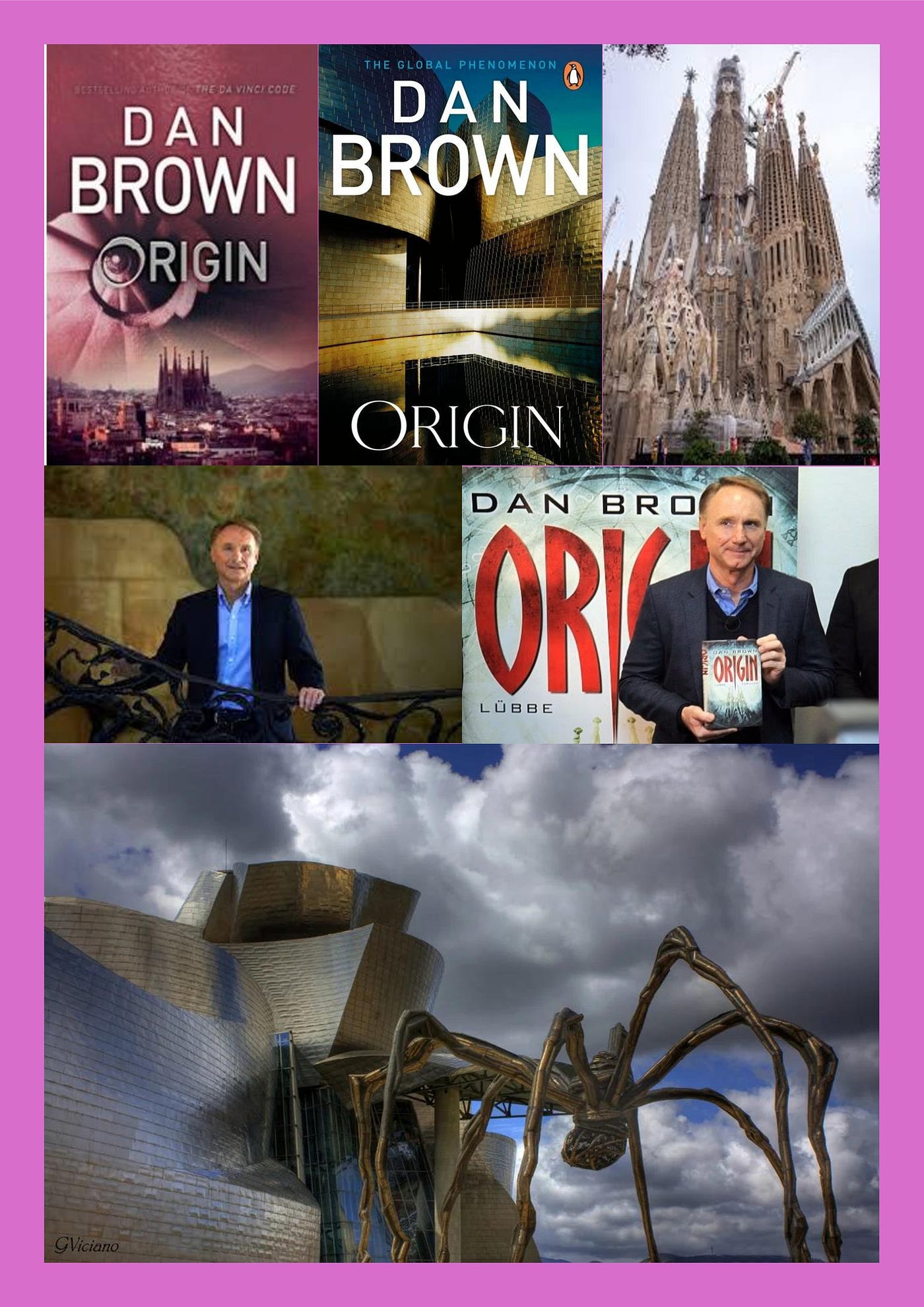
This book is essential, first and for all because of the picture on the cover, the Sagrada Familia in Barcelona, Catalonia, Spain. That’s the most folkloric and anecdotic aspect of the book. It is all based on some famous and important places and monuments in Spain and only Spain, with a fair share in Catalonia, which is Spain. I will not enumerate all the places. There are too many apart from this church in Barcelona but let me give you the second most important place, the Guggenheim Museum in Bilbao. Let’s say here that, if we only look at the touristic places covered by and described in the book, then we will fall in the touristic trap this aspect constitutes and then the book is no better than a guide for uncultivated people to whom a benevolent author is providing some cultural enrichment. The book is so much more than that, even if it is that too.
This novel is entirely centered on the Roman Catholic Church and its renegades of the Palmarian Church, a sect of some sort that was born in Spain, rejects the Roman Popes and pretends to retain the true Catholic if not Christian faith. They are extremely sectarian; a band of fundamentalists who believe science has to be rejected and destroyed because it destroys faith and God himself. At the same time, they are mostly survivors of the Franco era, more than conservative, actually advocating violence against the non-believers.
So, we are not surprised with the reference to Churchill understood as meaning Church [on the] Hill on the model of Montjuïc understood page 444 as meaning either “Hill of the Jews” in Catalan or “Hill of Jove” in Latin. And this explains the meaning of the email address of the clandestine and anonymous informer all along, monte@iglesia.com, this time in Spanish meaning the church on the hill. This can even go slightly farther with the reference to the Jews in Catalan. Edmond Kirsch, the mad scientist or technician of the book, has a name that is very important because it has two meanings again: “Firstly, it may be of German origin, being either a topographical name for someone who lived near a cherry orchard or a wild cherry tree, or it may be a metonymic occupational name for a gatherer or seller of cherries, or it may be a nickname for a person with a ruddy complexion, all deriving from the Germanic Kirsh (Baum) meaning cherry (tree). Secondly, it may be of Hebrew origin being an Askenazic ornamental name, one of the many taken from words for trees and other features of the natural world.” (http://www.surnamedb.com/Surname/Kirsch#ixzz4yLqLqorn) When we know the importance of trees, forests, woods, real or manmade like the forest of columns in Sagrada Familia, we are not surprised by the Jewish connection, especially since page 452 Dan Brown refers to The Singularity without naming the main name attached to the concept, Ray Kurzweil, who is a Jewish inventor and developer who dedicated a lot of time and energy to write about that magic moment when machines will be more intelligent than men and he calls this moment with a mathematic concept, The Singularity.

A last note on this Edmond Kirsch, with the meaning of the word given by the Urban Dictionary: “A Kirsch is usually very ambitious, funny, and happy. They are easily stressed out, though. If you are a Kirsch, you are often creative, smart, and witty as well: That kid is way too smart! Obviously, he’s a Kirsch.” (https://www.urbandictionary.com/define.php?term=Kirsch)
That naturally leads us to the very beginning of the book as much as to the very end.
The most surprising element at the beginning is that Parliament of the World’s Religions in which Edmond Kirsch invites himself to meet three representatives of three religions: Bishop Valdespino, Rabbi Yehuda Köves and Allamah Syed al-Fadl, the Catholic religion, seen as the only Christian religion, the Jewish religion and the Islamic religion that we can consider Sunni. These three religions all started in Palestine. They are the three Semitic religion by their origins. The book is clear on that point. Page 87–88, Edmond Kirsch mentions the other religions of the world that are all disappearing or have all disappeared, and among these, he lists Hinduism, a polytheistic religion that does not seem to be vanishing, and Buddhism that is even less vanishing than all other religions since the Buddhists are reaching out to the whole world. And these two living religions are lost in a list that contains the old Egyptian religions, the old Greek religions, and the old Roman religions, all polytheistic. With that reduction of the religions of the world to only three, even if we take into account the various variants within each one of them, we are far from covering the whole humanity and Asia is particularly rejected out of humanity. That is West-centered and particularly NOT postcolonial. It is in fact a good old neo-colonial approach, especially since both the Rabbi and the Allamah are assassinated by the only assassin in this book, the Regent who is slightly excused at the end for several of his ordered assassinations, including that of Edmond Kirsch himself and those of Robert Langdon and Ambra Vidal, future Queen of Spain, and these last two assassinations failed due to a pure miracle, what is called a Deus ex Machina in good old dramatic technique, something totally impossible in real life. But that Regent is not excused at all for the Rabbi and Allamah’s deaths. A shortcoming, you say? Oh yes, there are several, including twice the mention of the President of Spain page 139 and 140. I would have sworn Spain had a King as head of state, and since the king and his son are central in the whole novel, how could a President pop up in those two pages?
Such small mistakes are small and can be neglected but they are bizarre since this book was supposedly edited by a real editor. I guess that editor did not know Spain does not have a President, but the head of the government is a Prime Minister. Mariano Rajoy is the President of his own party but has as such no official role in the country, certainly not that of a person who could officially reject some allegations leveled against Robert Langdon and Ambra Vidal, not to mention Prince Juan, the future King of Spain.
But let’s get to more serious things.
The vision of the emergence of Homo Sapiens is totally erroneous. Once again all that is more or less attributed to Edmond Kirsch, but we know he is a character and the author behind should have been more cautious and not take Edmond Kirsch’s word for granted, true, undebatable, or Dan Brown could have enriched his character by updating his views on many subjects that are at least superficially covered by this technician who is no real scientist except in computing technology. Homo Sapiens started emerging at least 300,000 years ago. The book says 200,000 BC (page 406). The fable of a human leap at 65,000 BC or years ago is also a myth because Homo Sapiens started moving out of his nest or nests in Black Africa at least 180,000 or 200,000 years ago to Northern Africa. He was attested in the Levant up to 80,000 years ago, retired from the Levant then and was only to return 35,000 years ago. This is essential because all Homo Sapiens going through the Middle East to move essentially to Europe, Central Asia, and Siberia met Neanderthals in these out of Africa regions and started mixing their genes with them there. On the other hand, some other Homo Sapiens that migrated through Pakistan and directly to Asia met Denisovans in Central Asia and mixed with them genetically spreading their genes along with their migration right through to Melanesia and maybe beyond.
We are dealing here with migrations that occurred from at least 180,000 years ago to 45,000 years ago or slightly later, definitely before the peak of the Ice Age in 19,000 BC.
But this mythical vision of the emergence of Homo Sapiens asserted by Edmond Kirsch as absolutely true goes even farther in this line of impossible improbability and today this has been proved over and over again. Page 404 Edmond Kirsch, or Winston, his Artificial Intelligence being, or Dan Brown present the filiation of Homo Sapiens in one sequence: Homo Erectus, Homo Neanderthalensis, Homo Sapiens and a visual chart show them directly one skull after another. This is absolutely false.
Homo Faber or Ergaster was already a migrating species who left Africa very early to go quite far since some of his bones were found in Northern Caucasus. That explains why three species evolved from the same base but not at the same time and not in the same place. Homo Neanderthalensis evolved from Homo Faber in the Middle East and moved to Europe long before Homo Sapiens was out of Africa. Homo Denisovan evolved from Homo Faber in Central Asia, Mongolia, and Siberia, and though recently discovered and identified, this species is not directly descending from Homo Neanderthalensis or vice versa. They are two branches evolving from the same trunk, Homo Faber. These Homo Denisovans moved into Siberia and Asia, though we do not know how far. Homo Sapiens evolved long after these first two species, and evolved in Africa, in fact in what is today black Africa and they moved out of this Black Africa, first to Northern Africa and slightly beyond like Crete where some Homo Sapiens remnants have been found dated to 160,000 years ago or BC. At that time, the waters were very high and that is quite a nice distance from Libya to Crete. Starting around 100,000 or 120,000 years ago the next migrations out of Africa went essential from the Horn of Africa, along the Southern Arabia corridor to what is today Ormuz, Iran and Pakistan, a first migration moving up to Central Asia and then the whole of Asia, meeting Homo Denisovan, then a later migration around 70–60,000 years ago moving to the Middle East where they met with Homo Neanderthalensis. It is the first wave of this later migration that will go to Europe and a second wave slightly later will remain mostly on the Iranian plateau and will only move after the Ice Age, west to Europe, the Indo-Europeans, and East to India, the Indo Aryans. In both cases, they found Homo Sapiens populations that were from previous migrations and had arrived or migrated there long before them and before the Ice Age, anyway.

That explains then how primitive Edmond Kirsch is in his programming of his computer transformed into a virtual time machine. The parameters quoted page 404 are the size of the brain, spatial recognition, range of vocabulary, long-term memory, processing speed. This is not Homo Sapiens. It is a mechanical reduction of a human being to a robot that can be programmed. Spatial recognition is essential but has little to do with temporal recognition and there is no memory, especially long-term memory, if temporal recognition is not reconstructed into temporal awareness, just the same way as spatial recognition has to be reconstructed into spatial awareness, both being abstract architectures. How is that possible? It is possible because of what Edmond Kirsch does not understand, i.e., that the brain is nothing but an organ, with its architecture that enables man to process sensations into perceptions and into recognition or identification of patterns. And that is where the most important element is neglected, overlooked, reduced to the range of vocabulary. That is not human language which is articulated, has three articulations, a lexicon for sure based on vowels and consonants, but a whole categorial and syntactic architecture abstracted from the communicational situation Homo Sapiens is in from the very start, from the moment he is becoming a bipedal long distance fast runner, which takes him out of the primeval forest and this is only possible because of genetic mutations that little by little makes him what he has become, a bipedal long distance fast runner with a deep larynx, a rich innervation of the subglottal area, a complex coordination of various bodily functions and organs, along with all types of sensors to enable him to run upright. This means the smaller brain of Homo Sapiens is in fact 11% bigger than the brain of Homo Neanderthalensis when compared to the mass of their bodies, what we call EQ. Hence language is a side effect of this transformation, but it can certainly not be reduced to a lexicon of any size at all.

A last remark on this unrealistic vision of the past when Edmond Kirsch pretends: “This leap in quality is akin to the three-thousand-year evolution from cave drawings to Michelangelo’s masterpieces.” (page 402) The attested cave paintings that have survived because they were or still are in caves, hence in some protected environment (all that was on less durable media or in less protected areas has, of course, disappeared, implying that this artistic dimension of Homo Sapiens probably started a long time before these attested cave paintings), are dated as starting ALL OVER THE WORLD between 45,000 and 35,000 BC, hence the leap to Michelangelo is not three thousand years but at least 36,500 years. Such mistakes discredit Edmond Kirsch or his doppelganger Winston, the AI ghost of his master, or Dan Brown who should have corrected the erroneous assertion.
Sorry, Edmond Kirsch, even if your name refers to a tree, a cherry tree among other big trees, you have a name similitude with the German “Kirche” and you sure are a scientific fundamentalist. In fact, a technocratic computerizing fundamentalist mind. And that makes your prediction of the future absurd.
First, you speak of life but for you, life is exclusively human life. You only mention non-mineral and non-human life forms page 408. All along you only speak of at best an animal, but in reality, human life. Page 408 you quote the six kingdoms of Life from Animalia to Fungi, but you forget the cosmic and geological lives. The cosmos is alive. The mineral world is alive. Mountains grow up because of cosmic forces and mountains grow down because of erosion and decomposition. All that is pushed aside. The questions you ask are simply absurd. Page 53: “where do we come from and where are we going?” Page 187: “Why is evolution happening and how did it all start?” And you mean the evolution that produced us after vegetal an animal life appeared. The rest is reduced to some kind of primeval soup that is going to produce life and thus is seen as NOT alive. Page 237 : “Gauguin. D’où venons-nous / Que sommes-nous / Où allons-nous. Where do we come from? What are we? Where are we going?” The references to Nietzsche and Blake are just circumstantial since neither is a scientist of any sort. It is true William Blake provides the final liberating password that enables the second part of the presentation to be released to several hundred million listeners. But it is not science. It is poetry. It is good suspense in the story but there is no real argument.
The prediction from Edmond Kirsch is similar to that from Ray Kurzweil in The Singularity. It is a redigested or regurgitated vision of the Messianic Jerusalem that we find in the Old Testament as a promise that will never be fulfilled, in the New Testament and the Book of Revelation as a promise that will only come on the basis of the full destruction of this world, and of course in Karl Marx with his description of communism. Page 411–412 we have the same vision as in Kurzweil’s The Singularity and in Karl Marx:
“A future where technology had become so inexpensive and ubiquitous that it erased the gap between the haves and the have-nots. A future where environmental technologies provided billions of people with drinking water, nutritious food, and access to clean energy. A future where diseases like Edmond’s cancer were eradicated, thanks to genomic medicine. A future where the awesome power of the Internet was finally harnessed for education, even in the most remote corners of the world. A future where assembly-line robotics would free workers from mind-numbing jobs so that they could pursue more rewarding fields that would open up in areas not yet imagined. And above all, a future in which breakthrough technologies began creating such an abundance of humankind’s critical resources that warring over them would no longer be necessary.”

You need a lot of faith to believe this. And we can wonder why that future is described in the past tense. It does not make sense, and it is even difficult to consider this past tense as some modal past, hence conditional. It would have been clearer in the future, and if the modal form of the conditional had been used, just like in the case of the use of the modal past, it would have implied that the author doubted that description very much. Does he or does he not?
But the basic question of the beginning of life, and I tend to expand the question to the beginning of the universe, is unanswerable because so far, we cannot imagine that the laws of physics or chemistry or biology can bring into existence anything at all from nothing. The Big Bang is not the Big Bang of anything empty but of something we cannot even imagine, not to mention conceptualizing infinite density and infinite heat, as defined by the machines who use mathematical calculations to retrospectively reconstruct the past (page 188). Infinity cannot be conceived by a human mind or a mechanical mind. We say the universe is expanding which means the universe is not infinite though it is expanding in some void space that is seen as limitless but is it void, is it empty and what are its laws of physics? Are there such laws in such an empty limitless space in which a finite but expanding universe is growing day by day? Why is it growing? Retrospective science always comes to a dead-end in all subjects. Retrospectively we can reconstruct proto-Indo-European but the human beings who spoke that proto-Indo-European language, where did they come from and what language did they speak from which this proto-Indo-European evolved because everything evolves from something else. The book does not answer. Edmond Kirsch has no answer and his seventh kingdom of life, what he calls Technium and defines as the full merging, the endosymbiosis, the fusion of biology and technology, does not produce a new species. A man and a woman with each one 1,000,000 nanobots in their bodies can reproduce, I guess, but the child that will be born should not have reproduced the nanobots. The child might be invaded by nanobots “stolen” from his or her mother, but the child will basically be just plain human because the reproduction is genetic and only the genome of the father and the mother can join to produce the genome of the child. All the rest is romanticism or genetic manipulation, but then it is NOT the fusion of biology and technology.
The author maybe expresses a certain distance from this romantic nightmare Edmond Kirsch describes as a miracle of absolute fulfillment of everything we can dream of; when he clearly identifies the assassin as a being produced and manipulated by Edmond Kirsch’s bicameral machine; when the machine is programmed to self-destroy the para-human artificial intelligence in the machine itself supposedly without destroying the machine per se; when out of rage, fear or some divine inspiration he destroys an end-product of this technology with a stone. He destroys the icons of this modern dream that is sprouting and developing in the minds of some people who have forgotten they are just human and they will die and the machines will never do anything but obey their programs and if there are no limits on this obedience and these programs the machines may become criminal, destructive, morbid, mortiferous, lethal and many other things of the sort. And we have Terminator again.

Of course, the author will say he is nothing but an entertainer and not a seer or a prophet. That’s why we can imagine pink elephants flying in the sky. But that will not help us at all understand the relationship between someone who believes in God and this transcending concept this supernatural powerful and yet impotent character is. Dan Brown and his character Edmond Kirsch have reduced the essential human dimension required to be human, that is to say the belief in a transcendence beyond our immediate real life, to nothing but what they call a religion, or several religions whereas the modern time we are living in made it possible for this dimension to become an inspiration, a vision, imaginary creativity, a humanness more human than plain humankind. It is this Ideal of our Ego as a species, what Jacques Lacan calls the Phallus, that makes us human and makes us able to go beyond the limits we have reached which are never real limits because we can always imagine a way to go beyond them. That is God. He/she is with us. He/she is next to us. He/She is pushing us and pulling us on the road to something better than what we were yesterday, what we are today. He/she is inside us, inside our minds. In fact, we could call that religion and we would be in full agreement with Buddhism for whom there is no creator; no God seen as a creating force; no stable and immobile permanence; no stable and immobile essence of things and beings; for whom there is only change in cycles from birth to death and a rebirth that is nothing but the sprouting and growing of the seeds we left behind us when we died, these seeds being our children, our students, or simply our achievements. We do not need martyrs, as Winston thinks, as Edmond Kirsch may think. We need creative minds that target the development of their communities in peace, equality, and humanity. Killing rabbis, killing allamahs, making bishops kill themselves with morphine out of gay love does not help at all in the present situation. Modern technology requires that we should change our vision of the world and life.
But never forget the earth and the cosmos are living beings and their lives are cyclical and we do not know the operating system and the programs of this cosmos, of this earth. And we will never know it completely because we can only build a model of the real world and that model is always limited, especially when a machine that is programmed in a certain way tries to replace our imaginary and inventive mental power.
Dr. Jacques COULARDEAU

FERRIS WHEEL AND HOLY FAMILY


DAN BROWN — THE SECRET OF SECRETS — 2025
HE WANDERS, HE WANDERS,
THE C-I-ATHIC FERRET
MINT-SCENTED WATER
I went back to my archives and found articles on Dan Brown’s books. I will republish them all soon.
Digital Fortress (1998).
Angels and Demons (2000).
Deception Point (2001).
The DaVinci Code (2003).
The Lost Symbol (2009).
Inferno (2013).
Origin (2017).
And now The Secret of Secrets (2025
I missed a couple, but more about it later. But most of those I followed, I covered both the book and the film adapted from the book. The last or maybe latest novel published in 2025 slowed down production. It took the author eight years, twice as much as before, to come to the end of this book, which I am going to cover now. Why might be a fair question. I might give some intelligence on the question along with the critique. But the place where the main action takes place, Prague, and the main participant, the CIA, may have had some weight in this project, slowing it down, if not purely imposing a negotiation, or the’ arrangement of some compromise with this CIA for the protection of its Brand name and brand image, in other words its reputation, if the CIA has one, meaning positive. Robert Langdon is more than positive, several times, and he asserts under the keyboard clicking of Dan Brown, that the CIA can block the publication of any book they want or impose severe cuts in it.

The main action takes place in Prague in Czechia. The CIA operates there an enormous, clandestine, totally anonymous research center where they use some epileptic subjects recuperated from Russian orphanages. These are submitted to laboratory experiments without having been informed what it was about, without having been asked for their agreement, and without respecting any international convention on clinical trials on human beings. Death rate 50%. Two subjects were brought to this center. One died. The other survived but in a state that cannot even be qualified as acceptable, and certainly not humane. The CIA, hence, the US government, recuperated an old bomb shelter of the Germans during WWII. They tremendously expanded it underground, under a park and an extremely important museum. At the very end of the novel, the laboratory explodes, and the damage is minimized on the surface because that would have been a second novel. Then — maybe, for sure, possibly, probably — the European Community would have gotten involved. That would have been an interesting cleaning-up mission. This novel reveals the US as the colonizer of the whole world, at least the whole world where it, the US, can put its dirty shoes, mainly Europe and the West. That’s my first remark, and the novel shows it in nearly graphic terms. How long will the world agree to play that game, or rather to be played as a stake, or a lottery reward, in that poker game with only one player, the USA, and of course its guns, loaded and ready to shoot. Look at Venezuela and read my lips. Monroe rhymes with My-Donkey.

The real danger for the Europeans does not come from Mercosur, which is dangerous only to the agriculture of the countries where the real technical and industrial level of mechanization and technologization has not been reached. That concerns mainly France and its basically exporting agriculture, but not only. When you read that China has mechanized its cotton production up to 80 to 90%, you wonder about Europe. It is the same thing in China again for all sorts of crops, like corn, wheat, oats, and even more with soybeans, and the size of the fields and agricultural units are becoming enormous. In Latin America, concerned by Mercosur, we have exactly the same evolution that makes agricultural products frighteningly more profitable on the international market. The real global — or pretending to be global — colonizer is the USA, which practices piracy to impose its own objectives. In fact, we should have an alliance with South American countries, including Venezuela, to oppose and reject the American blackmail. But no, some in Europe do not want to scratch the dear friends in Washington DC who are getting rid of the Ukrainian cesspool and granting it, weapons, soldiers, and all, to the Europeans, and they are fighting to be first in the battalion that is going to recuperate a file that has been pestering Europe for so many centuries. And Europe has no weight in possible negotiations because Europe does not have the armed forces necessary, nor the economy necessary, nor the social stability necessary, which is completely stampeded by under NO control immigration from everywhere you can and may imagine, including more than five million refugees from Ukraine, all of them patriots ready to die for their countries, provided it is in Warsaw, Berlin, Paris and London.
So, Dan Brown tells us, or rather tells the American public, that Europe is ripe for being entirely colonized by the CIA and the USA. And he is laughing at the heavy hangover the Europeans are going to have when they finally wake up from their slumbering and disquieting indifference and distraction in vain political games between extreme A and extreme B and in between C for centerfold, a beautiful picture of a sexy body at the bottom of their retinas, the poor Europeans. So, remember when you read the book that you are reading one of the numerous Bibles of Trump, who knows it is fiction, especially serialized fiction on TV or Netflix that Makes America Great Again. We, the Europeans, don’t seem to care. That is my second remark.
The third remark is the style. It is becoming a standard model or architecture to have an average 145 chapters with an average length of less than five pages each. No length, no complication, just plain simple small chapters with a couple of facts and nothing else. It is already serialized for television. Each chapter is going to be one sequence, and altogether there might be 125 small one minute or one minute and a half sequences and five that may reach three minutes. Altogether, 203 minutes plus advertising, and that will be four episodes of 60 or 65 minutes, all in all. That kind of serialization of the novel into small slices in great number destroys the architecture of the storytelling. We are not told a story. We are hammered with a mechanical shovel into accepting an exploded and unstructured story that we have to swallow slice after slice and say thank you for the small minuscule mouth-10%-ful modern cuisine in literature. If we don’t like it, we can always go back to Dickens, or after all, Stephen King, though even he, our master of us all, has to accept and be laminated into sliced baloney.
Now, the fourth remark is no longer about literature but about the supposedly scientific content of the book: that reads most of the time as a PhD dissertation about Noetics, the newly devised science of human consciousness that the author accepts to drape into some kind of specter or ghost haunting our nights and slumbering moments in the daytime. “*Thinking About Noetic. *Noetic derives from the Greek adjective noētikos, meaning “intellectual,” from the verb noein (“to think”) and ultimately from the noun nous, meaning “mind.” (Nous also gave in English the word paranoia by joining with a prefix meaning “faulty” or “abnormal.”) Noetic is related to noesis, a rare noun that turns up in the field of philosophy and refers to the action of perceiving or thinking. The most notable use of noetic might be in the name of the Institute of Noetic Sciences, a research organization based in California that is devoted to studies of consciousness and the “mind.” (https://www.merriam-webster.com/dictionary/noetic, accessed January 10, 2026) Page 101 “noetic” is declared to be the antagon of materialism, as if we could live on immaterial consciousness of the simple conscious idea of a potato, and nothing else to survive. That level of absurd idealism makes any sane person completely lost in translation from here to there, from one black hole to another black hole.

The idea is simple. Consciousness is a non -material, hence entirely virtual mass of data living its own life, produced by we do not know what, who or how, In some kind of cosmic niche that is everywhere and nowhere at the same time, and from which any glimpse of consciousness we may have about the meat we are eating, the wine we are drinking, the sex we are enjoying is nothing but some immaterial waves captured by our brain that does not invent anything but only receives these radio sound waves, if they are sound, but they might only be waves with no material dimension. We thus are in touch with a cosmic niche where all the knowledge and consciousness, past, present, future, in fact totally timeless, is accumulated and can be recuperated, piece by piece, by the gullible human audience who thinks they are thinking what they are thinking in their evanescent thoughts.
And they assume that will impress us so much that we will accept all the rest, particularly that we can have Extra Sensorial Perception and thus practice any day, anytime, anywhere (page 81–82), pre-cognition, prophecy, soothsaying, augury, divination, astrology, human obsessive knowledge of the future, out of body experience, and who-knows-what-else. When we accept this total dematerialization of all mental, intellectual, sentimental, emotional data into that cosmic but uncatchable, unpositionable, and unidentifiable entity, we are supposed to understand that the CIA, Russia, and China are doing the same: they try to be the first to harness this cosmic consciousness data bank and control the whole humanity by injecting into this data bank what they want all humanity to believe and accept doing.
The future, my dear babies, is totally locked in an absolute, three-tiered prison governed by three competing powers who will use the human prisoners in each prison to attack the other two prisons and destroy their prisoners till only one exists and controls it all. The perfect recipe for something that has nothing to do with fascism, nazism, communism, socialism, or any other [-ism] because it will end as a totally mechanical humanity in which there might be an elite of three times ten people playing an enormous chess game with the human puppets that we will all be. Welcome to the parallel universe that could be called the opera of the ghosts. Only the ghost puppeteers are humans, and all other beings are puppets, on strings, on rods, on hands, but puppets all the time.

By the way, but I won’t enter this barrel of <worms, Dan Brown neglects completely the phylogeny of human articulated language that starts from what Homo-becoming-Sapiens inherit from all Hominins before him and even from many other species, if not all, as for communication. There can only be any consciousness if we are able to set words on items, individuals, actions, emotions, etc., in one word, if we are able to communicate. Without this phylogeny, there is no possible communication, hence no possible consciousness. Dan Brown starts humanity from scratch, but humans, and probably all Hominins, are mute, dumb if you prefer, and cannot communicate. If it were true, then Homo Sapiens would not have been able to expand and survive the Ice Age. Dan Brown is an ideological fantasist who flatters the elites who know better and enslaves the others because they cannot know better, and they are the slaves of their various screens.
The last point is the reference to the Golem.
“The Evolution of Golem
The Hebrew ancestor of the word golem means “shapeless mass,” and the original mythical golems started as lumps of clay that were formed into figures and brought to life by means of a charm or a combination of letters forming a sacred word. In the Middle Ages, golems were thought to be the perfect servants; their only fault was that they were sometimes too literal or mechanical in fulfilling their masters’ orders. In the 16th century, the golem was thought of as a protector of the Jews in times of persecution. But following its entrance into English, golem acquired a less friendly second sense, referring to a man-made monster that inspired many of the back-from-the-dead creations of classic horror fiction. These days, the word golem is frequently used in the gaming world for a variety of foes and beasties made of materials ranging from ice to iron to even, in one game, candy.” (https://www.merriam-webster.com/dictionary/golem accessed January 10, 2026)
To transform this legend that could be perfectly antisemitic, as much as Judeo-protective, into the identity of the alter of Sacha Vesna, who suffers a strange case of Dissociative Identity Disorder that is added on top of her epilepsy. Dan Brown, here again, manipulates such medical phenomena and turns them into an impossible vision. A person who has a split personality, split into two very different characters, can get dominated by the alter, the one hidden from the public, the one the normal character may even not be conscious of at all, but then the alter does not get out of the body of the main character, the way he does on the plane going to the USA. He cannot either get out of the main character‘s body at all, the way he promised, more or less, to do as soon as Sacha Vesna is safe. Believing that he can take over the body of the main character to achieve his own objectives without the main character having any consciousness of what happened during these periods is a myth. Possible, partially maybe, but certainly not that radically. He pretends he is protecting Sasha Vesna, but he takes her body, hence her, into situations that are life-endangering.

The case used by Stephen King in his latest novel Never Flinch, is a lot more credible because it is the famous man-woman division of a non-binary person. We all know some people around us who have a divided sexual identity, and that is becoming manageable in our societies. But one sexual identity cannot step out of the other sexual identity, except if it is to be forever with a special treatment that will turn a man into a woman or a woman into a man. Beyond that, it is a medical case. But what Dan Brown suggests is highly improbable, and that makes the story slightly awkward.
Enjoy the incredible fable of the Golem of Prague, though the Golem of any city is generally some monstrous, violent, brutal, and aggressive male character. Why not a woman? Good question. Sexism has its own ways to turn into a story: the alter of Sasha Vesna is a male character, and he identifies (by disguise) with the Golem of Prague. There, the male identity has no fuzziness, flexibility, or uncertainty.
I can’t resist commenting on the inscription on this Golem’s forehead.
It’s a Hebrew word, a triconsonantal word meaning “truth.” But the Golem claims that removing the first letter of this word gives the word “death.” Dan Brown should brush up on his Hebrew. While it’s true that to get the word meaning “death,” you have to remove the first letter of the word meaning “truth,” you also have to add a second consonant between the two remaining ones. Note that Hebrew, like Arabic and most, if not all, Semitic languages, is read from right to left, but transliteration is read from left to right. This rewriting produces a second word meaning “death,” but it’s also a triconsonantal word.
אֶמֶת מָוֶת
truth death
emet mavet
alef-mem-tav mem-vav-tav
Dr. Jacques COULARDEAU

²
VERSION FRANÇAISE
IL ERRE, IL ERRE, LE FURET
C-I-ATHIQUE MENTHE À L’EAU
J’ai retrouvé dans mes archives des articles sur les livres de Dan Brown. Je les republierai bientôt.
La Forteresse digitale (1998).
Anges et Démons (2000).
Point de non-retour (2001).
Da Vinci Code (2003).
Le Symbole perdu (2009).
Inferno (2013).
Origine (2017).
Et maintenant, Le Secret des Secrets (2025)
J’en ai manqué quelques-uns, mais j’y reviendrai plus tard. Pour la plupart des titres que j’ai suivis, j’ai traité à la fois du livre et de son adaptation cinématographique ou télévisuelle. Le dernier roman, ou peut-être le plus récent, publié en 2025, a ralenti la production. Il a fallu huit ans à l’auteur, soit deux fois plus longtemps qu’auparavant, pour achever ce livre, que je vais aborder maintenant. La question du « pourquoi » est légitime. Je pourrais apporter quelques éléments de réponse dans le cadre de cette critique. Mais le lieu où se déroule l’action principale, Prague, et l’acteur principal, la CIA, ont probablement pesé sur ce projet, le ralentissant, voire imposant des négociations ou des compromis avec la CIA pour protéger son image de marque, autrement dit sa réputation, si tant est qu’elle en ait une, c’est-à-dire une réputation positive. Robert Langdon est plus que positif, à plusieurs reprises, et il affirme, sous l’influence de Dan Brown, que la CIA peut bloquer la publication de n’importe quel livre ou y imposer des coupes importantes.

L’action principale se déroule à Prague. En République tchèque, la CIA exploite un immense centre de recherche clandestin et totalement anonyme où elle utilise des sujets épileptiques récupérés dans des orphelinats russes. Ces derniers sont soumis à des expériences de laboratoire sans être informés de leur nature, sans que leur consentement soit requis et sans aucun respect des conventions internationales relatives aux essais cliniques sur l’être humain. Le taux de mortalité atteint 50 %. Deux sujets ont été amenés dans ce centre. L’un est décédé. L’autre a survécu, mais dans un état inacceptable, et certainement inhumain. La CIA, et donc le gouvernement américain, a récupéré un ancien abri anti-bombes allemand datant de la Seconde Guerre mondiale. Ils l’ont considérablement agrandi sous terre, sous un parc et un musée d’une importance capitale. À la toute fin du roman, le laboratoire explose, et les dégâts sont minimisés en surface, car cela aurait nécessité un second roman. Alors — peut-être, certainement, vraisemblablement — la Communauté européenne serait intervenue. Cela aurait donné lieu à une mission de nettoyage intéressante. Ce roman révèle les États-Unis comme le colonisateur du monde entier, du moins du monde entier où ils peuvent exercer leur influence, là où ils peuvent poser leurs godillots tout encrottés, surtout l’Europe et l’Occident. Voilà ma première remarque, et le roman l’illustre de façon presque crue. Combien de temps le monde acceptera-t-il de jouer à ce jeu, ou plutôt d’être l’enjeu, le gain d’une loterie, dans cette partie de poker où il n’y a qu’un seul joueur, les États-Unis, et bien sûr leurs armes de poing, chargées et prêtes à tirer ? Regardez le Venezuela et lisez sur mes lèvres. Monroe rime avec Mon-Âne (jeu de mots callipyge qui marche bien en anglais).
Le véritable danger pour les Européens ne vient pas du Mercosur. Ce dernier ne représente un danger que pour l’agriculture des pays où le niveau technique et industriel de mécanisation et de technologisation requis n’est pas atteint. Cela concerne principalement la France et son agriculture essentiellement exportatrice, mais pas seulement. Quand on apprend que la Chine a mécanisé sa production de coton à 80 ou 90 %, on s’interroge sur l’Europe. C’est la même chose en Chine pour toutes sortes de cultures, comme le maïs, le blé, l’avoine, et encore plus pour le soja, et la taille des champs et des exploitations agricoles devient énorme. En Amérique latine, concernée par le Mercosur, nous assistons exactement à la même évolution qui rend les produits agricoles terriblement plus rentables sur le marché international. Le véritable colonisateur mondial — ou du moins celui qui prétend l’être — ce sont les États-Unis, qui recourent à la piraterie pour imposer leurs propres objectifs. En réalité, nous devrions former une alliance avec les pays d’Amérique du Sud, notamment le Venezuela, pour nous opposer au chantage américain et le rejeter. Mais non, certains en Europe ne veulent pas froisser leurs chers amis de Washington qui se débarrassent du cloaque ukrainien en le livrant aux Européens, armes, soldats et tout le Saint Frusquin, le coup de chapeau des Européens à leur passé chrétien. Ils se battent pour être les premiers à récupérer un dossier qui hante l’Europe depuis des siècles. Et l’Europe n’a aucun poids dans d’éventuelles négociations, car elle ne dispose ni des forces armées nécessaires, ni de l’économie nécessaire, ni de la stabilité sociale nécessaire, cette dernière étant complètement déchaînée par une immigration incontrôlée en provenance de tous les horizons imaginables, y compris plus de cinq millions de réfugiés ukrainiens, tous des patriotes prêts à mourir pour leur pays, pourvu que ce soit à Varsovie, Berlin, Paris ou Londres.

Alors, Dan Brown nous dit, ou plutôt il le dit au public américain, que l’Europe est mûre pour être entièrement colonisée par la CIA et les États-Unis. Et il se moque de la terrible gueule de bois qui attend les Européens lorsqu’ils se réveilleront enfin de leur torpeur et de leur indifférence inquiétante, absorbés par de vains jeux politiques entre les extrêmes A et B, et entre les deux, une image de corps sexy figée au fond de leurs rétines, pauvres Européens. Alors, souvenez-vous, en lisant ce livre, que vous lisez l’une des nombreuses bibles de Trump, qui sait pourtant que c’est de la fiction, surtout une fiction sérialisée à la télévision ou sur Netflix qui contribue à rendre sa grandeur à l’Amérique. Nous, les Européens, semblons nous en moquer. Voilà pour ma deuxième remarque.
Ma troisième remarque concerne le style. Il est devenu courant d’avoir en moyenne 145 chapitres de moins de cinq pages chacun. Pas de longueur, pas de complexité, juste de courts chapitres simplistes avec quelques faits et rien de plus. C’est déjà adapté en feuilleton télévisé. Chaque chapitre constituera une séquence, pour un total d’environ 125 courtes séquences d’une minute ou une minute trente, et cinq séquences pouvant atteindre trois minutes. Au total, 203 minutes, publicités comprises, soit quatre épisodes de 60 à 65 minutes chacun. Ce découpage du roman en une multitude de petits fragments détruit la structure narrative. On ne nous raconte pas une histoire. On nous l’impose à coups de pelle mécanique : un récit décousu et informe, qu’il nous faut avaler morceau après morceau, en nous disant merci pour cette minuscule portion de littérature moderne, à peine suffisante pour remplir notre bouche à moins de 25% de sa capacité. Si cela ne nous plaît pas, nous pouvons toujours retourner à Dickens, ou à Stephen King, même si lui, notre maître incontesté, doit se contenter de ce qu’il a de plus indigeste, le saucisson saucissonné.

La quatrième remarque ne porte plus sur la littérature, mais sur le contenu prétendument scientifique de l’ouvrage : il s’agit en réalité d’une thèse de doctorat sur la noétique, cette science nouvellement inventée de la conscience humaine que l’auteur s’autorise à dépeindre comme une sorte de spectre hantant nos nuits et nos somnolences diurnes. « Réflexions sur la noétique. Noétique dérive de l’adjectif grec noētikos, signifiant « intellectuel », du verbe noein (« penser ») et, en définitive, du nom nous, signifiant « esprit ». (Nous a également donné naissance au mot paranoïa en anglais, en l’associant à un préfixe signifiant « défaillant » ou « anormal ».) Noétique est apparenté à noèse, un nom rare qui apparaît dans le domaine de la philosophie et désigne l’action de percevoir ou de penser. L’utilisation la plus notable de noétique se trouve peut-être dans le nom de l’Institut des sciences noétiques, un organisme de recherche basé en Californie et consacré à l’étude de la conscience et de l’esprit. » (https://www.merriam-webster.com/dictionary/noetic , consulté le 10 janvier 2026) Page 101, le terme « noétique » est présenté comme l’antagoniste du matérialisme, comme si l’on pouvait survivre grâce à une conscience immatérielle réduite à la simple idée consciente d’une pomme de terre. Un tel idéalisme à un autre trou noir. « Au suivant », comme dirait Jacques Brel.
L’idée est simple. La conscience est une masse de données immatérielles, donc entièrement virtuelles, qui vivent leur propre vie. Cette masse, ou banque pour faire plus capitaliste, est produite par quelque chose, qui ou quoi, dans une sorte de niche cosmique à la fois omniprésente et insaisissable. De cette niche, toute perception de la conscience que nous pouvons avoir concernant la viande que nous mangeons, le vin que nous buvons, le sexe dont nous prenons du plaisir, n’est rien d’autre que des ondes immatérielles captées par notre cerveau, comme si les ondes ne transportaient rien. Ce cerveau ne crée rien. Il se contente de recevoir ces ondes radio, si tant est qu’il s’agisse de son, mais il pourrait aussi ne s’agir que d’ondes sans dimension matérielle. Nous sommes ainsi en contact avec une niche cosmique où toute la connaissance et la conscience, passées, présentes, futures, en fait totalement intemporelles, sont accumulées et peuvent être récupérées, morceau par morceau, par le public humain crédule qui croit penser ce qu’il pense dans ses pensées éphémères qui ne sont que des bribes récupérées de la déchetterie mentale du cosmos, une sorte de bébé vagissant du big bang.

Et ils supposent que cela nous impressionnera tellement que nous accepterons tout le reste, notamment l’idée que nous pouvons avoir une perception extrasensorielle et ainsi pratiquer n’importe quel jour, n’importe quand, n’importe où (pages 81–82), la précognition, la prophétie, la divination, l’augure, l’astrologie, la connaissance obsessionnelle du futur, les expériences hors du corps, et que sais-je encore. Lorsque nous acceptons cette dématérialisation totale de toutes les données mentales, intellectuelles, sentimentales et émotionnelles dans cette entité cosmique mais insaisissable, inlocalisable et inidentifiable, nous sommes censés comprendre que la CIA, la Russie et la Chine font la seule et même chose : elles tentent d’être les premières à exploiter cette banque de données de conscience cosmique et à contrôler l’humanité entière en y injectant ce qu’elles veulent que toute l’humanité croie et accepte de faire.

L’avenir, mes chers enfants, est totalement enfermé dans une prison absolue à trois niveaux, gouvernée par trois puissances rivales qui utiliseront les prisonniers humains de chaque prison pour attaquer les deux autres et anéantir leurs détenus, jusqu’à ce qu’il n’en reste qu’une qui contrôle tout. La recette parfaite pour quelque chose qui n’a rien à voir avec le fascisme, le nazisme, le communisme, le socialisme, ou tout autre -isme, car cela aboutira à une humanité entièrement mécanique où une élite de trois fois dix personnes jouera un gigantesque jeu d’échecs avec les marionnettes humaines que nous serons tous. Bienvenue dans l’univers parallèle que l’on pourrait appeler l’opéra des fantômes. Seuls les marionnettistes fantômes sont humains, et tous les autres êtres ne sont que des marionnettes, manipulées par des fils, des tringles, des mains, mais toujours des marionnettes.
Au fait, mais je ne m’aventurerai pas sur ce terrain miné, Dan Brown néglige complètement la phylogénie du langage humain articulé. Ce langage trouve son origine dans l’héritage d’Homo sapiens, transmis par tous les homininés qui l’ont précédé, et même par de nombreuses autres espèces hominidées, mammifères, reptiles, insectes, oiseaux et poissons, en matière de communication. La conscience ne peut exister que si nous sommes capables de nommer les choses, les individus, les actions, les émotions, etc., en un seul mot ; si nous sommes capables de communiquer, alors la conscience n’est possible que si nous sommes capables de formuler un discours compréhensible et de le transmettre à d’autres individus capables de le recevoir. Sans cette phylogénie, aucune communication n’est possible, et donc aucune conscience. Dan Brown fait surgir l’humanité de zéro, mais les humains, et probablement tous les homininés, sont muets, voire stupides, et incapables de communiquer. Si c’était vrai, Homo Sapiens n’aurait pas pu se développer et survivre à l’ère glaciaire. Dan Brown est un idéologue qui flatte les élites qui prétendent tout savoir et asservit les autres parce qu’ils ne peuvent pas savoir ni mieux ni plus, prisonniers qu’ils sont de leurs écrans.
Le dernier point concerne la référence au Golem.
« L’évolution du golem
L’ancêtre hébreu du mot golem signifie « masse informe ». Les golems mythiques originaux étaient des boules d’argile modelées en figurines et animées par une incantation ou une combinaison de lettres formant un mot sacré. Au Moyen Âge, les golems étaient considérés comme des serviteurs parfaits ; leur seul défaut était parfois leur exécution trop littérale ou mécanique des ordres de leurs maîtres. Au XVIe siècle, le golem était perçu comme un protecteur des Juifs persécutés. Mais après son introduction dans la langue anglaise, le mot golem a acquis un second sens moins amical, désignant un monstre créé par l’homme qui a inspiré nombre de créatures ressuscitées de la littérature d’horreur classique. De nos jours, le mot golem est fréquemment utilisé dans l’univers du jeu vidéo pour désigner divers ennemis et créatures faites de matériaux allant de la glace au fer, voire, dans un jeu, de bonbons. » (Https://www.merriam-webster.com/dictionary/golem consulté le 10 janvier 2026)
Transformer cette légende, potentiellement antisémite autant que judéo-protectrice, en l’identité de l’alter de Sacha Vesna, atteinte d’un trouble dissociatif de l’identité s’ajoutant à son épilepsie, relève de la pure fantaisie. Dan Brown, une fois de plus, manipule ces phénomènes médicaux pour en faire une vision invraisemblable. Une personne souffrant d’un dédoublement de la personnalité, scindée en deux personnages très différents, peut certes être dominée par son alter, celui caché au public, celui dont le personnage principal n’a même pas conscience. Mais alors, cet alter ne quitte pas le corps du personnage principal, comme il le fait dans l’avion pour les États-Unis. Il ne peut pas non plus quitter ce corps, contrairement à ce qu’il avait plus ou moins promis de faire dès que Sacha Vesna serait en sécurité. Croire qu’il puisse prendre possession du corps du personnage principal pour atteindre ses propres objectifs sans que le personnage principal n’ait conscience de ce qui s’est passé est un mythe. Possible, en partie peut-être, mais certainement pas à ce point. Il prétend protéger Sasha Vesna, mais il l’entraîne, elle et son corps, dans des situations plus que périlleuses.

Le cas utilisé par Stephen King dans son dernier roman, « Never Flinch », est bien plus crédible car il s’agit de la fameuse dualité homme-femme d’une personne non binaire. Nous connaissons tous des personnes ayant une identité sexuelle double, et cette réalité est de plus en plus acceptée dans nos sociétés. Cependant, une identité sexuelle ne peut se dissocier de l’autre, sauf par une intervention chirurgicale définitive transformant un homme en femme ou une femme en homme. Au-delà de cela, il s’agit d’un cas médical un peu biscornu ou farfelu. Mais ce que suggère Dan Brown est hautement improbable, ce qui rend l’histoire un peu maladroite, pour ne pas dire gauche.
Laissez-vous emporter par l’incroyable fable du Golem de Prague, même si le Golem de toute ville est généralement un personnage masculin monstrueux, violent, brutal et agressif. Pourquoi pas une femme ? Bonne question. Le sexisme a ses propres façons de se transformer en récit : l’alter de Sasha Vesna est un personnage masculin qui s’identifie (par déguisement) au Golem de Prague. Là, l’identité masculine est dépourvue de toute ambiguïté, flexibilité ou incertitude.
Je ne peux résister à faire une remarque sur l’inscription au front de ce Golem.
Un mot en hébreu, donc triconsonantique signifiant « la vérité ». Mais le Golem prétend qu’en enlevant la première lettre de ce mot on obtient le mot « mort ». Dan Brown devrait réviser son hébreu. Certes pour obtenir le mot qui signifie « mort », il faut enlever la première lettre du mot signifiant « vérité », mais il faut rajouter une deuxième consonne entre les deux restantes. Attention, l’hébreu, comme l’arabe et une bonne partie des langues sémitiques, sinon toutes, se lisent de droite à gauche, mais la translittération se lit de gauche à droite. Cette réécriture produit un deuxième mot signifiant « mort » mais triconsonantique lui aussi.
אֶמֶת מָוֶת
la vérité la mort
emet mavet
alef-mem-tav mem-vav-tav
Dr Jacques COULARDEAU

메타데이터
- post_id
- 3291a66c104f
- slug
- complicated-intricacy-is-not-humanistic-visionary-3291a66c104f
- url
- https://medium.com/@jacquescoulardeau/complicated-intricacy-is-not-humanistic-visionary-3291a66c104f
- canonical_url
- https://medium.com/@jacquescoulardeau/complicated-intricacy-is-not-humanistic-visionary-3291a66c104f
- author_url
- https://medium.com/@jacquescoulardeau
- status
- ok
- fetched_at
- 2026-09-10 20:27:05