What Happens When a Novel Refuses to Resolve You
Virginia Woolf refuses to turn insight into healing
What Happens When a Novel Refuses to Resolve You
Virginia Woolf refuses to turn insight into healing
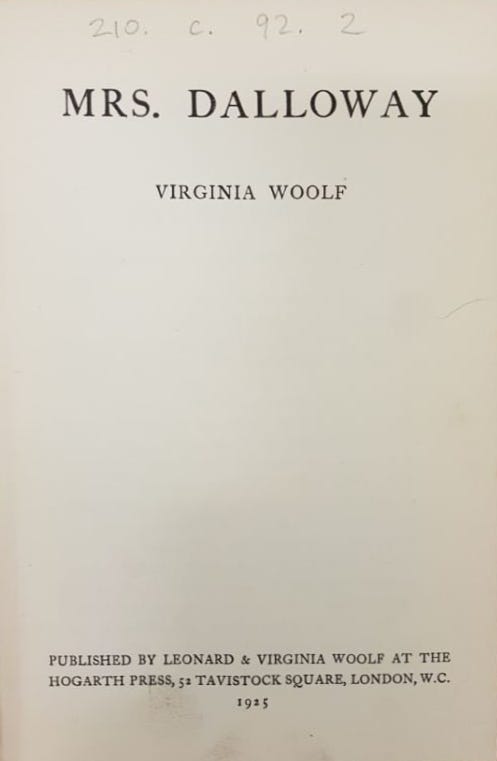
Cover of Mrs Dalloway (1925 first edition), public domain via Wikimedia Commons.
I first read Mrs Dalloway at university, where it was framed — inevitably — as an experiment. Stream of consciousness. Modernism. A day in the life. I admired it, understood it well enough to write the essay, then moved on. What I didn’t register then was how much effort the novel is quietly documenting. Not the effort of writing, but the effort of living while holding yourself together.
Woolf is attentive to that effort in ways that feel almost impolite. She notices how much psychic energy is spent on small acts of composure: choosing a dress, making a call, timing an entrance, smoothing a social moment so it doesn’t snag. None of this is framed as heroism. It’s simply the background labour required to remain legible to others. The novel moves through these acts without commentary, as though to say: this is what most lives consist of, whether or not we ever name it as work.
When I first read the book, I was trained to look for innovation — how Woolf broke the sentence open, how thought replaced plot. What I didn’t yet have was the lived experience to recognise what those techniques were carrying. The loosened syntax, the drifting attention, the way one consciousness bleeds into another; all of it reflects a mind that is never fully at rest, even in moments of apparent calm. This is not interior freedom. It’s internal vigilance.
Coming back to it years later, what stays with me isn’t the wandering thoughts or the famous opening line. It’s the moment at the party, near the end, when Clarissa Dalloway — successful host, composed social creature, the axis around which the evening turns — hears, almost in passing, that a young man has killed himself. A stranger. Someone she never met. Septimus Smith.
The information arrives obliquely, as everything important in this novel does. Clarissa withdraws for a moment, not in collapse or melodrama, but in a small pocket of privacy. And in that brief interior pause, something unsettling happens. She doesn’t moralise his death. She doesn’t romanticise it either. What she recognises is sharper and harder to sit with than either of those responses. She senses that in refusing to continue, he preserved something she has spent her life bargaining away.
What Clarissa recognises is not courage or cowardice, but refusal. Septimus steps outside the economy of endurance altogether. And that is precisely what makes the moment so destabilising for her. His death exposes the fact that continuation is not neutral. It is an ongoing negotiation, one she has been conducting for decades, often successfully, sometimes gladly — but never without loss.
Woolf is careful not to turn this recognition into admiration. Clarissa does not envy Septimus. She does not wish to follow him. What unsettles her is the clarity of the contrast: he would not give what was demanded, and she always has. The novel holds that tension without resolving it, without telling us which choice is right. It simply allows both to exist in the same moral frame.
It’s a recognition without action. Without consequence. And Woolf lets it pass almost as soon as it appears.
This is where Mrs Dalloway does something that still feels bracingly modern. The novel does not convert insight into change. Clarissa does not emerge transformed. She does not renounce her life, her role, her parties. She returns to the room. The guests are still there. The social machinery resumes its smooth rotation. Understanding, here, is not a lever. It’s a weight.
This is a deeply unfashionable move. We are accustomed to insight being productive, to the idea that once something is understood, it must be acted upon, integrated, and healed. Woolf resists that logic. Clarissa’s understanding does not improve her life. It does not simplify her feelings or clarify her future. It settles inside her as an additional layer of awareness, one she will carry back into the room with her.
There is no therapeutic arc here, no implication that awareness naturally leads to freedom. Woolf seems more interested in what it means to know something and still choose not to change. Or perhaps not be able to change, without the novel framing that choice as failure.
At university, Septimus was taught as the obvious counterpoint: the damaged one, the casualty of war, the figure who cannot survive society’s demands. Clarissa, by contrast, was read as the one who does survive — adaptable, socially fluent, intact. But rereading the novel now, that binary feels too neat. Woolf isn’t staging a contrast between breakdown and health. She’s showing two responses to the same pressure: the demand to render inner life acceptable.
Septimus cannot do it. Clarissa can — and does — but not without a private cost.
That cost is never itemised. Woolf doesn’t give us a ledger of sacrifices or a moment of confession. Instead, it appears as a faint but persistent thinning, a sense that something vital has been traded for fluency, for belonging, for ease of movement within the world. Clarissa’s success is real. Her party works. Her life functions. And yet the novel keeps returning to moments of solitude, of withdrawal, as though to remind us that survival has contours we don’t often acknowledge.
In this way, Mrs Dalloway feels less like a novel about trauma than a novel about accommodation. About the thousand small adjustments required to stay in place. Septimus breaks under the strain of those adjustments. Clarissa absorbs them. Neither response is presented as exemplary.
What makes the party scene so precise is its restraint. Woolf doesn’t give Clarissa a speech or a revelation. The thought flickers and is absorbed back into motion. The novel refuses to grant us the comfort of resolution, just as it refuses to punish Clarissa for choosing life as it is. Survival is not framed as moral success. It’s framed as continuation.
Continuation is a modest outcome, but Woolf treats it with seriousness rather than irony. The novel understands that most lives do not climax or collapse. They proceed. They accumulate. They develop hairline fractures rather than dramatic breaks. Clarissa’s return to the party is not a triumph, but it is not a defeat either. It is simply what happens next.
That ordinariness is the book’s quiet provocation. It asks us to sit with the idea that endurance, even graceful endurance, can still be costly — and that cost does not always announce itself in visible damage.
And that, I think, is why this book feels different now than it did when I first read it. In a culture obsessed with healing arcs and redemptive narratives, Mrs Dalloway is uninterested in repair. It understands that many lives do not break, but they also do not resolve. They function. They endure.
They host the party.
Woolf’s quiet insistence is that this, too, is a condition worth looking at closely. Not because it’s admirable or tragic, but because it’s common. Clarissa does not fall apart. She does something harder to name. She carries on, aware (if only for a moment) of what that choice costs her.
The refusal to demand more from Clarissa, more insight, more transformation, more narrative payoff, is the novel’s final act of discipline. Woolf does not ask her to redeem herself through suffering or self-awareness. She allows her to remain what she is: a person who understands something difficult, briefly, and then lives on anyway.
And the novel refuses to ask for anything more.
Thanks for reading — I’m Mhairi. I write about literature, writing, and the ideas that shape both. You’re welcome to follow me here on Medium for more.
메타데이터
- post_id
- 4044acf8d7a6
- slug
- what-happens-when-a-novel-refuses-to-resolve-you-4044acf8d7a6
- url
- https://baos.pub/what-happens-when-a-novel-refuses-to-resolve-you-4044acf8d7a6
- canonical_url
- https://baos.pub/what-happens-when-a-novel-refuses-to-resolve-you-4044acf8d7a6
- author_url
- https://medium.com/@mbe.mhairi
- status
- ok
- fetched_at
- 2026-06-21 15:33:18