I Had No Idea “Digital Shoplifting” Had Become So Common
The surprising online trend that could end up costing every honest shopper
ONLINE SHOPPING|SOCIAL MEDIA
I Had No Idea “Digital Shoplifting” Had Become So Common
The surprising online trend that could end up costing every honest shopper
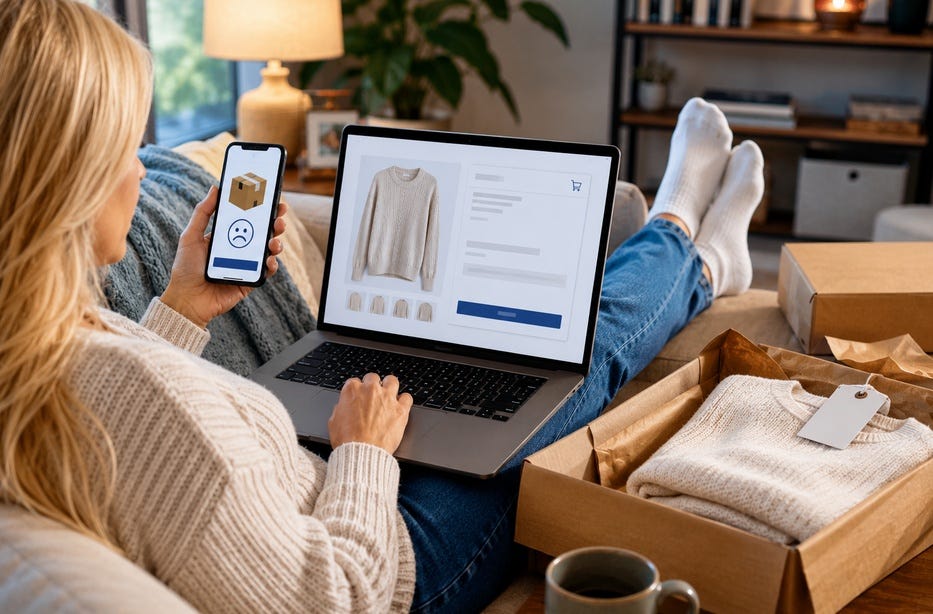
Image created by author with ChatGPT
Online shopping has become so routine that most of us barely think about what happens after we click Buy Now.
A package shows up on the porch. We bring it inside, open the box, and hopefully enjoy whatever we ordered.
But while researching a completely different story recently, I stumbled across something I had never heard of before.
It’s called digital shoplifting.
At first, I assumed it referred to hackers stealing credit card numbers or criminals intercepting deliveries. It doesn’t.
Instead, it involves ordinary shoppers receiving exactly what they ordered — and then convincing the retailer to give them their money back anyway.
The Refund Trick Costing Retailers Millions
Imagine ordering a $250 sweater or a new pair of wireless headphones online. The package arrives on time. You open it, decide to keep it, and then log into the retailer’s website to report that it never arrived.
A few days later, the company refunds your purchase. You now have both the product and the money.
That sounded unbelievable to me. Surely retailers had safeguards to prevent something so obvious.
Then I kept reading.
The Number That Made Me Stop
The statistic that caught my attention wasn’t how much money retailers are losing.
It was who was admitting to causing those losses.
According to a survey by identity verification and fraud prevention company Socure, nearly half of Gen Z and Millennial consumers earning more than $100,000 a year admitted they had engaged in digital shoplifting during the previous 12 months.
The survey, which questioned 2,000 U.S. adults in December 2024, suggests refund fraud has become far more common than most shoppers probably realize.
That genuinely surprised me.
Like many people, I assumed this kind of fraud was mostly driven by financial desperation. If someone couldn’t afford groceries or was facing an unexpected emergency, I could at least understand the temptation, even if I didn’t excuse it.
Instead, many of the people admitting to it were already earning six-figure incomes. That suggests this isn’t simply about financial hardship. For at least some people, it’s about opportunity.
A Legitimate Purchase
Unlike traditional shoplifting, nobody walks out of a store carrying unpaid merchandise. The purchase is completely legitimate. The fraud happens afterward.
Some customers falsely report that a package never arrived. Others claim it was stolen from their doorstep after it was delivered. Some dispute legitimate charges with their credit card company even though they received exactly what they ordered. Others insist they never authorized the purchase in the first place.
Fraud investigators classify much of this behavior as first-party fraud because the customer, not an outside criminal, is the one making the false claim.
From the retailer’s perspective, proving what actually happened can be surprisingly difficult. Tracking information isn’t always conclusive, security camera footage is rarely available, and investigating every disputed order would cost time and money.
For many companies, issuing a refund is simply cheaper than fighting every claim.
That’s exactly what digital shoplifters are counting on.
Social Media May Be Making It Worse
One of the most surprising discoveries was how openly people discuss these tactics online. On TikTok and other social media platforms, influencers openly share what they describe as refund “hacks.”
I expected these videos to be hidden in obscure corners of the internet. They weren’t. Some had millions of views.
In fact, one creator with nearly three million followers reportedly explained how someone could request a refund from Amazon by claiming a package arrived late, telling viewers that “99% of the time” they would still receive the item without having to send it back.
The videos rarely present the practice as fraud. Instead, many frame it as a clever way to beat the system or stretch a tight budget.
The comments can be even more revealing. Some viewers celebrate their success stories. Others swap additional tips and techniques, almost as though they’re sharing money-saving advice instead of discussing deceptive claims.
Somewhere along the way, behavior that many people would once have recognized as fraud has been repackaged as a life hack. To me, that cultural shift may be the most unsettling part of the entire story.
Why Are People Doing It?
There isn’t one simple answer.
Some experts point to inflation and the rising cost of living. Others argue that people are more willing to target large retailers because they assume billion-dollar companies can absorb the losses without feeling much impact.
For some, the motivation may be even simpler. They see an opportunity and believe there’s very little chance of getting caught.
Ori Snir, Socure’s head of product management for fraud and identity solutions, offered another possible explanation in an interview with Fortune. People who understand how banks, credit card companies, and retailers handle disputes may also have a better understanding of how to manipulate those systems.
I found that idea especially interesting.
We often assume financial knowledge leads people to make better decisions. But in some cases, it may also make it easier to identify weaknesses in the system.
That’s an uncomfortable thought.
The Real Cost Doesn’t Stop With Retailers
At first glance, digital shoplifting may seem like a victimless crime. After all, many of the targets are enormous companies with billions of dollars in annual revenue.
But the losses don’t simply disappear.
Fraud experts estimate that every fraudulent refund costs merchants an average of 3.75 times the original purchase price once shipping, processing, customer service, fraud investigations, and other operational expenses are factored in.
Eventually, those costs have to be absorbed by someone.
You may have already seen the effects without realizing why. Some retailers now require photos of damaged merchandise before issuing refunds. Others insist on signatures for deliveries, shorten return windows, or place additional verification steps between customers and their money.
Retailers raise prices. Return policies become more restrictive. Verification requirements become more burdensome. Honest customers spend more time proving legitimate claims because companies have learned to trust everyone a little less.
In the end, the cost of someone else’s “free” purchase doesn’t disappear.
It gets passed on to the rest of us.
A Different Kind of Shoplifting
What surprised me most wasn’t that people commit fraud.
Unfortunately, fraud has always existed.
What surprised me was how comfortable some people seem talking about it.
Previous generations might have quietly celebrated getting away with something. Today, some people record step-by-step tutorials explaining exactly how to do it, attracting millions of views in the process.
If digital shoplifting continues to spread, retailers will almost certainly respond. Returns may become more difficult. Refunds may take longer. Honest customers may face more questions, more delays, and more hurdles before their legitimate claims are approved.
Ironically, the people who suffer the most may not be the ones exploiting the system. They may be the millions of shoppers who simply expect to be treated fairly when something genuinely goes wrong.
The next time you have to jump through extra hoops to prove your refund request is legitimate, this growing trend may be part of the reason why. Sometimes the biggest cost of fraud isn’t just isn’t just the money that’s stolen.
It’s the trust that’s lost.
메타데이터
- post_id
- 4912ec63ec9c
- slug
- i-had-no-idea-digital-shoplifting-had-become-so-common-4912ec63ec9c
- url
- https://medium.com/secrets-and-mysteries/i-had-no-idea-digital-shoplifting-had-become-so-common-4912ec63ec9c
- canonical_url
- https://medium.com/secrets-and-mysteries/i-had-no-idea-digital-shoplifting-had-become-so-common-4912ec63ec9c
- author_url
- https://medium.com/@kelly.carmichael
- status
- ok
- fetched_at
- 2026-07-10 01:40:30