Bitcoin Corrections in the ETF Era: Where Did Institutional Capital Move?
Since the approval of spot Bitcoin ETFs, the structure of the crypto market has changed fundamentally. In the past, Bitcoin corrections…
Bitcoin Corrections in the ETF Era: Where Did Institutional Capital Move?
Since the approval of spot Bitcoin ETFs, the structure of the crypto market has changed fundamentally. In the past, Bitcoin corrections were often explained through retail fear, exchange selling pressure, and derivatives liquidations. But in the ETF era, Bitcoin has become an asset influenced simultaneously by institutional capital, U.S. long-term Treasury yields, the dollar index, portfolio rebalancing, and shifting risk appetite.
This shift became clearly visible during the Bitcoin correction after May 14, 2026. Spot ETF inflows slowed, and in some periods, net outflows appeared repeatedly. The market reacted nervously not only to the structural selling pressure from Grayscale GBTC, but also to outflows from major ETFs such as BlackRock’s IBIT and Fidelity’s FBTC. Investors began asking whether institutional demand for Bitcoin was weakening.
However, it would be inaccurate to conclude that institutional capital has completely abandoned Bitcoin. A more precise interpretation is that institutional investors shifted from aggressive buying to defensive rebalancing. In an environment where long-term Treasury yields are elevated and the dollar is strong, it is natural for institutions to reduce Bitcoin exposure and move part of their capital into bonds, cash-like assets, gold, and dollar-based assets.
This article explains what makes Bitcoin corrections different in the ETF era, why institutional investors adjust Bitcoin exposure, how to interpret ETF inflows and outflows, where institutional capital may have moved, and what individual investors should watch in the second half of 2026.
Table of Contents
- What Has Changed for Bitcoin in the ETF Era?
- Why Do Institutional Investors Adjust Bitcoin Exposure?
- How Should Investors Interpret ETF Inflows and Outflows?
- Where Did Institutional Capital Move?
- Key Variables for the Bitcoin Market in H2 2026
- How Individual Investors Should Respond to Corrections in the ETF Era

1. What Has Changed for Bitcoin in the ETF Era?
Spot Bitcoin ETFs were a decisive event that changed the structure of the crypto market. Before ETFs, Bitcoin was mainly traded through exchanges, personal wallets, crypto funds, and direct holdings by a limited number of institutions. After ETFs, Bitcoin became a regulated asset that can be bought and sold inside traditional financial markets.
This change means more than improved investment access. ETFs brought Bitcoin into institutional portfolios. As a result, Bitcoin is now more directly affected by interest rates, bonds, the dollar, equity-market volatility, and portfolio rebalancing.
- What It Means for Bitcoin to Enter Institutional Portfolios
① Before spot ETFs, institutions that wanted to hold Bitcoin directly had to solve custody, accounting, regulatory, internal approval, and security-management issues. This process was complex and created a significant entry barrier for many institutions.
② ETFs lowered that barrier substantially. Institutions can now add Bitcoin ETFs to portfolios in a similar way to equity or bond ETFs. This improved Bitcoin’s accessibility and created a channel for institutional capital inflows.
③ But institutionalization is a double-edged sword. When institutional capital flows in, it can become a powerful upward driver. When institutions reduce risk, ETF outflows can make downside pressure much more visible.
- From a Retail-Driven Market to an Institutional Flow Market
① In the past, the crypto market was heavily influenced by retail investor sentiment. Buying pressure on exchange apps, community mood, and altcoin rotation often drove market direction.
② In the ETF era, institutional flows have been added to that structure. Institutional investors do not move only on short-term news the way many retail investors do. They consider interest rates, volatility, risk-asset allocation, client fund allocation, regulation, and portfolio correlations together.
③ This means Bitcoin in the ETF era cannot rise sustainably simply because “retail investors are buying.” Institutional capital must remain supportive, ETF inflows must continue, and long-term Treasury yields and the dollar must not become too hostile.
- Do ETFs Reduce or Increase Volatility?
① Over the long term, ETFs can deepen Bitcoin liquidity and increase institutional trust. As institutional capital enters the market, market depth can improve and long-term holding demand may grow.
② In the short term, however, ETFs can also increase volatility. When ETF inflows are strong, price appreciation can accelerate. When net outflows appear, fears of institutional exit can grow and declines can accelerate.
③ ETF flow data is disclosed regularly, which means it immediately affects investor psychology. A single day of net outflows may sometimes trigger an excessive market reaction. But if several consecutive days of net outflows appear, they may be interpreted as a real change in supply and demand.
- Why the Framework for Reading Bitcoin Corrections Has Changed
① In past corrections, the key indicators were exchange selling pressure, miner selling, whale wallet movements, and futures liquidation data.
② Now, investors must also watch ETF inflows, ETF outflows, capital flows by major products such as IBIT, FBTC, and GBTC, and institutional portfolio rebalancing.
③ Therefore, analyzing Bitcoin corrections in the ETF era requires more than chart analysis. Investors need to examine interest rates, the dollar, ETF flows, derivatives positioning, and stablecoin liquidity together to understand the market’s true direction more accurately.

2. Why Do Institutional Investors Adjust Bitcoin Exposure?
Institutional investors do not evaluate Bitcoin in isolation. They compare it with equities, bonds, gold, cash-like assets, the dollar, commodities, and alternative investments. Therefore, when the market environment changes, institutions may reduce short-term Bitcoin exposure even if their long-term view remains positive.
The ETF outflows that appeared after May 14, 2026 should be understood more realistically as short-term risk reduction and portfolio adjustment rather than a complete institutional abandonment of Bitcoin.
- Institutions Do Not Treat Bitcoin as a Standalone Asset
① Retail investors often look at Bitcoin mainly through the question, “Will it rise or fall?” Institutions view Bitcoin as one component of a broader portfolio.
② When institutions allocate to Bitcoin, they consider not only expected return, but also volatility, maximum drawdown, comparison with bonds, correlation with equities, liquidity, and whether the allocation can be explained to clients.
③ Therefore, even if institutions acknowledge Bitcoin’s long-term growth potential, they may reduce exposure in the short term when rates and the dollar create a more difficult environment. This is not a rejection of Bitcoin. It is risk management.
- When Bond Yields Rise, Risk-Asset Exposure Often Falls
① When U.S. long-term Treasury yields rise, institutional investors recalculate portfolio allocations. If stable bonds can offer attractive yields, there is less need to hold large positions in highly volatile assets.
② Bitcoin offers high expected return potential, but it also carries high volatility. In an environment of rising bond yields, reducing Bitcoin exposure and increasing bonds or cash-like assets can become a natural decision.
③ This tendency becomes stronger when expectations for Fed rate cuts weaken. If the market begins to believe that “high rates may last longer,” risk appetite can cool quickly.
- How Portfolio Rebalancing Affects ETF Flows
① Institutions adjust asset weights at regular intervals. If Bitcoin rises significantly and its portfolio weight becomes larger than the target allocation, institutions may sell part of the position to return to their original target weight.
② This process does not necessarily reflect a negative outlook on Bitcoin. It may simply be the result of portfolio rules: trimming assets that have appreciated and moving capital into assets that have lagged or offer greater stability.
③ In the ETF market, however, this rebalancing appears as net outflows. Retail investors may interpret this as institutional exit, but in reality, it may be the result of risk management and allocation control.
- Why Volatility Management Is Central for Institutions
① Institutional investors care about volatility as much as returns. When managing client assets or fund capital, avoiding large drawdowns is extremely important.
② Bitcoin can produce large gains over short periods, but it can also fall sharply. When derivatives liquidations occur at the same time, large intraday volatility can appear quickly.
③ For that reason, even institutions that remain positive on Bitcoin over the long term may reduce ETF exposure or delay new purchases during periods of high short-term volatility. This is one reason ETF outflows appeared during the correction after May.
3. How Should Investors Interpret ETF Inflows and Outflows?
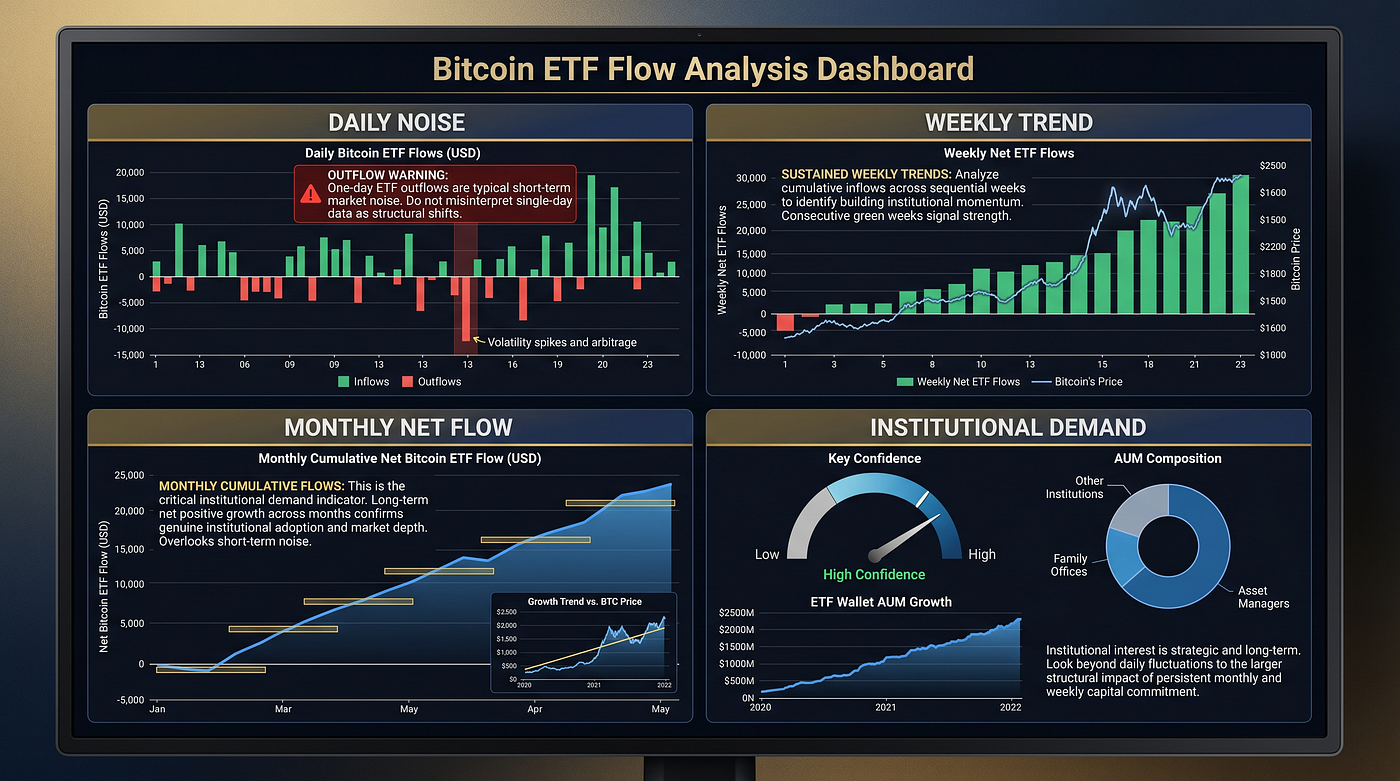
In the ETF era, Bitcoin investors must watch ETF flows. But the most common mistake is overreacting to daily figures.
A single day of net outflows may simply reflect short-term rebalancing. But if net outflows repeat for several days while long-term Treasury yields rise, the dollar strengthens, and derivatives liquidations occur, that can become a more serious warning signal.
- Why Investors Should Not Overreact to Daily ETF Data
① Bitcoin ETFs experience inflows and outflows every day. Interpreting a single day of net outflows as proof that institutions have abandoned Bitcoin is excessive.
② Institutions may sell temporarily because of month-end or quarter-end adjustments, risk-management rules, client redemptions, or portfolio rebalancing. These flows may have little to do with the long-term outlook.
③ Therefore, investors should focus on trends rather than one-day numbers. It is far more important to ask whether ETF inflows recover after a few days or whether net outflows continue for several weeks.
- Why Weekly and Monthly Net Inflow Trends Matter More
① Weekly and monthly ETF inflows show the direction of institutional demand. They remove short-term noise and help investors determine whether capital is actually entering the Bitcoin market.
② If weekly net inflows remain positive, a single day of outflows is not necessarily a major concern. The market can still be interpreted as having structural buying support.
③ But if weekly and monthly net outflows repeat, the situation changes. That may signal that institutions are reducing Bitcoin exposure or that new capital inflows are slowing.
- The Difference Between Slower Inflows and Repeated Outflows
① Slowing inflows mean that less money is entering ETFs. In this case, upside momentum weakens, but it does not automatically mean the market must fall.
② Repeated outflows are a more negative signal. They indicate that previously invested capital is leaving, which can weaken market sentiment more quickly.
③ If repeated outflows appear at the same time as Bitcoin price declines, rising long-term yields, dollar strength, and leveraged long liquidations, the correction can deepen. This combination explains why the market became unstable after May 14.
- The Time Lag Between ETF Flows and Bitcoin Prices
① ETF flows are not always reflected in same-day price action. Sometimes price moves first, and ETF flow data follows later.
② Investors need to understand this time lag. Institutional redemptions may occur after prices decline, and prices may rebound several days after ETF inflows recover.
③ For that reason, ETF data is better used as an indicator of market strength than as a short-term trading signal. When ETF inflows recover and long-term yields stabilize, confidence in a Bitcoin rebound can increase.
4. Where Did Institutional Capital Move?
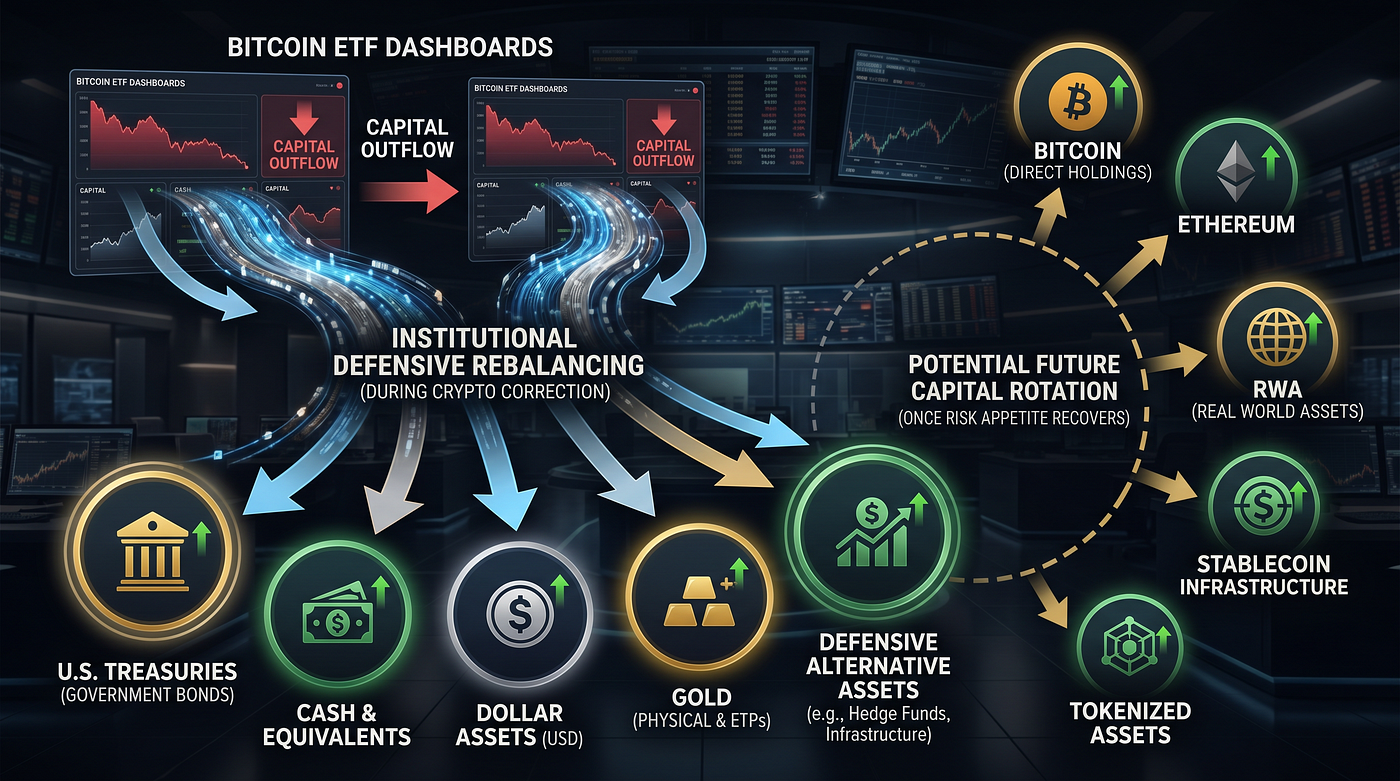
If some institutional capital left Bitcoin, where did it go? The most realistic answer is bonds, cash-like assets, the dollar, gold, and some defensive alternative assets.
When markets become unstable, institutions reduce risk-asset exposure and increase safer allocations. ETF outflows during a Bitcoin correction are more likely to represent defensive asset allocation than a complete departure from the market.
- Defensive Movement Into Bonds and Cash-Like Assets
① When U.S. long-term Treasury yields rise, bonds become relatively more attractive. From an institutional perspective, holding Treasuries or short-duration bonds with attractive yields can be a rational choice.
② Cash-like assets become more valuable when uncertainty rises. Cash may appear to offer low returns, but during a correction, it provides optionality: the ability to wait for the next opportunity.
③ Some of the capital leaving Bitcoin ETFs likely moved into these defensive assets. This is a short-term burden for Bitcoin, but it can also become sidelined capital that may return to risk assets once the market stabilizes.
- Shifting Preference Toward Gold and Dollar Assets
① When markets become unstable, investors often look at gold and the dollar together. Gold is a traditional store of value, while the dollar is the central asset of global liquidity.
② Bitcoin is sometimes viewed as digital gold, but during corrections, it often trades more like a high-volatility risk asset. Because of this, institutions may prefer gold or dollar assets over Bitcoin when short-term uncertainty rises.
③ Over the long term, however, both gold and Bitcoin may regain attention as hedges against currency debasement. The key is to distinguish between short-term risk management and long-term narrative.
- The Possibility of Capital Spreading From Bitcoin to Ethereum and RWA
① The fact that institutional capital reduced Bitcoin exposure does not mean interest in all digital assets has disappeared. Once the market stabilizes, capital may spread again into Ethereum, RWA, stablecoin infrastructure, and tokenized assets.
② RWA is especially easy for institutional investors to understand because it connects real-world assets such as Treasuries, gold, real estate, private credit, and commodities to blockchain infrastructure.
③ Gold-backed digital assets also deserve attention in this context. Even during Bitcoin corrections, assets that combine real-world value with digital liquidity may carry both defensive qualities and growth potential.
- Sectors Most Likely to React First When Risk Appetite Returns
① If risk appetite recovers, Bitcoin is likely to be the first asset to respond. It has the highest ETF accessibility, the deepest liquidity, and is the easiest digital asset for institutions to add to portfolios.
② Ethereum and large infrastructure assets may follow. Once Bitcoin flows stabilize, investors often expand interest into assets with higher growth potential.
③ After that, capital may move into themes such as RWA, AI, DeFi, stablecoin infrastructure, and payment networks. However, this rotation becomes more reliable only after Bitcoin ETF flows and long-term Treasury yields stabilize first.

5. Key Variables for the Bitcoin Market in H2 2026
For the Bitcoin market in the second half of 2026, no single indicator is enough. Bitcoin has become a market where rates, ETFs, the dollar, stablecoins, and derivatives move together.
Therefore, investors should avoid simplistic conclusions such as “Bitcoin has fallen a lot, so it must rebound” or “there was one day of ETF outflows, so the cycle is over.” Confidence in a rebound increases when multiple indicators improve in the same direction.
- U.S. 10-Year Treasury Yield and the Dollar Index
① The U.S. 10-year Treasury yield is a core macro indicator for Bitcoin. If long-term yields stabilize or fall, a more favorable environment for risk assets can emerge.
② Conversely, if the 10-year yield rises again, Bitcoin faces pressure. Bonds become relatively more attractive, and institutions become more likely to reduce risk-asset exposure.
③ The dollar index must also be watched. If dollar strength continues, global liquidity can tighten, and capital flowing into the crypto market may weaken.
- Cumulative Net Inflow Trends in Bitcoin ETFs
① In the ETF market, the most important figure is cumulative net inflows. Rather than daily inflows and outflows, investors should ask whether capital is continuing to build across the entire ETF market.
② It is useful to monitor BlackRock, Fidelity, and Grayscale separately, but final judgment should be based on total ETF net inflows. Investors need to check whether inflows into other ETFs are offsetting GBTC outflows.
③ If cumulative ETF net inflows begin rising again, that can be interpreted as a sign that institutional demand is recovering. It can become an important foundation for a Bitcoin price rebound.
- Stablecoin Market Capitalization and Exchange Inflows
① Stablecoins are the cash-like buying power of the crypto market. If stablecoin market capitalization increases, it can signal that new liquidity is entering the market.
② When stablecoins flow into exchanges, it can be interpreted as more capital waiting to buy. This can become fuel for a rebound in Bitcoin and altcoins.
③ Conversely, if stablecoin growth slows or exchange inflows decrease, the market’s buying power weakens. In that case, even if a rebound appears, its durability may be limited.
- Derivatives Open Interest and Funding Rates
① Derivatives open interest shows how much leverage is built up in the market. If open interest becomes excessively high, liquidation risk also increases.
② If funding rates are too high, it may signal overheated long positioning. In that case, even a small decline can trigger forced liquidations.
③ Conversely, if open interest declines after a correction and funding rates stabilize, the market may become healthier. Leverage resets are painful in the short term, but they can create a stronger foundation for a medium-term rebound.
- Fed Rate-Cut Expectations and the FOMC Dot Plot
① In H2 2026, the direction of Fed policy remains a core variable for Bitcoin. If rate-cut expectations revive, risk appetite may recover.
② The FOMC dot plot shows where Fed officials expect rates to move in the future. If the dot plot shifts lower, markets may interpret it as an easing signal.
③ Conversely, if the Fed signals that it will keep rates high for longer because of inflation concerns, Bitcoin’s rebound may remain limited. Investors should therefore pay close attention to FOMC statements and press conferences.

6. How Individual Investors Should Respond to Corrections in the ETF Era
In the ETF era, individual investors need to respond to corrections differently than before. Simply buying every sharp drop or chasing every rally can be dangerous. Investors now need to adjust exposure while monitoring institutional flows and macro indicators together.
Especially during corrections like the one after May 14, 2026, investors should focus less on “how much Bitcoin has fallen” and more on “why it fell, what kind of capital left, and what conditions are needed for that capital to return.”
- Watch Institutional Flows Before Short-Term Price Moves
① Bitcoin prices can move sharply even within a single day. But judging only by price can cause investors to miss the deeper market structure.
② Investors should check whether ETF inflows are recovering, whether capital is returning to major ETFs such as BlackRock and Fidelity, and whether GBTC outflow pressure is easing.
③ A rebound without returning institutional capital may remain only a short-term technical bounce. A rebound supported by recovering ETF flows has a greater chance of becoming a stronger trend.
- Set Rules for Phased Buying Instead of Chasing Rallies
① One of the most dangerous behaviors during a correction is aggressively chasing the first rebound. Before the market fully stabilizes, rebounds and renewed declines can repeat.
② Individual investors should divide price zones and use phased buying while checking ETF flows and long-term Treasury yield trends.
③ It is relatively more stable to begin with large-cap assets such as Bitcoin and Ethereum. Altcoins can produce larger rebounds, but during downturns, their losses can also be much deeper.
- Leverage Can Be the Most Dangerous Choice During Corrections
① Even in the ETF era, leverage risk remains high in crypto markets. If long positions become overcrowded in futures markets, declines can accelerate sharply.
② During corrections, even if investors correctly predict the long-term direction, poor timing can still lead to liquidation. Even if Bitcoin rises over the long term, leverage can fail to withstand short-term volatility.
③ Therefore, in highly uncertain periods, spot-based phased accumulation is safer than leveraged positions. Survival in the market is the prerequisite for participating in the next uptrend.
- View the Market Through Bitcoin, Ethereum, and RWA Separately
① Bitcoin is the core asset of the ETF era. It is the asset institutions approach first, has the deepest liquidity, and often determines the direction of the broader market.
② Ethereum is the core asset of smart contracts and the on-chain ecosystem. Once Bitcoin flows stabilize, attention may spread to Ethereum, Layer 2 networks, DeFi, and stablecoin infrastructure.
③ RWA is an important sector that institutions may focus on after 2026. Structures that connect gold, Treasuries, real estate, and real-world assets to blockchain represent a key intersection between traditional finance and digital assets.
- Final Strategy: Increase Exposure When ETF Flows and Rate Direction Align
① Investors should not increase Bitcoin exposure simply because the price has fallen significantly. They should check whether ETF inflows are recovering, long-term Treasury yields are stabilizing, dollar strength is easing, and stablecoin liquidity is returning.
② When multiple indicators improve at the same time, confidence in a market rebound becomes stronger. Conversely, if price rebounds without improvement in ETF flows and rates, the rebound may remain limited.
③ The Bitcoin strategy in the ETF era is simple: increase exposure when institutional capital is flowing in, rates are stabilizing, and liquidity is recovering. Maintain a larger cash position when ETF outflows and rising long-term yields repeat.
BitcoinETF #BitcoinCorrection #InstitutionalCapital #ETFInflows #ETFOutflows #BitcoinOutlook #USLongTermYields #US10YearYield #DollarIndex #StablecoinLiquidity #CryptoInvestmentStrategy #RWA #EthereumOutlook #MacroCrypto #DigitalAssets
[Official CrypWorld Channels]
- Website: crypworld.io
- Whitepaper: Read Whitepaper
Community:
- Telegram Channel: Join Here
- Medium: Follow us
- Twitter (X): @Crypworld_CWG
- Instargram: https://www.instagram.com/crypworld_official/
- Blog: koreagabriel.blog
메타데이터
- post_id
- 49c2ad3c0014
- slug
- bitcoin-corrections-in-the-etf-era-where-did-institutional-capital-move-49c2ad3c0014
- url
- https://medium.com/@crypworld/bitcoin-corrections-in-the-etf-era-where-did-institutional-capital-move-49c2ad3c0014
- canonical_url
- https://medium.com/@crypworld/bitcoin-corrections-in-the-etf-era-where-did-institutional-capital-move-49c2ad3c0014
- author_url
- https://medium.com/@crypworld
- status
- ok
- fetched_at
- 2026-06-09 21:43:20