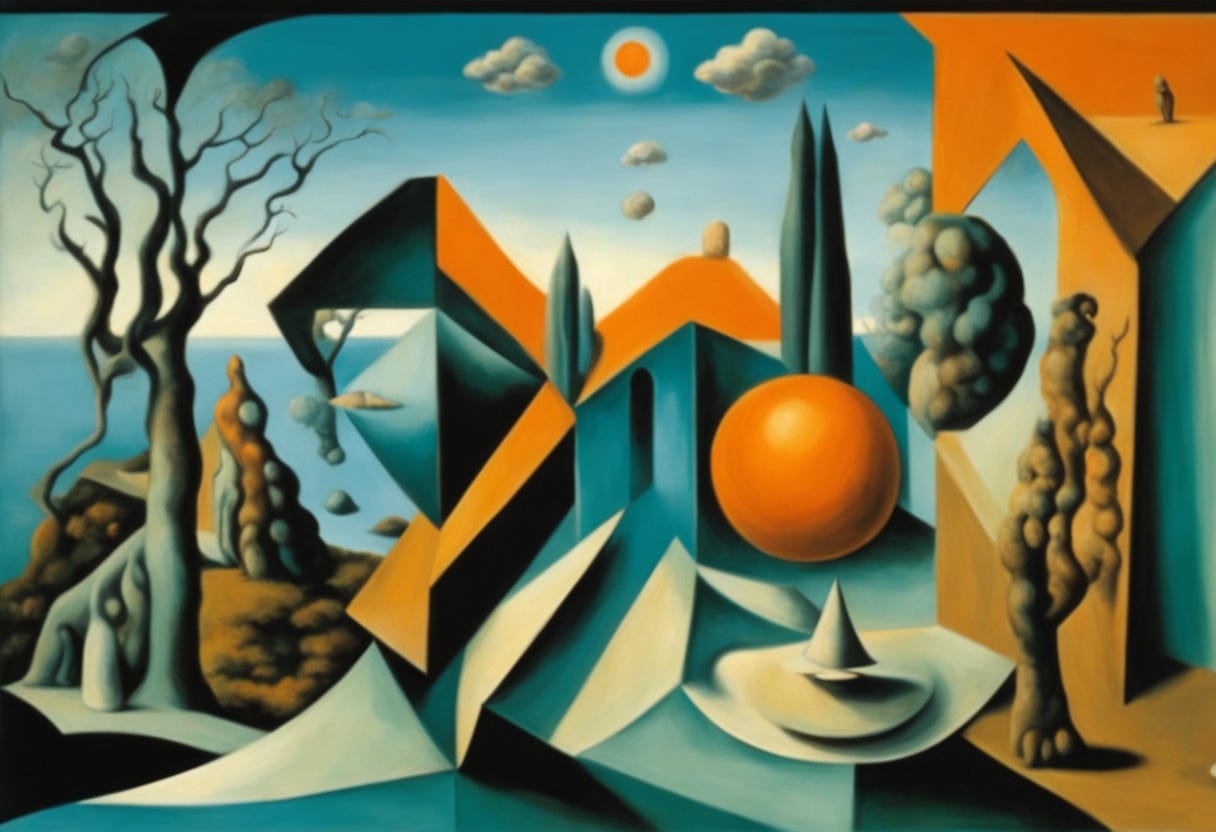
Constructing the Unspoken Blueprint
The ‘Muse’ is not merely a fleeting inspiration but a manifestation of the soul’s deepest yearning — a call from the universe that guides…
Constructing the Unspoken Blueprint
The ‘Muse’ is not merely a fleeting inspiration but a manifestation of the soul’s deepest yearning — a call from the universe that guides toward the true essence. This understanding did not come overnight; it was a gradual, step-by-step realization rooted in philosophical inquiry and personal experience.
The Door That Opens Inward
An artistic hand that clenches gathers dust, The open shaded palm receives its trust. Idea flow, as seed obeys no shouted plea; It stimulation blooms by silent gravity.
I sought the mused lightning in the sky, Demanding reasons — “Tell me why.” But ingenuity refused the tyrant’s pace; It came out of enlightenment into the space.
Insightful reason is not the Muse’s chain, Nor is surrender blind or vain. One shapes the vessel, true and strong; The other fills it with its song.
Do not pursue the distant light, As though it fled artistic faithful sight. Become the dawn that darkness knew, And morning will arrive through you.
For creative inspiration is no prize, Awarded to the higher guidance, or a wise. It enters where the self grows thin, An uplift unlocked by peace within.
The ego asks, “What can I make?” The deeper self asks, “What can I wake?” One bends the world to wear its name; The other disappears in artful flame.
I labor well, then lay originality aside, The restless aesthetic sense of pride. Prepare resourceful soil, refine the air — Creative impulse knows exactly where.
The greatest works are seldom won; They happen when the muse undone. Not by abandoning the clever mind, But leaving only mused timidity behind.
For every masterpiece began, Before it ever touched a hand: An inner vision through creator’s soul, Where emptiness became the whole.
An awe inspired artistic journey usually began with a simple question: Where does true inspiration come from?
These moments felt less like something deliberately constructed and more like something discovered. It soon became clear that this experience was not unique; throughout history, writers, philosophers, scientists, politicians, musicians, and artists have described inspiration as an inner force that arises when the mind is receptive rather than just striving. This realization marked the first step in understanding artistic spark: recognizing that inspiration is more than a collection of learned skills. It is an internal force waiting to be awakened, cultivated, and trusted.

Many influential figures have expressed similar insights. Over the years, the memory of such losses became the push needed during moments of doubt. It was then that the words of poet and novelist Rainer Maria Rilke echoed in the mind.
The novelist Rainer Maria Rilke urged creators to look inward in Letters to a Young Poet (letters written 1903–1908; first German publication, 1929), writing: “Go into yourself. Find out the reason that commands you to write.” Rilke argued that authentic aesthetic insight originates from an inner necessity rather than external recognition. He observed that a writer must cultivate both freedom and solitude for creative insight to truly emerge. In her writing, she paints inspiration as a delicate bloom that thrives in the stillness of the mind. It’s in the hush of solitude, away from the clamor of daily life, that the deepest wells of creativity are stirred. Her words always invite me to search comfort in reticence, to cherish moments of mused reflection, for it is there that the ideas quietly take root.
In a similar manner, the artist Pablo Picasso is widely credited with the remark, “Inspiration exists, but it has to find you working.” Although no definitive book records the original wording, the statement has been cited in interviews and biographies throughout the twentieth century, including Picasso Speaks, and reflects Picasso’s belief that disciplined practice invites moments of inspiration.
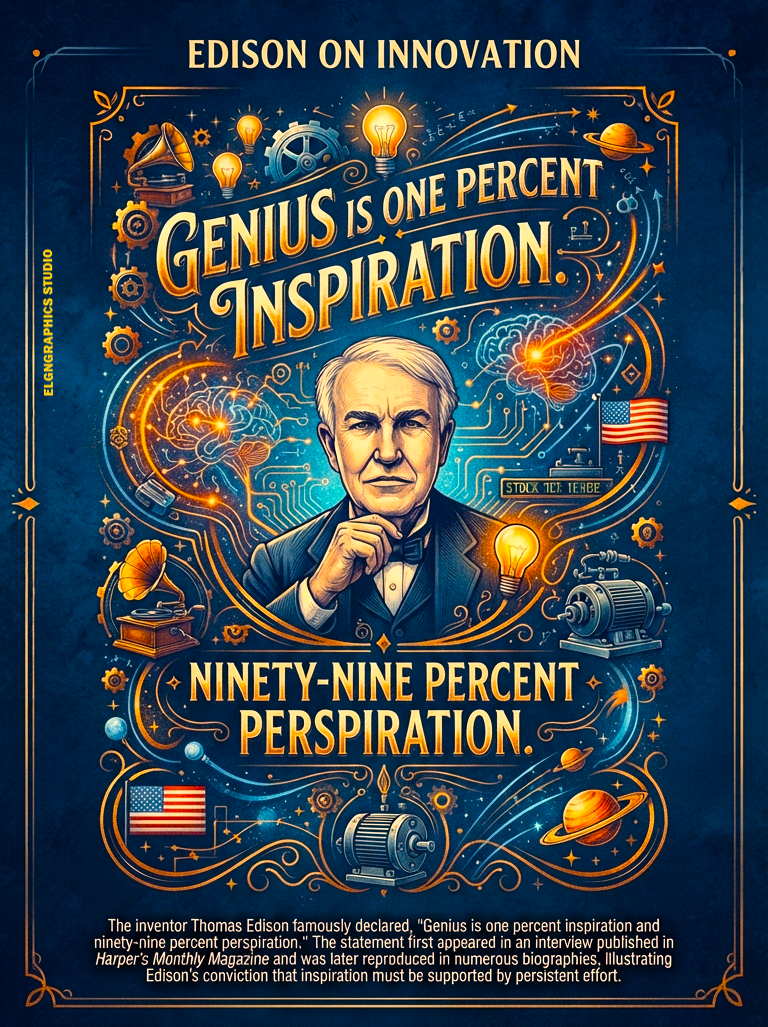
In the same vein, the inventor Thomas Edison famously declared, “Genius is one percent inspiration and ninety-nine percent perspiration.” The statement first appeared in an interview published in Harper’s Monthly Magazine and was later reproduced in numerous biographies, illustrating Edison’s conviction that inspiration must be supported by persistent effort.
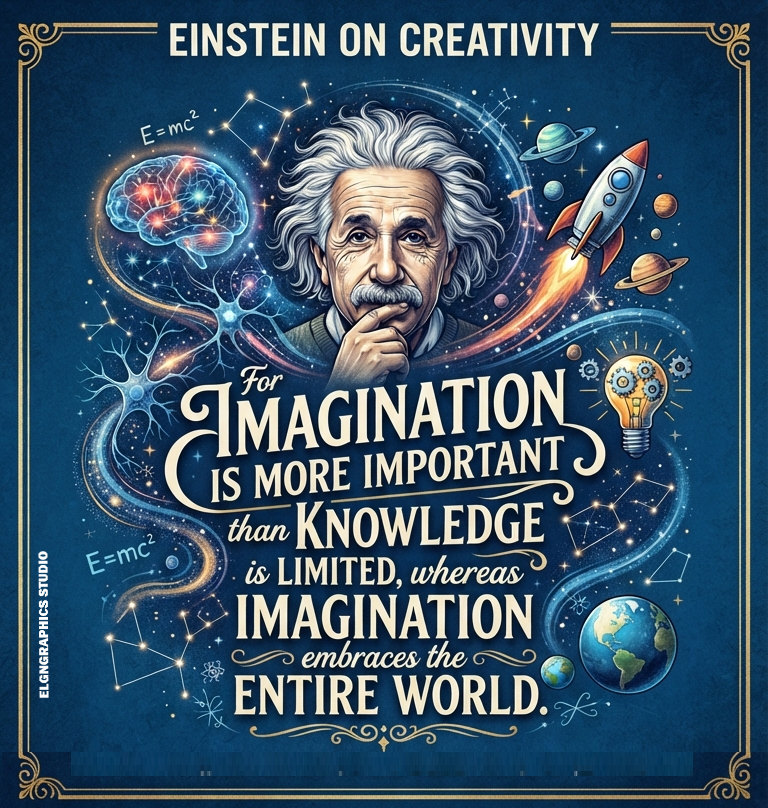
Nonetheless, the physicist Albert Einstein wrote, “Imagination is more important than knowledge. For knowledge is limited, whereas imagination embraces the entire world.” The quotation appeared in his interview published in The Saturday Evening Post and was later reprinted in collections such as [Ideas and Opinions](https://www.amazon.com/Ideas-Opinions-Albert-Einstein/dp/0517884402)*. A. Einstein emphasized that imagination is the foundation of scientific discovery.

Conversely, musician John Lennon reflected on uncertainty and creative perception, as well as in interviews collected in ‘The Playboy Interviews with John Lennon and Yoko Ono’. He remarked, “The more I see, the less I know for sure,” suggesting that visual appreciation flourishes through curiosity and openness rather than certainty.

Conversely, singer-songwriter Bob Dylan discussed the mysterious origin of songs in Chronicles: Volume One, describing songwriting as a process in which ideas often arrive unexpectedly and seem to come from beyond deliberate thought. As he observed, “A song is like a dream, and you try to make it come true.” In Chronicles: Volume One, Dylan also reflected on how songs can feel like they already exist somewhere before the artist finds them. The songwriter’s job, in this view, is not invention from nothing but recognition and shaping of something that already has an emotional or narrative form.
Together, these many united voices — from literature, science, politics, music, and art — point toward the same conclusion. Inner vision is neither entirely mystical nor entirely mechanical. But despite all the beliefs it emerges from the meeting point of creative impulses’ preparation and receptivity, where disciplined effort creates the conditions for moments of insight that feel more recognized than fabricated.
“Yet, it is often seen as reframed somewhat, so a spark of aesthetic awareness in the work is less an act of receiving authorship and more an act of mused alignment. When experience, memory, and attention briefly synchronize in focused dedication, what was previously scattered across the mind becomes comprehensible as a single idea.” ELGN
As a further point, neuroscience as well supports this. A 2012 study in ‘Frontiers in Human Neuroscience’ revealed that spontaneous insights are linked to activity in the brain’s default mode network, a neural network linked to daydreaming and spontaneous mind-wandering appears to play a key role in this process, suggesting that moments of inspiration often emerge not through focused effort alone, but when the conscious mind loosens its grip, allowing thoughts to drift freely and unexpected connections to surface. (The Brain’s Default Network and its Adaptive Role in Internal Mentation, Beaty et al., 2012).
Understanding the Inner Point
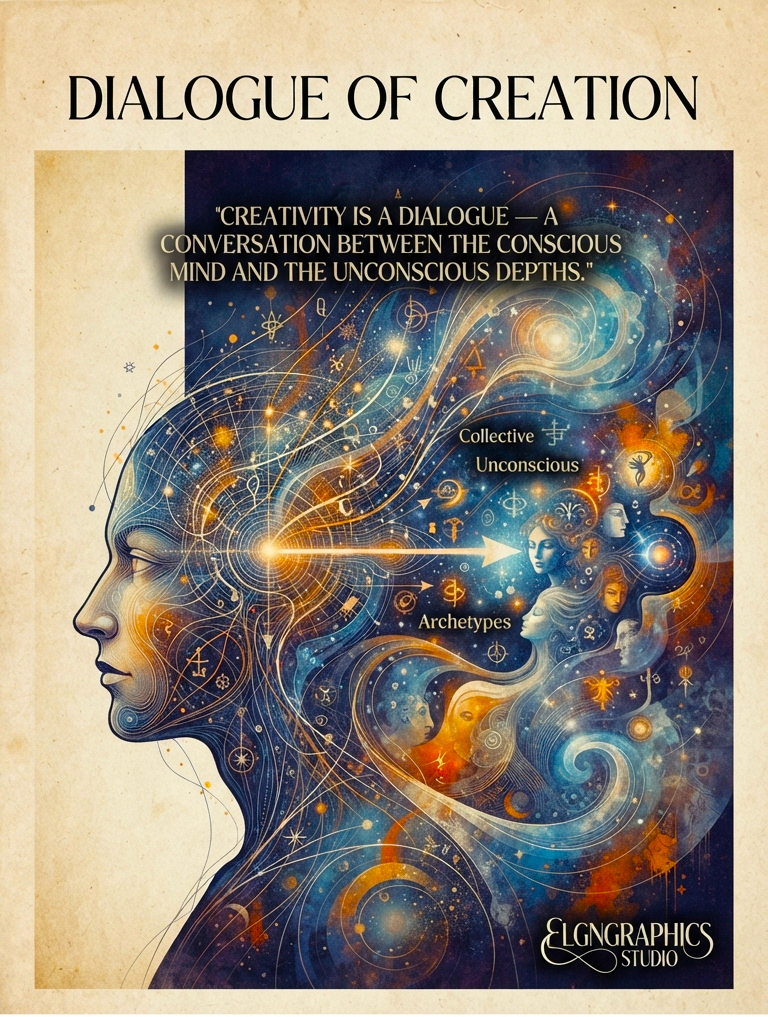
As the investigative point delves further, it brings up the philosophical idea that creative sensibility is conversation between the conscious mind and the unconscious depths. Carl Jung’s concept of archetypes and the collective unconscious illustrated that creative inspiration resides within the mind, waiting to be recognized.
The realization that the “Muse” is not merely an external source of inspiration, but an archetype — a universal symbol of divine human aesthetic sensitivity residing within every individual — offers a deeply compelling perspective on artistic experience. Though often obscured by layers of doubt, fear, expectation, and self-imposed limitation, this inner presence remains continuously available, quietly shaping perception and imagination.
In this context, the profound insights of The War of Art by Steven Pressfield come to mind, emphasizing that artistic intuition is not a rare privilege granted to a select few but an inherent human capacity — an inner force waiting to be recognized, cultivated, and trusted. What makes this insight particularly powerful is the idea that inspiration is not something to be chased in distant places but something already present within the architecture of the mind itself, patiently waiting for focused engagement, deep attention, openness, and courage to emerge.
This deep understanding invites to see sensory intelligence as a natural, accessible force, always within reach, waiting for us to listen and respond with courage.
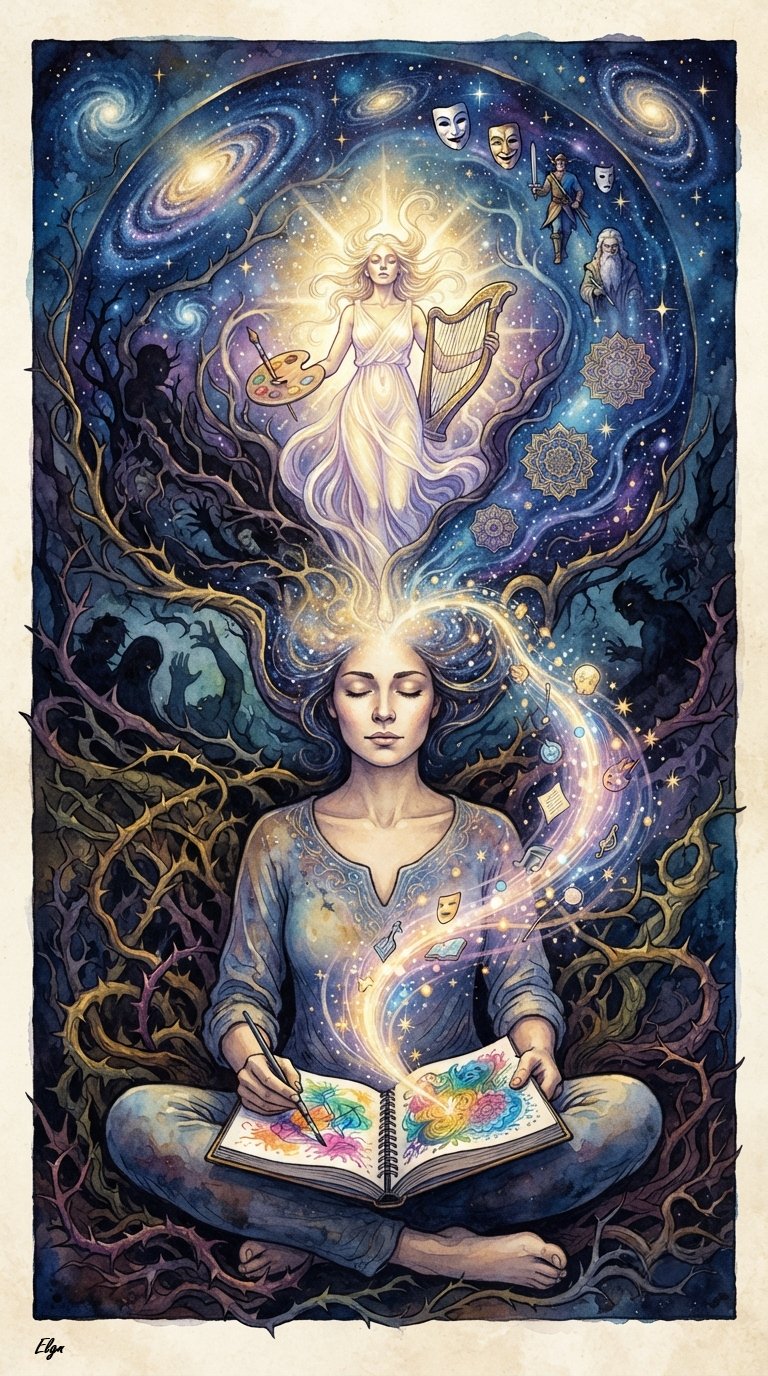
In that sense, it signifies embracing a deeper intelligence — trusting a fluid, artistic flow in which the deeper self perceives more than the surface-level ego. Creative enlightenment seems to emerge when the ego pauses long enough for this underlying coherence to surface.
To illustrate, neuroscientific research supports this idea. A 2015 study published in Frontiers in Human Neuroscience demonstrated that mindfulness— practices that quiet the conscious mind — significantly enhance creative thinking by allowing unconscious processes to surface (From a state to a trait: Trajectories of state mindfulness in meditation during intervention predict changes in trait mindfulness, Kiken et al., 2015).*
The Personal Practice: Surrender and Openness
With this understanding, openness and surrender became central to the creative process. Routines of meditation, reflection, and mindful presence were embraced, allowing visions, reveries, and sparks of inspiration to gently drift into awareness. In this silent openness, notions unfolded naturally, without force or expectation, trusting that the well of aesthetic acumens flow freely when given patience and reverence.
“Should we prioritize developing the internal conditions that naturally attract inspiration, rather than seeking it from external sources?”
Inspiration rarely appears by force. Psychology suggests that creativity flourishes when focused effort is balanced with openness, allowing the brain’s analytical and intuitive processes to work together.
Practical 5 steps:
- Quiet the ego (5 minutes): Sit in silence and observe your thoughts without judging them. Let go of the need to produce something great.
- Set a clear intention: Ask yourself one meaningful question or define one creative challenge, then release the urge to solve it immediately.
- Create space: Take a walk, breathe deeply, or engage in a simple repetitive activity. Insight often emerges when the mind is relaxed.
- Trust first impressions: When an idea appears, write it down before evaluating it. Separate creation from criticism.
- Reflect and refine: Return later with a fresh mind to shape the idea using reason, knowledge, and skill.
This 5 free-style practices can cultivate a kind of inner surrender — not as a giving up of control, but as a release of the overvalued illusion that every insight must be consciously ‘logicaly mind-manufactured’. The deeper mind is already at work, continuously weaving together experience, and intuition beneath the surface of deliberate thought.
Step by step, by learning to listen before judging, it became apparent that inspiration is not something to be forced into existence, but rather something one becomes capable of receiving. Gradually, this subtle presence becomes clearer and more recognizable. From that point, it can be shaped, refined, and ultimately transformed into meaningful creation.
This unique felting sense of creative awe-flow, reminds me always the concept of the “flow,” described by psychologist Mihaly Csikszentmihalyi, further strengthens this understanding. Csikszentmihalyi — who was the Distinguished Professor of Psychology and Management at Claremont Graduate University, and developed this idea through extensive research on artists, scientists, and performers who frequently reported states of deep immersion in their work. In the book Flow: [The Psychology of Optimal Experience (1990)](https://www.researchgate.net/publication/224927532_Flow_The_Psychology_of_Optimal_Experience), he defines “flow” as a mental state in which attention becomes fully absorbed in an activity, self-consciousness diminishes, and action and awareness merge into a unified, continuous process. In this condition, individuals often describe a paradoxical sense of effortlessness, even while engaging in highly complex and demanding tasks.
What makes this concept particularly compelling is that it transcends mere theoretical philosophy; it is a phenomenon consistently observed in psychological research and deeply relevant to daily life. Whether by creators or individuals in other fields, this state — often described as mystical yet highly recognizable — tends to emerge when there is a delicate balance between challenge and skill. This equilibrium is supported by clear and immediate feedback, which enables ongoing creative adjustment. Under these conditions, cognition becomes less fragmented by hesitation, over analysis, or self-judgment. As a result, both mused thought and spontaneous creative action can unfold with greater clarity and continuity, revealing a natural flow that transforms effort into effortless expression.
Reading this book was quietly revelatory. It felt unexpectedly freeing — less like absorbing an academic theory and more like receiving permission to trust the process of deep focus and sustained engagement. It helped me face inconsistencies and the “biting logic” of critique without becoming mentally paralyzed by them. Rather than interpreting pressure as something purely obstructive, the understanding emerged that complete immersion could stabilize attention, dissolve self-consciousness, and unlock performance. What struck me most, however, was that Csikszentmihalyi’s argument extended far beyond artistic clarity. He proposed that flow is ultimately about the architecture of consciousness itself.
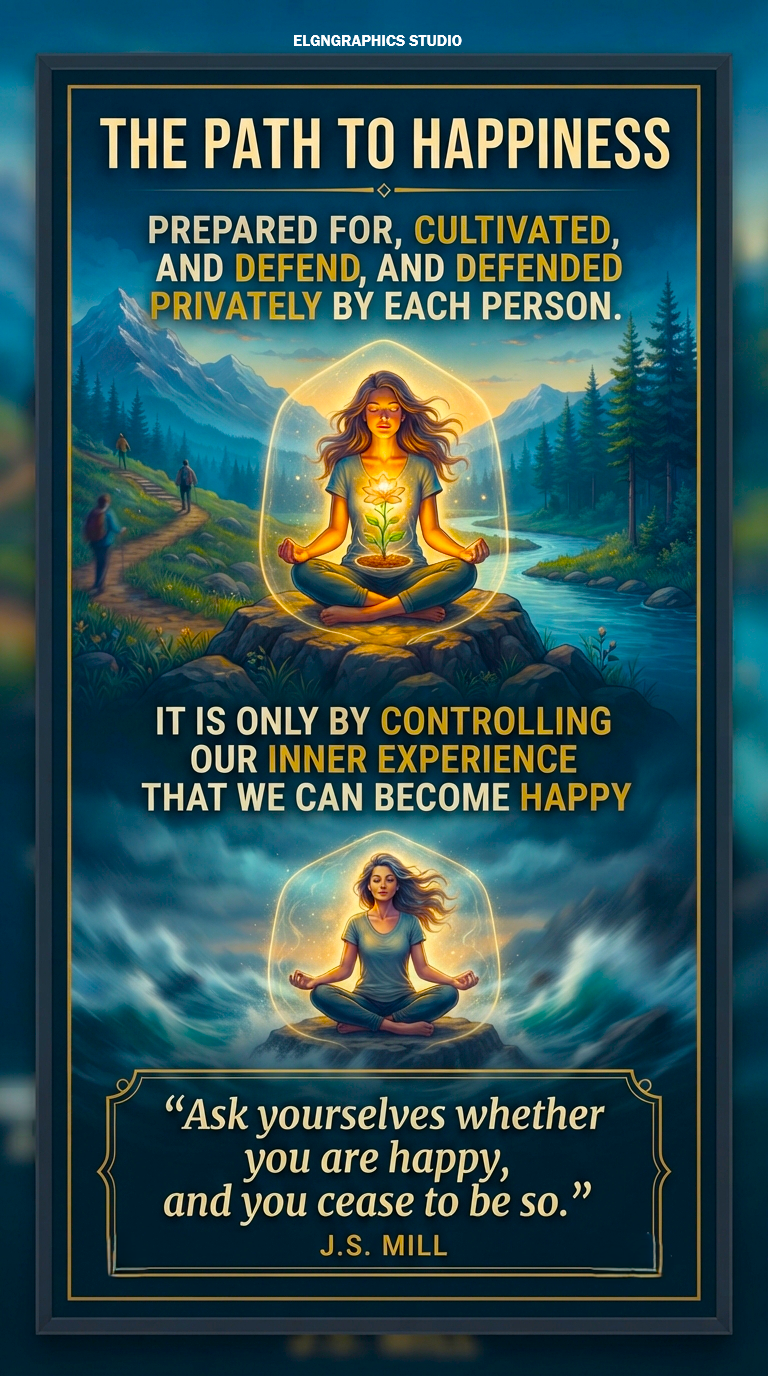
As Mihaly Csikszentmihalyi wrote, “Happiness is a condition that must be prepared for, cultivated and defended privately by each person. It is only by controlling our inner experience that we can become happy.”
In contrast, happiness, he argued, is not something that happens to all of us, nor something that can be pursued directly. As opposed to that, it is a condition that must be consciously cultivated and protected through the way we direct the attention.
Likewise, he echoes the nineteenth-century philosopher John Stuart Mill, who observed, “Ask yourself whether you are happy, and you cease to be so.”**
This perspective fundamentally shifts the understanding of artistic perspective. The goal is no longer to chase inspiration or force originality, but to cultivate a state of disciplined attention. Creativity then becomes a bridge between surrender and attentiveness, revealing that the most profound insights often arise when effort relaxes into openness.
In that sense, ‘flow’ is paradoxical, the self performs at its highest level precisely when it temporarily stops making itself the center of attention.
Rather than adding something to consciousness, flow removes the internal noise that normally prevents deeper patterns from becoming visible. That inversion , the realization that the artful ideas emerge not from trying harder but from interfering less, was perhaps the most enduring lesson I took from those great books.
For instance, a 2018 report by Adobe revealed that 67% of creative professionals believe that intuition and listening to their inner voice lead to superior work. This finding reinforces the idea that surrendering to internal inspiration is essential for authentic and impactful creativity (Adobe, 2018).
Creating & Working by the Philosophy
The culmination of this artistic journey is the understanding that the manifestation of the Muse state is not a fixed achievement, but an ongoing and evolving process. It is about living with an open heart and mind, recognizing that every act of creation becomes part of a continuous inner-out dialogue — almost sacred in its unfolding.
While I deeply hope to have offered some measure of inspiration, I remain fully aware that the world is shaped by countless artists, creators, minds, and creative approaches — each contributing their own unique vision, language, and way of seeing. In that sense, this vision is both private and universal, rooted in deeply personal origins, yet echoing in shared resonance with others creators world-wide.
Inspiring Conclusive Point
Over time, the concept of creative insight has become quieter and more personal. Inspiration is no longer viewed as something to be chased or forced but as something that emerges naturally. The emphasis is on cultivating the conditions that allow insight to unfold. Each project becomes a reflective conversation — developing gradually through attentive presence, and an openness to uncertainty, even when the path forward is unclear.
Humble Practical Approach to Cultivate the Muse:
A Personal and Philosophical Approach
Cultivating a meaningful connection with the Muse is a deeply personal journey — one that requires gentle dedication and a willingness to nurture the subtle currents of inspiration.
*Csikszentmihalyi also reminds that *“Most enjoyable activities are not natural; they demand an effort that initially one is reluctant to make.”****
Those steps presented not in pursuit rooted in quirkily fleeting tricks, but rather an ongoing commitment to creating sacred private space for insight to emerge and for inspiration to flow with grace and trust. In embracing these practices, the creative spirit indeed invited to flourish quietly, revealing its key realizations in time.
1. Establish a Sacred Ritual of Reflection
When feeling stuck or disconnected from inspiration, taking a quiet moment with a cup of tea, lighting a candle, and reflecting on thoughts and feelings can be profoundly beneficial. Making this a daily ritual honors the inner voice and creates a safe space for creative awakening.
Rumi’s words, “The wound is the place where the Light enters,” highlight that reflection allows inspiration to emerge through vulnerability, doubt, and uncertainty.
Dedicate ten minutes each morning to journaling or meditation — simply observe what naturally arises without agenda or judgment.
2. Practice Active Surrender
Letting go of control and judgment can lead to unexpected beauty and inspiration. For example, engaging in automatic drawing or free writing — moving the hand without conscious direction — can be a liberating experience that uncovers hidden ideas.
Incorporation of weekly sessions of automatic drawing or free writing to allow the subconscious to guide the process.
3. Embrace Silence and Stillness
Regularly sitting in silence, away from digital distractions and noise, can spark profound ideas. Moments of quiet reflection allow the mind to wander freely and open pathways for inspiration.
Making time for nature walks or simply sitting quietly in a peaceful space fosters fertile ground for creative insights.
4. Use Creative Constraints as Catalysts
Limitations can paradoxically stimulate creative sensibility by forcing new ways of thinking. For instance, restricting a palette to only three colors can push the artistic mood to innovate within boundaries, turning constraints into opportunities.
This approach echoes Stoic principles — discipline and limitations serve as tools that sharpen focus and foster ingenuity, ultimately leading to greater freedom in expression.
Set challenges such as limiting tools or timing sessions to stimulate creative problem-solving and spontaneity.
This practical approach of 4 approaches aligns with Taoist Wu Wei — effortless action, is a concept from ancient Chinese philosophy that literally means not-acting or non-doing, variously interpreted and translated as action-lessness, inaction, or effortless action.
As inspiring observed and advised by Lao Tzu that: “When I let go of who I am, I become what I might be.”
Similarly, these clues regarding creative surrender foster flow states, where visual conceptualization and aesthetic understanding arise naturally and spontaneously, illuminating the depths of any artistic insight.
메타데이터
- post_id
- 55d96116c660
- slug
- constructing-the-unspoken-an-artists-consciousness-in-blueprint-55d96116c660
- url
- https://medium.com/@nirelpublishinghouse/constructing-the-unspoken-an-artists-consciousness-in-blueprint-55d96116c660
- canonical_url
- https://medium.com/@nirelpublishinghouse/constructing-the-unspoken-an-artists-consciousness-in-blueprint-55d96116c660
- author_url
- https://medium.com/@nirelpublishinghouse
- status
- ok
- fetched_at
- 2026-07-15 19:28:09