CPM Calculator: The Ultimate Guide to Calculating Cost Per Mille Like a Pro
If you’ve ever sat across the table from a media buyer or managed a digital ad campaign, you already know that CPM — Cost Per Mille — is…
CPM Calculator: The Ultimate Guide to Calculating Cost Per Mille Like a Pro
CPM Calculator: The Ultimate Guide to Calculating Cost Per Mille Like a Pro
If you’ve ever sat across the table from a media buyer or managed a digital ad campaign, you already know that CPM — Cost Per Mille — is one of the most fundamental metrics in advertising. Yet, despite its simplicity in concept, calculating CPM manually across campaigns, channels, and budgets can become surprisingly complex, error-prone, and time-consuming.
After years of working in digital advertising and media planning, I’ve seen brands burn thousands of dollars simply because they miscalculated their CPM — or worse, didn’t understand what they were buying in the first place. That’s exactly why a reliable CPM Calculator isn’t just a convenience tool; it’s an essential part of any advertiser’s arsenal.
In this guide, I’m going to walk you through everything you need to know about CPM calculation — from the foundational formula to real-world applications, advanced comparisons, and how to use a CPM calculator the right way to stretch every dollar of your ad spend.
What Is CPM? Understanding Cost Per Mille
Before we dive into the mechanics of the calculator, let’s establish a rock-solid foundation.
CPM stands for Cost Per Mille, where “mille” is Latin for thousand. In advertising terms, CPM represents the cost an advertiser pays for one thousand impressions of their advertisement — regardless of how many people actually click on it or convert.
This is a crucial distinction. CPM is an impression-based pricing model, which means you’re paying for visibility, not action. It’s the currency of brand awareness campaigns, programmatic display advertising, video pre-rolls, podcast sponsorships, and Out-of-Home (OOH) media placements.
Why Does CPM Matter?
CPM is the lingua franca of media buying. Whether you’re negotiating with a premium publisher, setting up a Google Display Network campaign, buying Facebook impressions, or planning a traditional TV spot, CPM gives you a standardized, apples-to-apples way to compare the cost of reaching audiences across wildly different channels.
Without understanding CPM, you’re essentially flying blind. You can’t compare a $5,000 newspaper ad reaching 200,000 readers to a $2,000 YouTube pre-roll serving 500,000 impressions unless you translate both into CPM terms.
What Is a CPM Calculator?
A CPM Calculator is a digital tool that automates the computation of three interrelated variables in the CPM equation:
- CPM (Cost Per Thousand Impressions)
- Total Cost (Ad Spend / Budget)
- Impressions (Total number of times your ad is shown)
By entering any two of these three values, the calculator instantly solves for the third. This eliminates manual math errors, saves time during campaign planning and reporting, and allows marketers to run quick “what-if” scenarios in real time.
You can use our dedicated CPM Calculator to run these calculations instantly, without any spreadsheets or formulas.
The Core CPM Formula Explained
The foundational CPM formula is deceptively simple:
CPM = (Total Cost ÷ Total Impressions) × 1,000
From this single equation, you can derive two additional formulas:
Total Cost = (CPM × Impressions) ÷ 1,000
Total Impressions = (Total Cost ÷ CPM) × 1,000
These three variations let you solve any CPM-related problem you’ll encounter in practice — whether you’re calculating what a campaign will cost, what CPM a publisher is charging you, or how many impressions you can buy with a fixed budget.
How to Use a CPM Calculator: Step-by-Step
Using a CPM calculator is straightforward, but knowing which scenario you’re solving for changes which fields you’ll fill in. Here’s a breakdown of all three use cases.
Scenario 1: Calculate CPM from Cost and Impressions
Use this when: A publisher sends you a proposal — say, “500,000 impressions for $2,500” — and you want to know the effective CPM.
Steps:
- Enter Total Cost: $2,500
- Enter Total Impressions: 500,000
- Leave CPM blank
- Click Calculate
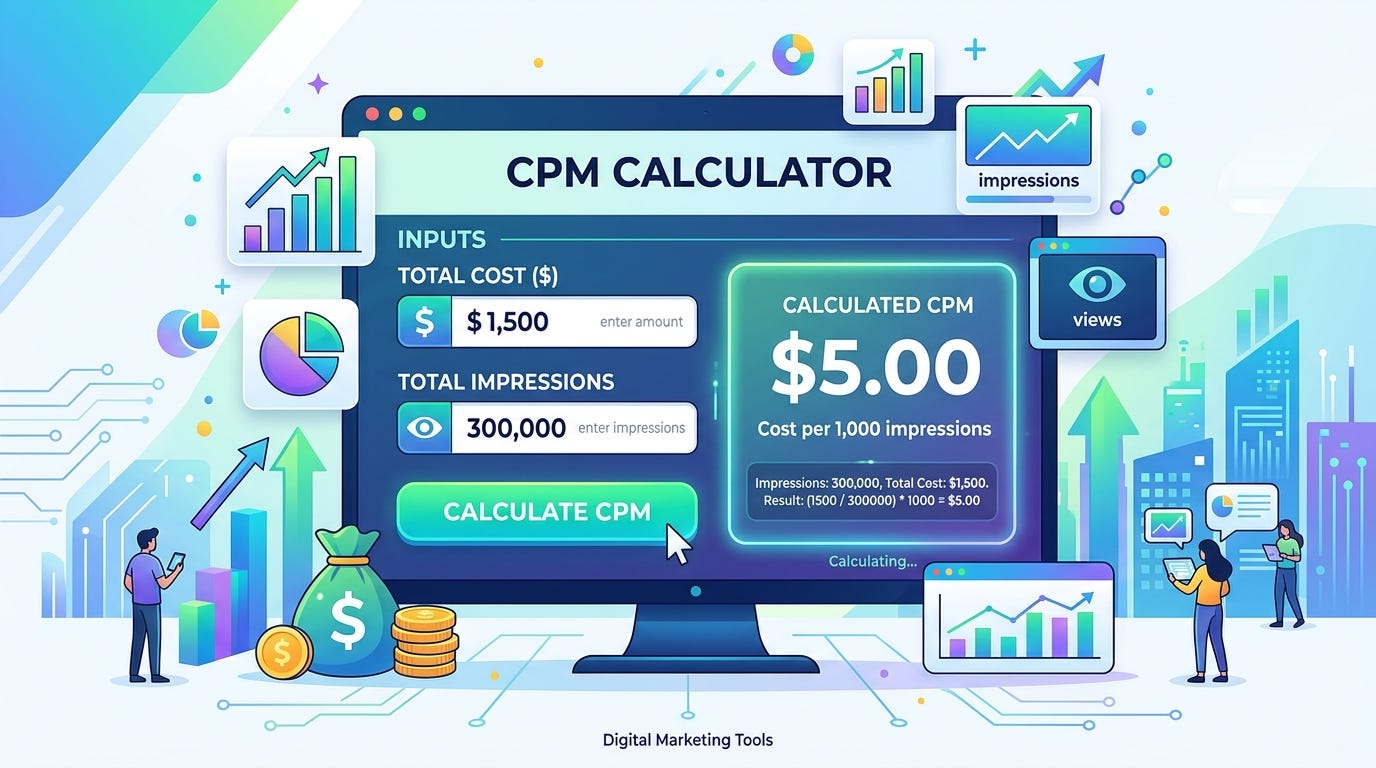
Result: CPM = ($2,500 ÷ 500,000) × 1,000 = $5.00 CPM
Scenario 2: Calculate Total Cost from CPM and Impressions
Use this when: You know a channel charges a $12 CPM and you want to buy 2,000,000 impressions. What’s your total budget?
Steps:
- Enter CPM: $12
- Enter Total Impressions: 2,000,000
- Leave Total Cost blank
- Click Calculate
Result: Total Cost = ($12 × 2,000,000) ÷ 1,000 = $24,000
Scenario 3: Calculate Impressions from Budget and CPM
Use this when: Your budget is fixed at $5,000 and you’re buying at a $7 CPM. How many eyeballs can you reach?
Steps:
- Enter Total Cost: $5,000
- Enter CPM: $7
- Leave Impressions blank
- Click Calculate
Result: Impressions = ($5,000 ÷ $7) × 1,000 = 714,285 impressions
This third scenario is particularly powerful during media planning when you need to forecast reach under budget constraints.
CPM Calculator Example: A Real-World Campaign Walkthrough
Let me share an example that mirrors a real scenario I’ve encountered many times when advising brands on media strategy.
The Situation
A mid-sized e-commerce brand has a $30,000 quarterly brand awareness budget. Their media plan includes three channels:
ChannelBudget AllocatedImpressions DeliveredCPMProgrammatic Display$10,0002,500,000$4.00YouTube Pre-Roll$12,000800,000$15.00Podcast Sponsorship$8,000320,000$25.00TOTAL$30,0003,620,000$8.29 blended
What the CPM Calculator Reveals
At first glance, programmatic display looks like the winner — $4.00 CPM is dirt cheap. But here’s what the CPM calculator alone doesn’t tell you: not all impressions are equal.
The podcast sponsorship at $25.00 CPM delivers a highly engaged, trusted audience that listens attentively. The $4.00 programmatic CPM includes banner blindness, bot traffic risk, and low viewability.
This is a lesson I’ve hammered home to dozens of clients: use the CPM calculator to get accurate numbers, then apply judgment about quality.
The blended CPM across the entire buy is $8.29 — calculated as:
Blended CPM = ($30,000 ÷ 3,620,000) × 1,000 = $8.29
This single number becomes your benchmark for the next quarter’s negotiation.
CPM Benchmarks by Industry and Channel (2024–2025)
One of the questions I get asked most frequently is: “Is my CPM good?” Here’s a reference chart based on current industry data:
CPM Benchmarks by Ad Channel
Ad ChannelAverage CPM RangeNotesFacebook/Instagram Ads$7 — $14Varies by audience targeting depthGoogle Display Network$2 — $6Lower quality, high scaleYouTube Ads$10 — $30Pre-roll vs. bumper ads varyLinkedIn Ads$30 — $90Premium B2B audienceProgrammatic Display$1 — $5Includes long-tail inventoryPodcast Advertising$18 — $50Host-read commands premiumConnected TV (CTV)$25 — $50High viewability, growing channelOut-of-Home (OOH)$3 — $15Location and format dependentPrint/Magazine$10 — $30Declining but niche valuePremium Publisher Direct$15 — $45Brand-safe, high viewability
CPM Benchmarks by Industry Vertical
IndustryTypical CPM RangeFinance & Insurance$15 — $40Healthcare$12 — $35Retail & E-commerce$5 — $15Technology (B2B)$20 — $60Travel & Hospitality$8 — $20Entertainment$4 — $12Education$6 — $18
Note: These are directional benchmarks. Actual CPMs fluctuate based on seasonality, targeting parameters, creative quality, and auction dynamics.
CPM vs. CPC vs. CPA: Understanding Pricing Models
No discussion of CPM calculation is complete without situating it within the broader landscape of advertising pricing models. As someone who’s worked across all three, here’s my honest take on each:
CPM (Cost Per Mille)
- Pay for: Impressions
- Best for: Brand awareness, reach campaigns, top-of-funnel
- Risk: You pay regardless of engagement
- Reward: Predictable reach at scale
CPC (Cost Per Click)
- Pay for: Clicks to your website or landing page
- Best for: Mid-funnel traffic generation, lead capture
- Risk: Low-quality clicks or click fraud can inflate costs
- Reward: You only pay when someone acts
CPA (Cost Per Acquisition)
- Pay for: Conversions (purchases, sign-ups, downloads)
- Best for: Bottom-of-funnel, performance campaigns
- Risk: Publishers require conversion tracking; lower publisher inventory access
- Reward: Most directly tied to ROI
When CPM Is the Right Model
CPM pricing makes sense when:
- You’re building brand awareness at scale
- You can’t easily track clicks or conversions (podcast, OOH, TV)
- You want predictable, guaranteed reach
- You’re negotiating direct publisher deals
For performance-focused campaigns, you’ll want to convert your CPM thinking into eCPM (effective CPM) — a metric that allows you to compare the efficiency of CPM buys against CPC or CPA buys. You can find other useful marketing calculators, like the Vorici Calculator, to complement your media planning toolkit.
eCPM vs. CPM: What’s the Difference?
This is a distinction that trips up even experienced marketers.
CPM is the price you pay as an advertiser — it’s the buy-side metric.
eCPM (Effective CPM) is what publishers earn per thousand impressions, regardless of whether their inventory was sold on a CPM, CPC, or CPA basis. It normalizes all pricing models into a CPM equivalent.
eCPM = (Total Earnings ÷ Total Impressions) × 1,000
For publishers, eCPM is critical for comparing revenue across ad networks and formats. For advertisers, calculating eCPM on your performance campaigns helps you understand the true impression cost of your CPC or CPA buys.
Advanced CPM Concepts Every Marketer Should Know
Viewable CPM (vCPM)
Standard CPM counts an impression the moment an ad loads, regardless of whether a user actually sees it. vCPM only counts impressions that meet the IAB viewability standard: at least 50% of the ad in view for a minimum of one second (display) or two seconds (video).
Always ask publishers for viewability rates alongside raw CPM. A $3 CPM with 40% viewability is effectively a $7.50 vCPM — worse than a publisher charging $5 CPM at 90% viewability.
Share of Voice (SOV) and CPM
In certain media buys — particularly OOH, digital out-of-home (DOOH), or roadblocks — you’re buying a percentage of impressions in a given context. Your CPM is directly tied to your SOV. Higher SOV = higher CPM, but also more competitive dominance in that environment.
Frequency and CPM
Reach and frequency are the twin pillars of media planning. CPM tells you the cost of impressions, but frequency tells you how many times the same person sees your ad. A campaign with a $5 CPM and 10+ frequency might be less efficient than a $10 CPM campaign with 3–4 frequency, depending on your creative and objectives.
CPM in Programmatic Advertising
Programmatic advertising — the automated buying and selling of digital ad inventory — runs almost entirely on CPM pricing. Understanding CPM in this context requires familiarity with a few additional concepts:
Floor CPM
Publishers set a floor price (minimum CPM) below which they won’t sell inventory. Floor prices protect premium publishers from devaluing their inventory through low-ball bids.
Bid CPM vs. Clearing CPM
In a real-time bidding (RTB) auction, you set a bid CPM — the maximum you’re willing to pay. The clearing CPM (what you actually pay) is typically $0.01 above the second-highest bid, thanks to second-price auction mechanics. Your bid CPM should reflect the maximum value of the impression to you; the market sets the actual clearing price.
Target CPM (tCPM)
Google’s campaigns use target CPM as a bidding strategy, where you set an average CPM you want to achieve, and the algorithm optimizes bids across an auction to hit that target while maximizing impressions.
Common CPM Calculation Mistakes (And How to Avoid Them)
In my years consulting on media buys, I’ve seen the same mistakes repeated across organizations of every size.
Mistake 1: Confusing Gross and Net Impressions
Agency fees, ad serving costs, and technology fees can reduce your effective impression count. Always calculate CPM on delivered impressions, not contracted impressions.
Mistake 2: Ignoring Invalid Traffic (IVT)
Bot traffic, click farms, and ad fraud inflate impression numbers. A campaign reporting 5,000,000 impressions with 15% IVT has effectively delivered 4,250,000 valid impressions — raising your real CPM meaningfully. Use third-party measurement to strip out IVT before calculating final CPM.
Mistake 3: Comparing CPMs Across Incompatible Formats
Comparing a 30-second unskippable video CPM to a small banner CPM is like comparing apples to oranges. Always compare CPMs within the same format and context.
Mistake 4: Forgetting to Account for Frequency Caps
If you’re applying tight frequency caps, your effective reach expands but your per-person impression count drops. This changes the value of your CPM even if the rate stays constant.
Mistake 5: Not Benchmarking Seasonally
CPMs spike significantly in Q4 (holiday season) and around major events. A $10 CPM in October might balloon to $20+ in December. Build seasonal CPM escalation into your planning models. You can also explore tools like Vorici Calculator for additional planning utilities that complement your media buying workflow.
How to Lower Your CPM Without Sacrificing Quality
This is where strategy meets execution. Here are proven techniques I recommend to clients:
1. Improve Your Audience Targeting Precision
Overly broad audiences drive up competition and CPMs. Layer first-party data, contextual signals, and behavioral segments to reach high-value audiences more efficiently — often at lower CPMs because you’re buying less inventory but more relevant inventory.
2. Test Multiple Creative Formats
Certain ad formats command premium CPMs by default. Experimenting with alternative formats (e.g., native ads vs. standard display) can yield significantly lower CPMs with comparable or better engagement.
3. Negotiate Directly with Publishers
Programmatic auctions are competitive. Direct deals with publishers — particularly private marketplace (PMP) deals — often yield better CPMs, higher viewability guarantees, and premium placement that programmatic open exchange can’t match.
4. Optimize for Time of Day and Day of Week
CPMs aren’t static. Running campaigns during lower-competition time windows (weekday mornings, for instance) often results in lower clearing CPMs without significantly sacrificing reach.
5. Improve Quality Score and Relevance
On platforms like Google and Meta, your ad quality and audience relevance scores directly influence your effective CPM. Better-targeted, higher-quality creative receives favorable pricing treatment from platform algorithms.
CPM Calculator for Publishers: Monetization Planning
CPM isn’t just for advertisers. Publishers need to understand CPM deeply to maximize their ad revenue.
If you’re a publisher, the CPM formula helps you answer critical business questions:
- “How much can I earn if I sell all my inventory at a $10 CPM?”
- “What CPM do I need to hit my monthly revenue target?”
- “How does adding an ad unit change my total eCPM?”
Publisher Revenue Formula
Ad Revenue = (Total Impressions ÷ 1,000) × CPM
For example, a blog generating 2,000,000 monthly page views with 2 ad units per page (4,000,000 ad impressions) and a blended eCPM of $3.50 would earn:
Revenue = (4,000,000 ÷ 1,000) × $3.50 = $14,000/month
Understanding this math empowers publishers to make smart decisions about ad density, format mix, and network partnerships.
CPM Calculation in Social Media Advertising
Social media platforms each have their own CPM dynamics, and knowing the nuances can save you significant budget.
Facebook and Instagram CPM
Meta’s auction-based system means CPMs fluctuate constantly based on audience competition. Narrow targeting on high-demand audiences (25–45, household income $75K+, in major metros) consistently produces higher CPMs. Broad targeting with good creative often yields lower CPMs with acceptable reach quality.
LinkedIn CPM
LinkedIn CPMs are structurally higher ($30–$90+) because the B2B professional audience is genuinely hard to reach elsewhere. The premium is often justified for high-ticket B2B offers, but it makes LinkedIn prohibitively expensive for low-margin products.
Twitter/X CPM
X CPMs have become more volatile post-acquisition, but for news, technology, and cultural content, engagement rates can partially offset higher per-impression costs.
TikTok CPM
TikTok’s CPM has risen as the platform has matured but remains competitive for reaching younger demographics. The format forces authentic creative, which can perform extremely well at scale.
Using CPM Data to Improve Campaign ROI
CPM is the starting point, not the ending point, of campaign analysis. Here’s how to connect CPM to actual business outcomes.
The CPM → CTR → CPC → CPA Chain
Every impression-based campaign ultimately needs to be traced back to revenue impact. The analytical chain works like this:
- CPM tells you the cost of reaching 1,000 people
- CTR (Click-Through Rate) tells you what percentage clicked
- CPC (Cost Per Click) = CPM ÷ (CTR × 10)
- Conversion Rate tells you what percentage of clicks converted
- CPA (Cost Per Acquisition) = CPC ÷ Conversion Rate
If your CPM is $10, CTR is 0.5%, conversion rate is 2%, then:
- CPC = $10 ÷ (0.005 × 10) = $10 ÷ 0.05 = $200 CPC
- CPA = $200 ÷ 0.02 = $10,000 CPA
That would clearly be unprofitable for most products — which is why CPM context matters enormously. A $3 CPM with a 0.1% CTR can outperform a $12 CPM with a 0.8% CTR depending on your conversion funnel efficiency.
Frequently Asked Questions (FAQs) About CPM Calculator
Q1: What does CPM stand for in advertising?
CPM stands for Cost Per Mille, where “mille” is Latin for one thousand. It represents the cost an advertiser pays for every 1,000 impressions (ad views) delivered. It is one of the most widely used pricing models in digital, broadcast, print, and outdoor advertising.
Q2: How is CPM calculated?
CPM is calculated using this formula: CPM = (Total Cost ÷ Total Impressions) × 1,000
For example, if you spend $500 to reach 100,000 people, your CPM = ($500 ÷ 100,000) × 1,000 = $5.00 CPM.
Q3: What is a good CPM rate?
A “good” CPM depends heavily on the channel, industry, and campaign objective. As a general guide:
- Programmatic display: $1–$5 is considered competitive
- Social media (Facebook/Instagram): $7–$14 is average
- Video (YouTube/CTV): $10–$30 is typical
- LinkedIn (B2B): $30–$90 is the norm
- Podcast: $18–$50 for host-read ads
The right CPM is one that delivers a positive return relative to the lifetime value of the customers acquired.
Q4: What is the difference between CPM and eCPM?
CPM is the rate advertisers pay to buy impressions. eCPM (Effective CPM) is a publisher-side metric that normalizes revenue across all pricing models (CPM, CPC, CPA) into a per-thousand-impression equivalent. Publishers use eCPM to compare the performance of different ad networks and formats.
Q5: Can I use a CPM Calculator to plan my total ad budget?
Absolutely. If you know your target CPM and the number of impressions you need to achieve your reach goals, the CPM Calculator instantly computes your required budget. This is one of the most practical uses of the tool during media planning.
Q6: Does a lower CPM always mean better value?
Not necessarily. A lower CPM reflects lower cost per impression, but it doesn’t account for impression quality, viewability, audience relevance, ad fraud, or engagement rates. A $25 CPM on a highly engaged, verified audience can deliver better ROI than a $2 CPM on low-quality, bot-inflated inventory.
Q7: How does CPM differ from CPC?
CPM (Cost Per Mille) charges for impressions, while CPC (Cost Per Click) charges only when a user clicks your ad. CPM is ideal for awareness campaigns; CPC is better for direct response and traffic generation. You can convert between the two: CPC = CPM ÷ (CTR × 10).
Q8: Why do CPMs spike in Q4?
Q4 sees massive advertiser competition due to Black Friday, Cyber Monday, and the holiday shopping season. More advertisers competing for the same ad inventory drives up auction clearing prices, resulting in significantly higher CPMs across most digital channels — often 30–100% higher than Q1 rates.
Q9: How do I reduce my CPM without losing reach?
Key strategies include: improving audience targeting precision, testing alternative ad formats, negotiating direct publisher deals, running campaigns during lower-competition time windows, and improving creative quality to boost platform quality scores. Each of these can reduce your effective CPM while maintaining or improving campaign performance.
Q10: Is CPM used in streaming and podcast advertising?
Yes. Both Connected TV (CTV) and podcast advertising are primarily CPM-based. CTV CPMs typically range from $25–$50 due to high viewability and premium content environments. Podcast CPMs (especially host-read) range from $18–$50 and are valued for their high listener trust and low ad-skipping behavior.
Summary: Why Every Marketer Needs a CPM Calculator
After more than a decade working in digital advertising, media planning, and campaign strategy, I can tell you with confidence that the CPM Calculator is one of the most used — and most underappreciated — tools in the marketer’s toolkit. It’s not glamorous. It won’t generate creative inspiration or predict consumer behavior. But it will do something arguably more important: it will keep your math honest.
Here’s what you should take away from this guide:
- CPM = (Cost ÷ Impressions) × 1,000 — master this formula and its two derivatives
- A CPM Calculator solves for any one variable when you have the other two
- Always evaluate CPM in context — viewability, audience quality, and fraud rates all affect true value
- Industry CPM benchmarks give you negotiating leverage with publishers
- CPM connects to CPC and CPA through CTR and conversion rate — never analyze it in isolation
- Seasonal fluctuations (especially Q4) can dramatically shift your effective CPM
Use our CPM Calculator to run your calculations, benchmark your buys, and build media plans grounded in real math. Your campaigns — and your budget — will thank you.
For additional marketing and media planning tools, explore the resources available at passportphotos4.com and the broader Vorici Calculator ecosystem.
메타데이터
- post_id
- 61dcf9d8539b
- slug
- cpm-calculator-the-ultimate-guide-to-calculating-cost-per-mille-like-a-pro-61dcf9d8539b
- url
- https://medium.com/@passportphotos3/cpm-calculator-the-ultimate-guide-to-calculating-cost-per-mille-like-a-pro-61dcf9d8539b
- canonical_url
- https://medium.com/@passportphotos3/cpm-calculator-the-ultimate-guide-to-calculating-cost-per-mille-like-a-pro-61dcf9d8539b
- author_url
- https://medium.com/@passportphotos3
- status
- ok
- fetched_at
- 2026-06-24 04:09:36