The Second Job Nobody Hired You For
There’s a particular weariness that sets in when seeking care stops feeling like a partnership and starts feeling like a battle you’re…
The Second Job Nobody Hired You For
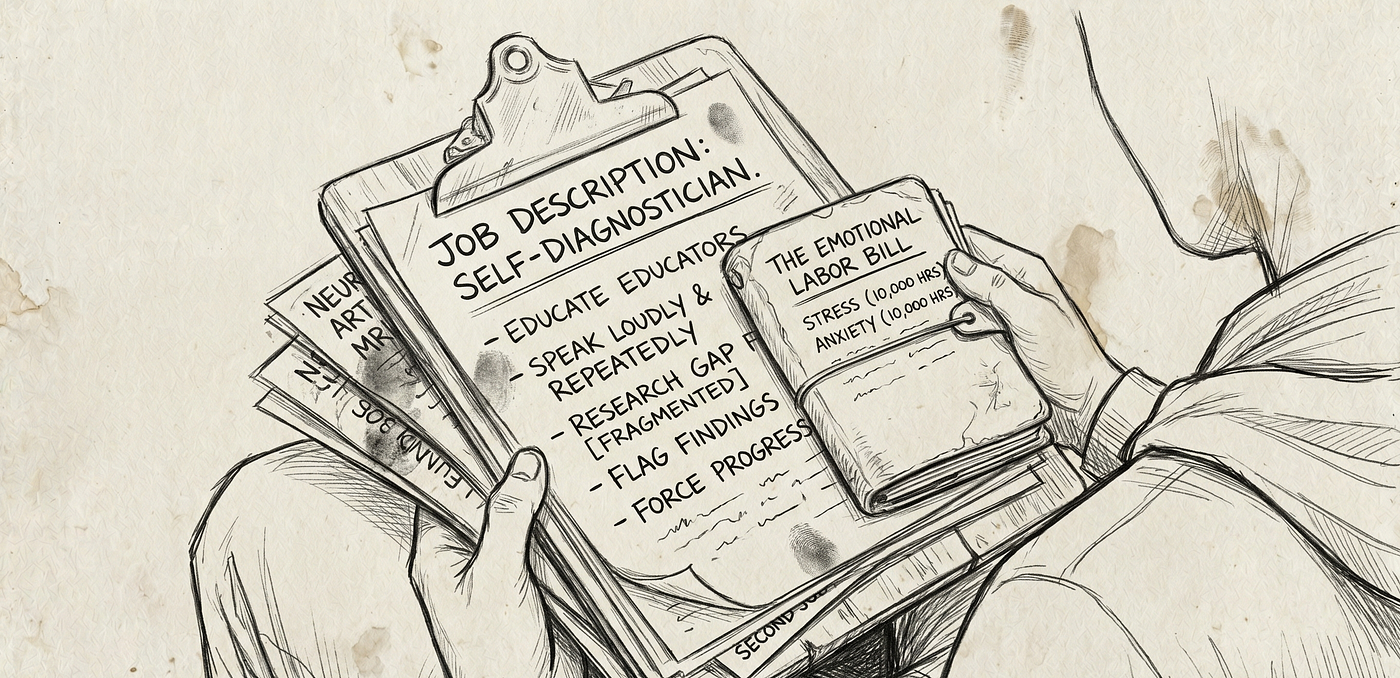
There’s a particular weariness that sets in when seeking care stops feeling like a partnership and starts feeling like a battle you’re waging entirely on your own. Since October 2024, that’s what it was for me. Not seeking care, exactly. Working a second job. One nobody hired me for, one I couldn’t quit, and one that paid nothing — not even answers.
The path is familiar to anyone who’s been in the rare disease world long enough: you push for tests, suggest possibilities, quietly nudge toward referrals. You hear “manage your stress” and “drink more water” from people who mean well but are already mentally on to the next patient. And you come to understand, through repetition, that what’s missing isn’t information. It’s curiosity. The willingness to stay in the question with you long enough to actually look. To believe that you know your own body, and that what you’re describing means something.
What made this stretch stranger, in my case, is that I wasn’t coming into those appointments empty-handed. I spent years as a genetic counselor. I sat on the other side of the table — explaining connective tissue disorders, walking people through diagnostic processes, trying to model what it looks like when a provider shows up with genuine investment. I know what prepared care looks like from the inside. Which means I also know, in a specific and uncomfortable way, exactly what it looks like when it isn’t there.
The feeling that progress only happens when you force it is isolating. Hard to explain to someone who hasn’t felt it. A potential answer finally emerged, but not from anything systematic, not from the worsening symptoms I’d been reporting for over a year. It came from an incidental finding on a CT scan ordered to check on kidney stones. And even then, the silence was deafening. It fell to me to flag the finding, to push for the referral, to research what I should and shouldn’t be doing during the months-long gap before I could see a specialist. That guidance was never offered. I went looking for it the same way I’d been going looking for everything else.
The reality underneath all of this is uncomfortable: without the knowledge I’d built over years, without the willingness to speak up loudly and repeatedly, I was causing harm to my own body while the system caught up. That’s not a small thing to sit with.
But the toll goes deeper than the research hours. There’s also the self-doubt, and it’s the part that rarely gets named out loud. Even when you’re certain something is wrong, there’s a voice, worn into you by enough dismissals, that starts asking: what if I’m catastrophizing? What if I’m wrong this time? What if the stress really is the issue? The system fails you medically and then keeps going: it makes you doubt your own read on your own body. That damage is real. It doesn’t stop at the door.
And then there’s the cost of just walking into the room. Every visit became a chess match I hadn’t asked to play. How do I frame this so I’m heard? How much do I share, and how much do I hold back? Do I lead with the research, or will that put them on the defensive? Do I push harder today, or is this the visit where pushing harder backfires? You’re running all of that in the background while also trying to process your symptoms, your fear, and your entirely reasonable anger that any of it is required at all.
When people in the rare disease world ask what I’d tell someone newly diagnosed, I always feel a little uneasy before I answer — because the honest answer is: learn everything you can about your condition, and get very good at articulating what you need. That’s not how it should work. But your informed, persistent voice can be the difference between getting critical imaging in an emergency and being sent home dismissed. That’s just the reality.
Every time I say it, I also apologize.
I apologize because you shouldn’t have to carry this. You shouldn’t need to become an expert diagnostician just to receive appropriate care. Educating your own educators shouldn’t be part of the job either. The emotional and intellectual labor is immense, and the system handed you that bill expecting gratitude.
I stepped away from clinical practice a few years ago — partly because I’d spent so long carrying other people’s medical weight that I’d stopped tracking my own. What I didn’t expect was that leaving the provider role wouldn’t make the patient role any easier. The people I used to counsel were carrying more than medical facts. They were carrying the full-time job of making the system see them. I know that now in a way I didn’t when I was the one handing out the advice.
We do this because we have to. Our lives can depend on it. But I won’t dress that up as empowerment. The system is broken, and we’re the ones filling the gap it left.
The least I can do is name what that costs. And refuse to pretend the cost is okay.
What does this second job take from you?
All views and opinions expressed here are my own and do not represent those of my employer.
메타데이터
- post_id
- 67215a8d0a0a
- slug
- the-second-job-nobody-hired-you-for-67215a8d0a0a
- url
- https://medium.com/@ryan.rodarmer/the-second-job-nobody-hired-you-for-67215a8d0a0a
- canonical_url
- https://medium.com/@ryan.rodarmer/the-second-job-nobody-hired-you-for-67215a8d0a0a
- author_url
- https://medium.com/@ryan.rodarmer
- status
- ok
- fetched_at
- 2026-06-15 20:49:13


