How Isabel Haugseng Johansen Became Vantix’s WAG of the 2026 FIFA World Cup
Photo: Thomas Nilsson / VG / Instagram, Courtesy
How Isabel Haugseng Johansen Became Vantix’s WAG of the 2026 FIFA World Cup
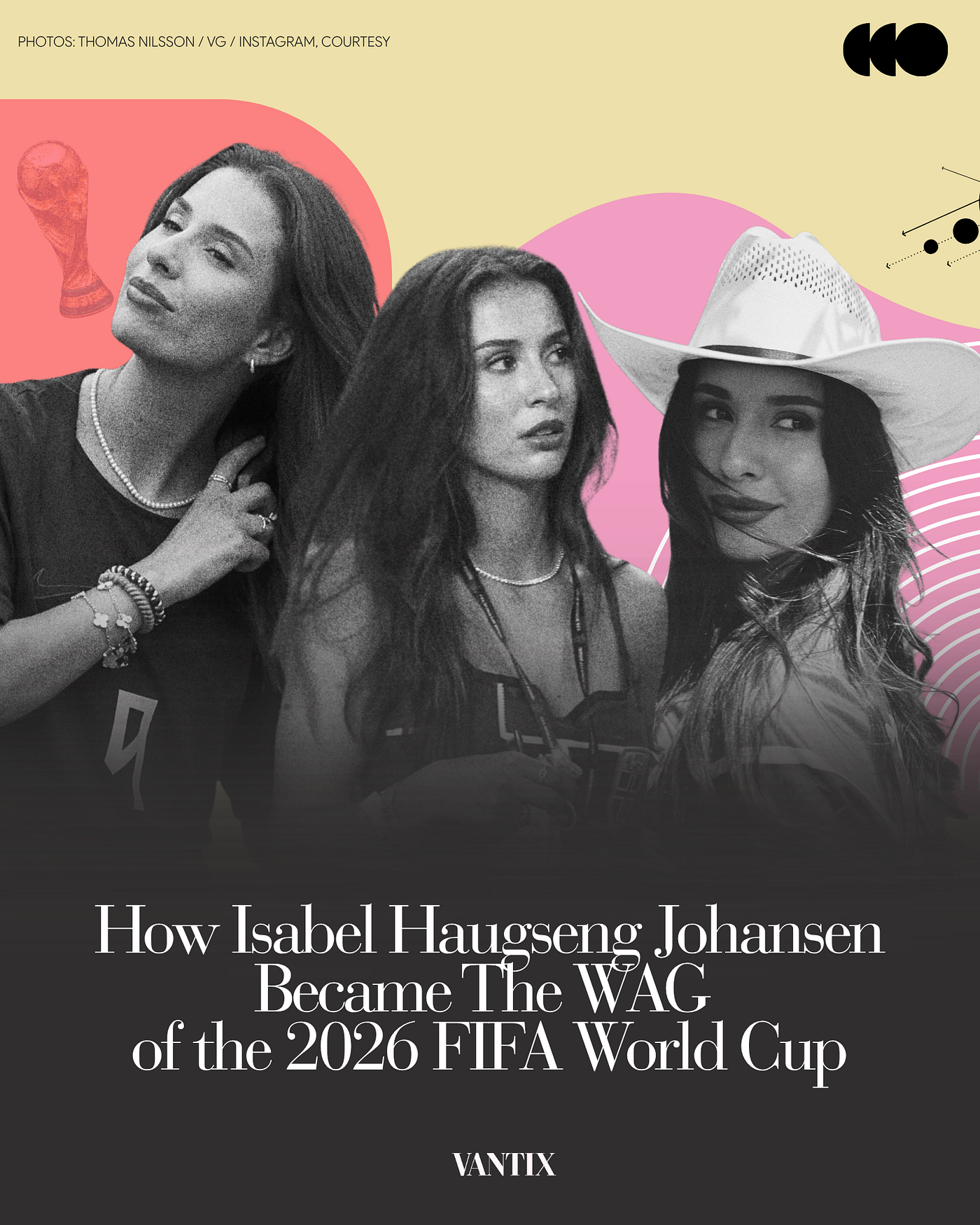
Photo: Thomas Nilsson / VG / Instagram, Courtesy
She didn’t arrive in North America as the tournament’s biggest off-pitch star. Five weeks later, she had become its defining cultural figure. This is the story of how Isabel Haugseng Johansen captured the 2026 FIFA World Cup beyond the football.
Every FIFA World Cup leaves two histories.
One lives in scorelines, trophies, and statistics. The other unfolds in photographs, fashion, viral moments, and personalities who shape the tournament off the pitch.
By the close of this summer’s tournament, one question stood out: Who was the defining World Cup WAG?
Popularity is not influence. Existing fame is not tournament impact. Vantix tracked audience growth, fashion consistency, editorial visibility, cultural conversation, commercial momentum, and sustained relevance across five weeks. No single metric decided it. The goal was clear: the woman whose profile became most intertwined with the tournament itself.
Several contenders finished with larger audiences. Yet none matched Isabel Haugseng Johansen’s combination of acceleration, fashion relevance, and sustained cultural presence. Her story became inseparable from the cultural narrative of the 2026 World Cup.
DISCOVER: Inside the Vantix Clout Index: The 100-Point Formula Defining World Cup Influence
Establishing the Baseline
Every credible verdict starts with the pre-tournament reality.
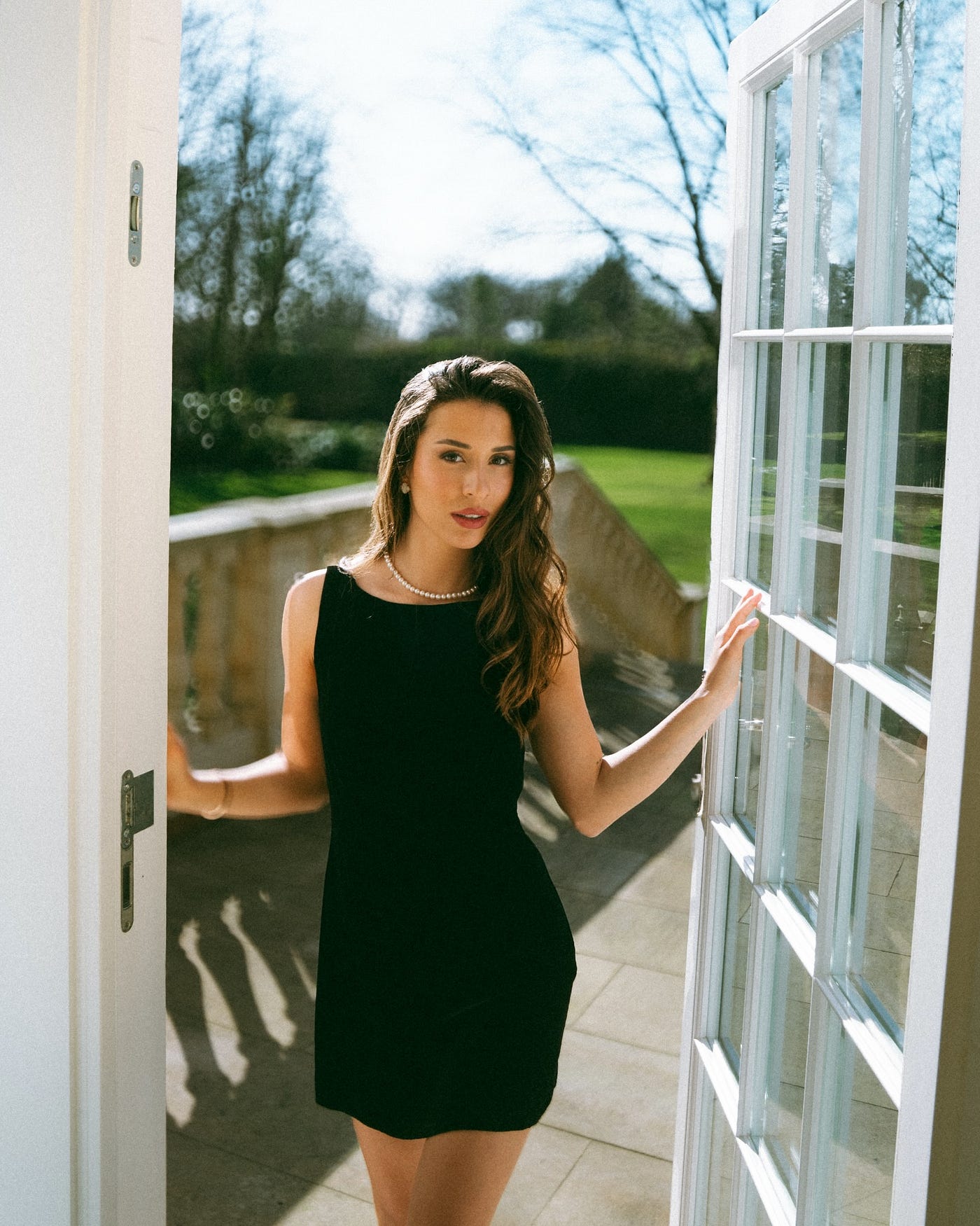
Photo: Instagram/Isabel Haugseng Johansen
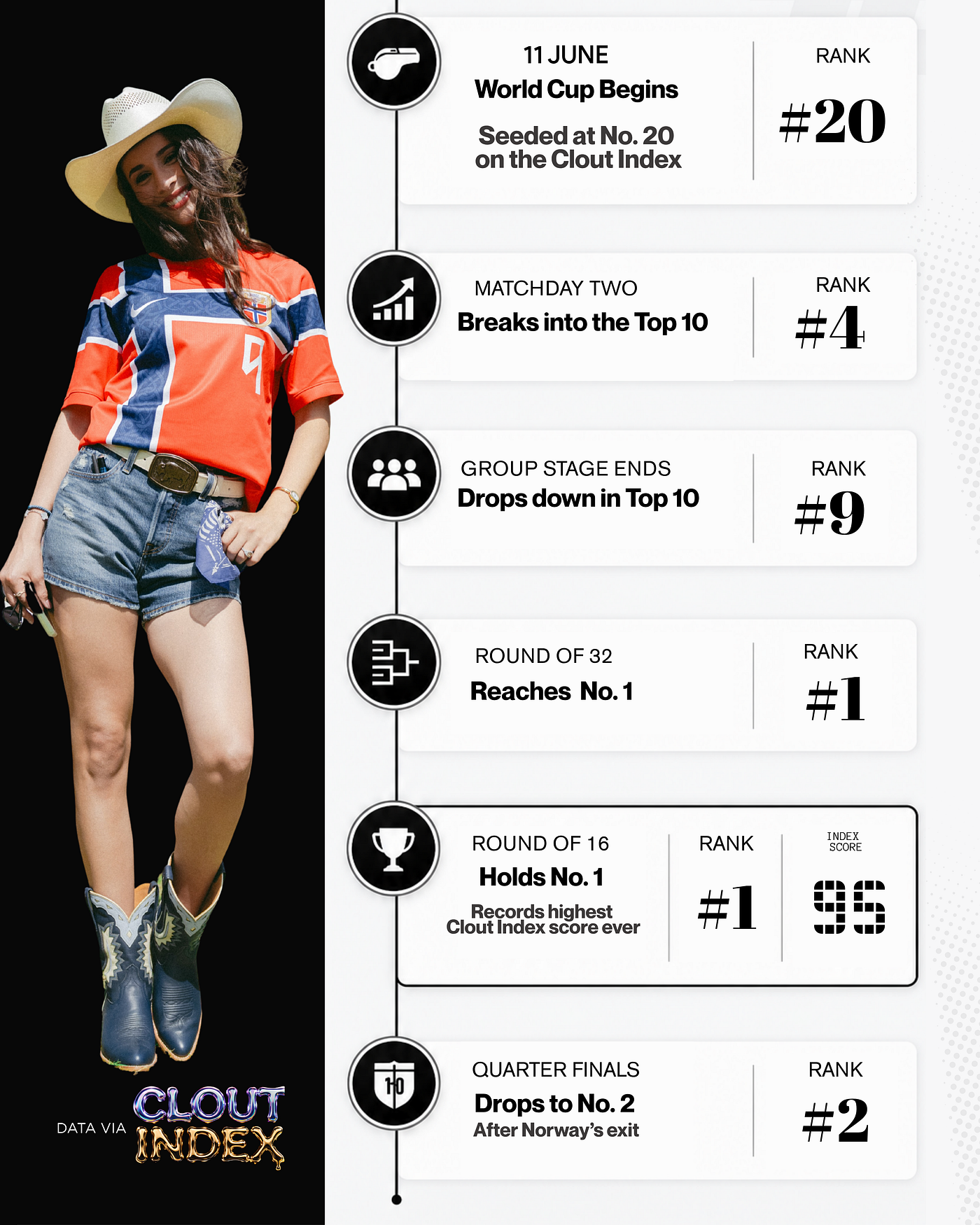
On 11 June 2026, Isabel Haugseng Johansen was not the favorite. She arrived with ~197,000 Instagram followers, a respectable but modest figure next to Georgina Rodríguez's, Antonela Roccuzzo's, and Bruna Biancardi’s tens of millions. Vantix’s inaugural Clout Index seeded her at No. 20.
She was known in football circles as Erling Haaland’s long-term partner, but her profile remained restrained and tied to his. The tournament did not need to introduce stars like Rodríguez or Roccuzzo. For Johansen, it created one. Her steady upward trajectory — unlike their consistency — forms the core of this assessment.
Understanding who Isabel Haugseng Johansen became during the 2026 FIFA World Cup first requires understanding who she was before the tournament began. Only then does the scale of her subsequent rise become fully apparent.
From Recognition to Relevance
Early appearances drew expected attention for Haaland’s partner. The shift came on 23 June (Norway vs Senegal). A shared photo after Haaland’s brace went viral beyond Norway, introducing Johansen to new audiences.
[embed]
Subsequent matchdays built on that momentum. Her visibility accumulated steadily rather than fading after early spikes. By the knockouts, coverage focused on her own style and presence. She had crossed into independent editorial territory.
Increasingly, coverage centered on her own matchday appearances, her personal style, and the growing influence she was exercising across platforms throughout the competition.
Public figures frequently benefit from proximity to established celebrities. Far fewer reach the point where they become editorial subjects in their own right. Johansen crossed that threshold before the group stage had concluded, and it fundamentally changed the nature of her World Cup.
The effect was reflected not only in audience behavior but also in Vantix’s own tournament tracking. Her progression through the Clout Index during this period demonstrated that the increase in attention was neither incidental nor temporary. It was becoming sustained. More importantly, it was becoming self-reinforcing. Increased visibility generated additional media coverage, which in turn expanded her audience, creating a cycle of growth that would reach its highest point during the knockout rounds.
At this stage of the tournament, however, one element of Johansen’s rise remained comparatively understated.
Fashion had accompanied her growing visibility from the outset, but it had not yet become the principal reason for it. That would change over the weeks that followed, as successive matchday appearances transformed personal style from a complementary aspect of her public image into one of the central narratives of her World Cup.
When Fashion Became the Story
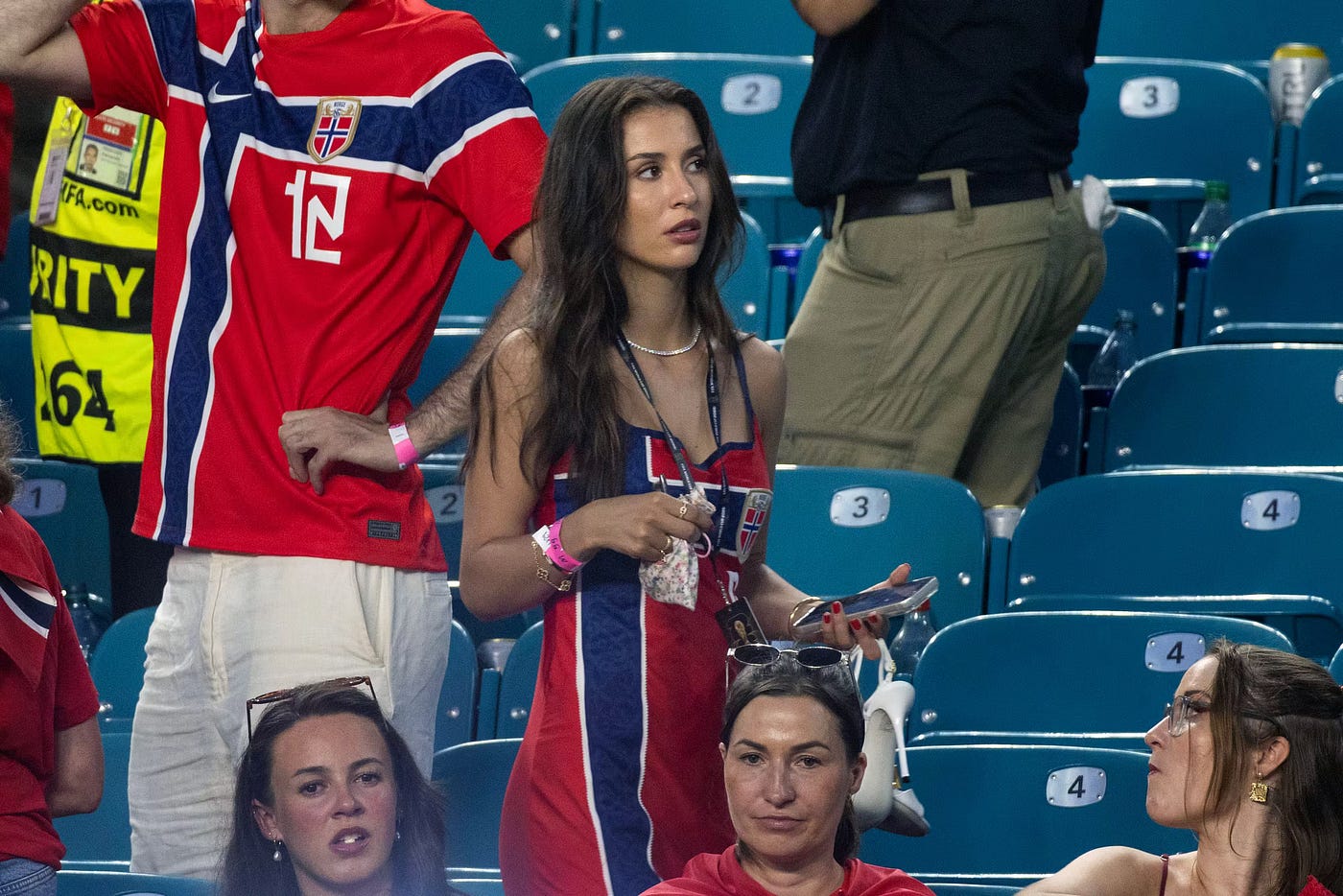
Photo: Thomas Nilsson / VG
Few World Cups produce a coherent fashion narrative. Johansen built one through consistency and progression.
Round of 32: 8.9/10 — refined yet accessible.
Round of 16: 8.8/10 — recognizably hers.
The culmination of that narrative arrived in the quarter-finals.
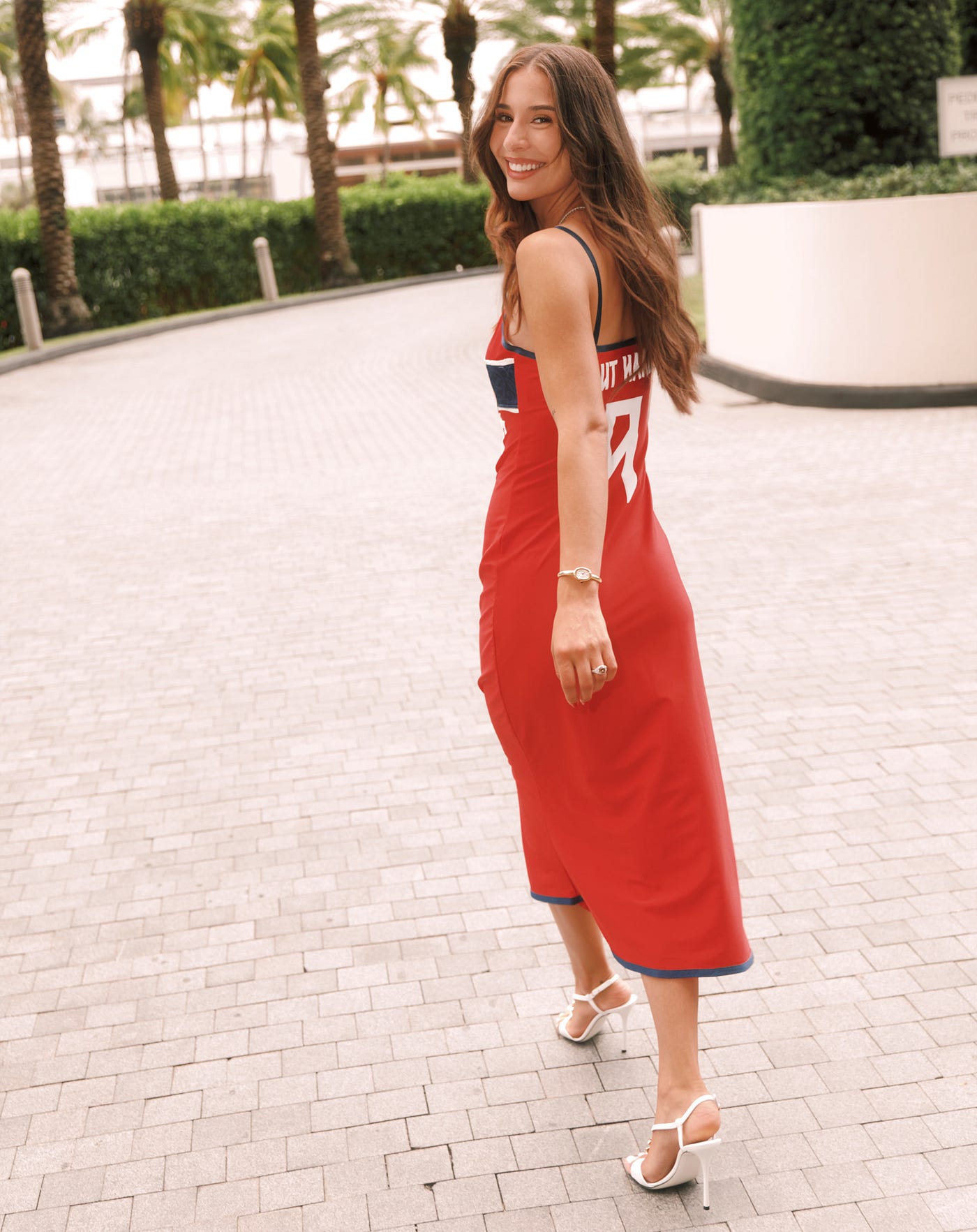
Created by German designer Fioona X, Johansen’s bespoke Norway-inspired gown represented the clearest expression of the visual identity she had been constructing throughout the tournament. The garment was more than a successful piece of matchday fashion; it functioned as a synthesis of the themes that had gradually come to define her public image. National symbolism, contemporary tailoring, and understated confidence converged in a look that felt neither derivative nor opportunistic.
Vantix awarded the appearance 9.3/10, making it one of the highest-rated individual looks of the entire World Cup.
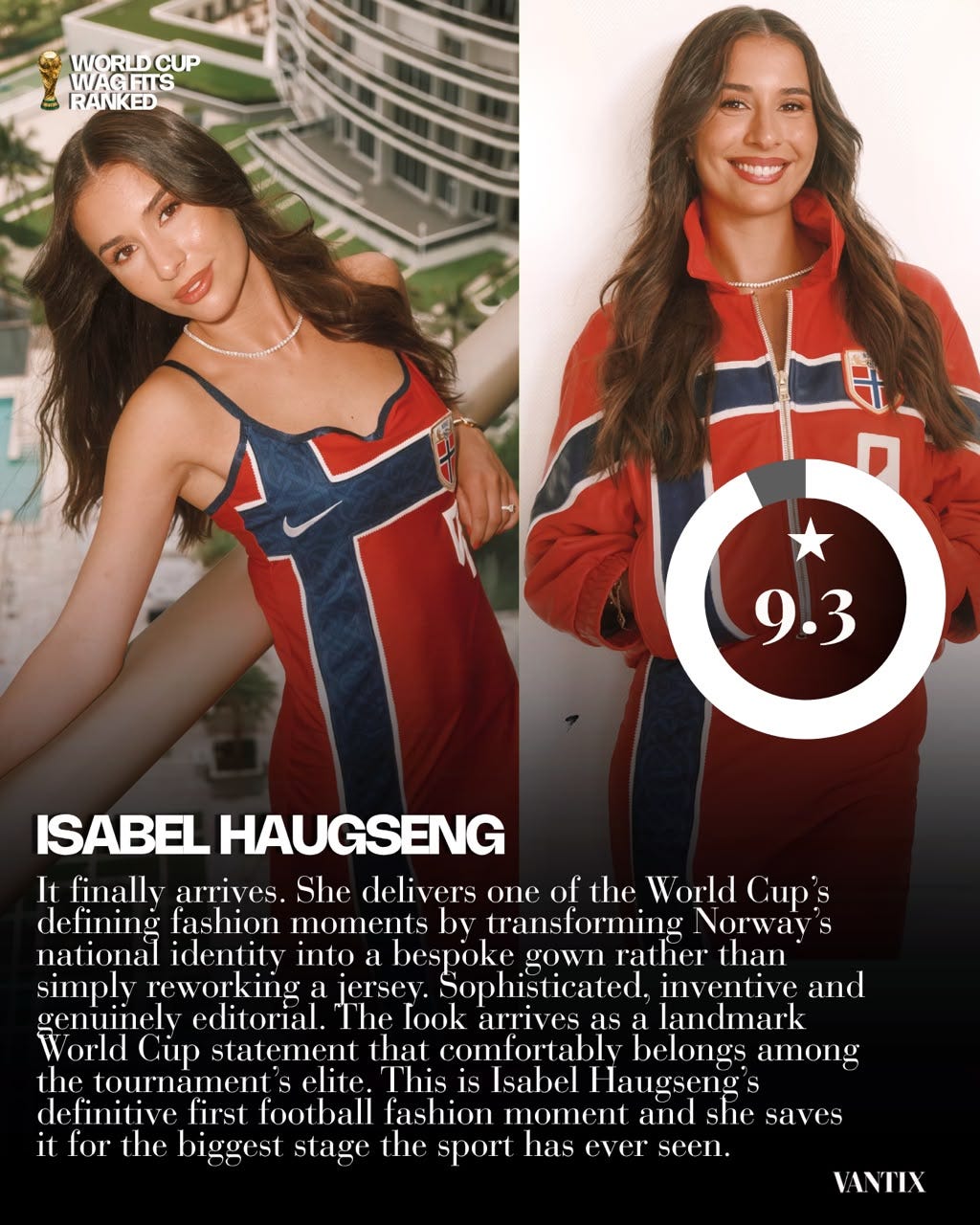
More revealing than the numerical score, however, was the response it generated.
Coverage of the gown extended well beyond fashion-focused platforms. Mainstream publications highlighted the appearance alongside reports of Norway’s campaign, while social media discussion increasingly treated Johansen’s matchday arrivals as events worthy of independent attention. The outfit quickly became the defining visual reference of her tournament, arriving at the precise moment when public interest in Johansen had reached its highest level.
[embed]
Visibility and fashion reinforced each other, turning her appearances into a sustained visual narrative.
By the conclusion of the quarter-finals, it had become increasingly difficult to separate discussions about Isabel Haugseng Johansen from discussions about World Cup matchday fashion itself. That convergence would prove critical as international media, many of whom had initially followed her tournament through football, began documenting a story that now extended far beyond the sport.
DISCOVER: Vantix Picks—The WAGs, Nations and Moments That Defined the 2026 FIFA World Cup
Beyond Football: When the Story Outgrew the Sport
Perhaps the most compelling evidence supporting Johansen’s selection lies not in the scale of her audience growth, but in the breadth of institutions that ultimately chose to document it.
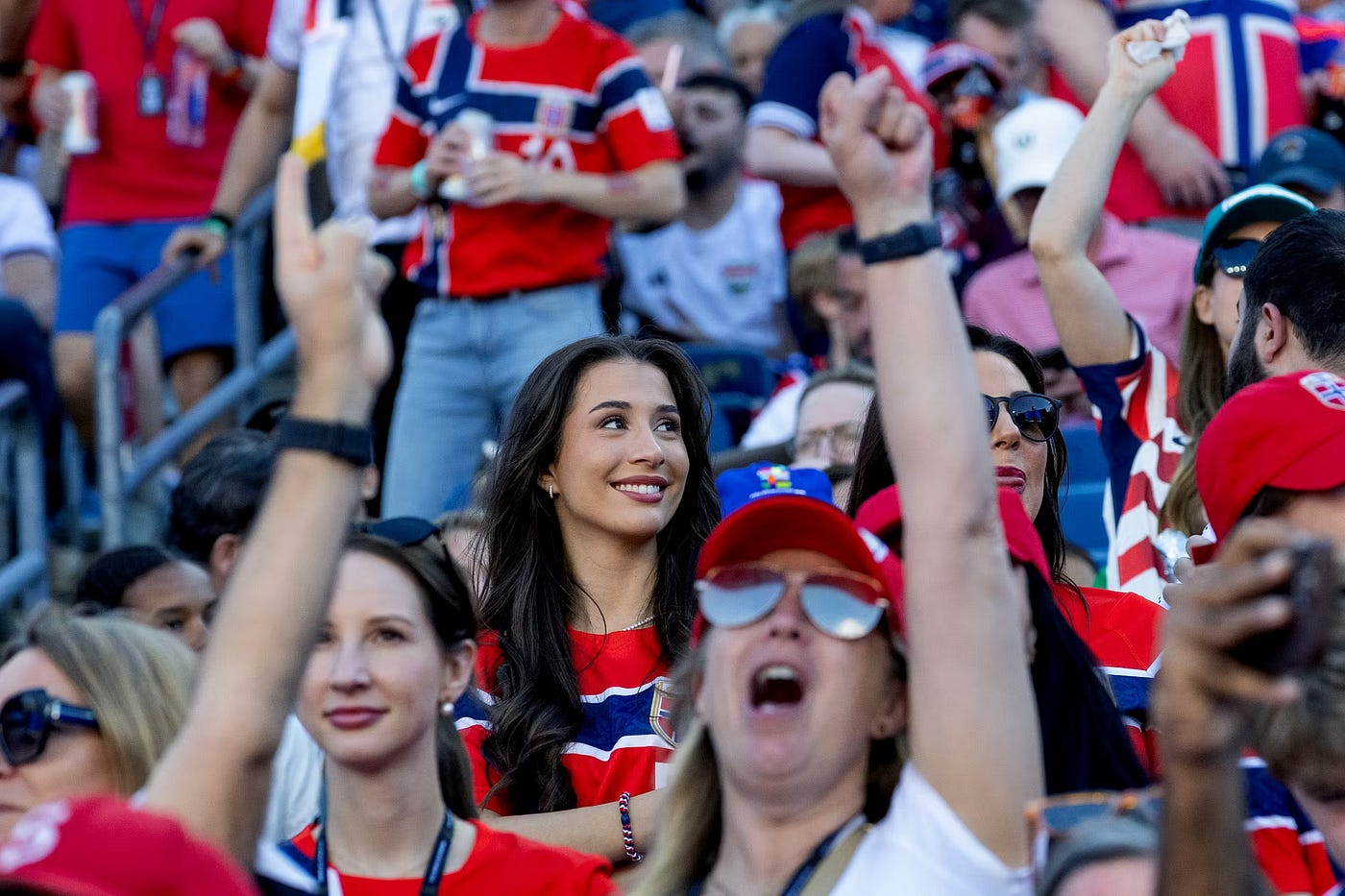
Photo: Thomas Nilsson / VG
Follower counts fluctuate. Viral posts disappear. Even sustained engagement can be shaped by platform algorithms beyond the control of the individual. Editorial attention operates differently. Every publication decides independently which stories warrant coverage, applying its own editorial priorities, audience expectations, and news values.
When organizations serving fundamentally different readerships repeatedly identify the same subject as newsworthy, the result is often a more reliable indicator of cultural significance than social media metrics alone.
Johansen’s World Cup presents a notable example of that phenomenon. As Norway progressed through the tournament, coverage of Johansen steadily expanded beyond football reporting into publications whose primary editorial interests extended well outside the sport. International news agencies, celebrity media, fashion titles, and lifestyle publications all began documenting different aspects of the same story, frequently arriving at similar conclusions despite approaching the tournament from entirely different perspectives.
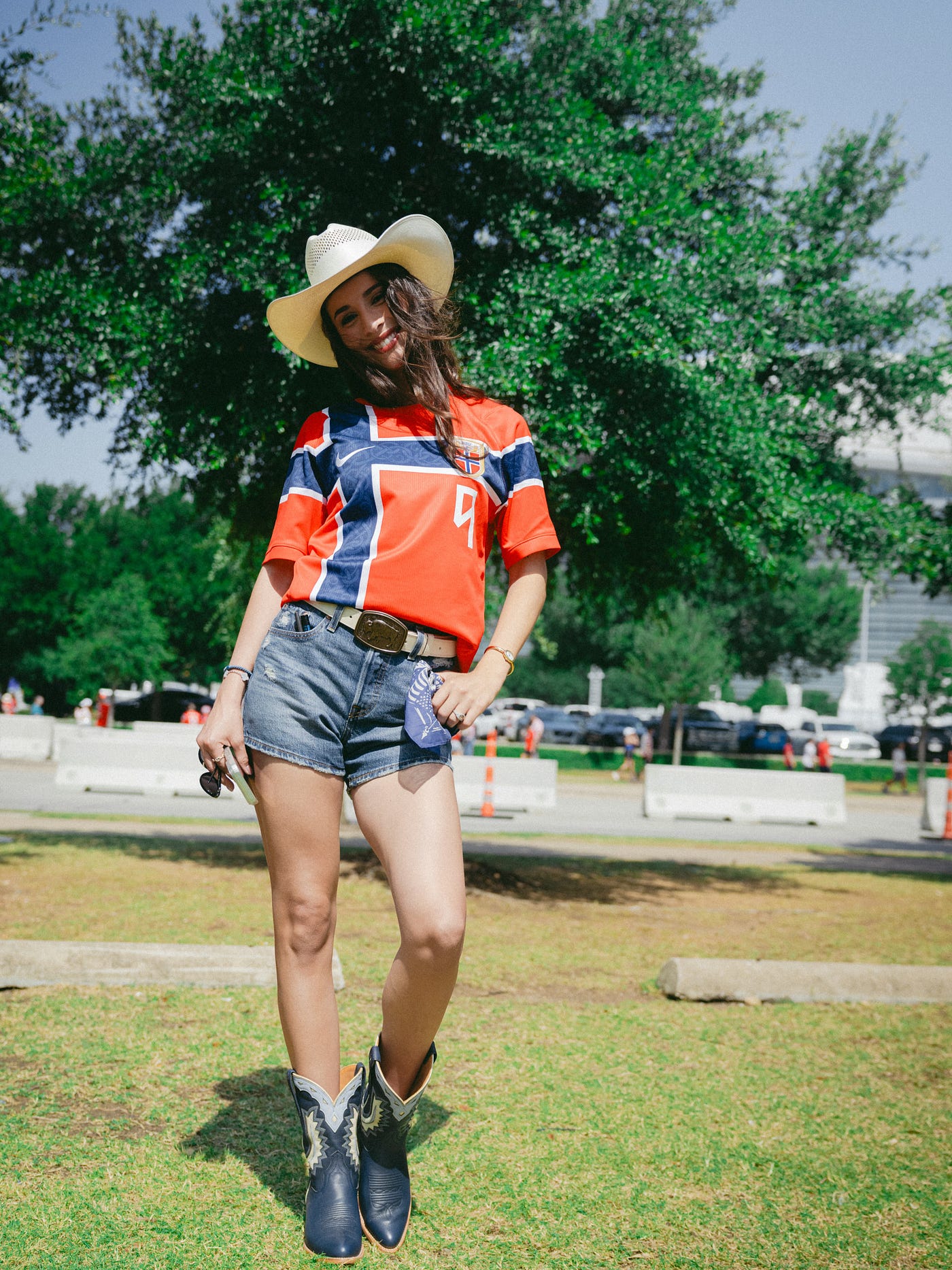
Photo: Instagram / Isabel Haugseng Johansen
Johansen’s coverage crossed categories: Reuters and Marca for football context; Vogue Scandinavia and ELLE for fashion; PEOPLE and Hello! for celebrity. Football outlets discussed her style; fashion titles covered her tournament presence.
[embed]
She had become a cultural figure moving fluidly between football, fashion, and lifestyle. Increasingly, she represented an independent point of public interest whose significance could be explained through multiple editorial lenses simultaneously. Different newsrooms were not reproducing the same story; they were identifying different stories centered on the same individual.
Digital culture reinforced that transition.
While traditional publications documented Johansen through articles and features, social media increasingly reframed her through fan participation. TikTok became populated with compilations of affectionate moments shared between Johansen and Haaland, post-match embraces, stadium arrivals, and candid interactions that collectively accumulated millions of views. Importantly, these edits rarely relied on manufactured narratives or controversy. Instead, they reflected an audience responding to recurring moments that had gradually acquired emotional familiarity over the course of the tournament.
Instagram told a similar story. Two of Johansen’s World Cup matchday posts surpassed two million likes, demonstrating that audience engagement remained consistent even as expectations surrounding her profile changed.
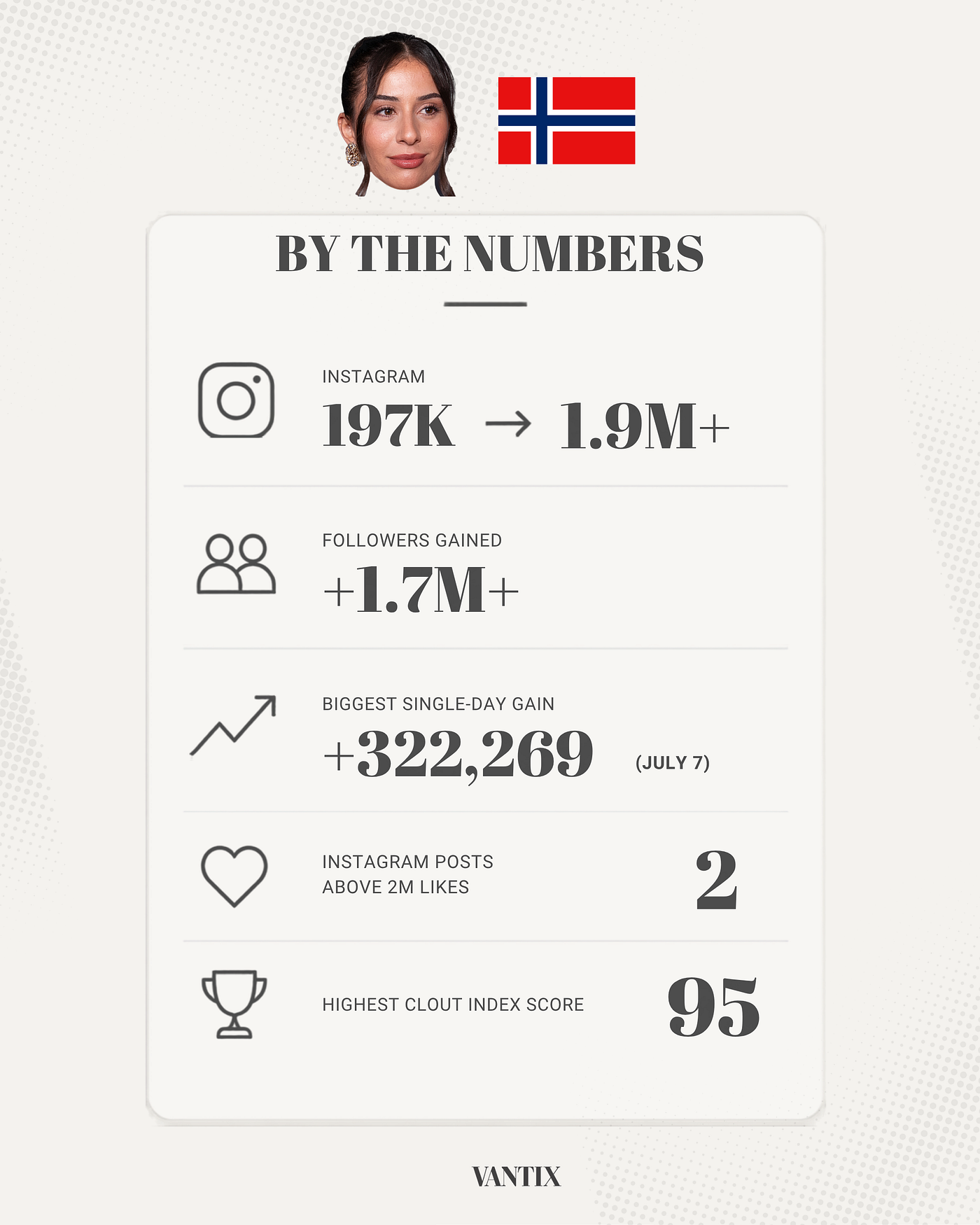
High-performing social media posts are hardly unusual during a World Cup, particularly when they involve globally recognized footballers. Sustaining that level of engagement across multiple posts, however, suggests something more durable than momentary curiosity. By this stage of the tournament, Johansen’s audience was no longer responding to isolated content. It was following an unfolding narrative.
That distinction also explains why her public profile continued to expand after individual viral moments had passed. Audiences were no longer waiting for another extraordinary photograph or headline. They had become invested in Johansen’s tournament itself. Every new matchday appearance, every stadium arrival, and every public interaction contributed another chapter to a story that followers had already committed to following.
From an editorial perspective, this represents an important transition.
Modern celebrity is increasingly sustained not by singular moments of visibility but by the ability to generate continued relevance across multiple forms of media simultaneously. Johansen’s World Cup demonstrates that process with unusual clarity.
Football introduced her to millions of people. Fashion provided a recognizable visual language through which that attention could be interpreted. Traditional journalism validated her significance by repeatedly documenting it, while social media transformed those individual moments into a continuous conversation that extended far beyond Norway’s fixtures.
By the time the tournament entered its closing stages, Johansen had become one of the figures through whom that landscape was being understood.
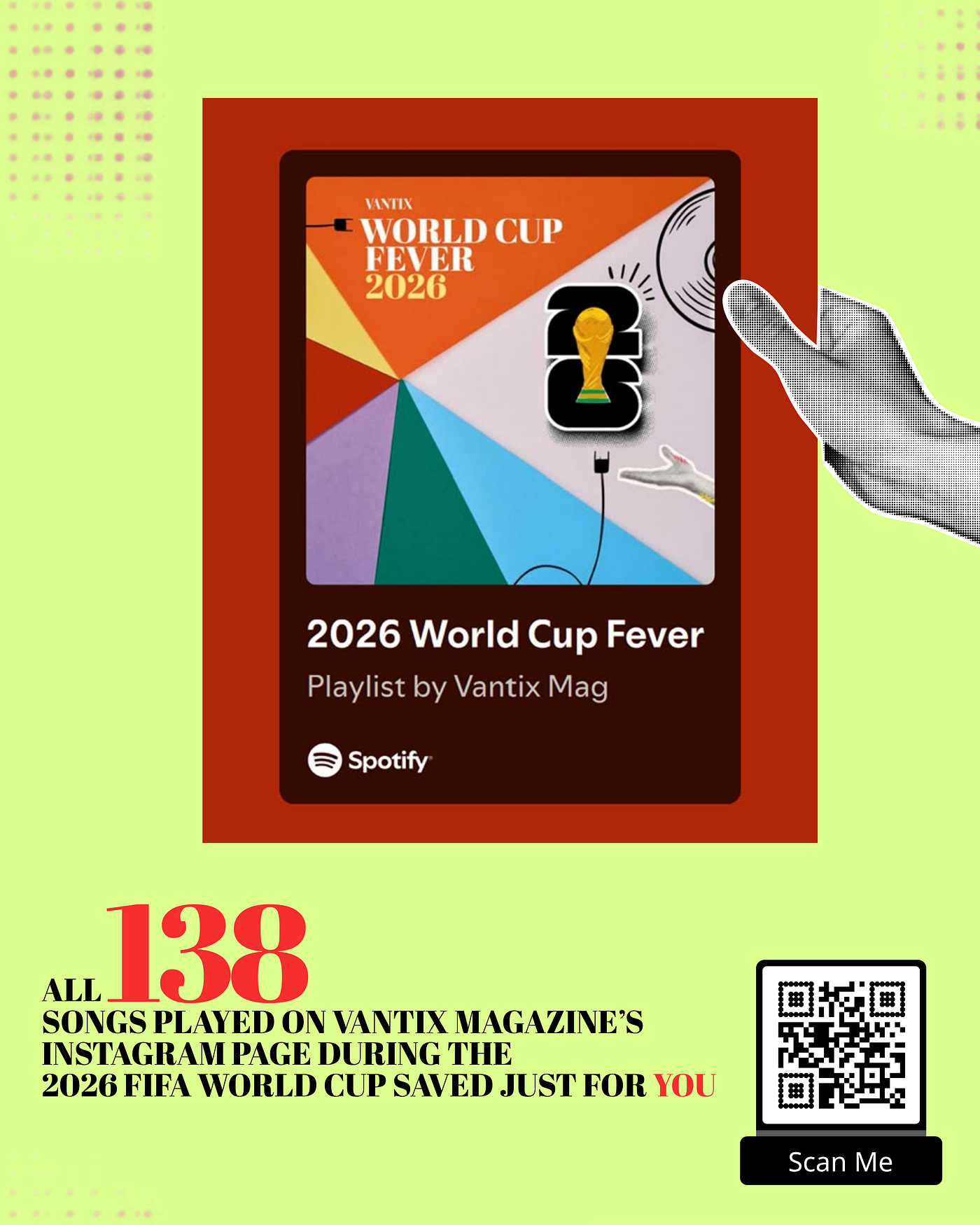
DISCOVER: Vantix Magazine’s 2026 FIFA World Cup Playlist Now LIVE on Spotify. Scan the QR code to view or listen here.
From Visibility to Value
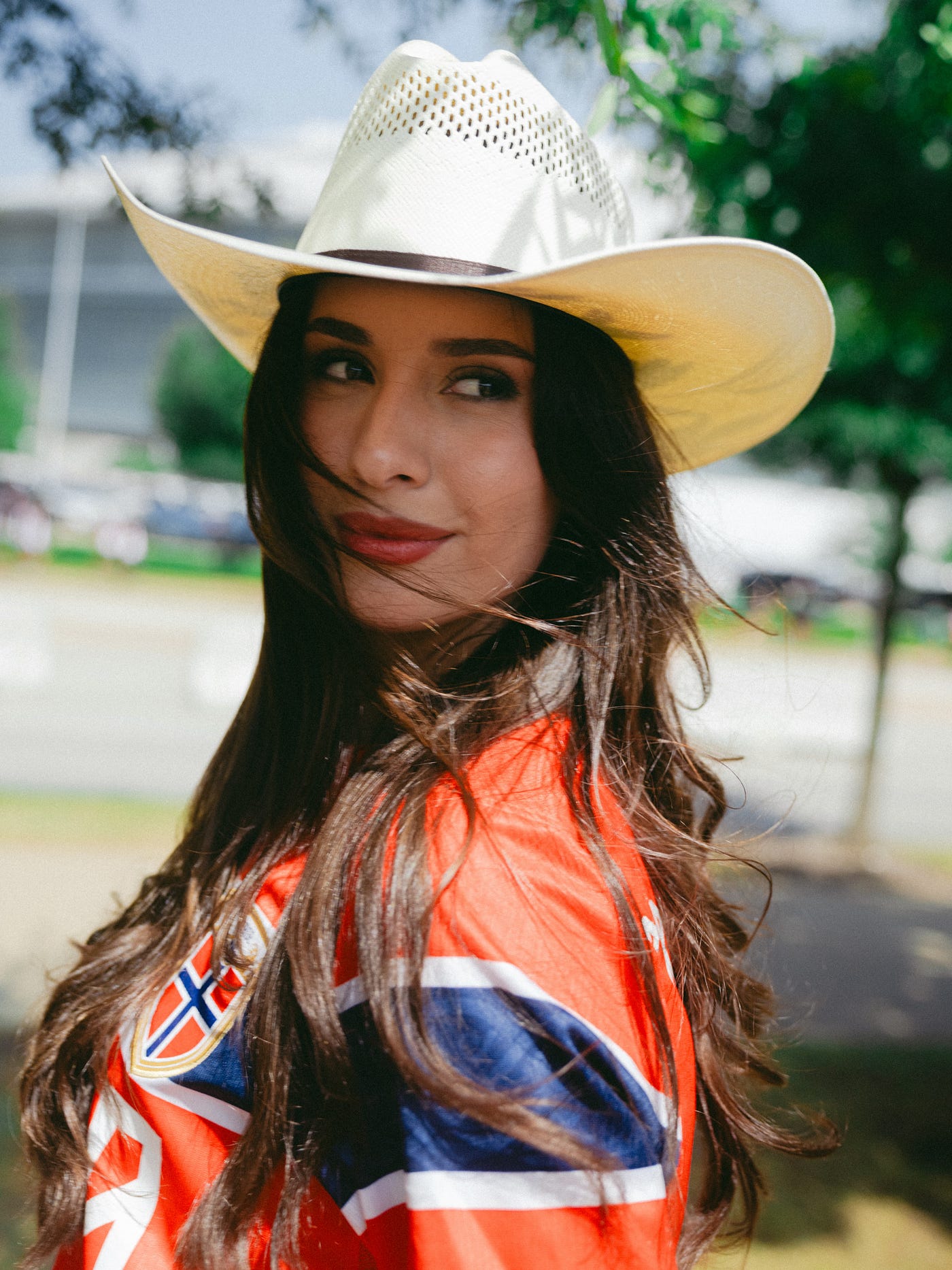
Instagram / Isabel Haugseng Johansen
Influence acquires greater significance when it begins to alter opportunities beyond the event that created it.
Every major sporting tournament produces temporary visibility. Athletes, supporters, and public figures routinely experience substantial increases in media attention while the competition remains active, only for that attention to recede once the final has been played. For that reason, audience growth alone provides only a partial measure of cultural impact. A more revealing question concerns whether heightened visibility produces tangible changes in commercial positioning, editorial demand, and long-term public value.
Johansen’s World Cup suggests that it did. Pre-tournament, she became ambassador for Juveler Langaard.
[embed]
During the event, KK Magazine, ELLE Norge, and Vogue Scandinavia profiled her. Post-tournament appearances, including Dolce & Gabbana, showed her value extending beyond football. Visibility had become cultural capital.
The World Cup was functioning not as the conclusion of a period of attention but as the foundation upon which a broader public profile could be constructed.
The timing of these developments is particularly instructive.
Commercial interest did not emerge after the tournament had concluded and retrospective narratives had begun to form. Instead, editorial and commercial recognition evolved simultaneously with Johansen’s rise, indicating that organizations across fashion and lifestyle media were responding to observable changes in public attention as they occurred rather than attempting to capitalize upon them retrospectively.
Johansen’s influence had begun acquiring independent economic value.
Brands do not simply seek audiences. They seek credibility, recognizability, and sustained relevance. Editorial publications operate according to similar principles. Covering a public figure requires confidence that audience interest extends beyond a single news cycle. By the latter stages of the tournament, Johansen increasingly satisfied those conditions.
Few World Cup stories produce that degree of cross-sector mobility within the space of five weeks.
For Vantix, that transition represents one of the strongest indicators that Johansen’s tournament should be understood as more than a successful period of audience growth. It marked the point at which visibility matured into cultural capital—a key point that would become critical when comparing her World Cup impact against the other leading contenders for this assessment.
Testing the Verdict
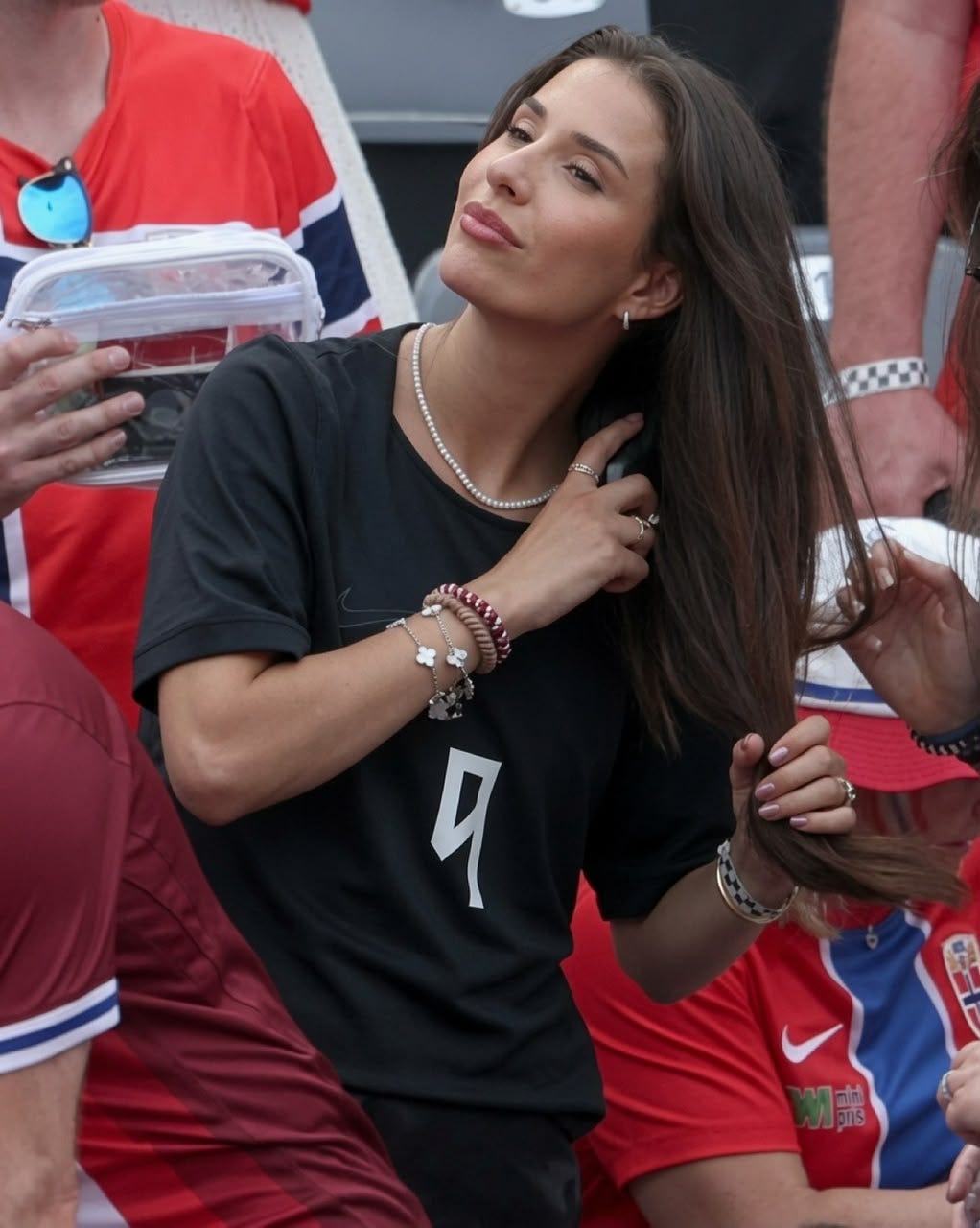
IMAGO/ABACAPRESS
Every editorial conclusion acquires greater credibility when it is tested against the strongest available alternatives. That principle guided Vantix Magazine throughout the preparation of this assessment.
The purpose of this feature is different. It seeks to identify the individual whose story most completely reflected the tournament’s broader cultural narrative.
That distinction required examining not only Johansen’s achievements but also the cases supporting every serious contender.
Each entered the World Cup with a compelling argument. Each left with accomplishments that deserve recognition. The question was whether any ultimately assembled a stronger overall case than Isabel Haugseng Johansen.
Georgina Rodríguez
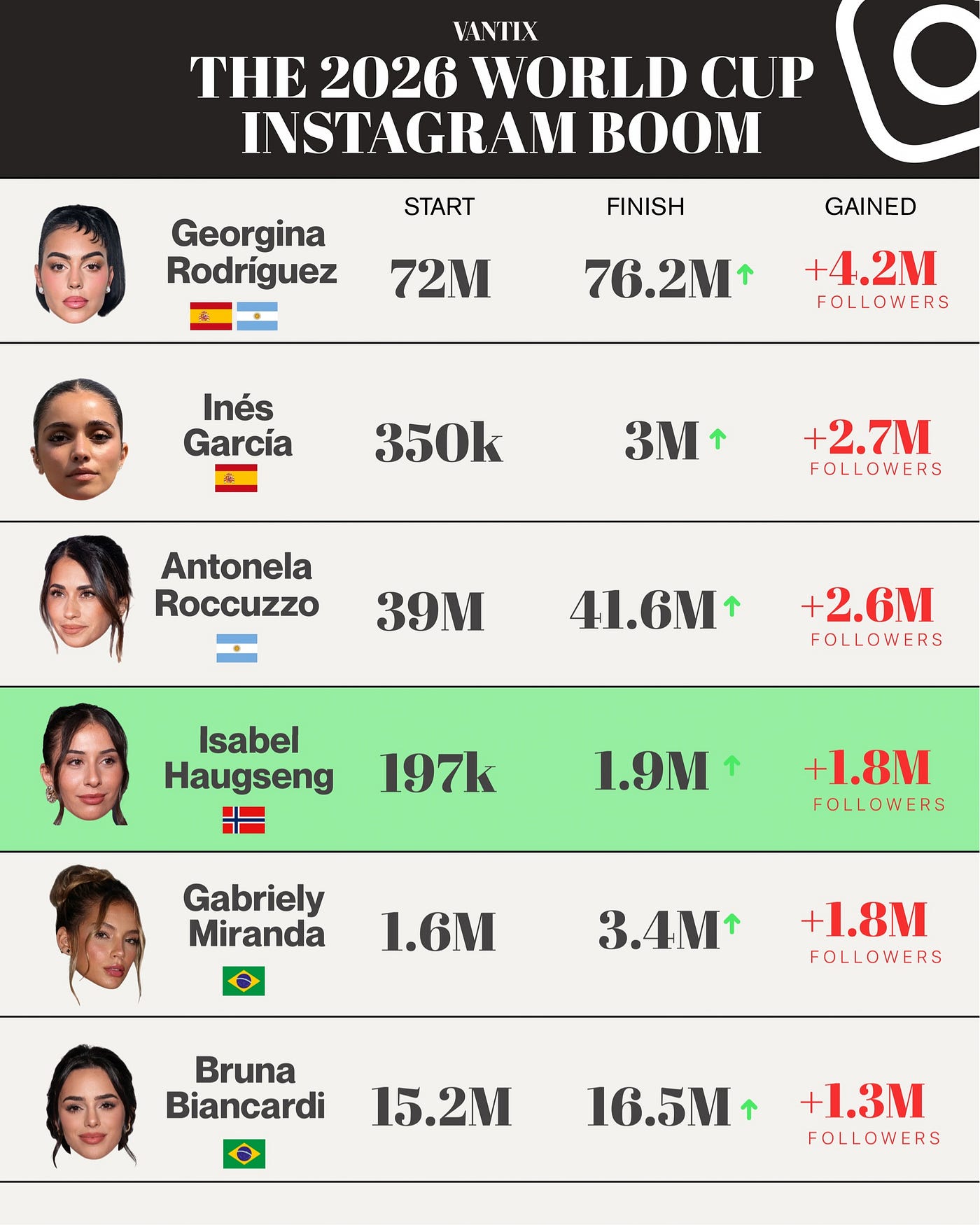
No woman entered the tournament with a larger existing platform than Georgina Rodríguez, the fiancée of Cristiano Ronaldo. Beginning the competition with approximately 72 million Instagram followers before finishing with more than 76.2 million, Rodríguez added in excess of 4.2 million followers during the World Cup while continuing to demonstrate the extraordinary reach that has defined her public career for several years. On July 8, two days after Portugal were eliminated by Spain in the round of 16 knockouts, she recorded a single-day Instagram increase exceeding 253,000 followers, while an Instagram Story shared during the tournament revealed that her account had generated more than two billion views over a thirty-day period.
For Rodríguez, the World Cup strengthened an existing empire—it did not create a new one. Johansen’s tournament transformed her profile entirely.
Antonela Roccuzzo
Few public figures associated with football possess comparable international affection, and Antonela Roccuzzo’s World Cup demonstrated why she remains one of football’s most consistently admired public figures.
Beginning the tournament with approximately 39 million Instagram followers before surpassing 41 million, Roccuzzo continued expanding an audience that has developed steadily over more than a decade alongside Lionel Messi’s extraordinary career. During the tournament, she also recorded the strongest documented single-day audience increase across Instagram and TikTok combined (1.4 million followers on July 17, exactly a week after her surprise TikTok debut), illustrating the exceptional cross-platform engagement she continues to command.
Yet the World Cup did not reshape her narrative. She remained exactly what she already was: one of the sport’s most admired personalities. Johansen’s story moved in the opposite direction because the tournament progressively redefined her public profile.
Bruna Biancardi
If any nation dominated the World Cup’s off-pitch conversation collectively, it was Brazil. Bruna Biancardi stood at the center of that discussion.
Beginning the competition with approximately 15.2 million followers before finishing above 16.5 million, Biancardi added more than 1.3 million followers, while recording a peak single-day increase of 212,850 on Instagram. Throughout Brazil’s campaign, she remained one of the tournament’s most photographed, discussed, and commercially visible personalities, reinforcing her position among the sport’s leading WAGs online.
Her World Cup was unquestionably successful and aligned perfectly with her established position. It reinforced expectations rather than overturning them.
Johansen, by contrast, entered outside the main conversation and gradually became one of its central drivers.
Gabriely Miranda
Few women experienced audience growth comparable to Gabriely Miranda. Beginning the tournament with approximately 1.7 million followers before concluding with more than 3.4 million, she effectively doubled her audience during the World Cup. Her largest documented single-day increase on Instagram — 205,485 followers on 26 June — illustrated the scale of public attention surrounding Brazil throughout the group stage.
Numerically, few matched her social media acceleration. However, audience growth alone does not equal cultural breadth.
The difference lay in scope and accumulation.
Inés García
If Isabel Haugseng represented the World Cup’s most remarkable sustained breakout, García delivered its most explosive social-media surge. Following Spain’s victory in the final, García gained an extraordinary 1.44 million Instagram followers in a single day, the biggest one-day follower gain recorded by any WAG during the tournament. Within 24 hours of Spain lifting the trophy, her audience had climbed beyond 3 million, giving her one of the most dramatic post-final rises in recent World Cup history. Her numbers ultimately surpassed Gabriely Miranda’s tournament growth, while only Georgina Rodríguez gained more Instagram followers than García across the full duration of the competition.
The scale of García’s rise is impossible to overlook, but so is the context in which it happened. Her extraordinary acceleration came at the precise moment Spain became world champions, amplified by the global celebration surrounding Lamine Yamal, one of the tournament’s defining young stars, and the enormous international attention that followed the final.
The distinction is that García’s was the World Cup’s most explosive late-stage amplification, while Johansen’s was a sustained rise that unfolded across the tournament itself.
The Difference
Taken together, each woman assembled a compelling World Cup. The numbers tell us who grew fastest. They do not, on their own, tell us who defined the tournament.
Fred Jonny / ELLE NORGE, Instagram (@isabellaa)
Inés García owns the most extraordinary single-day growth story. Georgina Rodríguez recorded the largest overall Instagram gain across the tournament. Gabriely Miranda’s audience also grew by more than Isabel’s over the full competition. Those achievements matter, and Vantix does not diminish them. But the WAG of a World Cup cannot be determined by follower acquisition alone. The question is not simply who gained the most followers, but who became most inseparable from the cultural story of the tournament itself.
Rodríguez demonstrated the power of established global celebrity. Roccuzzo reinforced enduring affection. Brazil’s contingent, anchored by Biancardi and Miranda, showed collective strength.
None of those achievements should be diminished. Johansen stands apart through the scale of her transformation.
Her rise was not concentrated in the aftermath of one defining result. It developed progressively, alongside Norway’s unexpected run, with each stage adding another layer to her visibility. She was not simply amplified by the World Cup’s conclusion; she became increasingly central to the conversation as the tournament unfolded.
The difference, ultimately, is between explosive amplification and sustained influence. Inés García had the biggest single-day surge. Georgina had the largest overall Instagram growth. Isabel, however, built the most compelling month-long trajectory from relative obscurity to the summit of Vantix’s own influence rankings.
The Case for Isabel
Instagram / Isabel Haugseng Johansen
Cultural influence resists simple metrics. The evidence, however, converged on one figure.
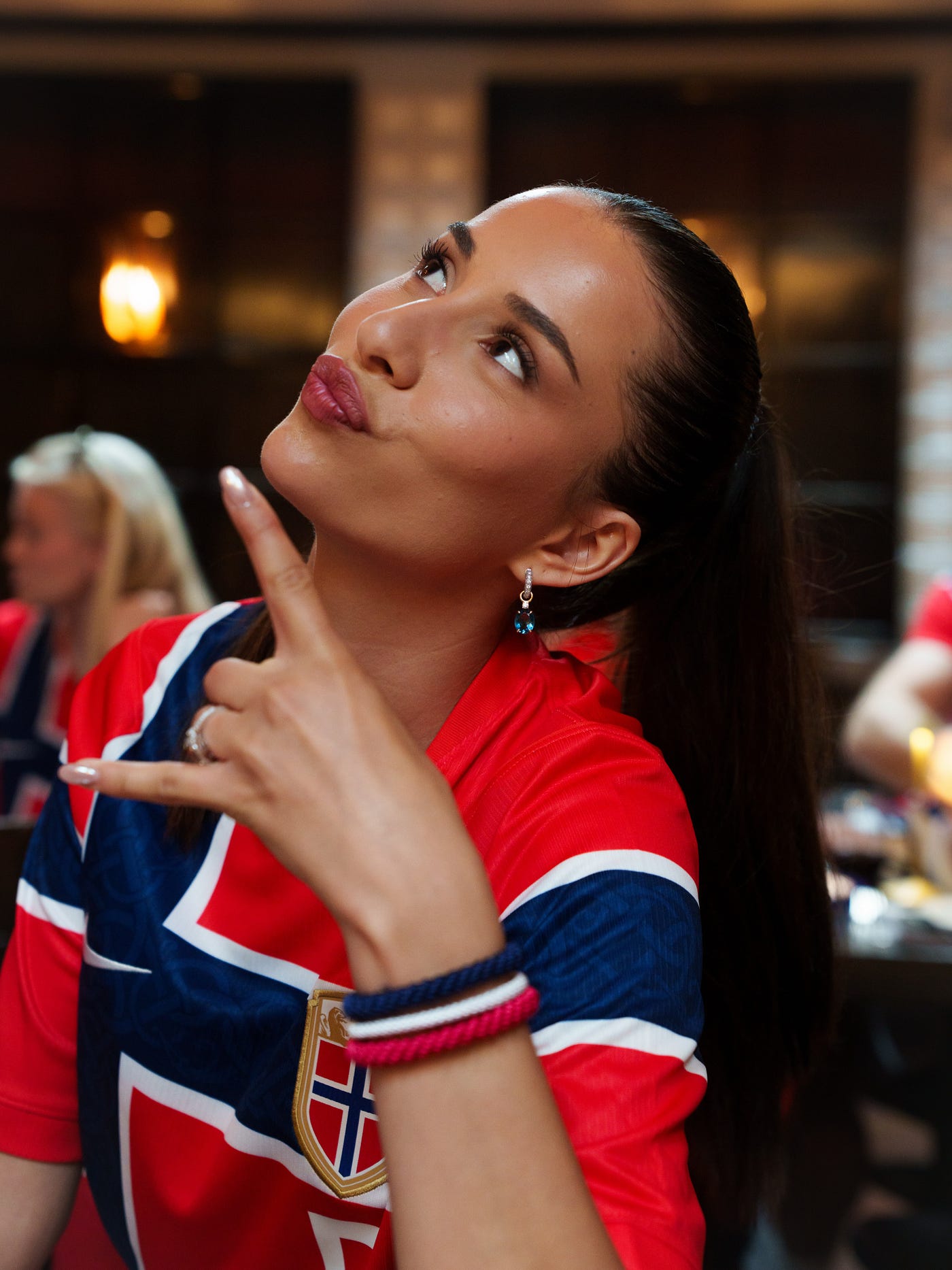
Isabel entered the competition with fewer than 200,000 Instagram followers and finished with the second-highest cumulative score of the Clout Index. Over the course of Norway’s campaign, she climbed into the top 10, reached No. 4, slipped to No. 9 after the group stage, and then rose to No. 1 during the knockout rounds. After the Round of 16, she recorded a 95-point Vantix Clout Index score—the highest score in the history of the index—cementing her status as the World Cup’s most influential WAG
She topped the Clout Index for two consecutive weeks, delivered one of the tournament’s strongest fashion narratives, earned broad editorial coverage across categories, and turned visibility into lasting commercial momentum. Football introduced her, and Norway’s run led by Erling Haaland’s global appeal served as the foundation of her own growing public profile. Fashion, media, and audiences made her defining.
She entered quietly and left it impossible to overlook.
Vantix names Isabel Haugseng Johansen the WAG of the 2026 FIFA World Cup. The pitch crowned its football champions. Off it, she became the face of its cultural story.
메타데이터
- post_id
- 6ce47880ebb1
- slug
- how-isabel-haugseng-johansen-became-vantixs-wag-of-the-2026-fifa-world-cup-6ce47880ebb1
- url
- https://medium.com/@vantixmag/how-isabel-haugseng-johansen-became-vantixs-wag-of-the-2026-fifa-world-cup-6ce47880ebb1
- canonical_url
- https://medium.com/@vantixmag/how-isabel-haugseng-johansen-became-vantixs-wag-of-the-2026-fifa-world-cup-6ce47880ebb1
- author_url
- https://medium.com/@vantixmag
- status
- ok
- fetched_at
- 2026-07-25 18:51:46