What Is VDS? Complete Guide to Virtual Dedicated Servers (VDS Hosting Explained)
As websites, applications, and online businesses grow, shared hosting often becomes too slow and limited. This is where VDS hosting becomes…
What Is VDS? Complete Guide to Virtual Dedicated Servers (VDS Hosting Explained)
virtual dedicated server ( vds hosting) -2026
As websites, applications, and online businesses grow, shared hosting often becomes too slow and limited. This is where VDS hosting becomes useful.
A Virtual Dedicated Server (VDS) gives users dedicated resources, better performance, stronger security, and more control compared to traditional shared hosting or standard VPS hosting.
Today, many businesses, developers, startups, and application owners use VDS hosting because it offers the balance of:
- Dedicated server performance
- Cloud flexibility
- Better scalability
- Lower cost than physical dedicated servers
If you are searching for:
- What is VDS?
- VDS meaning
- Difference between VPS and VDS
- Windows VDS hosting
- Linux VDS hosting
- Best VDS hosting plans
then this guide explains everything in simple words.
What Is VDS?
VDS stands for:
- V → Virtual
- D → Dedicated
- S → Server
A Virtual Dedicated Server is a virtualized hosting environment where dedicated CPU, RAM, storage, and operating system resources are assigned to a single user.
Unlike shared hosting, your resources are isolated and reserved only for your projects.
This means:
- Better performance
- More stability
- Improved security
- Full server control
A VDS works similarly to a dedicated server but at a much lower cost.
VDS Meaning Explained in Simple Words
Think of a physical server like a large building.
Shared hosting is like sharing one room with many people.
A VPS is like sharing an apartment floor where resources are partially shared.
A VDS is more like getting your own private apartment with reserved space, better privacy, and dedicated utilities.
This is why VDS hosting provides more stable performance for websites and applications.
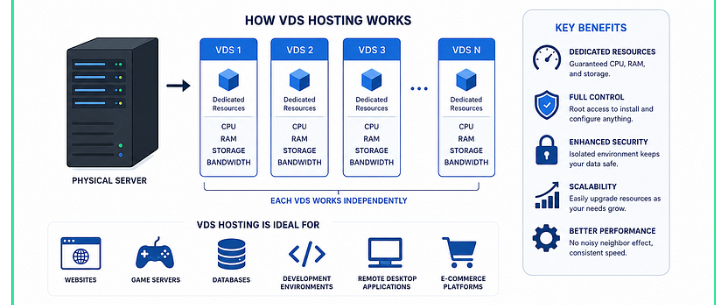
How Does a VDS Work?
A physical server is divided into multiple isolated virtual servers using virtualization technology like KVM.
Each VDS gets:
- Dedicated CPU cores
- Reserved RAM
- Private storage space
- Independent operating system
- Root or admin access
Every virtual server works independently without affecting other users on the same hardware.
This eliminates the “noisy neighbor” problem commonly found in shared hosting environments.
Difference Between Shared Hosting, VPS, VDS, and Dedicated Server
- **Shared Hosting** — Fully shared resources, best for small websites and beginners
- VPS Hosting — Partially shared resources, better performance for growing websites
- VDS Hosting — Dedicated virtual resources with full control and stable performance
- Dedicated Server — Entire physical server with maximum power and hardware control
- Performance Level — Shared < VPS < VDS < Dedicated Server
- Best for Scaling — VDS and Dedicated Servers handle higher traffic and applications better
- Control & Flexibility — More server control increases from Shared Hosting to Dedicated Server
- Cost Difference — Shared hosting is cheapest, dedicated server is most expensive
- Business Use — VDS is ideal for business apps, websites, APIs, and scaling projects
- Enterprise Workloads — Dedicated servers are best for very high-performance environments
VDS vs VPS — What Is the Real Difference?
Many people think VPS and VDS are exactly the same, but there are important differences.
VPS Hosting
- Resources may still be partially shared
- Performance can fluctuate
- More affordable for beginners
- Good for medium traffic websites
VDS Hosting
- Dedicated resources are guaranteed
- Better isolation and security
- Stable performance during traffic spikes
- Better for business-critical applications
A VDS server is usually preferred for:
- High-performance applications
- AI workloads
- Game servers
- eCommerce websites
- Remote Desktop environments
- Resource-intensive projects
Key Benefits of VDS Hosting
1. Dedicated CPU and RAM
Your server resources are reserved only for you. Other users cannot affect your performance.
This helps maintain:
- Faster website speed
- Stable uptime
- Smooth application performance
2. Better Performance
VDS hosting is optimized for:
- High traffic websites
- APIs
- Databases
- Business software
- Real-time applications
Combined with NVMe SSD storage, loading speed becomes significantly faster.
3. Full Root or Administrator Access
You get complete server control:
- Install custom software
- Configure security settings
- Manage applications
- Customize the operating system
This is especially useful for developers and businesses.
4. Improved Security
Because resources are isolated, your applications remain more secure compared to shared hosting.
VDS hosting reduces:
- Cross-user interference
- Security vulnerabilities from neighboring accounts
- Resource abuse issues
5. Scalability
As your project grows, you can upgrade:
- CPU cores
- RAM
- Storage
- Bandwidth
without moving to another server.
Why NVMe SSD Storage Matters in VDS Hosting
Modern VDS hosting platforms use NVMe /SSD storage because it is much faster than traditional HDD or SATA SSD storage.
improves:
- Website loading speed
- Database performance
- File transfer speed
- Application response time
- Boot performance
For Node.js apps, AI tools, APIs, automation workflows, and eCommerce websites, SSD/NVMe storage makes a noticeable difference.
Windows VDS vs Linux VDS
Windows VDS Hosting
Windows VDS is best for:
- Remote Desktop (RDP)
- ASP.NET applications
- Windows-based software
- Trading software
- Business applications
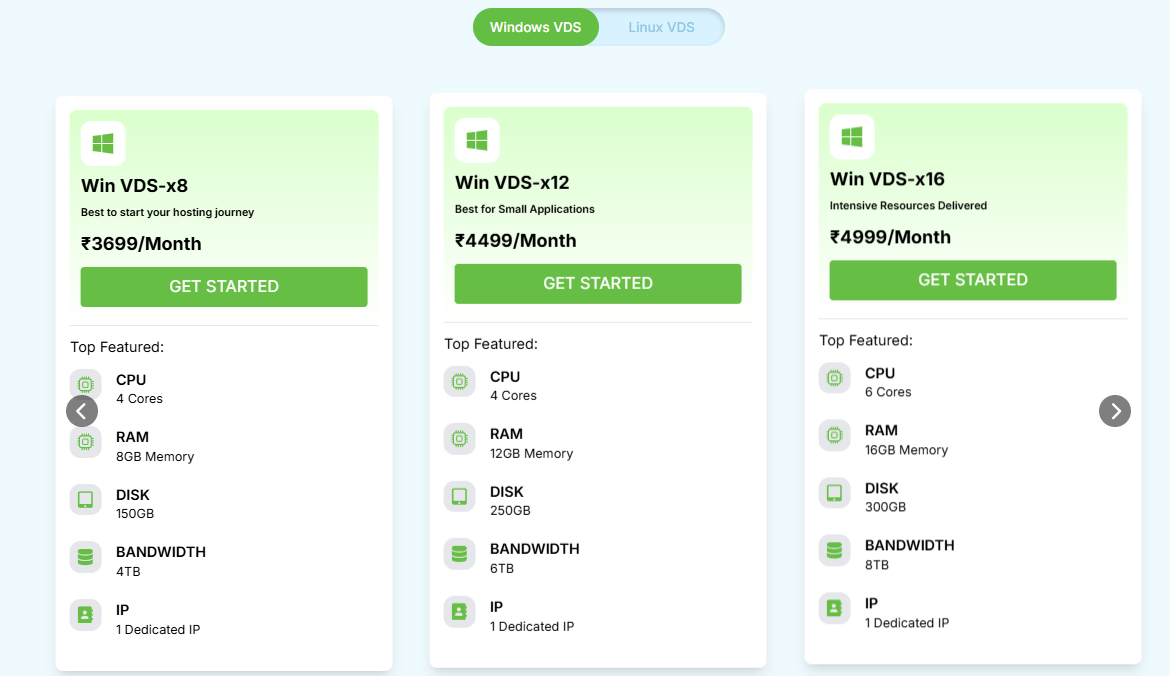
Windows VDS hosting plans
Advantages
- Easy graphical interface
- RDP support
- Microsoft software compatibility
Limitations
- Higher cost
- More resource usage
Linux VDS Hosting
Linux VDS is popular for:
- Websites
- APIs
- Node.js applications
- Python projects
- Web hosting
- Automation tools
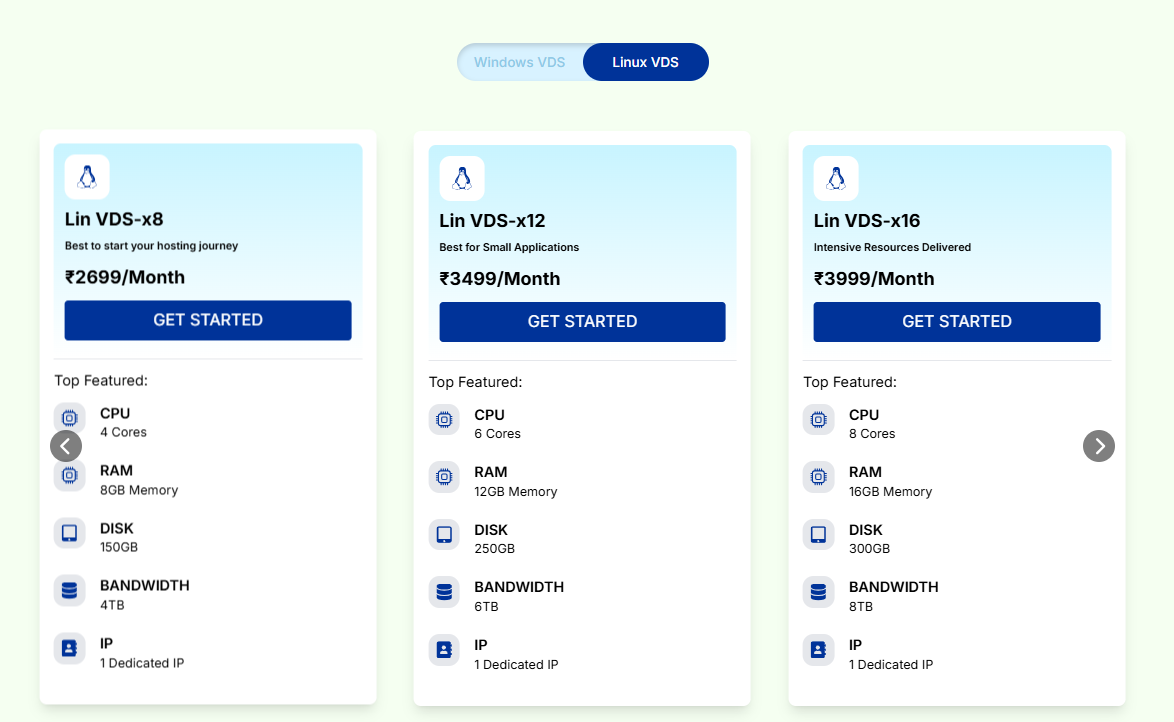
Linux VDS hosting plans
Advantages
- Better performance on lower resources
- Lower hosting cost
- Lightweight and stable
- Developer-friendly environment
Best Linux Distributions
- Ubuntu
- Debian
- AlmaLinux
- Rocky Linux
- CentOS
Common Use Cases of VDS Hosting
High-Traffic Websites
VDS hosting handles traffic spikes better than shared hosting.
eCommerce Stores
Online stores need stable speed and secure environments.
AI and Automation Tools
AI workflows require stable CPU and RAM resources.
Remote Desktop Hosting
Windows VDS allows users to access a full remote desktop environment.
Game Servers
Game hosting requires consistent CPU performance and low latency.
Development Environments
Developers use VDS hosting for testing and deployment.
How to Choose the Right VDS Hosting Plan
When selecting a VDS server, look for:
CPU Performance
More cores help multitasking and application processing.
RAM
Higher RAM improves database and application performance.
NVMe Storage
Faster storage means faster applications.
Bandwidth
Choose enough bandwidth for traffic and downloads.
Operating System
Linux for development and websites Windows for RDP and Microsoft applications
Example VDS Hosting Plans
Linux VDS Plans
Suitable for:
- Web hosting
- APIs
- Development environments
- Lightweight AI tools
Example Specs
- 4–12 CPU cores
- 8GB–64GB RAM
- 150GB–500GB NVMe SSD
- 4TB–20TB bandwidth
Windows VDS Plans
Suitable for:
- RDP hosting
- Business software
- Windows applications
Example Specs
- 4–8 CPU cores
- 8GB–64GB RAM
- Dedicated IP address
- NVMe SSD storage
IntechDC Virtual Dedicated Server Hosting
**IntechDC Hosting** provides scalable Windows and Linux VDS hosting solutions designed for:
- Performance
- Reliability
- Fast NVMe storage
- Dedicated resources
- Business scalability
Features include:
- KVM virtualization
- Instant provisioning
- Dedicated IP
- Multiple operating system choices
- High bandwidth
- Resource isolation
This makes it suitable for businesses, developers, and growing applications.
Is VDS Hosting Worth It?
Yes, VDS hosting is worth it if:
- Your website traffic is growing
- Shared hosting feels slow
- You need stable server performance
- You want dedicated resources without paying for a full dedicated server
VDS hosting offers one of the best balances between:
- Cost
- Performance
- Flexibility
- Security
Final Thoughts
A Virtual Dedicated Server is one of the most practical hosting solutions for modern businesses and developers.
It combines:
- Dedicated server-like performance
- Virtualization flexibility
- Better scalability
- Affordable pricing
Whether you choose Linux VDS hosting or Windows VDS hosting, a VDS gives you more speed, control, and reliability for websites, applications, AI tools, APIs, remote desktops, and business workloads.
For growing projects that need more than shared hosting but do not require a full dedicated server, VDS hosting is often the ideal solution.
메타데이터
- post_id
- 7078e4e27383
- slug
- what-is-vds-complete-guide-to-virtual-dedicated-servers-vds-hosting-explained-7078e4e27383
- url
- https://medium.com/@dm_64827/what-is-vds-complete-guide-to-virtual-dedicated-servers-vds-hosting-explained-7078e4e27383
- canonical_url
- https://medium.com/@dm_64827/what-is-vds-complete-guide-to-virtual-dedicated-servers-vds-hosting-explained-7078e4e27383
- author_url
- https://medium.com/@dm_64827
- status
- ok
- fetched_at
- 2026-06-09 15:37:30