God and Cancer: The Conversation I Never Wanted to Have
What happens when real life no longer fits the religious answers you were given?
God and Cancer: The Conversation I Never Wanted to Have
What happens when real life no longer fits the religious answers you were given?
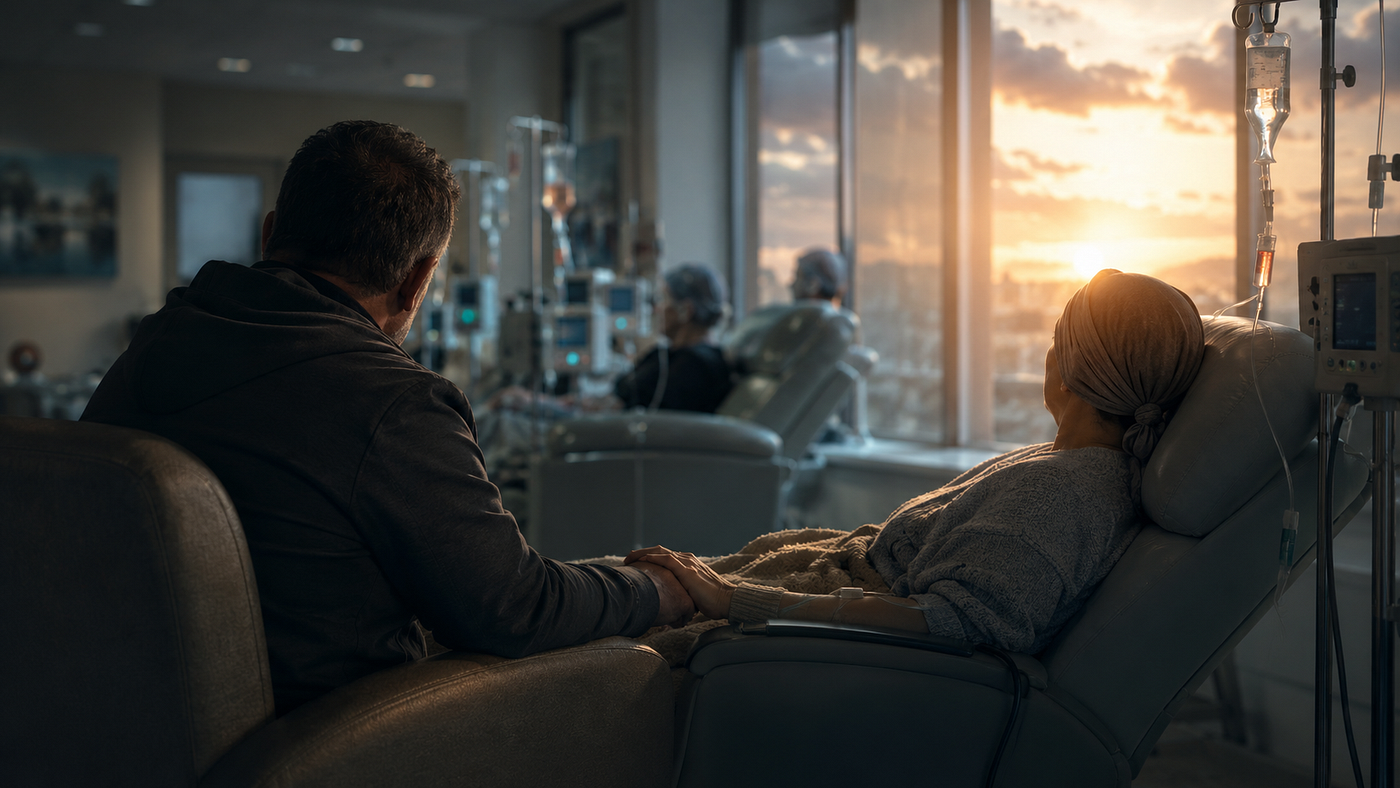
Image created by author in Canva Pro
Today, I sat next to my wife for six hours while chemotherapy drugs dripped slowly into her body.
The infusion clinic is a strange place. It is basically one large room with six recliner chairs arranged so that everybody quietly faces each other while poison enters their veins in the hope that it might also keep them alive.
There is something confronting about that.
Nobody really talks much. Occasionally, a nurse moves between chairs, checking blood pressure, adjusting drips, or replacing bags of medication. Machines beep. People stare at phones, books, walls, or nothing at all. Every person in that room is carrying a story they never wanted.
Today, everybody there was old. Mostly people in their sixties, seventies, and eighties.
My wife was the youngest by miles.
A few weeks ago, we were told she has now exhausted all surgical options. There will be no operation to “fix” this. There is no final breakthrough surgery waiting around the corner.
This is palliative chemotherapy.
I have noticed that the word palliative makes people uncomfortable. Some avoid saying it altogether. Others rush to soften it with optimism. They quickly start talking about miracles, breakthroughs, positive thinking, or “staying strong.”
I understand why.
Most of us do not know what to do with suffering that doesn’t have a happy ending. We want explanations. We want to believe life is controllable and that faith somehow protects us from chaos.
Cancer has a brutal way of stripping those illusions away.
For most of my life, I thought I had a reasonably coherent understanding of God. I studied theology. I preached sermons. I prayed for people in hospital rooms. I stood beside grieving families and tried to offer comfort in moments when words felt painfully inadequate.
Then my wife got cancer, and suddenly all the conversations I used to have about suffering became personal. Cancer is no longer something that happens to “other people.” It is part of our life now. It shapes calendars, finances, energy levels, holidays, conversations, and the emotional atmosphere of our home in ways I never could have understood from a distance.
Which brings me to the awkward conversation nobody really wants to have.
God and cancer.
Let’s be honest. Those two things do not sit comfortably beside each other.
Which is exactly why we need to talk about it.
The Problem We Don’t Know How to Solve
The problem is not simply that cancer exists. The problem is what cancer seems to say about God. Most of us were raised with some version of the belief that God is loving, powerful, attentive, and involved in our lives. We were taught that God hears prayers, cares deeply about human suffering, and has the ability to intervene.
Then life happens.
A forty-four-year-old mother of three ends up sitting in a chemotherapy chair surrounded by people twice her age while toxic drugs are pumped into her body because there are no surgical options left.
And suddenly the questions become unavoidable.
If God can heal, why do some people not get healed?
If God is loving, why does suffering feel so random?
Why do some prayers seem to go unanswered while others claim miraculous breakthroughs?
Why does one family receive a miracle story while another family receives a palliative care plan?
Christians often rush to solve these questions as quickly as possible because unresolved suffering makes us uncomfortable. We reach for phrases like “God has a plan,” “everything happens for a reason,” or “God is in control” because uncertainty feels terrifying.
The problem is that those answers can sound very different when you are sitting in an infusion clinic watching the person you love receive chemotherapy.
So, how do we reconcile the idea that there is both a God of love, and yet cancer exists?
The God I Had to Let Go Of
Cancer has not destroyed my faith in God.
It has destroyed certain ideas I had about God.
I no longer believe God operates like a cosmic vending machine where the right prayers, enough faith, or correct theology guarantee protection from suffering. I no longer believe every tragedy is part of a carefully orchestrated lesson from heaven. I no longer believe the deepest form of faith is pretending everything is okay when it clearly is not.
That version of Christianity simply could not survive the real world.
What cancer exposed in me was how transactional much of my faith had quietly become. Deep down, I think I believed faithfulness created a kind of spiritual safety net. Not perfect protection, perhaps, but at least some assurance that life would ultimately stay manageable.
I think a lot of Christians quietly believe this, even if we would never say it out loud. We assume there is some relationship between goodness and protection. We assume prayer should produce results. We assume faithful people should somehow be safer from catastrophe than everybody else.
Then life confronts us with realities that refuse to fit the framework.
People with deep faith still bury spouses. Children still get sick. Good people still receive terrible diagnoses. Some prayers seem to be answered while others dissolve into silence.
At some point, I realised I had two options. I could either force reality to fit my theology, or I could allow reality to reshape the way I understood God.
That has been one of the hardest parts of this journey.
When Reality Reshapes Your Theology
A few years ago, if somebody had pointed at my wife’s cancer and said, “This is exactly why I don’t believe in God,” I probably would have tried to defend God. Now, if I am honest, part of me simply nods and understands why they feel that way, because from the outside, cancer does look cruel and random.
And if your understanding of God is built mainly around the idea of protection and control, then suffering creates a devastating theological problem. Especially suffering that stretches on for years without resolution.
And yet, strangely, cancer has not pulled me away from God.
It has pulled me away from certainty.
One of the thinkers who has helped me during this season is Francis Weller, who writes extensively about grief, loss, and the emotional realities modern Western culture often avoids. Weller talks about what he calls the “gates of grief,” which are different experiences in life that open us to sorrow whether we are ready for it or not.
The first gate is this: everything we love, we will lose.
It’s true. And yet it’s hard to accept.
I expected to grow old with my wife.
I expected we would slowly drift into the ordinary routines older couples fall into: Complaining about the grocery bill, watching terrible television together at night, arguing about where we parked the car, sitting across from each other at cafés twenty years from now, having the same conversations we have already had a hundred times before.
I expected time.
That is what cancer disrupts more than anything else. It disrupts your assumption that there will always be more time.
Weller’s fourth gate says that people grieve for “what they expected but did not receive,” and that one feels painfully relevant, too. I did not expect our forties to look like this. I did not expect words like “palliative” to become part of our everyday vocabulary. I did not expect to spend long stretches of life waiting for scan results or sitting in infusion clinics watching chemotherapy drip into the body of the person I love.
Grief changes the way you see reality, but it also changes the way you understand God. Earlier in my life, I mostly interpreted God through outcomes. If things worked out, God was faithful. If prayers were answered, God was moving. If healing came, God was present. Most of my theology quietly revolved around resolution.
Cancer exposed how fragile that framework really was.
Because once you sit in enough oncology wards, you realise suffering does not distribute itself according to morality, prayerfulness, sincerity, or theological correctness. The chemotherapy clinic today was filled with ordinary human beings trying to survive. Elderly men. Elderly women. Tired spouses. Nurses doing their best. Nobody in that room looked like they were participating in a carefully scripted spiritual lesson. They looked vulnerable.
The Question I Cannot Fully Answer
At some point, every conversation about God and suffering eventually crashes into the same question: If God is all-powerful, why does cancer exist at all?
I wish I had an answer to that.
I do not.
And honestly, most of the answers I was given over the years no longer feel emotionally or morally satisfying to me.
I struggle with the idea that God carefully wills suffering for some greater hidden purpose. I struggle with the idea that my wife’s cancer was specifically designed to teach us lessons, strengthen our faith, or advance some mysterious divine plan. Maybe some people genuinely find comfort in that framework. Personally, I cannot look at a chemotherapy ward and believe every story in that room was individually scripted by God.
At the same time, I also struggle with the idea that life is completely meaningless, random, and empty.
So I live in the tension between those two realities.
I believe God exists.
I believe God is good.
I also believe we live in a world where terrible things happen every day, often without explanation.
That tension is uncomfortable because it leaves me without the certainty I used to have. Earlier in life, I wanted theology that explained everything neatly. Now, I am more interested in honesty than neatness.
The truth is, I do not know why my wife has cancer.
I do not know why some people recover while others do not.
I do not know why some prayers seem to be answered while others are met with silence.
What I do know is that suffering has forced me to stop relating to God as a system to be solved.
Not Done Living Yet
As we finally got up to leave, the woman across from us was still asleep in her chair while her chemotherapy continued dripping beside her. Another patient was slowly packing biscuits back into her handbag. A nurse was already preparing the next station for the next person coming through the door.
The room just kept moving.
That was probably the strangest part of the day for me. Not the machines or the medication or even the word “palliative.” It was how ordinary everything felt. People still joked occasionally. Phones still rang. Somebody nearby complained about hospital parking prices. Life somehow continued right there in the middle of fear and uncertainty.
I do not know what happens next for us.
I do know that next time treatment comes around, we will get back in the car, drive back to the hospital, walk back into that room, and sit down again.
Not because we are fearless.
Not because we have figured God out.
Just because we are not done living yet.
And somehow, despite all the questions that still remain, neither is my faith.
Dan Foster is the author of “The Bible is Your Story: What the characters of Scripture reveal about the patterns shaping your life.”
The Backyard Church is not just a blog. It’s a real online community for people who have faith but can’t, don’t, or won’t go to church. Join today.
If you’re a writer or blogger who wants to grow your voice and build momentum online, I also run Bloggers Academy — a smaller community where I teach what I’ve learned growing from zero to 100,000+ followers. Learn more here
For more articles on life, faith, and spirituality, Sign-up for my newsletter. Also, feel free to send questions and story ideas to thebackyardchurch@gmail.com
메타데이터
- post_id
- 73bc31961053
- slug
- god-and-cancer-the-conversation-i-never-wanted-to-have-73bc31961053
- url
- https://medium.com/backyard-theology/god-and-cancer-the-conversation-i-never-wanted-to-have-73bc31961053
- canonical_url
- https://medium.com/backyard-theology/god-and-cancer-the-conversation-i-never-wanted-to-have-73bc31961053
- author_url
- https://medium.com/@danfosterwriter
- status
- ok
- fetched_at
- 2026-06-09 15:37:30