You Cannot Stop Leaves From Falling, But You Can Design Against Churn
An apple tree is full of leaves, they make it look alive, but when the season changes, they fall…that is churn
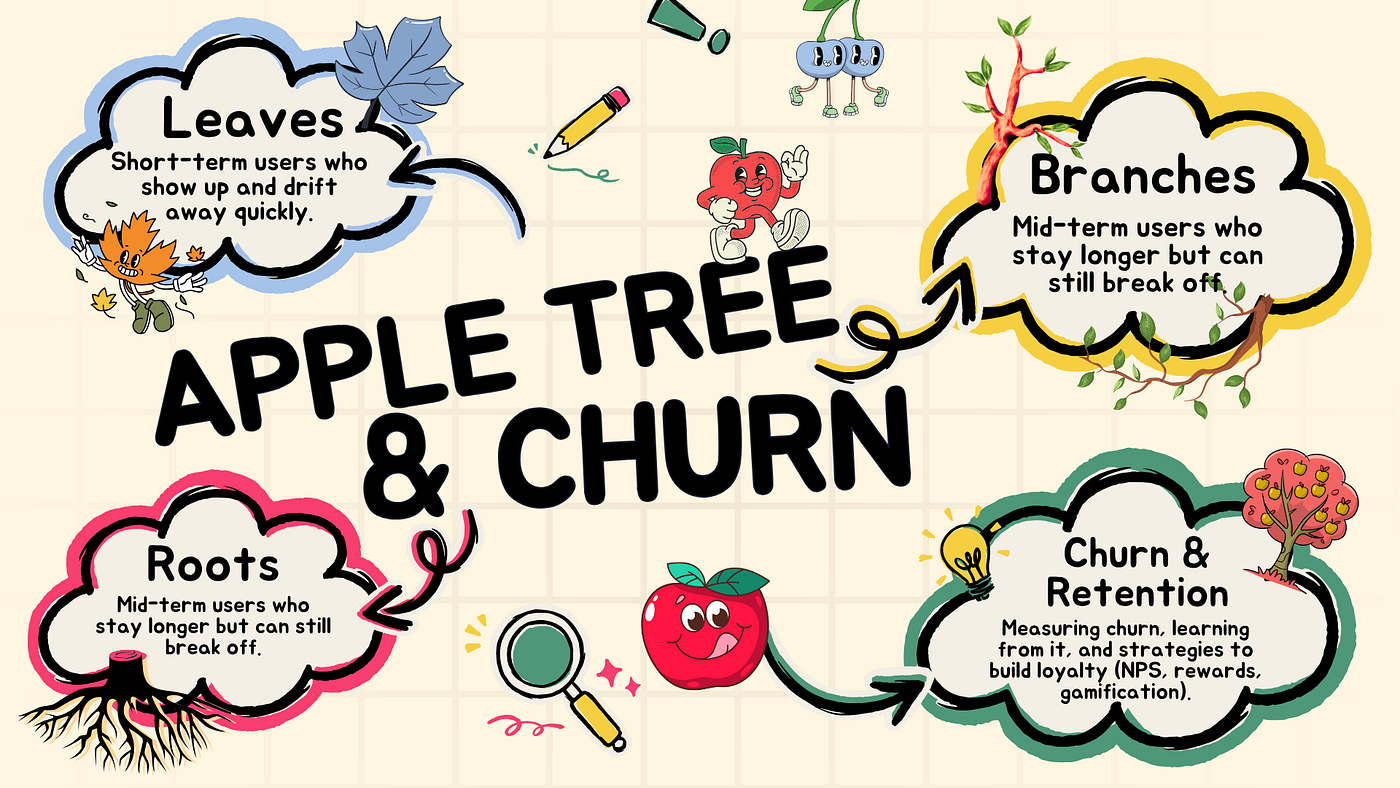
Churn reduction explained with Apple tree illustration
You Cannot Stop Leaves From Falling, But You Can Design Against Churn
An apple tree is full of leaves, they make it look alive, but when the season changes, they fall…that is **churn(**According to Uxcel, Churn measures how many users or customers stop using a product during a period, highlighting retention gaps or product dissatisfaction). Some users will always leave, and that is natural.
Speaking of apple trees, there is one in my house that I used to climb.I love eating the apples, and it always takes me back to when I was younger, sitting up there and watching how the tree changed. Some parts of it came and went with the seasons, some parts lasted longer, and some parts stayed hidden but held everything together.
That same apple tree explains something I now think about often as a UX designer. It shows why many users leave apps quickly, why some stay for a while, and why a few remain loyal for years.
Leaf Friends and Leaf Users
The apple tree is always full of leaves that make it look alive, but once the season changes, they drop. As a child I would see them cover the ground and I knew new ones would grow again.
Friendships are like that. You meet people who are fun for a while but once the setting changes, they disappear.
In apps these are the leaf users, they download once, sign up quickly, look around, and then never come back; that is normal. Most leaves fall quickly.
Branch Friends and Branch Users
The branches were the part of the tree I trusted when I climbed to pluck apples. They carried me up and lasted longer than the leaves. But heavy storms sometimes broke them off.
These are branch friendships. Friends who stay around for some years, send you jokes, remember your birthday. Yet when big life changes happen, some drift away.
Branch users are similar. They log in often, they build habits, and they enjoy your features. But if the product changes too much or something else looks better, they can still leave.
Root Friends and Root Users
The roots of the apple tree are hidden but they are the reason the tree lives. Without them, there would be no branches, no leaves, and no apples for me to pluck.
Root friendships are the strongest. They stay through every season of your life.
These are root users in apps. They come back daily, forgive mistakes, recommend your product to others, and even give feedback that helps you grow.
The Apple Tree Explains Churn
Churn is simply when users leave, the apple tree makes it clear.
According to Uxcel, Churn measures how many users or customers stop using a product during a period, highlighting retention gaps or product dissatisfaction.
When leaves fall, it is natural. Most new users leave quickly.
When branches break, it is a warning. If your regular users leave, you need to look closely at what is not working.
When roots pull away, it is an alarm. If your most loyal users leave, you need to act fast.
How to Calculate Churn
To calculate churn rate, you’ll need three data points:
- Total number of customers or users at the start of the period.
- Total number of customers or users at the end of the period.
- Total number of new customers or users at the end of the period.
Once you have the numbers, you can put them into a simple formula:
Churn Rate = (Customers at End of Period — New Customers During Period) ÷ Customers at Start of Period
Let us break it down with an example. Say you start the week with 1,000 customers. By the end of the week, you now have 1,200 customers, and during that week you added 250 new ones.
Plugging that in: (1,200–250) ÷ 1,000 = 0.15 or 15% churn rate.
Why subtract the new customers? Because it separates growth from churn. Without subtracting them, the numbers get distorted. Using the same example without removing new customers, your churn rate would look like 120%, which clearly does not make sense.
Reducing Churn Beyond the Basics
The obvious part is making the product easy for leaves, consistent for branches, and deep for roots, but there are other ways to keep people too, like:
- Net Promoter Score — NPS (NPS is a simple metric that measures customer loyalty) to listen to what people really think.
- Customer Onboarding Optimization.
- Predictive churn analytics.
- Customer success management.
- Value-based segmentation and personalization.
- Proactive customer support and issue resolution.
- Loyalty programs and incentive/reward systems.
You can even use gamification to turn routine actions into fun habits. Small things like this give users more reasons to return.
The Takeaway
Every product is like the apple tree I still climb today. Most users will be leaves. Some will grow into branches. A few will become roots. The goal is not to stop the leaves from falling, because that is natural. The real goal is to guide more leaves into branches and more branches into roots.
The deeper the relationship, the more valuable it becomes. Root users are not just customers. They are the base that keeps everything alive.
Sometimes the clearest lessons in design do not come from books or metrics, they come from something as simple and steady as an apple tree in your backyard😊. The big deal is not to stop the leaves, it is to design in a way that turns more leaves into branches, and more branches into roots.
How are you guiding users from “just trying” to “staying for good”?”
If you found this article helpful, leave 50 claps 👏 for me, PS: Clapping is free

Kindly leave 50 claps 👏 for me

Kindly leave 50 claps 👏 for me
메타데이터
- post_id
- 7a8ecb54bd88
- slug
- you-cannot-stop-leaves-from-falling-but-you-can-design-against-churn-7a8ecb54bd88
- url
- https://medium.com/design-bootcamp/you-cannot-stop-leaves-from-falling-but-you-can-design-against-churn-7a8ecb54bd88
- canonical_url
- https://medium.com/design-bootcamp/you-cannot-stop-leaves-from-falling-but-you-can-design-against-churn-7a8ecb54bd88
- author_url
- https://medium.com/@folasewaogunsola
- status
- ok
- fetched_at
- 2026-06-09 15:37:30