BAM15 Explained: The Experimental Fat Loss Compound
A next-gen fat burner or a metabolic disaster?
BAM15 Explained: The Experimental Fat Loss Compound
A next-gen fat burner or a metabolic disaster?

BAM15 is one of the newest and most controversial compounds to hit the biohacking scene.
And yes, all of these biohacking products have names that sound like they’re from Star Wars.
Researchers originally developed it as a mitochondrial uncoupler.
Early animal studies look VERY impressive.
We’re talking things like:
Reduced body fat.
Improved insulin sensitivity.
Increased energy expenditure without suppressing appetite.
But…there’s a darker side to mitochondrial uncoupling too.
The same mechanisms that make compounds like BAM15 interesting, may also create oxidative stress and metabolic strain.
And right now, human data is minuscule.
So before getting into all of the amazing things BAM15 can do…
Let’s learn what it is exactly, and what mitochondrial uncouplers are…
What is BAM15?

BAM15 is an experimental mitochondrial uncoupler.
(More on the uncoupler part in a minute.)
In early animal studies, BAM15 showed some impressive effects:
- reduced body fat
- increased calorie burning
- improved insulin sensitivity
- protection against diet-induced obesity
And notably, those effects occurred WITHOUT significantly reducing food intake.
Obviously, that part excites everyone.
Most modern fat loss drugs work by suppressing appetite or altering blood sugar regulation.
BAM15 takes a different route.
It acts directly on the mitochondria, which are responsible for producing cellular energy.
More specifically, BAM15 belongs to a category of compounds known as mitochondrial uncouplers.
(Told you we’d get back to it)
That term sounds extremely technical and maybe even a little scary at first.
But the idea is pretty simple once you strip away the scientific jargon.
What Are Mitochondrial Uncouplers?

Photo by National Cancer Institute on Unsplash
To understand mitochondrial uncouplers, you first need a basic idea of how mitochondria produce energy.
Think of mitochondria like tiny power plants inside your cells.
(Cliche, I know. But this analogy works)
Their job is to convert nutrients from food into usable cellular energy called adenosine triphosphate (ATP).
Normally, mitochondria try to do this as efficiently as possible.
They extract energy from carbohydrates and fats, then store that energy in ATP with minor amounts of waste.
Mitochondrial uncouplers turn that upside down.
Instead of allowing mitochondria to operate at maximum efficiency, uncouplers INTENTIONALLY create a kind of energy leak.
Some of the energy that would normally become ATP gets released as heat instead.
And that forces the body to burn more fuel to produce the same amount of usable energy.
You can think of it like a car engine that suddenly becomes less fuel efficient.
The engine still works.
But now it burns more gasoline to travel the same distance.
Sooo…that sounds terrible.
Why is that a good thing?
Because increasing energy expenditure at the cellular level helps reduce body fat…
…without relying entirely on appetite suppression.
And they’re not new on the scene.
Researchers have explored mitochondrial uncoupling for decades.
The problem is that older uncouplers came with major safety concerns.
Like:
-dangerous overheating
-rapid heart rate
-and severe metabolic stress
This is why BAM15 has attracted so much attention.
Research suggests it may produce mitochondrial uncoupling with a lower risk of hyperthermia than older compounds.
That has everyone excited: fat loss, without cutting calories, and no major side effects.
(We’ll get to the potential side effects later on)
Almost everyone is interested in fat loss.
But could BAM15 offer any other benefits…
More Than Fat Loss: Health Benefits of BAM15
Photo by julien Tromeur on Unsplash
Losing fat is already exciting enough.
But, yes, the research on BAM15 goes far beyond body composition.
Some of the most interesting findings involve metabolic health itself.
In simple terms metabolic health refers to how well your body turns food into energy, and how balanced your key health markers are.
Or as Hewings-Martin writes:
how efficiently your body converts food into energy and maintains stable blood sugar, cholesterol, triglycerides, and blood pressure without medication
In multiple animal studies, BAM15 improved insulin sensitivity and glucose control surprisingly quickly.
In one study involving mice fed a Western-style diet, researchers observed reductions in fasting glucose and insulin levels within just seven days.
That’s significant because impaired insulin sensitivity is at the core of many modern metabolic disorders.
Researchers also used hyperinsulinemic-euglycemic clamp studies to evaluate BAM15.
That’s the crème de la crème for measuring insulin sensitivity, btw.
And results showed increased glucose clearance and improved insulin responsiveness across multiple tissues.
Basically, the mice became better at managing and utilizing glucose.
Researchers also observed:
- reduced liver fat accumulation
- lower oxidative stress markers
- reductions in inflammatory lipid species
- increased fat mobilization and utilization

Photo by Lawrence Krowdeed on Unsplash
Interestingly, BAM15 increased plasma free fatty acids without pushing the animals into ketosis.
That’s promising news for people who want greater metabolic flexibility without following a strict ketogenic diet.
(I.e. everyone!)
Another detail caught researchers’ attention.
Despite the increase in metabolic activity, several standard safety markers remained normal in treated animals, including:
- liver enzymes
- muscle damage markers
- hematology panels
That doesn’t prove BAM15 is completely safe in humans.
But, it’s encouraging nonetheless.
Beyond obesity and metabolic dysfunction, BAM15 may have other uses.
Especially for the mitochondria.
Mitochondrial dysfunction plays a role in many chronic diseases, including:
- cardiovascular disease
- neurodegenerative disorders
- sepsis
- and certain cancers
That has opened the door to broader discussions around mitochondrial medicine, longevity, and healthspan.
At the moment, those possibilities remain…speculative.
Still, the early research is intriguing enough that BAM15 has quickly become one of the most closely watched experimental compounds out there.
And naturally, that has led many people to compare it to the most infamous mitochondrial uncoupler ever studied:
DNP.
BAM15 vs DNP
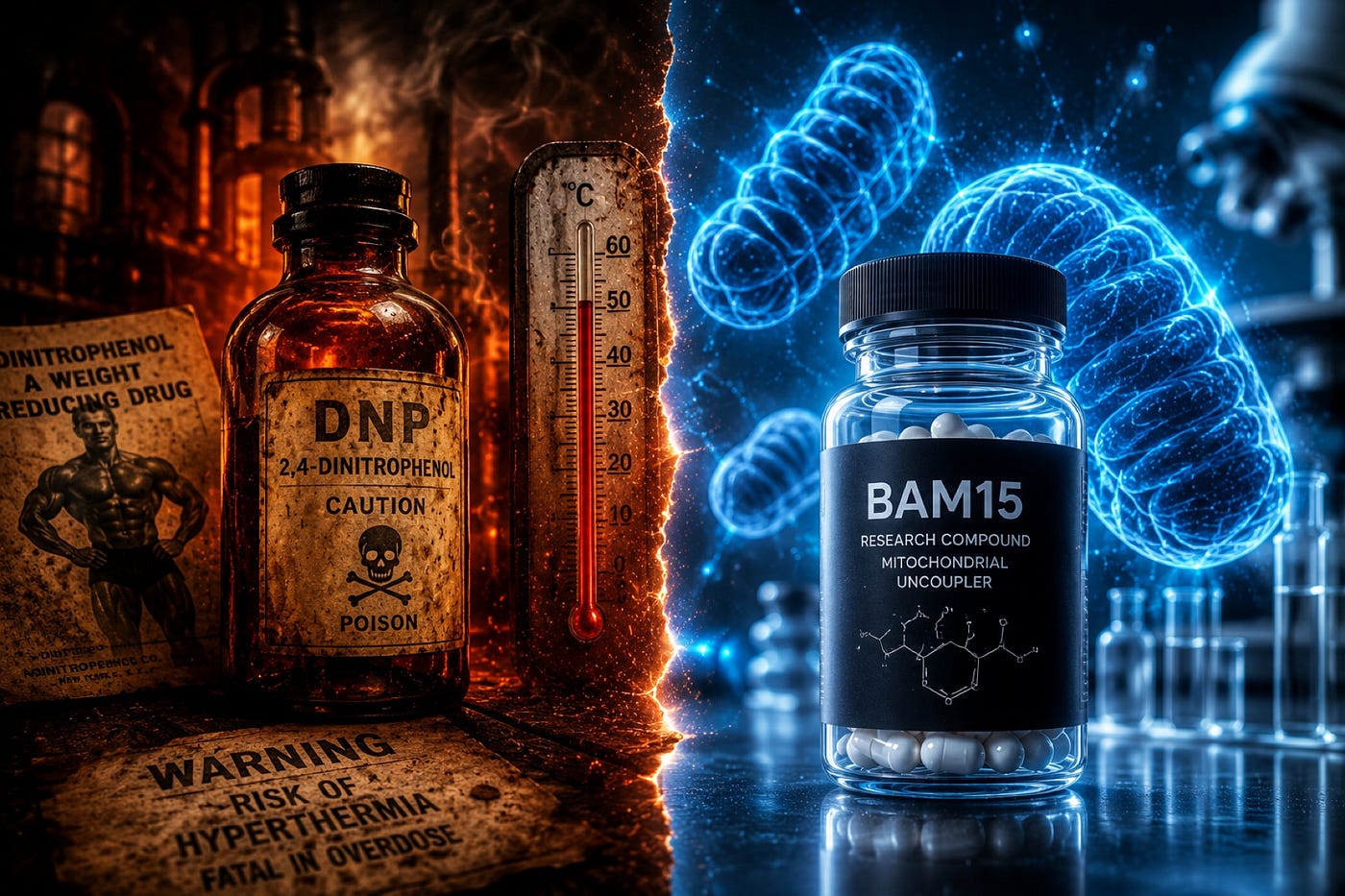
Any serious discussion about BAM15 has to also mention DNP.
And for good reason.
DNP, Dinitrophenol, is one of the most infamous fat loss compounds ever discovered.
For decades, it’s existed somewhere between underground bodybuilding lore, dangerous chemical experiment, and cautionary tale.
Like BAM15, DNP is a mitochondrial uncoupler.
It increases energy expenditure by making mitochondria less efficient.
The problem is that DNP pushes that mechanism extremely hard.
And as dosages increase, body temperature can rise rapidly…
and uncontrollably.
Obviously, that’s not good.
And DNP developed a reputation for:
- severe overheating
- dehydration
- rapid heart rate
- organ stress
- and fatal hyperthermia in overdose situations
Part of the problem is its narrow therapeutic window.
The difference between an “effective” dose and a dangerous one is thin.

Photo by James Hardman on Unsplash
And once body temperature starts climbing aggressively, there’s often little physicians can do to bring it down.
That history has tainted mitochondrial uncouplers ever since.
So when researchers began studying BAM15, one question immediately surfaced:
Could scientists create a mitochondrial uncoupler with similar metabolic benefits but fewer dangerous side effects?
So far, BAM15 appears less likely to trigger extreme hyperthermia compared to older uncouplers like DNP.
Still, “safer” does not automatically mean safe.
That’s important to keep in mind with compounds like BAM15.
Right now, human research remains extremely limited.
Researchers still don’t fully understand:
- long-term safety
- ideal dosing strategies
- mitochondrial stress thresholds
- or how chronic uncoupling may affect human physiology over time
And unlike approved medications, experimental compounds are usually found gray-market suppliers.
Which, raises questions about quality measures.
At the moment, BAM15 sits in a unique category.
The compound appears far more sophisticated than older uncouplers like DNP.
But it’s also highly experimental.
And that means anyone interested in BAM15 should approach it with curiosity, caution, and realistic expectations.
Because once you start manipulating mitochondrial energy production directly, you’re operating at one of the deepest levels of human metabolism.
But let’s find out how biohackers are using BAM15.
How Biohackers are Experimenting with BAM15

Photo by Anshu A on Unsplash
At the moment, there’s no established human dosing protocol for BAM15.
And there are no approved medical guidelines.
This is still mostly uncharted territory.
And most of the discussion around usage comes from:
- animal research
- mechanistic theory
- and anecdotal experimentation within biohacking communities
Still, certain patterns have started to emerge among people experimenting with the compound.
However, some experts in the field recommend starting at 250 milligrams.
One of the biggest involves cycle length.
Why Many Biohackers Cycle BAM15
Mitochondrial uncoupling increases metabolic activity at a very deep cellular level.
Which is why many people approach the compound cautiously.
Rather than using BAM15 continuously for months, biohackers often discuss:
- shorter experimental cycles
- conservative dosing
- and extended off-periods
Common anecdotal approaches include:
- 2 to 4 week cycles
- followed by several weeks off
- sometimes as long as 6 to 8 weeks between cycles
The logic behind this approach is fairly straightforward:
Short-term mitochondrial stress may trigger useful metabolic adaptations.
Chronic uncoupling is a different situation entirely.
Some researchers and biohackers speculate that prolonged mitochondrial inefficiency could increase oxidative stress and cellular wear over time.
And if your mitochondria aren’t functioning properly…that’s a huge problem.
Right now, nobody knows exactly where that threshold exists in humans.
Mitochondrial Support During BAM15 Cycles

Photo by Claudio Schwarz on Unsplash
Another interesting discussion has emerged around stacking.
More specifically, which mitochondrial compounds pair logically with BAM15 and which ones may not.
Some biohackers avoid combining BAM15 with highly stimulatory mitochondrial compounds such as:
- SLU-PP-332
- SS-31
- 5-Amino-1MQ
In theory, stacking multiple aggressive metabolic compounds together could increase energetic strain on the mitochondria.
And human data on these combinations is almost nonexistent.
So much of the discussion remains speculative.
On the other hand, many people experimenting with BAM15 focus heavily on mitochondrial support and recovery.
The goal is usually to support:
-antioxidant defenses
-mitochondrial quality control
-and cellular cleanup pathways while metabolic demand increases.
Compounds commonly discussed alongside BAM15 include:
- Urolithin A
- alpha-lipoic acid
- NAC
- CoQ10
- PQQ
- C60
Urolithin A has attracted particular interest because of its connection to mitophagy.
Which is the process cells use to recycle and remove damaged mitochondria.
Others, like alpha-lipoic acid and NAC, are often used to support antioxidant systems during periods of increased metabolic stress.
At the moment, none of these combinations have robust human research behind them.
Still, the conversations themselves reveal something important about BAM15:
Most people experimenting with mitochondrial uncouplers understand they’re operating in highly experimental territory.
This isn’t viewed like a typical fat burner.
It’s closer to metabolic engineering at the cellular level.
And that’s exactly why BAM15 has become such a fascinating topic in modern biohacking.
Risks & Safety

Photo by Bernd 📷 Dittrich on Unsplash
Mitochondria naturally produce reactive oxygen species during energy production.
Under normal conditions, the body can manage this process without issues.
But mitochondrial uncoupling changes the energetic balance inside the cell.
And as we discussed, prolonged or aggressive uncoupling could increase oxidative burden.
And place additional stress on cellular repair systems over time.
Another important point is that mitochondrial uncouplers can affect heat production.
That’s part of their mechanism.
Although BAM15 appears less likely than older uncouplers like DNP to trigger severe hyperthermia in preclinical research..
..researchers still don’t fully understand how the compound behaves in humans under different conditions.
Plus, variables like:
- dosage
- body composition
- stimulant use
- hydration
- exercise intensity
- and environmental heat
could potentially influence outcomes significantly.
I won’t sugarcoat it: this is one of the more experimental performance enhancers out there.
There’s a lot we don’t know.
But, biohackers have been using it for a while with no known serious side effects.
But again, we don’t have hard human evidence yet.
BAM15: A Promising, but Experimental Fat Burner

Photo by John Fornander on Unsplash
Everyone wants to be ripped.
And sport a lean, muscular, chiseled body.
There’s plenty of ways to achieve that naturally, but it can be challenging.
Especially as you get older.
But BAM15 might be a way to achieve that without following absurd diets.
It works…but at what cost?
A shredded physique isn’t worth massive mitochondrial damage.
But, it’s too early to label BAM15 completely dangerous.
And also too early to praise it as the holy grail of fat loss.
Time will tell.
For now, it’s a super interesting compound we should all keep an eye on.
메타데이터
- post_id
- 7dfaebf24790
- slug
- bam15-explained-the-experimental-fat-loss-compound-7dfaebf24790
- url
- https://medium.com/@KevAlghul/bam15-explained-the-experimental-fat-loss-compound-7dfaebf24790
- canonical_url
- https://medium.com/@KevAlghul/bam15-explained-the-experimental-fat-loss-compound-7dfaebf24790
- author_url
- https://medium.com/@KevAlghul
- status
- ok
- fetched_at
- 2026-07-13 06:23:13