What happens in a baby’s brain before they say their first word
and the one thing that shapes it most
What happens in a baby’s brain before they say their first word
and the one thing that shapes it most
The capacity for language is being built in the first twelve months of life through something far simpler and more available than any educational product — a parent’s voice, responding.
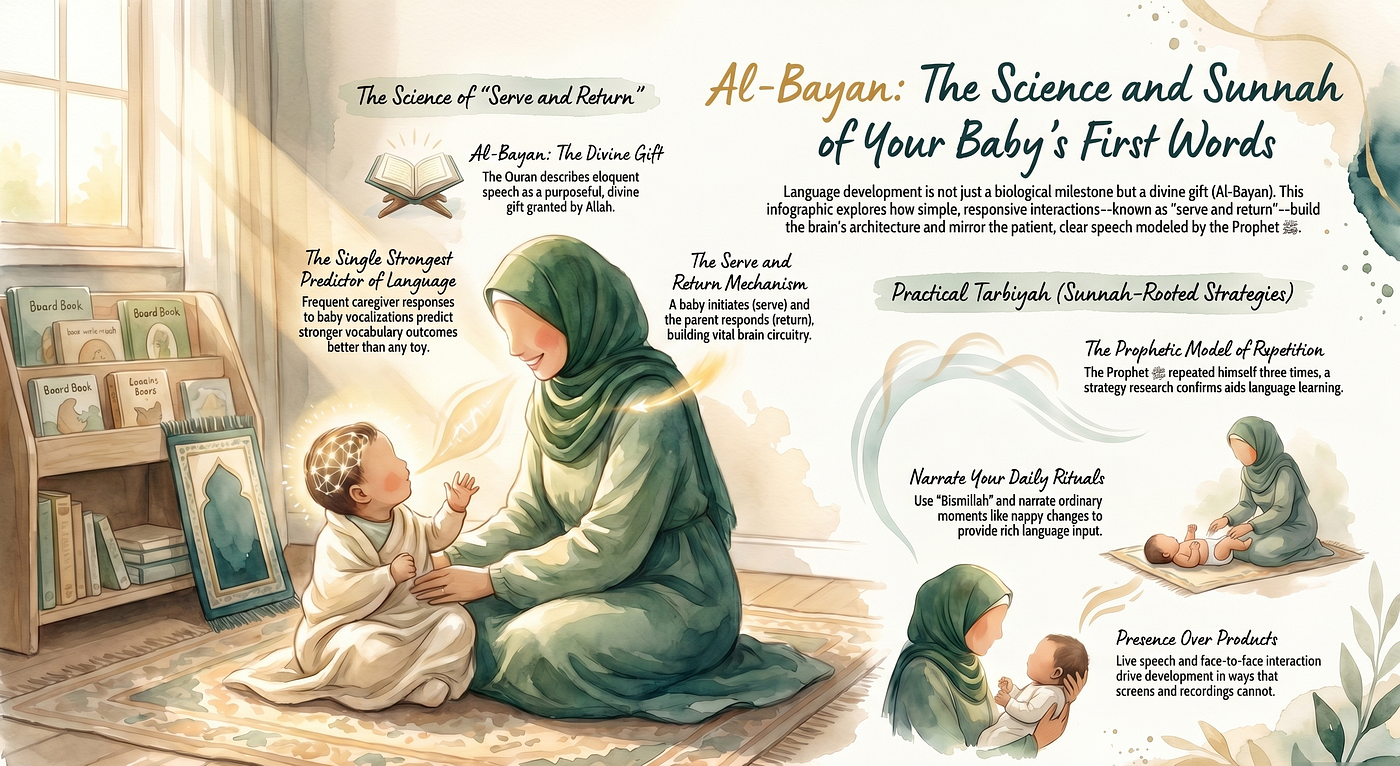
A mother once shared something with me that stuck. Her baby was four months old, and she’d been spending evenings sitting beside the cot, playing a Qur’an recording — beautiful, professional recitation, the kind that fills a room with something sacred. She felt good about it. Then she read that the recordings weren’t doing what she thought.
“But I’m giving him the Qur’an,” she said. “Isn’t that enough?”
The answer turned out to be more nuanced than either of us expected. And it changed how she spent those evening hours.
The first year isn’t a waiting room
Most of us treat a baby’s first year as a period of anticipation. We’re waiting for the crawling, the standing, the first word. Language feels like something that will arrive in its own time, a gift handed over at around ten months, give or take.
But language doesn’t arrive. It accumulates.
Long before a child produces a recognisable word, the architecture of communication is being laid down — through exposure to rhythm, to tone, to the experience of being responded to. A 2019 study published in Developmental Science tracked infants from seven months through their first words and found that the frequency of caregiver responses to a baby’s vocalisations was the single strongest predictor of when and how language developed. [1] Not the type of education. Not background stimulation. The responsiveness of the person in the room.
This is worth sitting with for a moment. Because it shifts the question entirely. It’s not: “What should I be playing for my baby?” It’s: “Am I turning toward them when they make a sound?”
What the milestones are actually measuring
Between three and twelve months, a recognisable sequence unfolds. Cooing comes first — soft vowel sounds that appear around three or four months, almost always accompanied by direct eye contact, which is itself a kind of conversation. [2]
Babbling follows. The first syllables are simple: “ba,” “ma,” “da.” Then those syllables start repeating, stacking into something that has the rhythm of speech without the meaning of words. By six or seven months, parents often notice their baby sounds as if they’re making a statement — or asking something. They’re not yet. But the shape of language is there. [2]
What changes between nine and twelve months is intentionality. The baby begins pointing at objects. They turn when their name is called. They start to understand that a specific sound, consistently made, refers to a specific thing — and somewhere in that understanding, the first true word takes shape. [2]
Differences in timing are completely normal. Children raised in bilingual households may reach some spoken milestones at slightly different points while demonstrating equivalent comprehension. [3] If anything seems off — if there’s no babbling by six months, no name recognition by nine, no gestures by twelve — an early conversation with a paediatrician is always the right call. The research on early intervention is consistent: sooner is better.
Why a recording isn’t the same thing
Back to that mother and her evening Qur’an recitation.
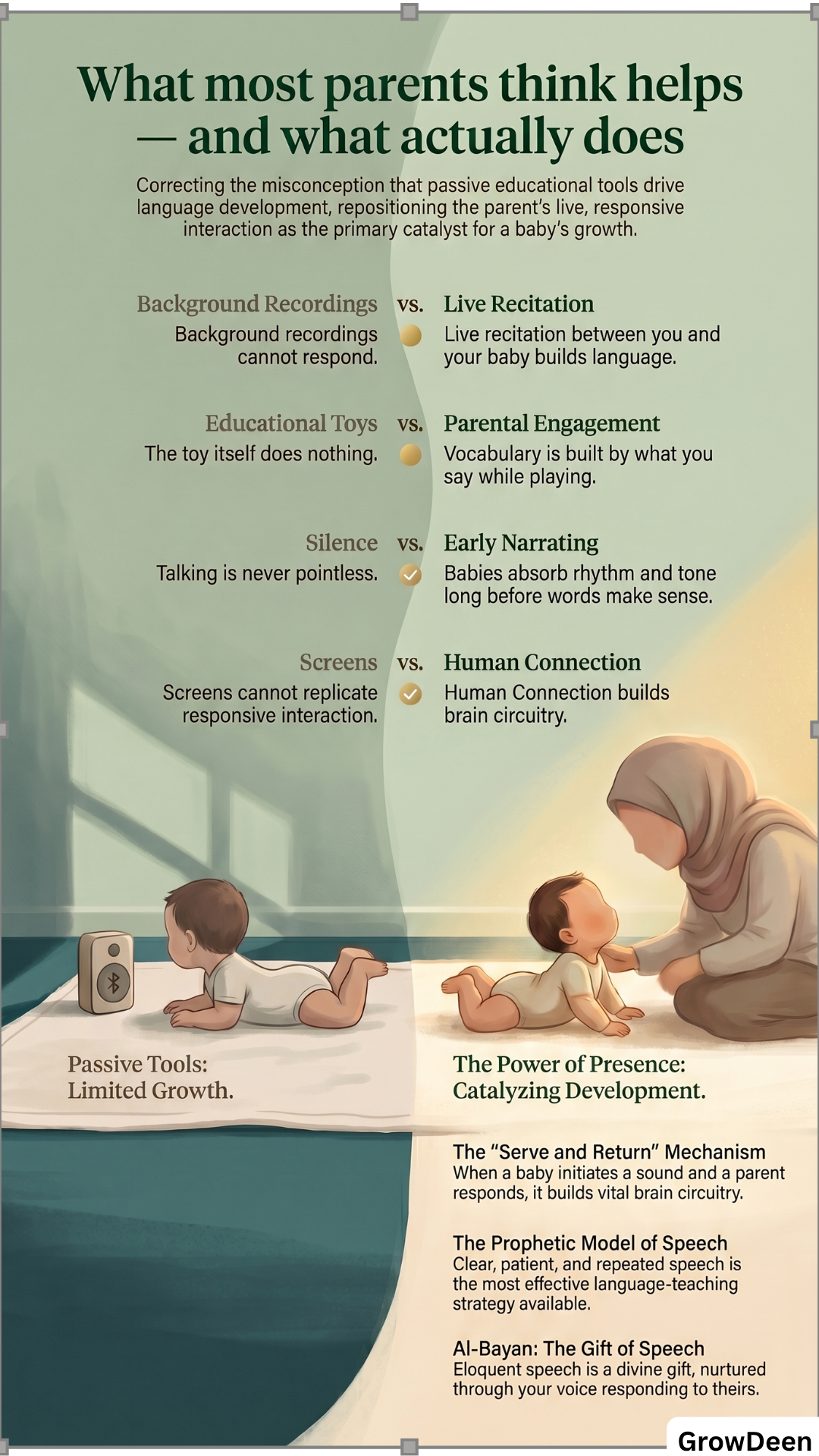
The research on language development distinguishes consistently between two things: passive audio exposure and responsive live speech. [6] A recording, however beautiful, presents the same input regardless of what the baby does. It doesn’t pause when the baby vocalises. It doesn’t repeat itself in response to a look of confusion. It doesn’t adjust its rhythm when the baby seems tired.
A parent does all of this without thinking.
Harvard’s Center on the Developing Child describes a mechanism called serve and return — the back-and-forth of a baby initiating communication and a caregiver responding. [4] Each exchange, however brief, reinforces the neural pathways that will eventually carry language. Thousands of these exchanges happen across the first year. Their absence, or their inconsistency, is measurably reflected in later outcomes.
The recommendation isn’t to avoid recorded Qur’an. It’s to recognise that the live recitation of a parent — sitting close, face visible, pausing to look at the baby — does something the recording cannot. Both are gifts. But they’re different kinds.
What the Qur’an says about the capacity to speak
There’s a passage at the opening of Surah Ar-Rahman that I’ve returned to many times since thinking through this topic.
“The Most Merciful. He taught the Qur’an. He created man. He taught him al-bayan.” [10]
Al-bayan — usually translated as speech or eloquent expression. According to Tafsir Ibn Kathir, Al-Hasan explained this as the ability to speak: specifically, Allah making it easy for the human being to produce letters through the instruments of the mouth — the tongue, the lips, the alveolar ridge. [10] The capacity for articulation isn’t incidental to human design. In the Qur’an’s framing, it’s listed immediately after the creation of the human being itself, presented as one of the primary gifts of the Most Merciful.
Your baby babbling at four months isn’t background noise. It’s al-bayan beginning to stir.
And the Prophetic example is consistent with this understanding. Anas ibn Malik recorded in Sahih al-Bukhari that when the Prophet ﷺ spoke, he repeated himself three times until he was understood. [11] Not once. Three times. Patient, clear, repeated speech — directed at the listener until comprehension was reached. It’s striking how directly this mirrors what developmental researchers now say about language acquisition: repetition is one of the most powerful mechanisms through which a baby builds vocabulary.
The ordinary moments that do the most
Parents who are told their voice matters often immediately imagine that this means sitting down for deliberate, structured talking time. It doesn’t.
The research is actually more interesting than that. A 2019 study examining speech directed to infants during everyday home activities found that language input during routine caregiving — feeding, bathing, changing — was significantly associated with language outcomes. [5] The ordinary moments. The unremarkable ones.
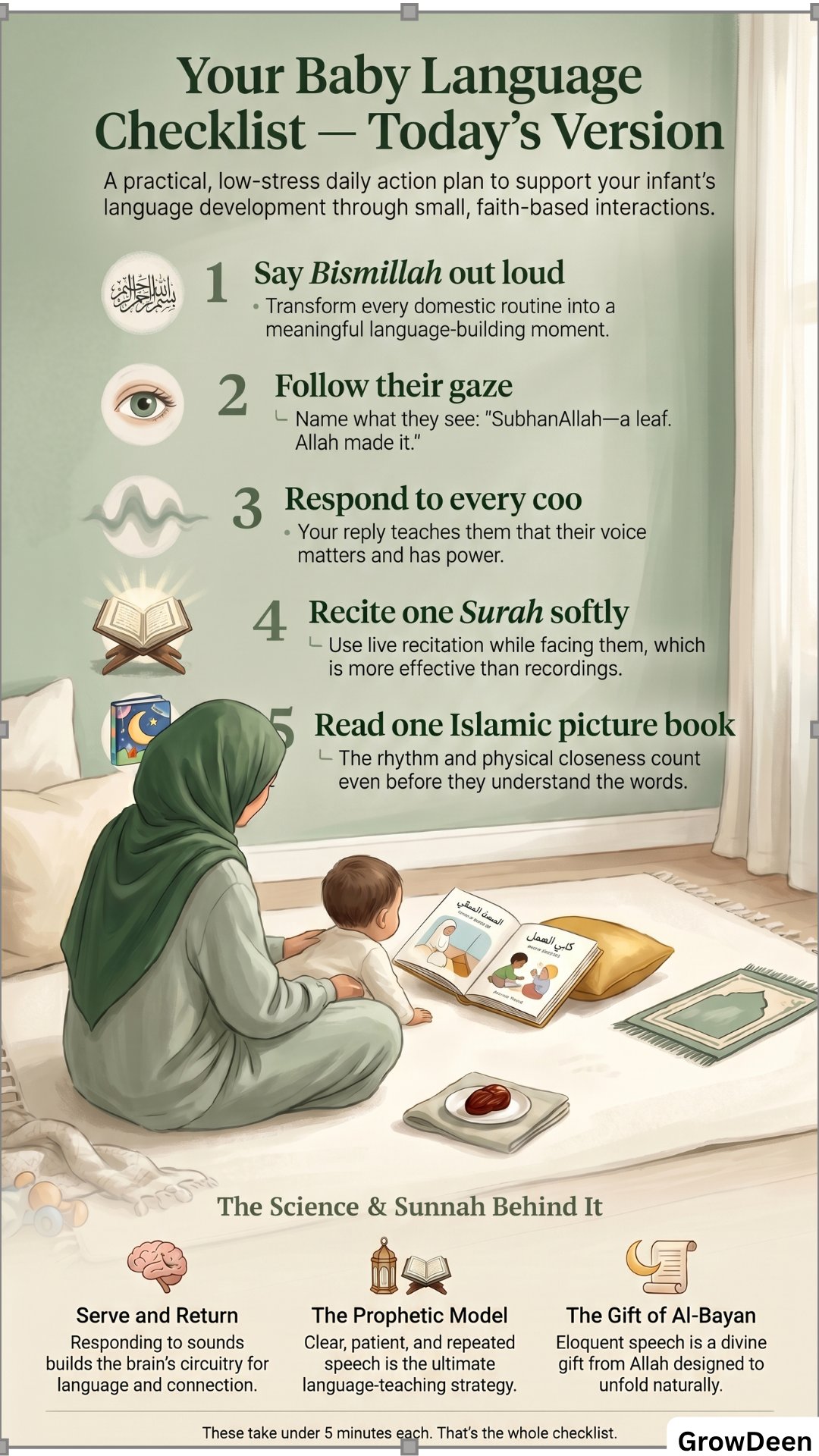
“Bismillah — time to change your nappy.” “One leg. Two legs. Alhamdulillah.” “SubhanAllah, look at that light.”
These phrases, repeated daily across the first year, are doing something. They’re not wasted on a baby who can’t understand them yet. They’re building the pattern, the expectation, the felt sense that language is woven through every part of life.
Parents who speak a heritage language at home should use it freely. The evidence on bilingualism is clear: hearing two languages from birth builds two parallel language systems simultaneously. [3] For Muslim families who also carry Arabic as a language of worship, even limited Qur’anic Arabic in infancy plants a familiarity with sacred language that deepens across childhood.
There’s also the matter of screens. The American Academy of Pediatrics recommends avoiding entertainment screen media for children under eighteen months, with video calls being the main exception. [9] The reason isn’t that screens are catastrophic. It’s that they don’t respond. And response — that specific experience of being answered — is what the data shows matters most.
When to raise a concern
The milestones exist to help parents calibrate, not to induce anxiety. But certain signs are genuinely worth discussing with a professional:
No social smiling or eye contact by three months. No babbling by six months. No consistent response to the baby’s own name by nine months. No deliberate gestures — pointing, waving — by twelve months. No first words by somewhere between twelve and sixteen months. [8]
Trust what you notice. Parents often perceive something before a formal assessment confirms it, and early support for language delays is reliably more effective than a wait-and-see approach.
What this asks of us
There’s something quietly demanding about what the research reveals. It means the most important language-development tool for a baby in the first year isn’t purchasable. It’s available — but it requires presence, attention, the willingness to turn toward a small person who can’t yet tell you what they need.
That’s the ask. To narrate the day. To respond to the coo. To read a board book about Prophet Ibrahim ﷺ at bedtime, not because the baby understands the story, but because your voice reading it to them is doing work you can’t see.
There’s a du’a that Ibrahim ﷺ himself made — preserved in Surah Ibrahim — asking Allah to make him and his descendants among those who establish prayer. [10] “Rabbi ij’alni muqimas-salati wa min dhurriyyati, Rabbana wa taqabbal du’a.” It’s the prayer of a father thinking not just about himself but about the chain he hopes to be part of, the language he hopes passes forward.
Every time a Muslim parent sits with their baby and speaks — says Bismillah, recites a surah, names the things around them in the language of this life and of worship — they’re participating in something like that. Not just language development. The beginning of a transmission.
A note for the parents who feel they’re not doing enough
One of the things the research makes clear is that the bar isn’t perfection. It’s responsiveness. Not constant, exhausting, high-effort responsiveness — but the basic orientation of turning toward your baby when they make a sound.
Parents in difficult circumstances, tired parents, parents juggling other children or work or illness: the question isn’t whether you’re doing enough structured language time. The question is whether, in the small ordinary moments you already have, you’re present. That’s available to almost everyone. And according to the research, it’s what matters most. [1, 5]
If you found this piece useful, consider following for more writing on child development, parenting, and Islamic family life. Every piece brings together peer-reviewed research and Islamic guidance — for parents who want both.
References
[1] Donnellan, E., Bannard, C., McGillion, M.L., Slocombe, K.E., & Matthews, D. (2019). Infants’ intentionally communicative vocalizations elicit responses from caregivers and are the best predictors of the transition to language. Developmental Science, 23(1), e12843. https://doi.org/10.1111/desc.12843
[2] National Institute on Deafness and Other Communication Disorders (NIDCD). (2010). Speech and language developmental milestones. https://www.nidcd.nih.gov/sites/default/files/Documents/health/voice/NIDCD-Speech-Language-Dev-Milestones.pdf
[3] Fellowes, J., & Oakley, G. (2019). Language, literacy and early childhood education (3rd edn). Oxford University Press.
[4] Harvard Center on the Developing Child. (2018). Serve and return interaction shapes brain circuitry. https://developingchild.harvard.edu/science/key-concepts/serve-and-return/
[5] Tamis-LeMonda, C.S., Custode, S., Kuchirko, Y., Escobar, K., & Lo, T. (2019). Routine language: Speech directed to infants during home activities. Child Development, 90(6), 2135–2152. https://doi.org/10.1111/cdev.13089
[6] Newman, R.S., Rowe, M.L., & Ratner, N.B. (2016). Input and uptake at 7 months predicts toddler vocabulary. Journal of Child Language, 43(5), 1158–1173. https://doi.org/10.1017/S0305000915000446
[7] Owens, R.E. (2021). Language development: An introduction (10th edn). Pearson.
[8] Speech Pathology Australia. (2023). Communication milestones. https://www.speechpathologyaustralia.org.au/Public/Public/Comm-swallow/Speech-development/Communication-milestones.aspx
[9] American Academy of Pediatrics. (2016). Media and young minds. Pediatrics, 138(5), e20162591. https://doi.org/10.1542/peds.2016-2591
[10] Qur’an, Surah Ar-Rahman 55:1–4; Surah Ibrahim 14:40 — https://quran.com/55/1 and https://quran.com/14/40
[11] Sahih al-Bukhari, Hadith 95 — Graded: Sahih — https://sunnah.com/bukhari:95
메타데이터
- post_id
- 824ffae91af5
- slug
- what-happens-in-a-babys-brain-before-they-say-their-first-word-824ffae91af5
- url
- https://medium.com/@growdeeneducation/what-happens-in-a-babys-brain-before-they-say-their-first-word-824ffae91af5
- canonical_url
- https://medium.com/@growdeeneducation/what-happens-in-a-babys-brain-before-they-say-their-first-word-824ffae91af5
- author_url
- https://medium.com/@growdeeneducation
- status
- ok
- fetched_at
- 2026-06-21 07:44:09






