U.S. NIW Green Card Approval Rate Drops Sharply, RFE Rises, Priority Date Stagnates: Is This Path…
In recent periods, Law Offices of Brian Jiang(蒋百庚律师事务所) has received numerous inquiries from NIW applicants with highly consistent…
U.S. NIW Green Card Approval Rate Drops Sharply, RFE Rises, Priority Date Stagnates: Is This Path Still Viable in 2026?
In recent periods, Law Offices of Brian Jiang(蒋百庚律师事务所) has received numerous inquiries from NIW applicants with highly consistent concerns. Many applicants are confused: with rising RFE rates and increasingly stringent adjudication standards for NIW petitions, do ordinary candidates still have a stable chance of approval? In 2026, amid long-term priority date stagnation and continuous policy tightening, is the traditional NIW immigration pathway still suitable for average applicants? Widespread uncertainty and market anxiety have left many petitioners hesitant to file or waiting passively for their pending cases.
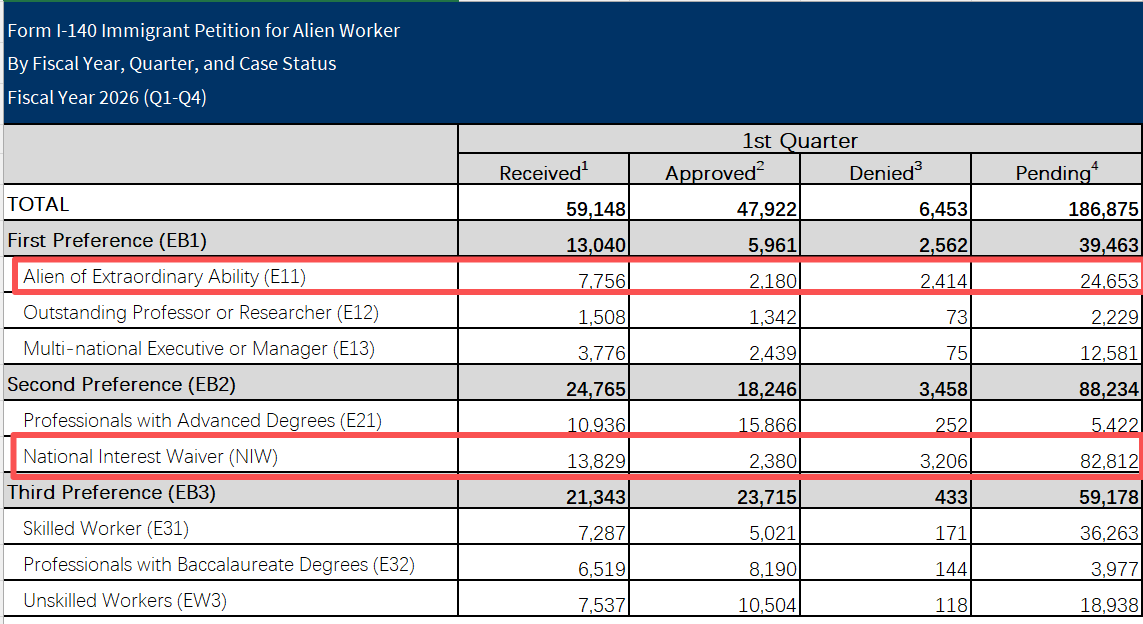
In fact, public anxiety is well-founded. Entering the 2026 fiscal year, the U.S. National Interest Waiver (NIW), once renowned for its high cost performance, labor certification exemption, and accessible threshold, has fully entered an era of rigorous and normalized adjudication. Based on the latest USCIS adjudication trends and industry case data, the current NIW overall approval rate has declined to a range of 55%-67%, while templated and homogenized petitions face RFE rates of 40% to 50%, leading to a substantial increase in case rejection rates. Meanwhile, the EB-2 (including NIW) priority dates for mainland Chinese-born applicants remain persistently stagnant at a high level. The official June 2026 Visa Bulletin released by the U.S. Department of State explicitly warns of potential future priority date retrogressions and temporary quota suspensions for this category. Focusing on the three major dilemmas of tightened scrutiny, high RFE frequency, and frozen priority dates, this article thoroughly analyzes the real status, feasibility, and high-efficiency approval strategies for 2026 NIW petitions based on updated policy rules and official adjudication standards.
I. Core Reasons for Falling NIW Approval Rates and Surging RFEs in 2026
Faced with falling NIW approval rates and rising RFE volumes, many mainland applicants mistakenly believe that U.S. immigration policies are closing doors to foreign talents. However, with 30 years of frontline practice experience, the current adjudication shift does not represent policy shutdowns. Instead, it reflects a profound restructuring and refinement of NIW legal review standards. USCIS has comprehensively tightened discretionary adjudication criteria to eliminate speculative filings and screen for high-quality talents with genuine industrial value, making case review far more professional, rigorous, and threshold-based than before.
1.1 NIW Adjudication Shifts From Loose Dividends to Strict Normalization
A longitudinal comparison of historical adjudication data reveals a dramatic shift in NIW review standards, creating a completely different application environment. The 2024 fiscal year featured relatively lenient NIW adjudication, with qualified and well-documented cases achieving approval rates of 75%-85%. Standards gradually tightened in 2025, and strict review has become fully normalized in 2026. Blind self-filings and templated applications can hardly obtain approval under current rules. The core data changes are highly evident:
- Significant decline in overall approval rates: The average NIW approval rate for the 2026 fiscal year stabilizes at 55%-67%, representing a drop of over 15 percentage points compared with the lenient cycle of previous years, with elimination rates rising sharply for conventional applications.
- Spiraling risks of RFE and denial: The current overall NIW RFE rate remains above 40%, reaching over 50% for poorly substantiated, logically flawed, and template-based petitions. Most RFE cases fail to meet updated adjudication standards due to incomplete evidence chains, ultimately resulting in official denials.
II. Long-Term NIW Priority Date Stagnation for Mainland Chinese Applicants: Status, Causes and Solutions
Compared with review challenges that can be improved through optimized documentation and legal drafting, EB-2 (NIW) priority date stagnation is the core structural dilemma for current mainland Chinese applicants, which cannot be resolved through individual application adjustments. According to the official June 2026 Visa Bulletin issued by the U.S. Department of State, the latest priority date status for mainland Chinese-born NIW applicants is as follows:
- Final Action Date (Chart A): According to official U.S. Department of State Visa Bulletins from June 2025 to June 2026, the EB-2 (NIW) priority date for mainland Chinese applicants advanced moderately in late 2025, moving forward from June 1, 2021 to September 1, 2021. After this minor advancement in January 2026, the priority date has remained completely frozen for five consecutive months with zero movement as of June 2026. Over the past 12 months, overall progression has been extremely limited with no retrogression recorded in 2026. Nevertheless, official warnings indicate a high risk of future priority date retrogressions.
- File Date (Chart B): Permanently locked at January 1, 2022, with no progression throughout multiple months of 2026. The chart status remains inactive, making applicants ineligible to submit I-485 adjustment of status applications and significantly extending the overall green card processing timeline.
The fundamental cause of prolonged EB-2 and NIW priority date stagnation lies in the explosive growth of global employment-based immigration filings. Applications from Chinese and Indian nationals have surged year after year, while annual U.S. immigrant visa quotas remain fixed and USCIS adjudication manpower is limited. This persistent case backlog has formed a normalized pattern of long-term priority date stagnation.
Previously, a common industry consensus prevailed: I-140 approval virtually guaranteed a green card. However, this logic is no longer valid under the 2026 immigration landscape. After I-140 approval, mainland Chinese applicants still face a waiting period of more than 5 years for final priority date adjudication. Such an extended waiting period brings two critical risks. First, applicants must maintain valid nonimmigrant status such as H-1B or O-1 for years with extremely low fault tolerance. Any status lapse or termination will directly disqualify their green card eligibility. Second, accompanying children are highly vulnerable to aging out before final adjudication, losing derivative green card eligibility and forcing families to bear additional time costs and complex immigration planning challenges.
To mitigate the structural dilemma of prolonged NIW priority stagnation, the most reliable and efficient strategy is dual-track immigration planning. While submitting a NIW petition to secure a priority date and await adjudication, qualified applicants may simultaneously evaluate eligibility for EB-1A Extraordinary Ability Green Card. The EB-1A category features no priority date backlog, faster adjudication speed, and higher quota priority, effectively avoiding NIW’s multi-year waiting cycle and accelerating permanent residency acquisition.
III. High Approval Strategies for NIW Petitions Under 40%+ RFE Rate in 2026
The era of casual filing, template copying, and simple document stacking for NIW approval has completely ended amid the current high RFE and ultra-stringent adjudication environment. Based on hundreds of successful NIW cases, RFE responses, and denial appeal experiences, applicants must abandon outdated filing mindsets. A tailored petition framework focusing on industrial value, complete evidence logic, and core competency demonstration is essential to align with USCIS 2026 adjudication standards and avoid RFE and denial risks.
3.1 Substantiate National Interest Value With Official and Industrial Data
During previous lenient adjudication cycles, generic recommendation letters with vague praise of an applicant’s excellence were often sufficient for approval. Such subjective and empty evaluations are no longer recognized by USCIS officers under the 2026 strict review system. Current mandatory review requirements demand solid supporting evidence, including macroeconomic industry data, U.S. federal official reports, authoritative industry white papers, and professional market research. Petitioners must clearly demonstrate that their professional field serves U.S. national interests, such as AI security, advanced semiconductor manufacturing, new energy technology, and biomedicine. Petitions must explicitly prove how the applicant’s work contributes to U.S. industrial innovation, technological upgrading, and industry development.
3.2 Focus on Irreplaceability Instead of Basic Qualifications
Simply listing publication counts, citation statistics, ordinary awards, and years of work experience is no longer sufficient to meet NIW labor certification exemption standards. Even PhD applicants with dozens of papers and high citation rates frequently receive RFEs or denials without substantive value demonstration. The core adjudication logic has shifted from “proving personal excellence” to proving industry irreplaceability and unique professional value.
Irreplaceability can be substantiated through high-value core evidence, including exclusive technical patents, participation in U.S. national-level scientific research projects, key backbone roles in major industrial programs, and verified records of creating substantial high-salary employment or promoting regional industrial development in the United States. These materials effectively prove that U.S. employers cannot easily replace the applicant through regular labor recruitment, fully justifying the labor certification exemption under U.S. national interest standards.
3.3 Build a Closed-Loop and Logical Evidence System
Modern USCIS adjudication focuses heavily on logical completeness, structural closure, and authenticity. The majority of RFEs and denials stem from broken evidence chains, disconnected legal arguments, and incoherent value logic. Rather than blindly accumulating scattered certificates, papers, and reference letters, applicants must rely on professional immigration attorneys to organize legal logic and structured narratives. A qualified petition must form a complete closed loop connecting past achievements, current industrial influence, and future contributions to the U.S., with every piece of evidence and argument precisely matching NIW statutory requirements.
IV. Is NIW Still Worth Applying for in 2026? Core Rules for Avoiding Risks
Considering the combined challenges of tightened adjudication, multi-year priority stagnation, and high RFE rates, many applicants question whether NIW remains a viable option. With 30 years of U.S. immigration practice, Law Offices of Brian Jiang(蒋百庚律师事务所) delivers a clear conclusion: NIW is still worthwhile to pursue, but blind self-filing and template-based petitions can no longer guarantee approval. Three core risk-avoidance principles are summarized for 2026 applicants:
- Abandon the fluke mentality of “basic eligibility equals approval”
- NIW is no longer a low-threshold, inclusive immigration channel nor a probabilistic application process. Applicants without core patents, authoritative industry honors, mainstream media recognition, or high-value industrial influence should avoid blind filing. It is advisable to accumulate professional achievements and polish qualifications before formal submission.
- Reject invalid document stacking and prioritize professional legal argumentation
- This is the most common misunderstanding among applicants. Many petitioners exhaust massive time and energy collecting dozens of generic recommendation letters while ignoring professional legal framing and value demonstration. Under the 2026 strict standards, one professionally tailored legal brief aligned with federal policies and personal technical advantages outweighs dozens of generic expert reference letters.
- Adopt dual-track planning to leverage time differences
- To resolve the long NIW backlog dilemma, flexible dual-track layout is strongly recommended. Top-tier talents with outstanding achievements can directly pursue EB-1A petitions for quota-free rapid approval. Applicants with developing qualifications may file NIW first to secure an early priority date, accumulate achievements during the waiting period, and upgrade to EB-1A seamlessly to shorten the overall immigration cycle.
V. Conclusion
Overall, the 2026 NIW policy tightening does not mean immigration closure. It represents an optimized talent screening mechanism designed to eliminate speculative and low-value petitions while selecting outstanding foreign talents capable of driving U.S. technological innovation, industrial upgrading, and economic growth. Applicants need not panic excessively. By abandoning outdated casual filing concepts, adopting professional customized planning, refining petition materials, and completing rigorous value logic demonstration, candidates can still achieve successful approval under the strictest 2026 adjudication standards.
If you feel confused about NIW’s stagnant priority dates, tightened policies, and high RFE risks, or struggle to evaluate personal qualifications and choose between NIW and EB-1A pathways, feel free to contact our team. With 30 years of specialized U.S. immigration experience and 2,000+ successful green card cases, Law Offices of Brian Jiang(蒋百庚律师事务所) specializes in complex and high-difficulty NIW and EB-1A cases. We provide free preliminary qualification evaluations and customize the most efficient and reliable immigration solutions based on your industry background, academic credentials, and professional achievements.
For further details and inquiries, please visit the firm’s official website: https://www.usaym.com.cn/
메타데이터
- post_id
- 8b28fc7ddfdb
- slug
- u-s-niw-green-card-approval-rate-drops-sharply-rfe-rises-priority-date-stagnates-is-this-path-8b28fc7ddfdb
- url
- https://medium.com/@USA_EB1/u-s-niw-green-card-approval-rate-drops-sharply-rfe-rises-priority-date-stagnates-is-this-path-8b28fc7ddfdb
- canonical_url
- https://medium.com/@USA_EB1/u-s-niw-green-card-approval-rate-drops-sharply-rfe-rises-priority-date-stagnates-is-this-path-8b28fc7ddfdb
- author_url
- https://medium.com/@USA_EB1
- status
- ok
- fetched_at
- 2026-06-12 18:14:10