When the Same Diagnosis Is Not the Same Patient: A Clinical Perspective on Pharmacogenomics and…
Symptoms may persist despite “normal” test results, while side effects emerge where none are expected.
When the Same Diagnosis Is Not the Same Patient: A Clinical Perspective on Pharmacogenomics and Digital Health in Chronic Care
Introduction
Clinical guidelines and standardized treatment protocols are foundational to modern healthcare. They provide safety, consistency, and scalability across health systems.
At the same time, clinicians working with chronic and multi-system conditions increasingly encounter a structural limitation of these models: patients with the same diagnosis often respond very differently to the same therapy. Symptoms may persist despite “normal” test results, while side effects emerge where none are expected.
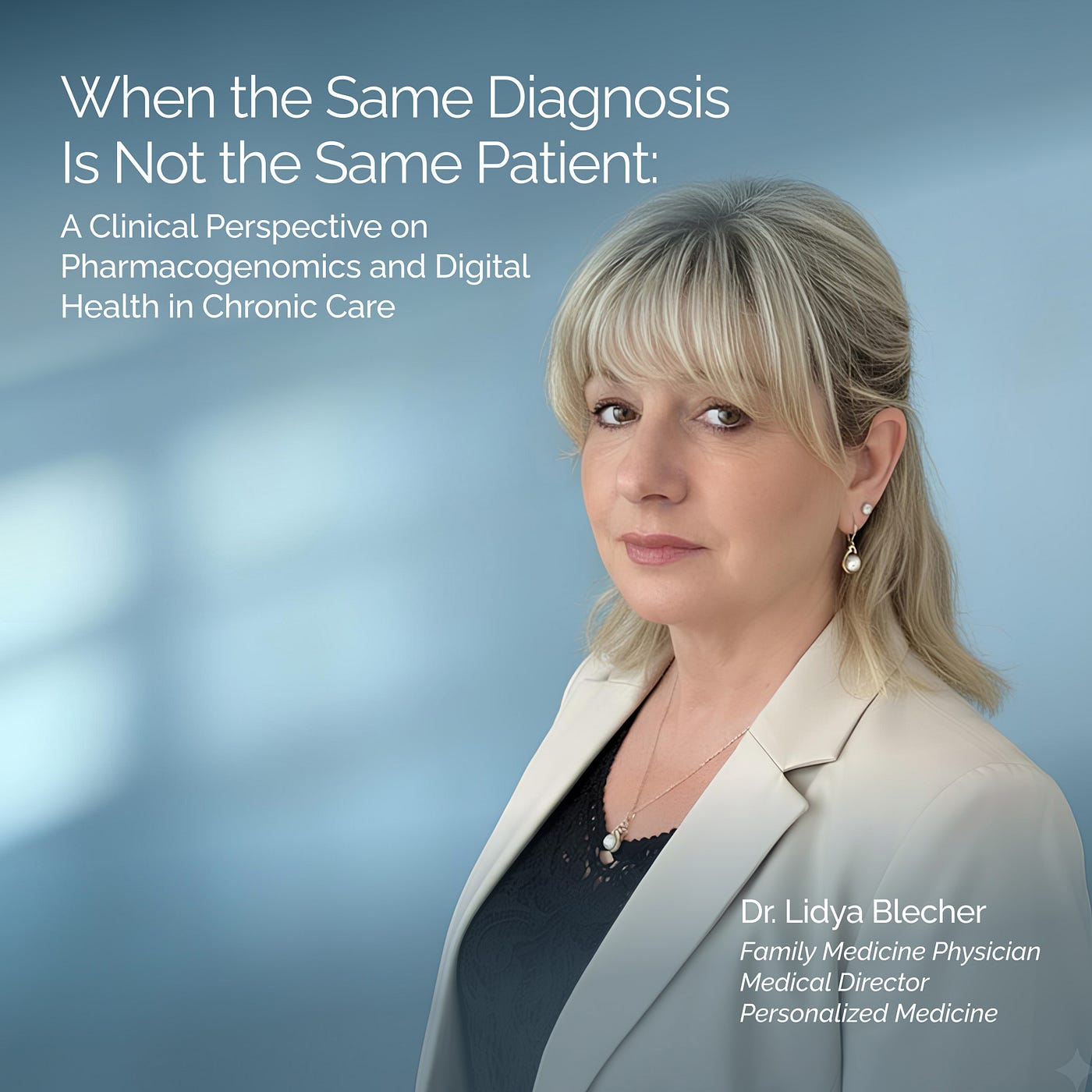
At Apixmed, we approach this gap as a data and decision-making challenge rather than a purely clinical one. To understand how this limitation manifests in everyday practice, we spoke with Dr. Lidya Blecher — a family medicine specialist with 20 years of clinical experience — whose work focuses on complex chronic conditions where standard protocols begin to lose explanatory power.
This conversation is presented as an expert clinical reflection grounded in real-world practice. It explores why personalization becomes unavoidable in chronic care, and how pharmacogenomics and digital health data increasingly inform more precise clinical decisions.
Expert background
Dr. Lidya Blecher is a specialist in family medicine with 20 years of clinical experience in public healthcare. She previously served as a clinical advisor at Smartomica, a biotech startup, and currently runs an independent personalized medicine clinic, INNMAP, which she founded six months ago. In addition, she serves as Medical Director of the Experts Center at Maccabi Health Services.
Dr. Lidya Blecher’s clinical work focuses on complex, chronic, and multi-system conditions, where variability in treatment response often challenges standardized therapeutic approaches.
Where standard protocols begin to break
In daily clinical practice, many patients formally meet diagnostic criteria yet continue to experience unresolved symptoms. We asked Dr. Blecher where the need for personalization becomes most evident.
In my practice at INNMAP, I primarily work with patients facing complex, chronic, and often multi-system conditions. These include hormonal imbalances such as obesity, peri- and menopause-related disorders, and PCOS; metabolic syndrome; autoimmune and inflammatory conditions; gastrointestinal disorders like IBS; and patients with unexplained or undiagnosed complaints such as chronic fatigue, mood disturbances, or sleep problems.
Many of these patients continue to have symptoms despite “normal” results on standard laboratory tests.
Personalization becomes essential because these patients rarely fit into a single diagnostic category. They often have overlapping drivers — genetic predispositions, metabolic imbalances, microbiome-related issues, environmental exposures, and lifestyle stressors. A one-size-fits-all protocol cannot adequately address this complexity.
What appears to be the same diagnosis on paper often reflects very different biological mechanisms across individuals.
Why identical treatments lead to different outcomes
One of the strongest signals that standard approaches may be insufficient is variability in treatment response. We asked how often this occurs in practice.
This happens all the time, and it is one of the strongest arguments for personalized medicine.
I frequently see patients with the same clinical diagnosis — acne, PCOS, dyslipidemia, IBS — who respond very differently to identical dietary plans, supplements, or medications. In many cases, the underlying pathophysiological drivers behind similar clinical presentations are not the same.
This reality pushed me to work with in-depth diagnostic and molecular testing. When I was practicing as a family physician in a public healthcare organization, I was not able to use this level of diagnostics, as it still largely belongs to the private healthcare sector.
Differences often become clear when we integrate metabolic profiling, hormone metabolism, gut microbiome data, and genetic variants. For example, two patients may receive the same hormone replacement therapy or statin. One improves, while the other develops side effects. Often this reflects differences in detoxification pathways, receptor sensitivity, or inflammatory background.
Personalization allows us to anticipate these mismatches rather than discover them only after adverse effects occur.
From standardized protocols to layered decision-making
Healthcare systems are gradually shifting toward more individualized approaches, particularly in chronic care. We asked how this shift appears from a clinical perspective.
I see this shift as necessary rather than optional.
Standard protocols work well for acute care and clearly defined conditions. However, they are insufficient for the growing burden of chronic, multifactorial diseases, especially when we consider the increasing volume of real-world data.
The future of healthcare lies in layering evidence-based guidelines with individualized data — omics, longitudinal biomarkers, and real-world clinical context. Over time, new biomarkers will likely be incorporated into standard guidelines, but this process takes time.
Personalized medicine does not replace conventional medicine. It refines and enhances it. In my work, the focus is on translating complex, multi-layered data into clinically actionable insights that complement mainstream medical practice and support more precise therapeutic decisions.
Clinical signals that personalization is required
Not every patient requires a highly individualized approach. We asked which factors most clearly indicate when standard therapy may no longer be sufficient.
In general, the more relevant data we have about a patient, the more precise and personalized treatment can be.
However, there are clear indicators that standard approaches may be inadequate. These include poor or paradoxical responses to standard therapy, recurrent side effects or intolerance, multiple comorbidities affecting different organ systems, and a mismatch between symptoms and routine laboratory results.
Additional signals include a strong family history, unusually early disease onset, and lifestyle or environmental exposures that significantly modify risk.
When these factors are present, relying solely on protocol-based decisions becomes clinically risky.
The role of genetics in clinical decision-making
Pharmacogenomics is increasingly discussed as part of personalized care. We asked how genetic variation fits into real-world clinical reasoning.
Genetics play an important role, but never in isolation. When we talk about genetic variations — not pathogenic mutations — I see genetic data as a modifier of risk, response, and tolerance.
Genetic variants affect many aspects of health, including drug metabolism, hormone pathways, methylation processes, inflammatory responses, and detoxification. These factors can significantly influence both treatment efficacy and safety.
At the same time, genetic information must always be interpreted in context, alongside biochemical markers, clinical presentation, and lifestyle factors. Genetics inform direction, but they do not dictate destiny.
Where personalization delivers the greatest value
Not all clinical domains benefit equally from personalized approaches. We asked where pharmacogenomics and data-driven personalization currently offer the most clinical value.
The greatest potential lies in women’s health, particularly hormonal therapies such as contraceptives and menopausal hormone therapy.
There is also significant value in psychotropic medications and cardiometabolic treatments, including lipid-lowering therapies and antihypertensives.
In these areas — including domains such as chemotherapy and immunotherapy — variability in response and risk is high, and the cost of trial-and-error approaches can be substantial for both patients and healthcare systems.
From clinical reality to system design
This clinical perspective does not argue against standards. Instead, it highlights their boundaries. As chronic, multifactorial conditions increasingly define the healthcare landscape, effective decision-making depends on the ability to integrate diverse data into coherent clinical logic.
From an infrastructure perspective, this reinforces a central principle: personalization is not about replacing clinicians or guidelines (including through artificial intelligence), but about enabling structured, transparent use of complex data so that clinical expertise can operate with greater precision and consistency.
A system-level question
Looking beyond individual clinical practice, one question remains open.
What data standards and decision frameworks are still required to make pharmacogenomics and personalized decision-making reproducible and scalable across healthcare systems?
메타데이터
- post_id
- 8e85f92b5c74
- slug
- when-the-same-diagnosis-is-not-the-same-patient-a-clinical-perspective-on-pharmacogenomics-and-8e85f92b5c74
- url
- https://medium.com/@apixmed/when-the-same-diagnosis-is-not-the-same-patient-a-clinical-perspective-on-pharmacogenomics-and-8e85f92b5c74
- canonical_url
- https://medium.com/@apixmed/when-the-same-diagnosis-is-not-the-same-patient-a-clinical-perspective-on-pharmacogenomics-and-8e85f92b5c74
- author_url
- https://medium.com/@apixmed
- status
- ok
- fetched_at
- 2026-06-09 15:37:30