Consumers Shouldn’t Need a Conversion Calculator to Compare Air Purifiers: Why Air Purifier CADR…
“When it comes to buying air purifiers or air exchangers, navigating through the technical datasheets can feel like an obstacle course. The…
Consumers Shouldn’t Need a Conversion Calculator to Compare Air Purifiers: Why Air Purifier CADR Should Be Reported in CFM
“When it comes to buying air purifiers or air exchangers, navigating through the technical datasheets can feel like an obstacle course. The real challenge is in the lack of transparency and consistency of the data provided, which makes it difficult for consumers to make informed decisions.”
I wrote that in a previous article. Today I want to add one more obstacle to the list — one that doesn’t require any bad intent from manufacturers to cause real harm: reporting CADR in m³/h instead of — or without — CFM.
This is something I’ve been thinking about for a while. I know how to convert m³/h to CFM, and I think it’s worth learning. But not everyone does — and manufacturers could easily help by providing both units, or by defaulting to the one the public already relies on.
To be clear: m³/h is a perfectly valid unit. The issue is not that CFM is better than m³/h. The issue is that the most widely used metric in the certified air purifier world — AHAM, Energy Star, HouseFresh — is CFM. Reporting in m³/h alone creates confusion for a public that is already navigating a lot.
To illustrate this with a concrete example, I’ll use the SA600 by Smart Air. Why Smart Air? Because they are widely regarded as one of the most transparent and education-focused actors in the industry. Which is exactly why I hope they will reconsider this practice.
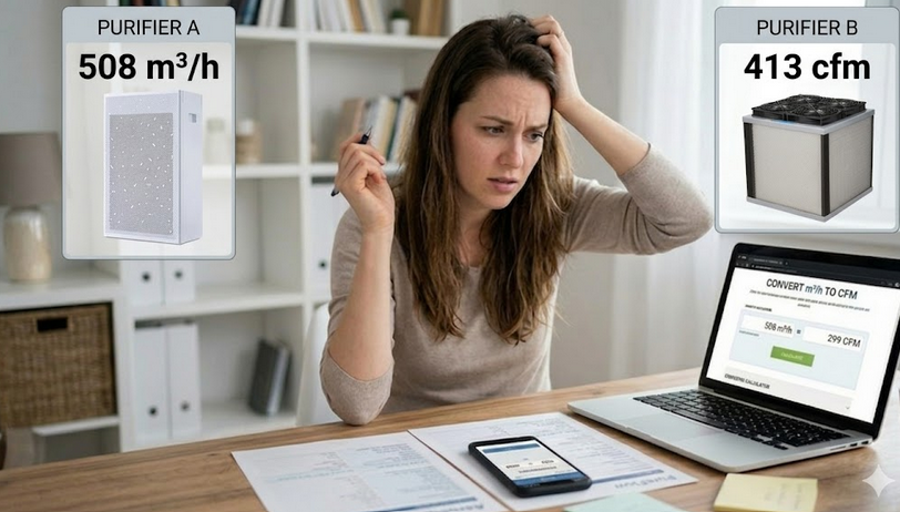
Someone unfamiliar with units might assume 508 m³/h and 508 CFM are equivalent. They are not. 508 m³/h = 299 CFM.
And someone who doesn’t yet know that CADR is the metric that matters (and not the “true hepa mantra”) is probably also not someone who knows how to convert m³/h to CFM.
CFM: The Reference Unit in the Certified Air Purifier World
CADR reported in CFM (cubic feet per minute) is the primary standard used by AHAM, Energy Star, Intertek, and the well-known independent tester HouseFresh.
Reporting in m³/h is equally precise and informative — but only for those who know how to use it. For everyone else, it means pulling out a calculator just to compare two purifiers. Without that step, you’re comparing apples and oranges.
My position is simple: reporting in m³/h is fine, as long as CFM is also provided. And if only one unit is shown, it should be CFM — the unit used by hundreds of certified purifiers worldwide, the one consumers and references already rely on. Let’s help consumers navigate, not add to the confusion they’re already facing.
There is also something worth naming directly: reporting in m³/h offers a numerical advantage. Since 1 CFM = 1.7 m³/h, a purifier’s CADR will always appear as a larger number in m³/h. For an uninformed consumer comparing two purifiers side by side, that larger number can be the deciding factor — even when the actual performance is lower. Everyone loses in that scenario, except the manufacturer who chose that unit. Even informed consumers — and I count myself among them — are forced to do extra math just to make a fair comparison. Math that adds no value whatsoever.
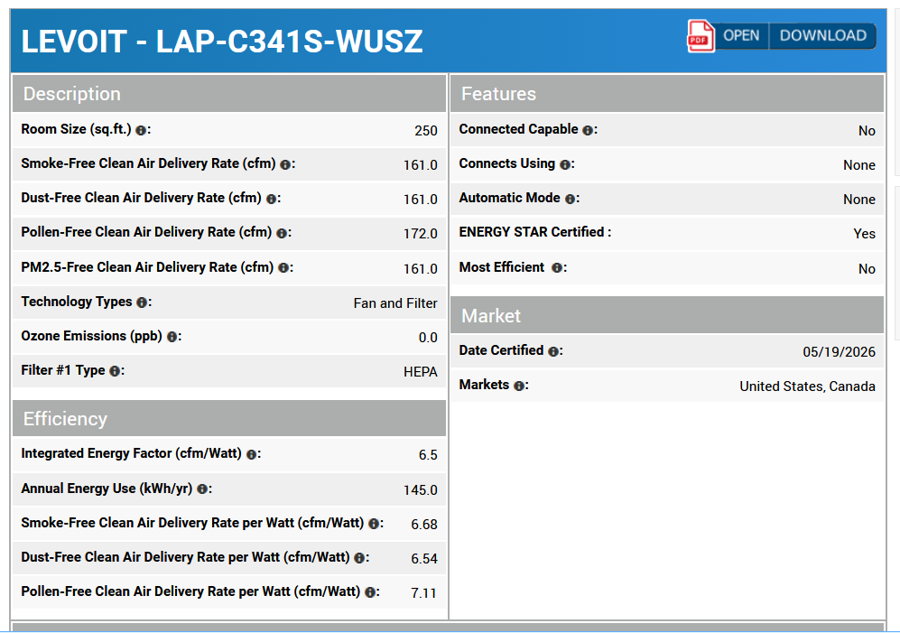
Energy Star specification sheet for the Levoit LAP-C341S-WUSZ air purifier
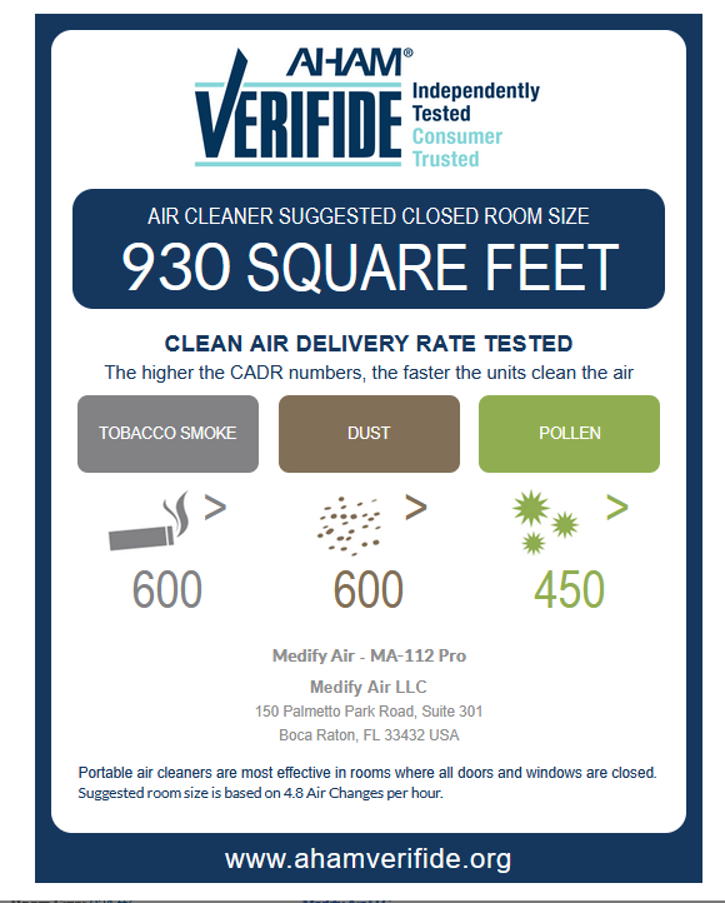
AHAM certification sheet for the Medify Air-MA-112 Pro air purifier
The Unit Confusion That Could Leave You Breathing Dirty Air : m³/h and CFM are not the same number
The Smart Air SA600 lists a CADR of 508 m³/h — without providing the CFM equivalent.
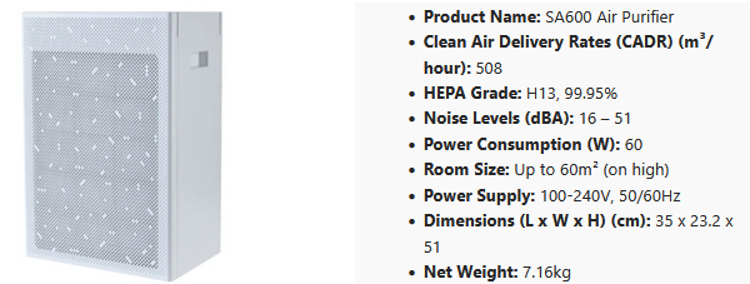
Smart Air SA-600 specification sheet
That number, 508, looks impressive. And here’s the problem: most people never look past the number itself. The unit right after it — m³/h or CFM — is easy to miss, especially when you don’t know there’s a difference to look for. Many consumers assume that 508 is 508, whatever the label says.
It isn’t. 508 m³/h = 299 CFM.
That’s not a rounding error. That’s a 41% gap — and it only shows up if you know to look for it, and if you’re willing to pull out a calculator. (For the record: 1 m³/h = 0.59 CFM, and 1 CFM = 1.7 m³/h.)
If you need a CADR of 500 CFM and you buy a purifier listed at “508” — not realizing it’s 508 m³/h, not CFM — you walk away with 299 CFM. Not zero. Not useless. Just not what you needed.
And that gap matters, because we buy air purifiers for a reason: cleaner air, better health, meeting the standards that actually protect us. When the number you relied on wasn’t the number you think it was, you may never reach that threshold — without ever knowing you missed it.
A Daycare, an Asthmatic Child, and a Number That Looked Right
Let’s make this concrete with a hypothetical — but entirely plausible — scenario.
A couple of parents has a child with severe asthma. The child attends a daycare in a 750 ft² room, in one of the most polluted cities in the world, where PM2.5 levels regularly exceed 50 µg/m³. The parents ask the daycare director if they can bring in an air purifier — at their own expense. The director agrees, on one condition: the unit must be quiet and not too bulky.
They did their homework. They find AHAM’s 2/3 rule: choose a purifier with a tobacco smoke CADR at least ⅔ of the room’s square footage.
(Source: AHAM Verifide Directory)
For 750 ft², that means a minimum of 500 CFM.
Run the numbers:
ACH = (CADR × 60) / room volume,
and that translates to 4.8 air changes per hour of clean air, which is what that rule is designed to deliver.
They find the Smart Air SA600. The spec sheet says 508. They don’t notice the m³/h. They see 508, they need 500, they buy it.
The purifier delivers 299 CFM — not 508.
Instead of 4.8 air changes per hour, the room gets roughly 3.
Not useless. But below the minimum standard — the one that was already a floor, not a ceiling.
The parents think the job is done. The child keeps breathing air that still carries more particles than it should. And nobody in that room knows the difference
Spec Sheets Should Help the Public Make Informed Decisions:
Clean air isn’t a luxury. Neither is the truth about what you’re buying
At the end of the day, air purifiers exist for one reason: cleaner air. Cleaner air means better health — for our children, our families, our communities. And better decisions start with honest, readable information.
Reporting CADR in m³/h alone — without the CFM equivalent — makes that harder. Not necessarily out of bad intent. But the effect is the same: a number that looks bigger than it is, a purifier that looks more powerful than it is, and a consumer who walks away thinking they bought something they didn’t. Meanwhile, the manufacturer who chose the larger-looking unit gets the sale.
Manufacturers have the power to change this tomorrow. Report both units. Or default to CFM — the standard used by AHAM, Energy Star, and every major certification body in the industry. It may cost some of them a competitive advantage they never should have had in the first place.
Consumers deserve spec sheets that are clear, complete, and readable without a calculator. Most people trust the number on the spec sheet — and they should be able to. The status quo needs to change. And it will — the more we demand transparency, the more pressure builds on manufacturers to deliver it. That’s how the future gets made.
This Is Just the Beginning : The Spec Sheet Rabbit Hole Goes Deep
Spec sheets in the air purifier industry are a Pandora’s box — and I intend to keep opening it. This article is the second in what will likely be a longer series. The first covered CADR at max speed paired with noise at minimum — a combination that tells you nothing useful about real-world performance. This one covers the m³/h vs CFM confusion.
There is no shortage of topics still on my radar:
- Room size claims that ignore the 4.8 ACH standard — and never mention how many air changes per hour that room size actually delivers
- The “True HEPA” mantra — and why 200 CFM through a True HEPA filter is exactly the same as 200 CFM through a MERV-13. CADR is what moves the needle, not the filter label
- CADR without particle size — and why reporting pollen CADR instead of smoke CADR inflates the number, misleads the consumer, and penalizes the honest manufacturer
- Bad faith in the industry — manufacturers attacking competitors on irrelevant grounds, or hiding behind the language of science to discredit rather than genuinely debate — whoever the target may be.
Every topic on this list has the same thing at stake: the public’s ability to make truly informed decisions about their air quality and their health.
Update June 7, 2026
After publishing this article, I came across a good example worth mentioning.
The Levoit Core® 300S-P specification sheet displays both CADR units: 141 CFM / 240 m³/h. This simple addition makes comparisons easier for consumers and demonstrates that greater transparency is possible without adding significant complexity to a specification sheet.

Levoit Core® 300S-P specification sheet showing CADR in both imperial and metric units: 141 CFM / 240 m³/h
Interestingly, some of the discussions generated by this article suggest that not everyone agrees that both units should be displayed. Some argue that consumers should simply learn the conversion or use a calculator. Others go further and argue that CFM should disappear altogether, describing it as a relic of the past that should be replaced everywhere by m³/h.
At times, the debate seems to extend beyond practicality and consumer information. For some, the issue appears to carry a cultural or symbolic dimension related to the continued use of imperial units. Whether that is the case or not, the focus of this article is much simpler: helping consumers make informed decisions.
While debates about units continue, ordinary consumers are trying to choose air purifiers that will provide the level of air cleaning they expect. If the information is difficult to compare or requires additional calculations, some may end up purchasing a unit that delivers less clean air than they thought they were getting. This is ultimately a matter of consumer protection, public information, and public health.
Perfect solutions can take years. Small improvements can start today.
A small step for the manufacturer, but a meaningful step for the public.
Second Update –june 7 2026.
Even trained healthcare professionals — pharmacists, nurses, and doctors — frequently make medication dosing errors because both pounds (lbs) and kilograms (kg) remain in use. Official reports document hundreds of such incidents, some leading to overdoses.
A 2023 Radio-Canada article also showed that Canadian retailers often display prices per pound first (e.g. $16.99/lb vs $37.46/kg for the same product). Consumers focus more on the number than the unit, perceiving the imperial price as cheaper and sometimes misjudging the real cost.
If professionals who know that kg and lbs are different units — and whose job is to protect patients — still make mistakes, and everyday shoppers who also know these two units exist still get confused, imagine the situation with air purifiers. Here the public is at a different level: many people simply do not know that CADR can be expressed in different units, let alone how to compare or convert them. They simply compare raw numbers — apples to oranges — which undermines truly informed choices and public health prevention.
Clearly displaying both units would be a major advancement that would help thousands of consumers make better decisions.
References
Emergency nurse association. Position Statement. Weighing All Patients in Kilograms. https://media.emscimprovement.center/documents/Weighing_All_Patients_in_Kilograms_ENA_Position_Statement.pdf
Radio-Canada. November 19, 2023. Des prix à la livre et au kilo qui alimentent la confusion.
메타데이터
- post_id
- 91581c9ff0e2
- slug
- consumers-shouldnt-need-a-conversion-calculator-to-compare-air-purifiers-91581c9ff0e2
- url
- https://medium.com/@levangelistedelaventilation/consumers-shouldnt-need-a-conversion-calculator-to-compare-air-purifiers-91581c9ff0e2
- canonical_url
- https://medium.com/@levangelistedelaventilation/consumers-shouldnt-need-a-conversion-calculator-to-compare-air-purifiers-91581c9ff0e2
- author_url
- https://medium.com/@levangelistedelaventilation
- status
- ok
- fetched_at
- 2026-06-15 20:49:13