Incan Chuño: 500-Year-Old Freeze-Dried Potatoes Found in Ancient Incan Site
Recent study reports the rare discovery of two 500-year-old freeze-dried potatoes at an Inka provincial center on Peru’s south coast
Incan Chuño: 500-Year-Old Freeze-Dried Potatoes Found in Ancient Incan Site
Recent study reports the rare discovery of two 500-year-old freeze-dried potatoes at an Inka provincial center on Peru’s south coast

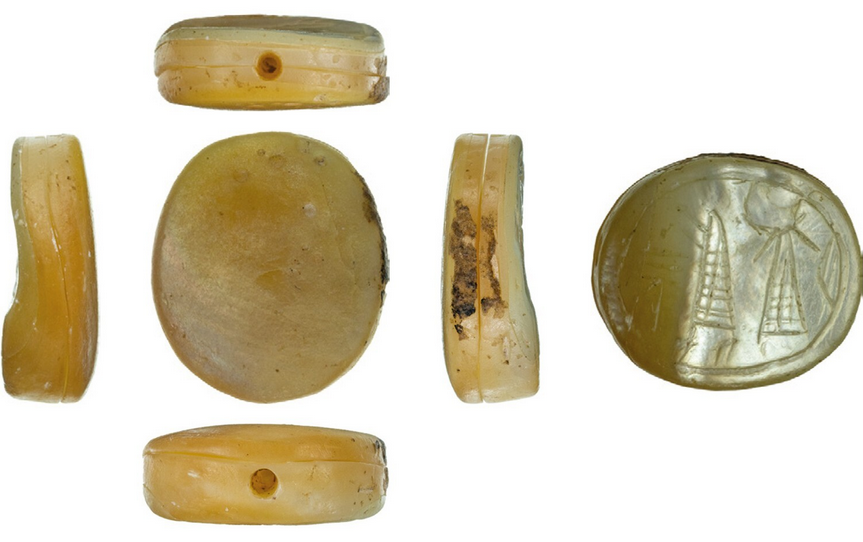
Freeze-dried potatoes (chuño) from Tambo Viejo, Peru. Credit: L. M. Valdez in Valdez and Bettcher 2026
I love potatoes; growing up, I had them almost every meal. To be fair, my experience is probably not too different from many other households. Potatoes are beloved around the world and have become a major global staple. But they were not always so widespread, and many dishes known and beloved today simply did not exist a few hundred years ago.
In fact, potatoes are indigenous to the Andes, where some of the first cultivated species appeared between 5000 and 2000 BC. The thing is, potatoes can spoil quite quickly, especially in warm, moist environments, where they often rot or begin to sprout within a week of storage. So ancient South American cultivators had to become creative in how they processed and stored them to ensure they lasted and could be transported across the empire before spoiling.
During archaeological digs at the ancient Incan provincial center of Tambo Viejo, Peru, Dr. Lidio Valdez and Dr. Katrina Bettcher unearthed two shriveled, roughly 500-year-old potatoes, and not just any potatoes, but a type of freeze-dried potato that could only be made high up in the Andes mountains. How did they get to coastal Peru, and what exactly are freeze-dried South American potatoes?
Potato, Potahto

Black (left) and white (right) chuño. Credit: Fremen Tours via Spudsmart
Besides water, shelter, and warmth, food is one of the fundamentals of survival. However, food also has this annoying tendency to rot or keep growing when we don’t want it to after harvest or slaughter. Thus, preventing the loss of food has been a primary concern for every human culture across the globe. The simplest method of preventing food loss was to eat it immediately after acquiring it, which may have given rise to some of the earliest communal feasts, while other methods included physically protecting it in storage facilities like pots, silos, and, in the case of the Inca, collcas.
But not all food can simply be thrown in a storeroom without prior processing. This led to quite a number of innovative ways to prevent food from rotting, including drying, freezing, salting, pickling, smoking, and fermenting. The Andean people were no exception and found innovative ways to prevent their food from spoiling. According to accounts made at the time of the Spanish conquest (~ AD 1532), the Incan state hosted storage facilities across the empire, which stretched over 5,500 km, filled with foods, including freeze-dried meats called charki and freeze-dried potatoes known as chuño.
Potatoes were so important to the Inca that the Spanish chroniclers describe it as the ‘bread of the people’. Yet despite their ubiquity in antiquity, finding such chuño in archaeology is rare, so rare that one of the few exceptions was the reported discovery, recorded by Dr. Max Uhle in 1903, which described the Peruvian expedition of 1896 by William Dapper in Pachacamac.
“… all kinds peculiar to the highland were represented, such as chuño (black),¹ t’unt’a² (a preparation of white potatoes), uma- or wipikaya³ (prepared of Oca, Oxalis tuberosa), apparently also ulluku (so-called yellow potatoes), quinoa (Chenopodium Quinoa), and the beans of aji (Capsicum sp. or cayenne pepper) strung on twine; of coca and its various components (Llijta), prepared of vegetable ashes, many pieces were found; also a quantity of lime.”- pg. 85.
Finding Shriveled Potatoes
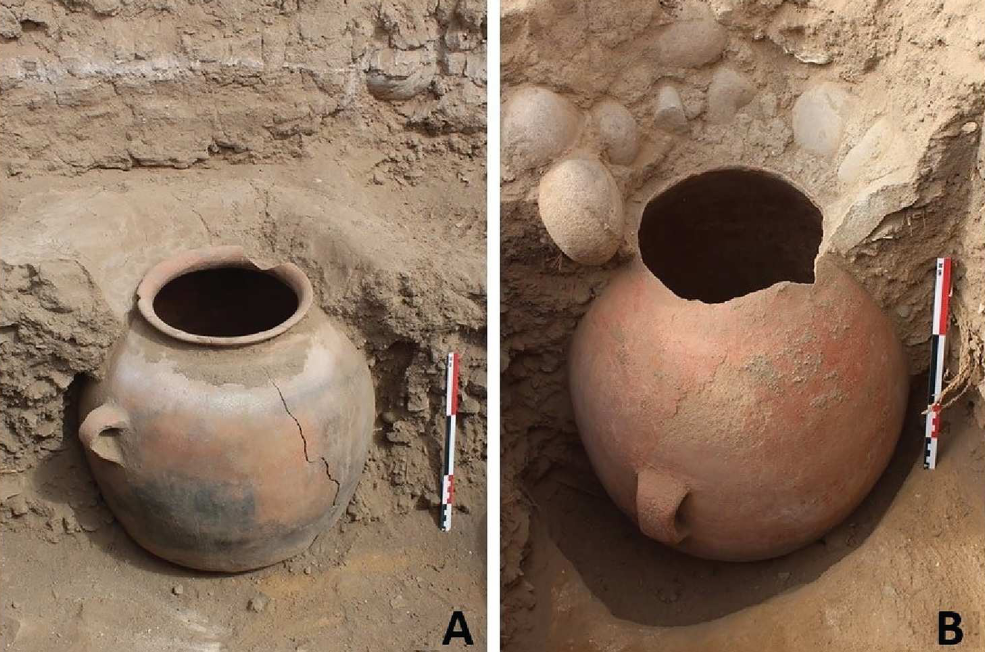
Ceramic vessels from Structure 1 that may also once have had freeze-dried potatoes. Credit: L. M. Valdez in Valdez and Bettcher 2026
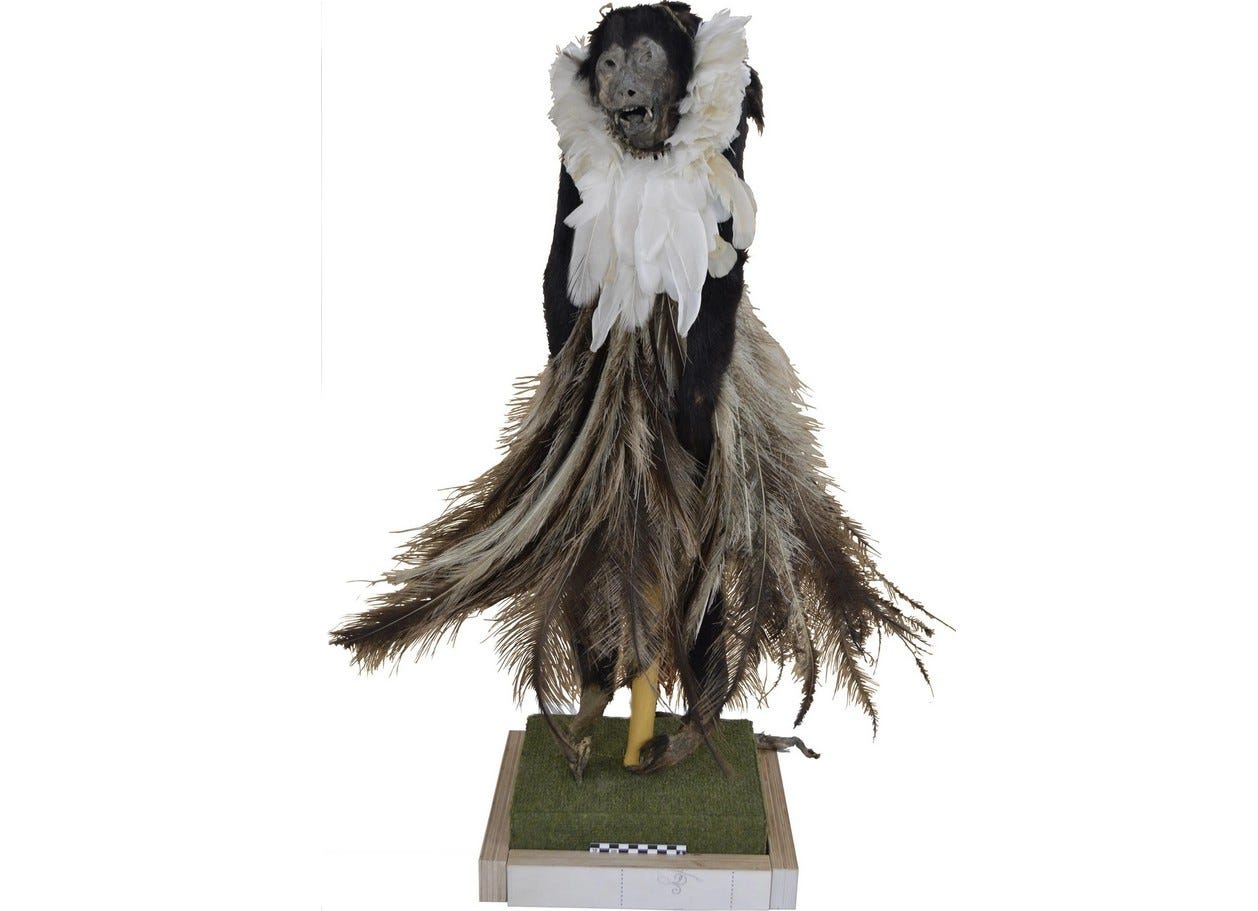
Tambo Viejo is located in the Acarí Valley on Peru’s south coast. It was an Inca administrative center built where a major imperial road met the Acarí Valley. Due to its arid climate, preservation here is exceptional, so exceptional that even guinea pigs naturally mummify here.
Dr. Valdez and his team were excavating here in 2024 when they came across a ceramic vessel. Well, actually, they came across two; the first was empty save for dirt, but the second was far more interesting. Within was an Inca sherd, a broken spindle whorl, and near its base two shriveled, sad-looking plants: white chuño.
Both chuños were similar in size and so well preserved that they still had parts of their dried peels attached. It is not too surprising that chuño was found inside this vessel, as even Spanish chroniclers such as Spanish Jesuit missionary Father Bernabé Cobo (1582–1657) recount how chuño and quinoa were kept in ceramic vessels. Similar vessels were found during excavations at Tambo Viejo, though all were empty, their contents likely rotted away long ago.
Finding chuño at Tambo Viejo is not only exceptionally rare, but how did it get there? You see, chuño cannot be made at the coast; in fact, making chuño requires very specific conditions.
How to Make Chuño
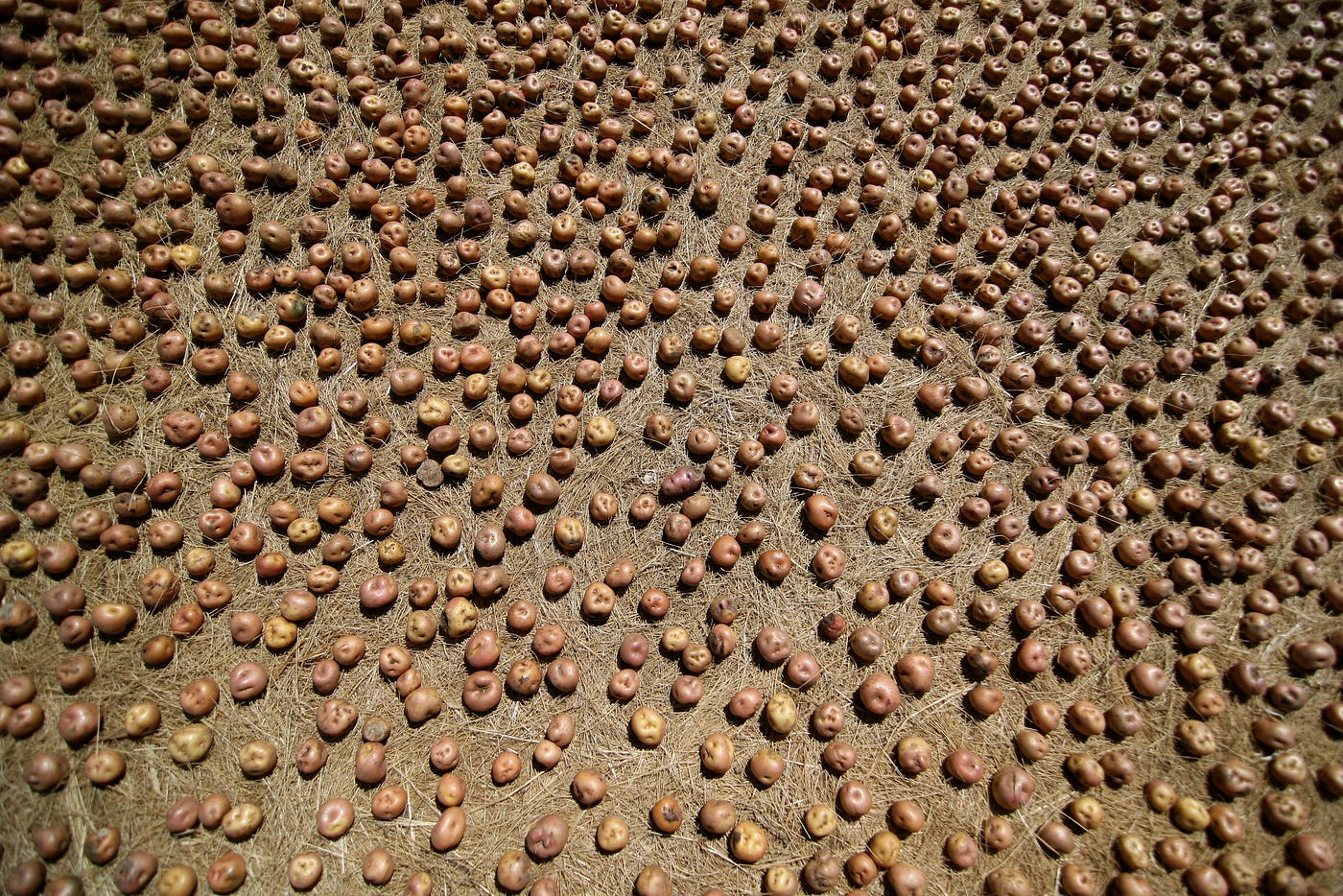
Chuño drying in the sun. Credit: Nathan Gibbs on Flickr
Chuño, as I have been saying, is a freeze-dried potato, but how do you freeze-dry a potato over 500 years ago?
They grow basically anywhere but are most common in higher elevations where cooler conditions limit pests, while at 4,500 meters above sea level, potatoes and other tubers (oca, ulluco, and maswa) become the only cultivatable plants. But as you know, fresh potatoes spoil so quickly ( a few months in cool climates, and weeks in warmer ones). Thus, they either had to be used immediately or transported short distances. For an empire the size of the Inca, where potatoes were such a staple, these were not always the best options.
Nocturnal frost can be a killer, destroying plants in a single night, but it can also be used to preserve meats and vegetal tissue, including potatoes. Early potato growers used one of two methods to preserve their potatoes; the first was burying them in pits packed with ichu grass and muña herbs, which guarded against fungal attack.
The second was freeze-drying. Farmers spread the potatoes on the ground during the freezing nights of June and July (winter in the Southern Hemisphere), let them thaw in the intense sunshine, and then stomped them underfoot to squeeze out all the moisture. This produced black chuño; however, white chuño, which was made with bitter potatoes containing glycoalkaloids, a chemical compound that serves as a natural defense against disease and predators, is also toxic to humans. Thus, these white chuño also had to be soaked in (preferably) running water for several weeks after freezing but before drying.
According to Uhle, “The Indians not only prepare chuño blanco … but also chuño negro (the real Chuñu) of lluq’i (bitter potatoes). This preparation is unpalatable to European taste; the Indians eat it thinking it strength giving. T’unt’a, white chuños, have not yet been found in graves.”-pg. 85.
That latter part is particularly interesting as the chuño found in Tambo Viejo was white chuño, not black.
By freeze-drying these potatoes, they not only lasted months but years. Allowing them to be transported across the Inca world. Llama caravans would haul chuño down the mountains along the empire’s vast road network, restocking storehouses that were dotted across the landscape meant to feed the large Inca workforce tasked with building and maintaining farms, roads, and monuments. According to the mit’a labor tax, the state reciprocated workers’ labor with food, thus chuño may well have been the empire’s principal fuel.
Meanwhile, Pedro de Cieza de León (1518 or 1520–1554), a Spanish conquistador and chronicler, states that not only were these storehouses filled with chuño, but also that “…many Spaniards became rich and went back to Spain prosperous just by selling this chuño in the mines of Potosí…”
The coolest part is that chuño never disappeared; it is still used today. For example, in dishes like Chairo, or Carapulcra. The latter is a traditional Peruvian stew. The pre-Columbian version of Carapulcra was likely made with llama or alpaca meat, diced chuño, chilies, and local herbs, all cooked in a clay pot. Today, pork and chicken have largely substituted llama and alpaca, and the dish also often features peanuts, but chuño remains a key ingredient in this local stew.
The chuño found at Tambo Viejo is an incredibly rare discovery and a testament to the vast supply networks of the Inca, able to transport chuño from the very highest peaks of the Andes down to the coast, a testament to their interconnectedness and a statement to just how important chuño was to the empire.
In a recent study, Dr. Valdez and Dr. Bettcher uncovered not one but two rare archaeological examples of chuño. The two shriveled tubers would have had to have been transported from the highest Andean peaks to their distant destination along Peru’s southern coast. Here they lay forgotten in a ceramic vessel for around 500 years.
I love potatoes, and I hope I get a chance to try some traditional chuño recipes one day.
Have you heard of chuño before, and have you had or are you curious to try some chuño dishes?
Let me know your thoughts, and if you’d like to support the countless hours I pour into researching, writing, and bringing these hidden corners of history to life, why not Buy Me A Coffee
Reference
Valdez, L. M., & Bettcher, K. J. (2026). Inka Freeze-Dried Potatoes from Tambo Viejo, Acarí Valley, Perú. Journal of Field Archaeology, 1–10. https://doi.org/10.1080/00934690.2026.2658319
Published in Palaeopress. **Follow **to explore everything old
메타데이터
- post_id
- 98adf30b8b36
- slug
- incan-chuño-500-year-old-freeze-dried-potatoes-found-in-ancient-incan-site-98adf30b8b36
- url
- https://medium.com/palaeopress/incan-chu%C3%B1o-500-year-old-freeze-dried-potatoes-found-in-ancient-incan-site-98adf30b8b36
- canonical_url
- https://medium.com/palaeopress/incan-chu%C3%B1o-500-year-old-freeze-dried-potatoes-found-in-ancient-incan-site-98adf30b8b36
- author_url
- https://medium.com/@sandeeoster17
- status
- ok
- fetched_at
- 2026-06-17 12:55:42