Myth at the Threshold
When Story Becomes Structural
Threshold Notes
Myth at the Threshold
When Story Becomes Structural
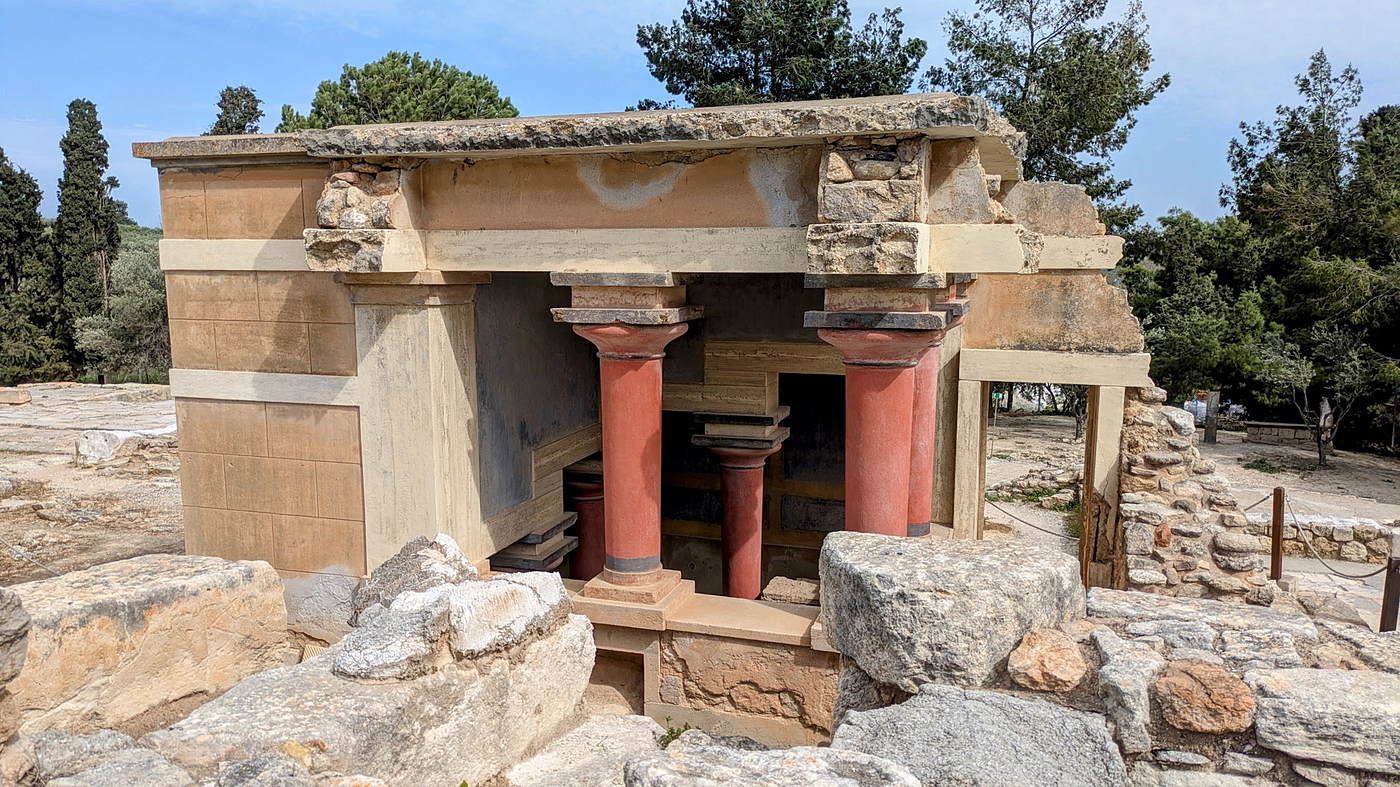
From author’s photo collection
Most myths do not survive because they are believed. They survive because they are used.
They are told at first as stories — light enough to travel, intimate enough to remember. But stories thicken with repetition. They settle into time, into bodies, into geography.
This is where myth crosses its first threshold.
Mythology is often approached in two ways: as narrative, or as structure. As narrative, myth is populated by gods, heroes, origins, and endings. As structure, it appears as calendars, rituals, taboos, genealogies, spatial arrangements, geography.
At the threshold, these are not competing interpretations. They arise together.
Myths do not begin as stories that later acquire structure. Nor as structures that later require explanation. They emerge where narration and infrastructure co-form; where meaning and use are braided.
Story is how myth becomes legible. Architecture is how it becomes durable.
Stories travel because they are light. They can be carried across borders, whispered in exile, compressed into memory. This mobility allows myth to survive rupture.
Architecture travels differently. It persists through inhabitation. Calendars regulate time even when belief fades. Rituals and spaces organize bodies long after their origins are obscured.
Myth allows each to compensate for the other’s limits. A ritual without a myth is choreography. A city without a myth is a settlement, not a place. It has infrastructure but no gravity. It has buildings but no shared dream about why they stand. Without a myth, a city can function, but it cannot mean. It moves bodies efficiently while failing to orient lives.
This is visible in contemporary corporate wellness culture which is often devoid of meaning. They offer yoga or meditation mornings but are missing a shared myth of why care matters beyond productivity. The ritual functions technically but it does not transform.
Contrast this with indigenous seasonal ceremonies. A harvest ritual embedded in a cosmology of reciprocity with land and ancestors does not need explanation. The story precedes the action. The movement of bodies is not symbolic, it is participatory. The ritual works because the myth gives it gravity.
Without myth, ritual becomes performance. With myth, it becomes orientation.
Stories teach bodies how to live inside structure. Structure gives story consequence. When a myth is told long enough, its narrative contours harden into expectation: what is rewarded, what is punished, what is sacred, what is inevitable.
Eventually these expectations stop feeling like lessons. They feel like reality. This is not metaphor (alone). It is how environments are made.
Las Vegas makes this legible at national scale. It is not a city without myth, but a city built from unintegrated myth. Archetypes abound — the gambler, the king, the outlaw, the temptress — but they are detached from continuity and consequence. Risk is ritualized and loss is aestheticized. Reinvention is promised without reckoning.
The Strip is not architecture in the ancient sense; it is mythic collage. Rome beside Paris beside Egypt, emptied of lineage and stacked side by side. Time is flattened into spectacle. History becomes interchangeable décor.
The city functions by suspending narrative memory. What happens here is framed as erasable (“What happens in Vegas, stays in Vegas”). The myth is used, but its shadow is disowned. It performs a buried American myth with brutal clarity: that reinvention is infinite, that debt can be deferred, that identity is elective, that the shadow can be entertained without being integrated. Perhaps, given the current state of affairs, this is not an exception in the American landscape. It is an exaggeration.
When myth is stripped of consequence, it no longer binds. It fragments into spectacle, lifestyle, brand. Citizens become visitors. Rituals become loops. Shared destiny dissolves into parallel performances.
A country fractures not only when its stories clash, but when its structures no longer carry those stories forward.
Myths are not only remembered. They are inhabited.
Contrast this to Athens: A city where myth did not retreat into shadow, but was metabolized into public life — argued in the agora and kafenio, staged in tragedy, embedded in law and stone. Its stories trained citizens to expect consequence, so when belief faltered, structure still carried meaning. The past does not haunt Athens as spectacle; it interrupts the present as obligation.
In Athens, the mask reveals the cost of becoming someone. In Las Vegas, the mask promises you can remove it without consequence. One city teaches how to live with limits. The other teaches how to forget them. One makes tragedy visible so it can be endured. The other makes tragedy a spectacle so it can be consumed.
Myth, in this sense, is the moment a story becomes load-bearing: when meaning crosses from voice into world.
Thanks to: Toshi Ochiai https://medium.com/@heatherochiai for inspiring me to put my thoughts on this topic into words. I both agree and disagree with them and that is inspiration.

Once a year, I invite others to explore this crossing in person, in Crete
메타데이터
- post_id
- 98f22c745c93
- slug
- myth-at-the-threshold-98f22c745c93
- url
- https://medium.com/counterarts/myth-at-the-threshold-98f22c745c93
- canonical_url
- https://medium.com/counterarts/myth-at-the-threshold-98f22c745c93
- author_url
- https://medium.com/@drharrys
- status
- ok
- fetched_at
- 2026-06-23 03:48:11