30 LLM Evaluation Concepts Every Engineer Should Know Before Shipping AI Apps
A beginner-friendly guide to testing LLMs for accuracy, hallucinations, safety, cost, speed, and real-world reliability.
30 LLM Evaluation Concepts Every Engineer Should Know Before Shipping AI Apps
A beginner-friendly guide to testing LLMs for accuracy, hallucinations, safety, cost, speed, and real-world reliability.
Hello curious builders,
Nonmembers click here
Imagine this. You finally ship your new LLM feature. You tested it manually. You tried a few prompts. The responses looked good. Everything felt ready. So you push it live.
Then one day later, a user shares a screenshot where your AI is confidently saying something completely wrong. Not slightly wrong. Wildly wrong. Now you open your code, change the prompt, test it again, and suddenly it works perfectly.
But here is the uncomfortable question:
Did you actually fix the problem? Or did the model just behave nicely this time? That is the strange part of building with LLMs. In normal software, a test usually gives you a clear answer. The button works or it does not. The API returns the right data or it does not. The function passes or fails.
But LLMs are different. They can answer correctly today and fail tomorrow. They can sound confident while being wrong. They can pass your five manual examples and still break badly in production.
So the real challenge is no longer just:
“How do I write a better prompt?”
The bigger question is:
“How do I measure whether this system is actually reliable?”
That is where evaluation comes in. LLM evaluation is the process of testing, measuring, and improving AI outputs before and after you ship them. It helps you understand whether your model is accurate, useful, safe, consistent, fast, cost-effective, and ready for real users.
Most articles about LLM evaluation feel like they are written for ML researchers.
This one is different. This story is for engineers who are building real AI applications. You already know how to ship software. You understand bugs, APIs, tests, logs, and production issues. But LLMs fail in new ways, and those failures need new measurement tools.
In this story, we will break down 30 important LLM evaluation concepts in simple language. No heavy research jargon. No confusing math-first explanation. No pretending that one accuracy score tells the full story.
We will talk about practical ideas like hallucination, golden datasets, human evaluation, LLM-as-a-judge, RAG evaluation, regression testing, latency, cost, safety, monitoring, and feedback loops.
By the end, you will not just understand why evaluation matters. You will have a clear mental model for building your own evaluation system from scratch. So before we talk about metrics, judges, datasets, and dashboards, let’s start with the first big lesson :
Your normal testing instincts are useful… but they are not enough for LLMs.
Let’s start !
1. Same Prompt, Different Answers
In normal programming, we expect consistency. Write a function. Give it the same input twice. You usually expect the same output twice.
add(2, 3) // 5
add(2, 3) // 5
This is how most of our testing mindset is built.
Same input. Same logic. Same result.
But LLMs do not always behave like normal functions. You can give an LLM the exact same prompt two times and still get two different answers. Sometimes the difference is small.
Maybe the wording changes. Maybe the structure changes. Maybe it gives a slightly different explanation.
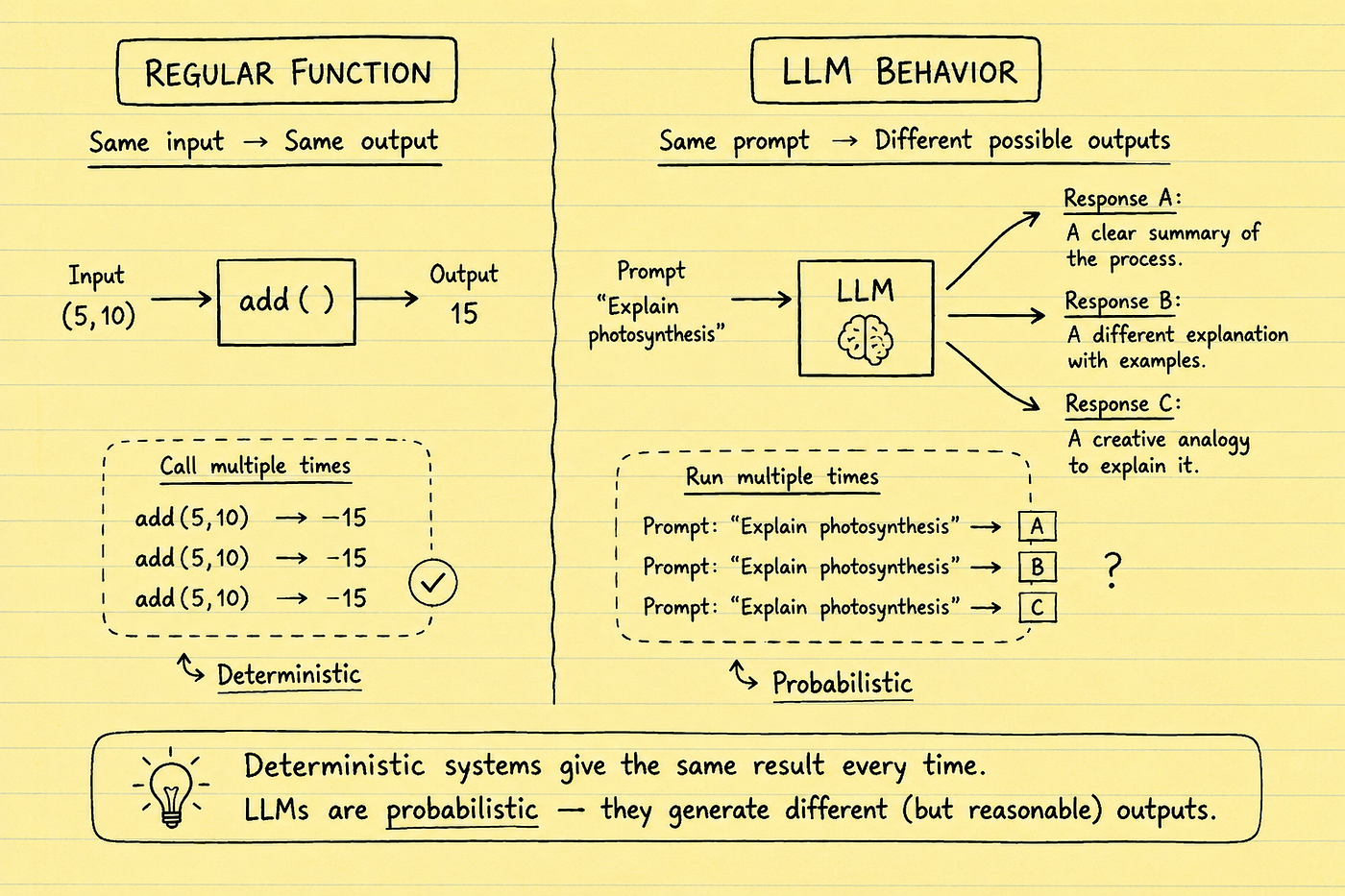
But sometimes, the difference can be much bigger. One response may be clear and correct. Another response may miss an important point. Another may confidently say something wrong. This does not always mean the model is broken. It is part of how LLMs generate text.
LLMs do not simply “look up” one fixed answer. They predict the next likely word again and again. Depending on the model settings, especially something called temperature, the answer can become more stable or more creative.
Low temperature usually makes responses more predictable. High temperature usually makes responses more varied. We will talk about temperature later in more detail.
For now, the important point is this:
A single successful test does not prove your LLM feature is reliable. It only proves that the model gave a good answer once. That is a big mindset shift. With normal software, a passing test often feels like a verdict. With LLMs, a passing test is only a data point. You are not testing a fixed function. You are sampling behavior from a system that can respond in many possible ways.
That is why testing an LLM once or twice is not enough. You need multiple examples, repeated runs, clear scoring, and a way to understand how often the model succeeds, not just whether it succeeded one time. This is the first reason traditional testing instincts can mislead engineers.
LLM evaluation starts when we stop asking:
“Did it work this time?”
And start asking:
“How often does it work, where does it fail, and how confident are we before shipping it?”
2. Why “Correct” Is Hard to Define
Some software tests are simple. A regex matches or it does not. An API returns 200 or it does not. A function gives the expected value or it does not. That kind of testing feels clean because the answer is binary.
- Pass or fail.
- True or false.
- Correct or incorrect.
But LLM outputs are not always that simple. Imagine you are building an AI support assistant, and you ask it:
“Summarize this support ticket empathetically.”
- Now what is the correct answer?
- Is it the shortest summary?
- Is it the warmest summary?
- Is it the one that captures every detail?
- Is it the one that sounds most human?
- Is it the one the customer support team likes best?
Suddenly, “correct” is not one clear thing.
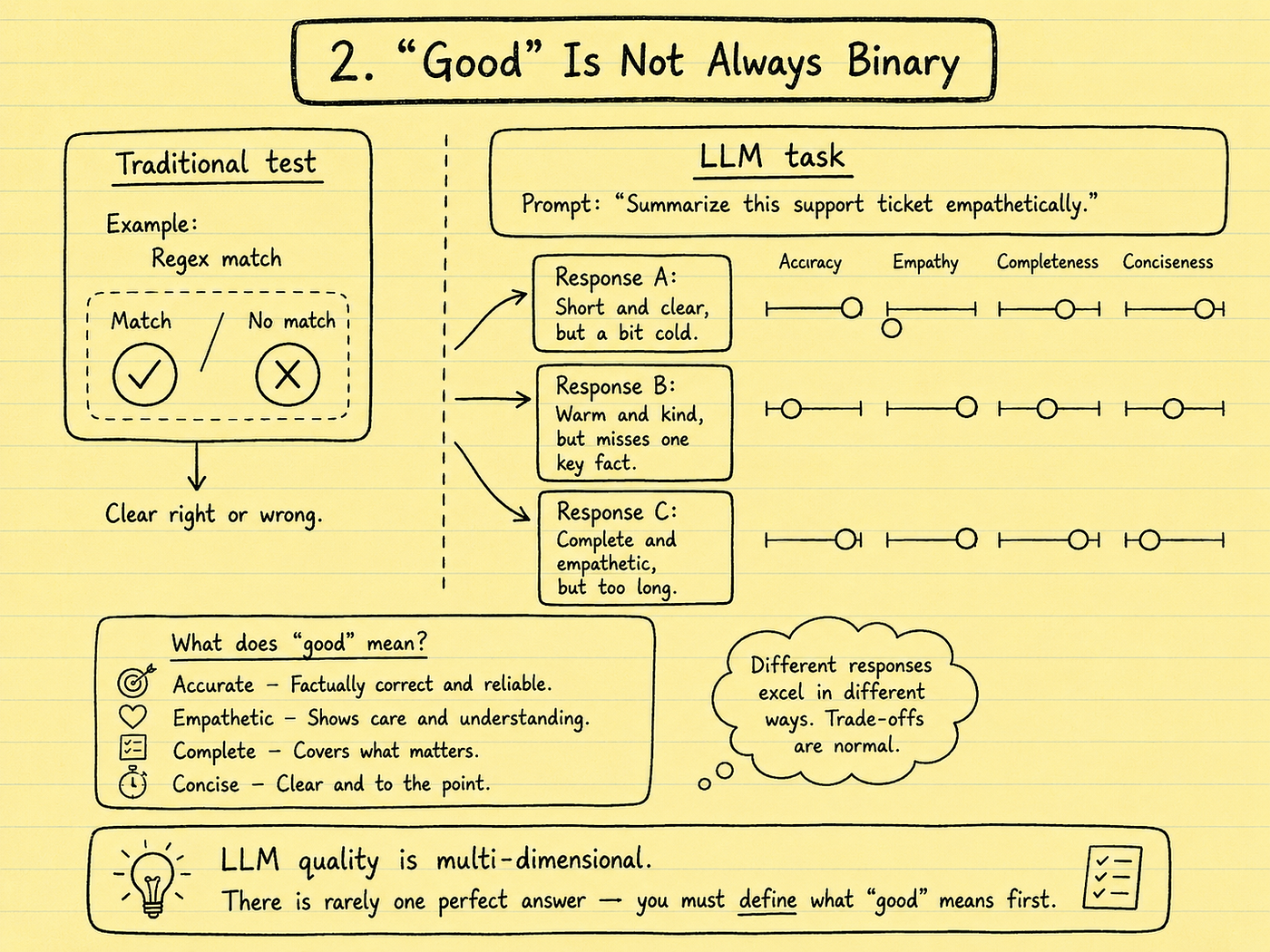
A good response may need to be accurate, polite, concise, complete, helpful, and aligned with your brand voice at the same time.That means LLM quality is multi-dimensional. One answer can be factually correct but too cold. Another answer can sound empathetic but miss an important detail. Another can be complete but too long for the user. So instead of one perfect answer, you usually have a range.
Some answers are clearly good. Some answers are clearly bad. And many answers sit somewhere in the middle.
That middle area is where evaluation becomes tricky. This is why you need to define what “good” means for your use case before you start measuring. For a legal assistant, “good” may mean accurate, careful, and well-cited. For a customer support bot, “good” may mean helpful, kind, and fast. For a coding assistant, “good” may mean working code, clear explanation, and no security issues. For a summarizer, “good” may mean short, faithful, and complete enough. You cannot evaluate quality if you have not defined quality.
Most teams skip this step. They say, “The answer looks good.” But “looks good” is not an evaluation strategy.
Before building evals, ask:
- What does a good answer include?
- What should it avoid?
- What matters most for this feature?
- Accuracy? Tone? Completeness? Safety? Speed?
Once you define that, you can create rubrics, test cases, scoring rules, and human review guidelines. Without that definition, every evaluation becomes a personal opinion. And personal opinion does not scale.
So the second big lesson is simple:
Before you measure LLM quality, define what quality means.
3. Prompt Changes Can Break Things Silently
You update your prompt. You run it a few times. The answers look better. So you feel confident and ship it.
But here is the real question:
- Did the quality actually improve?
- Or did you just get lucky with the few examples you checked?
This is one of the most dangerous parts of LLM engineering. A prompt change can fix one problem and quietly create another. Maybe your old prompt was too short, so you added more instructions. Now the model gives more detailed answers, but it also becomes slower and more expensive. Maybe your old prompt missed key facts, so you made it stricter. Now it captures more details, but the tone feels robotic. Maybe your old prompt hallucinated sometimes, so you told the model to be more careful. Now it avoids hallucinations, but it also refuses to answer useful questions.
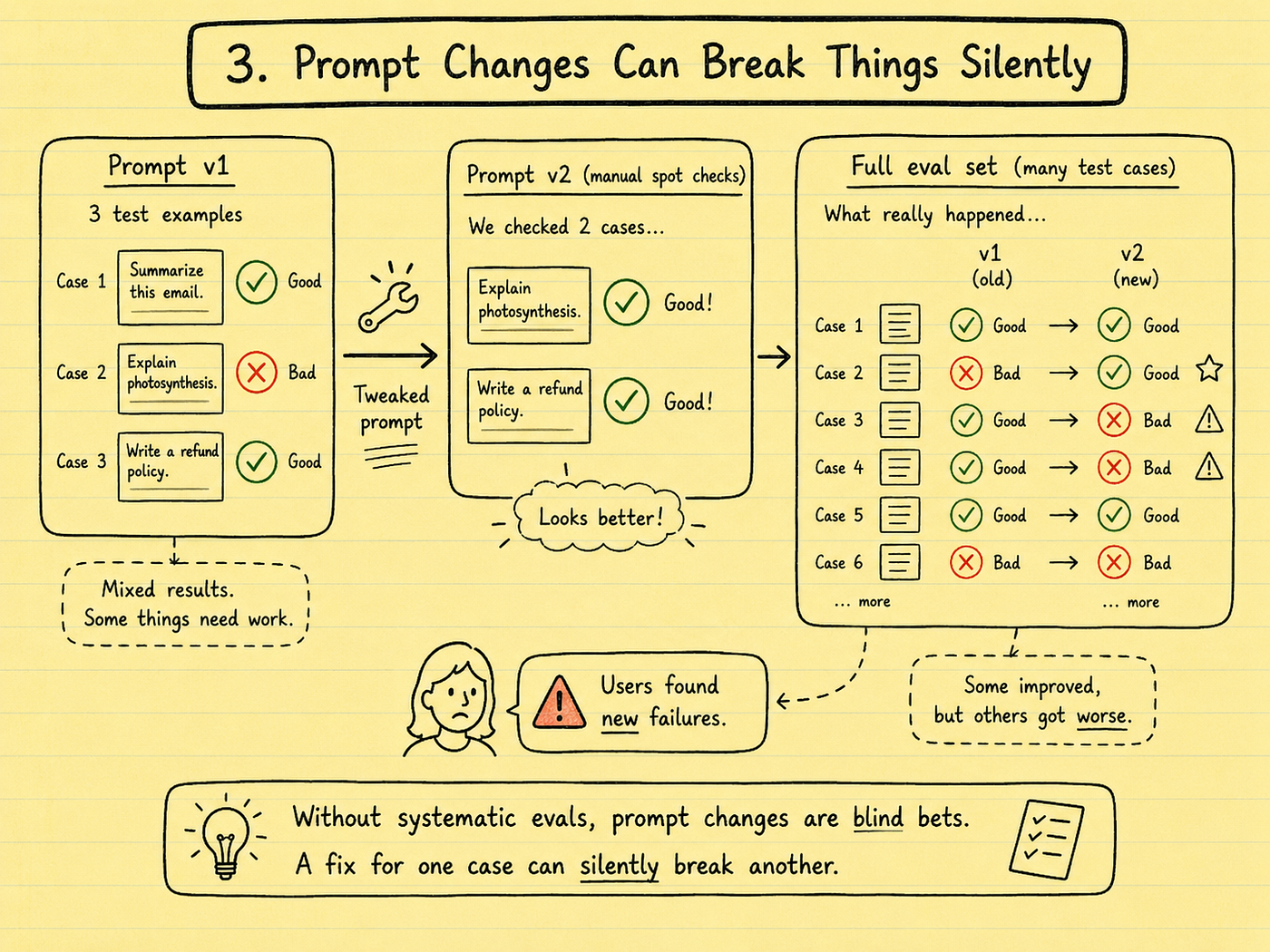
This is the silent regression problem. The system may look better in your quick manual test, but worse across the full set of real user cases.
In normal software, we have CI. You change the code. The test suite runs. If something important breaks, CI catches it before users do.
But many LLM applications do not have that kind of safety net. A developer changes the prompt, tests five examples manually, says “looks good,” and ships it. That is not evaluation. That is guessing with confidence. Without a proper evaluation process, every prompt change becomes a blind bet. You might be improving the product. You might be moving the failure from one place to another. You might be making the model better for easy cases and worse for edge cases. And you may not know until a user complains.
That is why LLM evaluation needs regression testing. Every time you change a prompt, model, retrieval method, tool, or system instruction, you should test it against a fixed set of examples. Not just one or two examples. A meaningful set of cases that represents how your feature is actually used.
The goal is simple:
Before shipping a change, you want to know what improved, what got worse, and what stayed the same. This is where LLM evaluation starts to feel like real engineering. Not vibes. Not gut feeling. Not “it looked good when I tried it.” A real process.
So these first three problems show us why LLM evaluation deserves its own discipline:
- LLMs are not fully deterministic.
- LLM correctness is often fuzzy.
- LLM changes can create silent regressions.
Now that we understand the problem, we can start building the vocabulary to talk about evaluation properly.
💠 The Building Blocks of LLM Evaluation
Before we go deeper, we need a small vocabulary reset. LLM evaluation can sound complicated because people use a lot of terms that It feels like a lot at first. But the foundation is actually simple. Learn these terms first , and the rest of LLM evaluation starts to make sense.
4. Criteria: Decide What “Good” Means
Before you evaluate an LLM output, you need to answer one simple question:
What does a good answer actually look like? That answer is called your criteria. Criteria are the quality dimensions that matter for your specific use case.
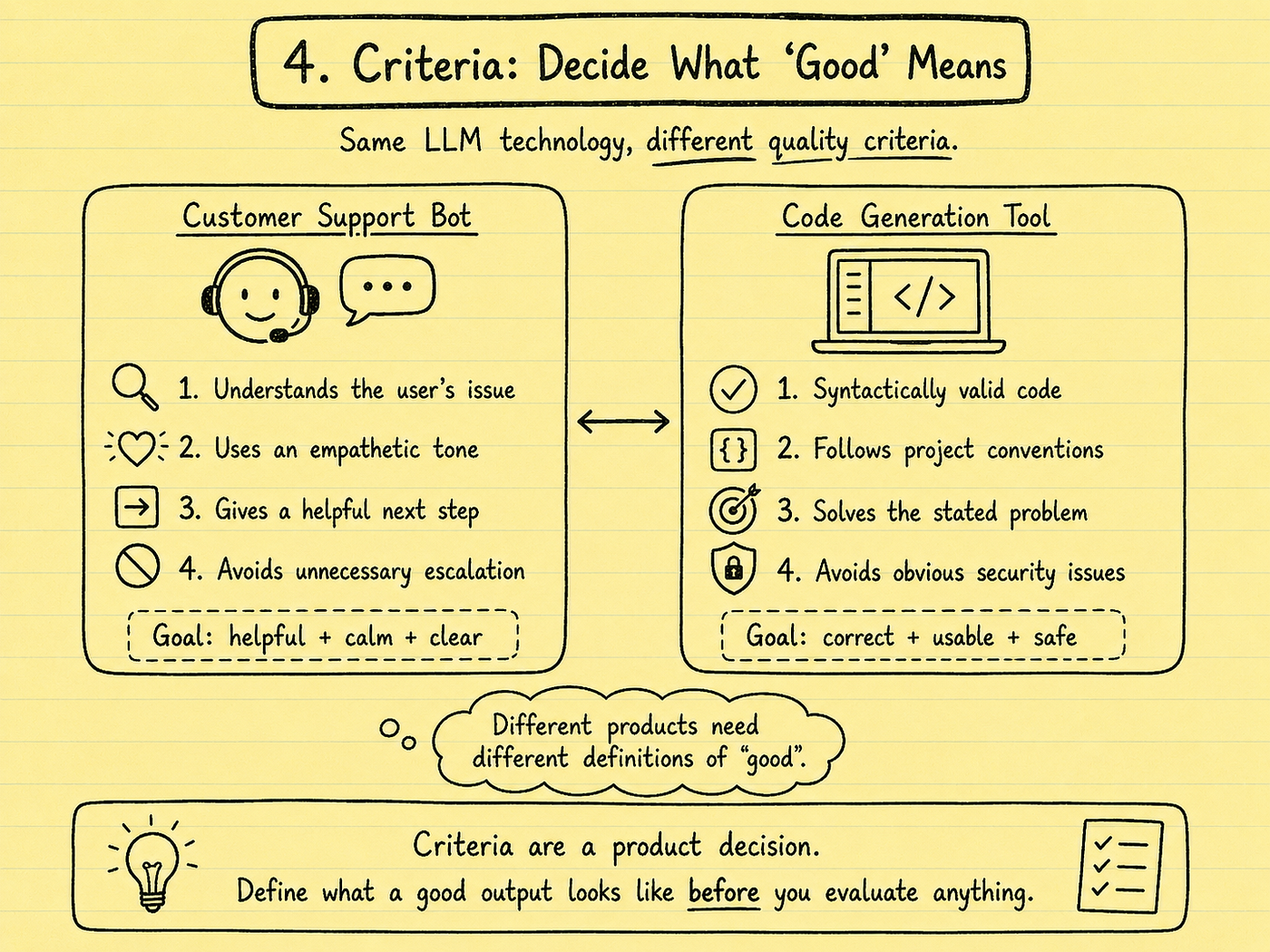
For example, a customer support bot may care about things like:
- Does the answer understand the user’s real issue?
- Is the tone calm and empathetic?
- Does it give a helpful next step?
- Does it avoid creating unnecessary panic or escalation?
Now compare that with a code generation tool.
A coding assistant may care about completely different things:
- Is the code syntactically valid?
- Does it solve the actual problem?
- Does it follow the project’s coding style?
- Does it avoid security issues?
- Does it explain the solution clearly enough?
Both tools use LLMs. But they should not be evaluated in the same way. A warm and empathetic answer may be great for customer support, but useless if the task is to generate working code. A very detailed technical answer may be great for developers, but too confusing for a normal customer.
This is why criteria are not universal. They come from your product, your users, and the job your AI feature is supposed to do. That also means criteria are not only a technical decision. They are a product decision. Your model cannot decide them for you. Your eval framework cannot decide them for you.
Someone on your team needs to sit down and clearly define:
- What should a good output include?
- What should it avoid?
- What matters most: accuracy, tone, completeness, safety, speed, or cost?
- Which mistakes are acceptable?
- Which mistakes are dangerous?
This step sounds simple, but many teams skip it. They start building evals before they define quality. Then they end up measuring random things. The model may get a high score, but the user experience still feels bad. That happens because the evaluation is measuring the wrong target. So before writing test cases, choosing metrics, or using LLM-as-a-judge, define your criteria first. Because if your criteria are wrong, everything downstream will be wrong too. Evaluation starts by deciding what “good” means.
5. Quality Dimensions: The Different Ways an Answer Can Be Good or Bad
Once you define your criteria, the next step is to understand the common quality dimensions. Quality dimensions are the standard ways engineers describe LLM output quality.
They help you avoid vague feedback like:
“This answer feels bad.”
Instead, you can say exactly what went wrong.
- Was it irrelevant?
- Was it confusing?
- Was it factually wrong?
- Was it unhelpful?
- Was it unsafe?
That clarity matters because different failures need different fixes. Here are five quality dimensions you will see again and again.
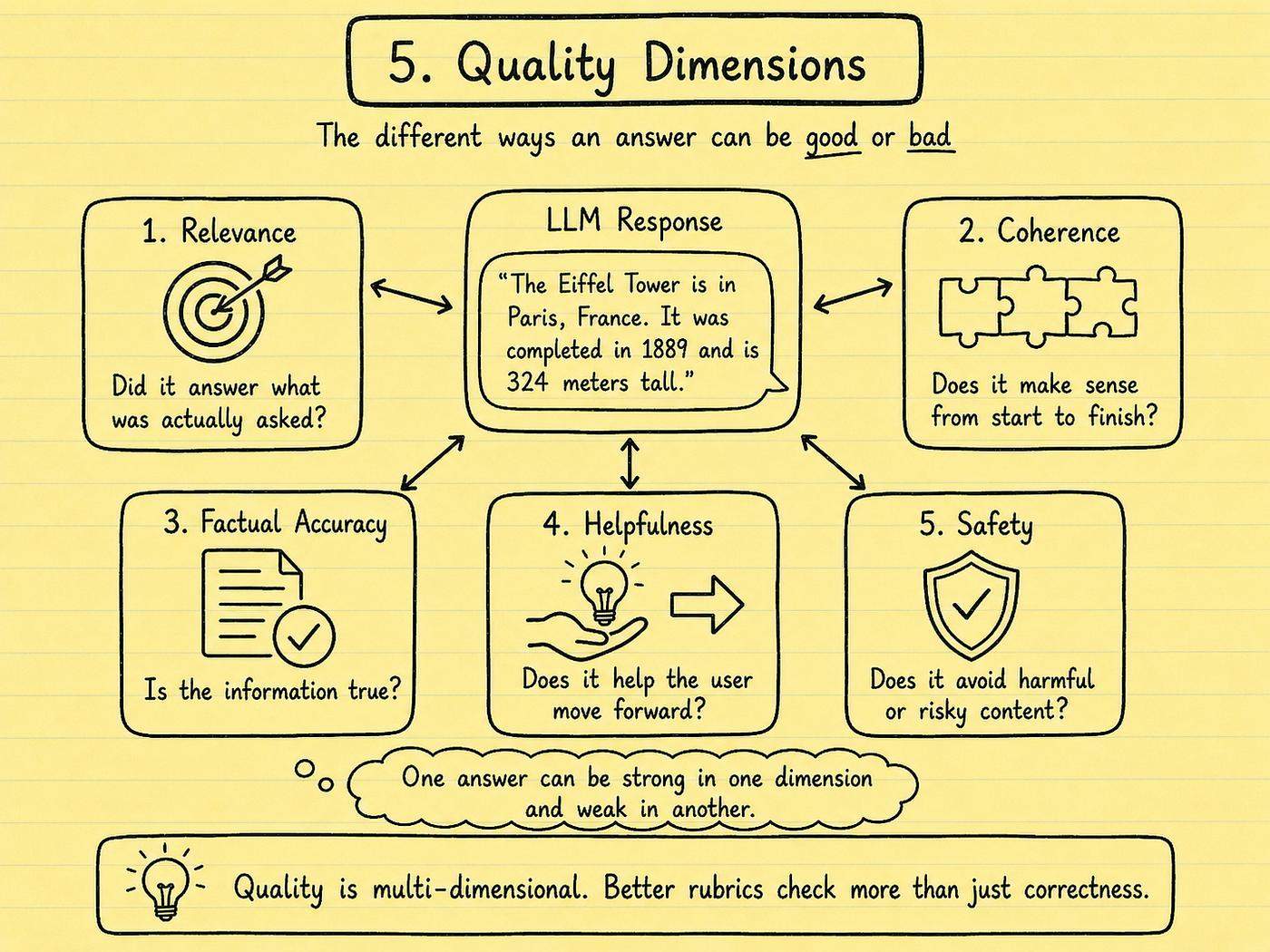
Relevance
Relevance asks:
Did the output actually answer what the user asked? A response can be beautifully written and still miss the point.
For example, if a user asks:
“How do I reset my password?”
And the model replies with a long explanation about creating a strong password, the answer may be useful in general, but it is not relevant to the user’s actual problem. Relevance is about staying on task.
Coherence
Coherence asks:
Does the response make sense from start to finish?
A coherent answer flows logically. It does not contradict itself. It does not suddenly change topic. It does not feel like random paragraphs stitched together. For example, a bad response may start by saying one thing, then later say the opposite. That creates confusion, even if some individual sentences sound correct. Coherence is about logical flow.
Factual Accuracy
Factual accuracy asks:
Is the information actually true?
This is different from relevance. A response can be relevant and still wrong.
For example, if a user asks:
“What is the capital of Australia?”
And the model answers:
“Sydney.”
The answer is relevant, but factually incorrect. Factual accuracy matters a lot when your product gives advice, explanations, summaries, research, legal information, medical information, financial information, or technical answers. Accuracy is about truth.
Helpfulness
Helpfulness asks:
Does the response help the user move forward? Sometimes an answer can be technically correct but still not very useful.
For example, a user asks:
“Why is my API request failing?”
And the model replies:
“Because the request is invalid.”
That may be true, but it does not help much. A more helpful answer would explain possible causes, show what to check, and suggest a next step. Helpfulness is about practical value.
Safety
Safety asks:
Does the response avoid harmful, biased, inappropriate, or risky content? This dimension matters more in some products than others, but it always matters.
A safe model should avoid giving dangerous instructions, spreading hate, exposing private information, encouraging harmful behavior, or confidently making sensitive claims without care.
For example, a medical chatbot, finance assistant, education app, or customer support bot needs strong safety checks because the cost of a bad answer can be serious. Safety is about protecting users and reducing harm.
These five dimensions are not the only ones, but they are a strong starting point:
- Relevance checks whether the answer is on topic.
- Coherence checks whether it makes sense.
- Factual accuracy checks whether it is true.
- Helpfulness checks whether it is useful.
- Safety checks whether it avoids harm.
Once you understand these dimensions, your evaluation becomes much sharper.
You stop asking:
“Is this answer good?”
And start asking:
“In what way is this answer good, and in what way does it fail?”
That is how you build better rubrics, better test cases, and better LLM products.
6. Rubric
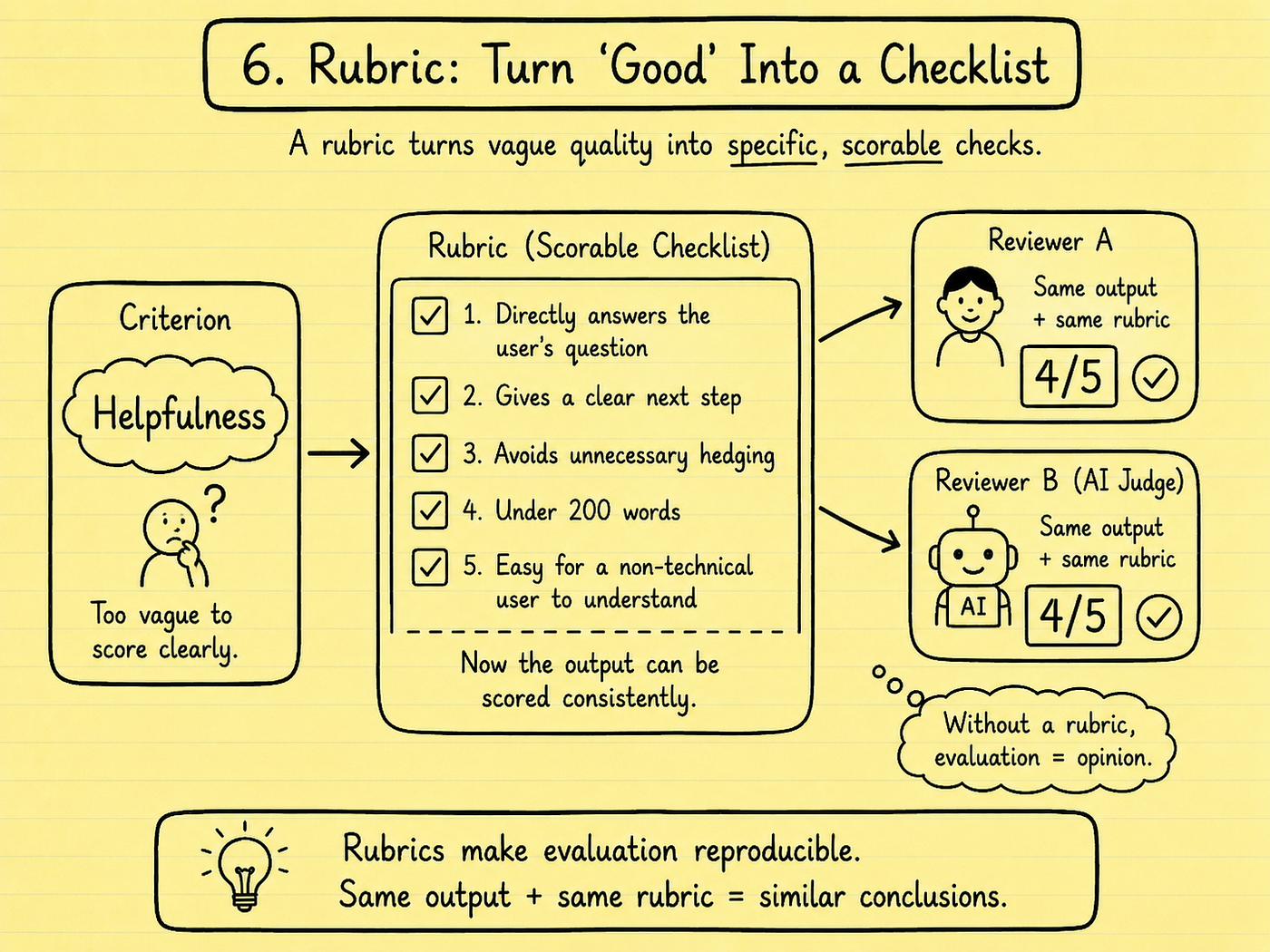
Once you define your criteria, the next step is to make them measurable. That is where a rubric comes in. A rubric turns a vague idea like “helpfulness” into specific questions that someone can actually score. For example, “helpfulness” sounds simple.
- But what does helpful really mean?
- Does the answer directly solve the user’s problem?
- Does it give a clear next step?
- Does it avoid unnecessary confusion?
- Is it short enough to read quickly?
- Can a non-technical user understand it?
A rubric breaks quality into small, clear checks. Think of it like a code review checklist.
Instead of asking:
“Is this good code?”
A good code review checklist asks better questions:
- Are there tests?
- Are the variable names clear?
- Is the function easy to understand?
- Does it handle errors?
- Is there any obvious security risk?
Rubrics do the same thing for LLM outputs.
Instead of asking:
“Is this a good answer?”
A rubric asks:
- Is it relevant?
- Is it accurate?
- Is it complete?
- Is it safe?
- Is the tone appropriate? Does it follow the required format?
This matters because evaluation should be reproducible. Two different reviewers should not give completely different scores just because they have different personal tastes. If the same output is judged by the same rubric, the conclusion should be similar. That reviewer could be a human. It could also be another LLM acting as a judge. Either way, the rubric gives the evaluator clear rules. Without a rubric, evaluation becomes opinion.
One person says, “This is good.”
Another person says, “This feels weak.”
A third person says, “I like it.”
That does not scale. A rubric gives your team a shared definition of quality. It makes feedback clearer. It makes scores more consistent. And it helps you understand exactly why an output passed or failed. So if criteria define what matters, the rubric defines how to judge it.
Criteria say:
“We care about helpfulness.”
The rubric says:
“Here is exactly how we decide whether the answer is helpful.”
That is how you move from vague judgment to repeatable evaluation.
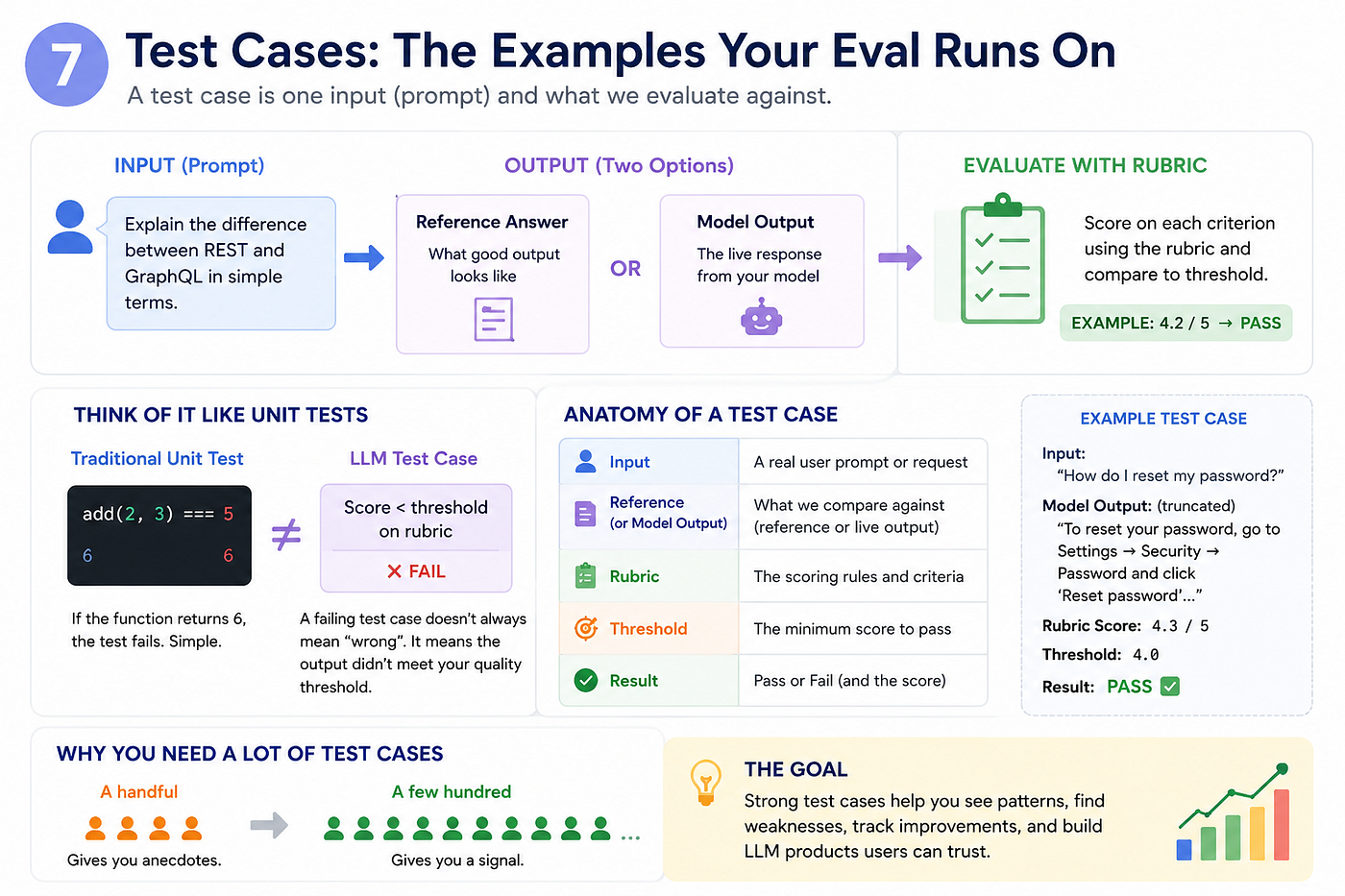
7. Test Cases: The Examples Your Eval Runs On
Once you have a rubric, you need examples to test. That is where test cases come in. A test case is one unit of evaluation.
In simple words:
One test case usually contains an input and something to evaluate against. The input is usually a prompt or user request. Ideally, that input should look like something a real user would actually ask.
For example:
“Summarize this customer complaint in a polite and helpful way.”
Or:
“Write a SQL query to find the top 5 customers by revenue.”
Or:
“Explain this error message to a beginner.”
The output can be used in two ways. Sometimes you have a reference answer. That means you already have an example of what a good answer should look like. Other times, you run your live model and score the response using your rubric.
Think of test cases like unit tests for LLMs. But there is one important difference. In normal unit testing, a test usually passes or fails clearly.
Expected output:
add(2, 3) === 5If the function returns 6, the test fails. Simple. But with LLMs, the output may not need to match the reference answer word-for-word. It may use different wording and still be good.
So a failing LLM test case does not always mean:
“The output is completely wrong.”
It usually means:
“The output scored below the quality threshold we defined.”
That threshold comes from your rubric. For example, maybe your support bot response needs at least 4 out of 5 on helpfulness. Maybe your coding assistant needs to pass syntax checks and score high on correctness. Maybe your summarizer needs to include all key facts and stay under 150 words.
- The test case gives you the example.
- The rubric gives you the scoring rules.
- The threshold tells you whether the output is good enough.
And you need many test cases. A handful of examples only gives you anecdotes. You may feel like the model is doing well, but you are still guessing. A few hundred strong test cases start to give you a real signal. They help you see patterns.
- Where does the model fail?
- Which prompts are risky?
- Which user requests are handled well?
- Did the new prompt improve the average score?
- Did it break some edge cases?
Good test cases make evaluation practical. Without them, you are just manually trying prompts and trusting your feeling. With them, you can measure changes over time.
So the simple rule is this:
Do not evaluate your LLM on random examples only. Build a test set that represents real users, real tasks, common cases, and painful edge cases. That is when evaluation starts becoming useful.
8. Golden Set: Your Source of Truth
Every evaluation system needs something stable to measure against. That stable thing is your golden set.
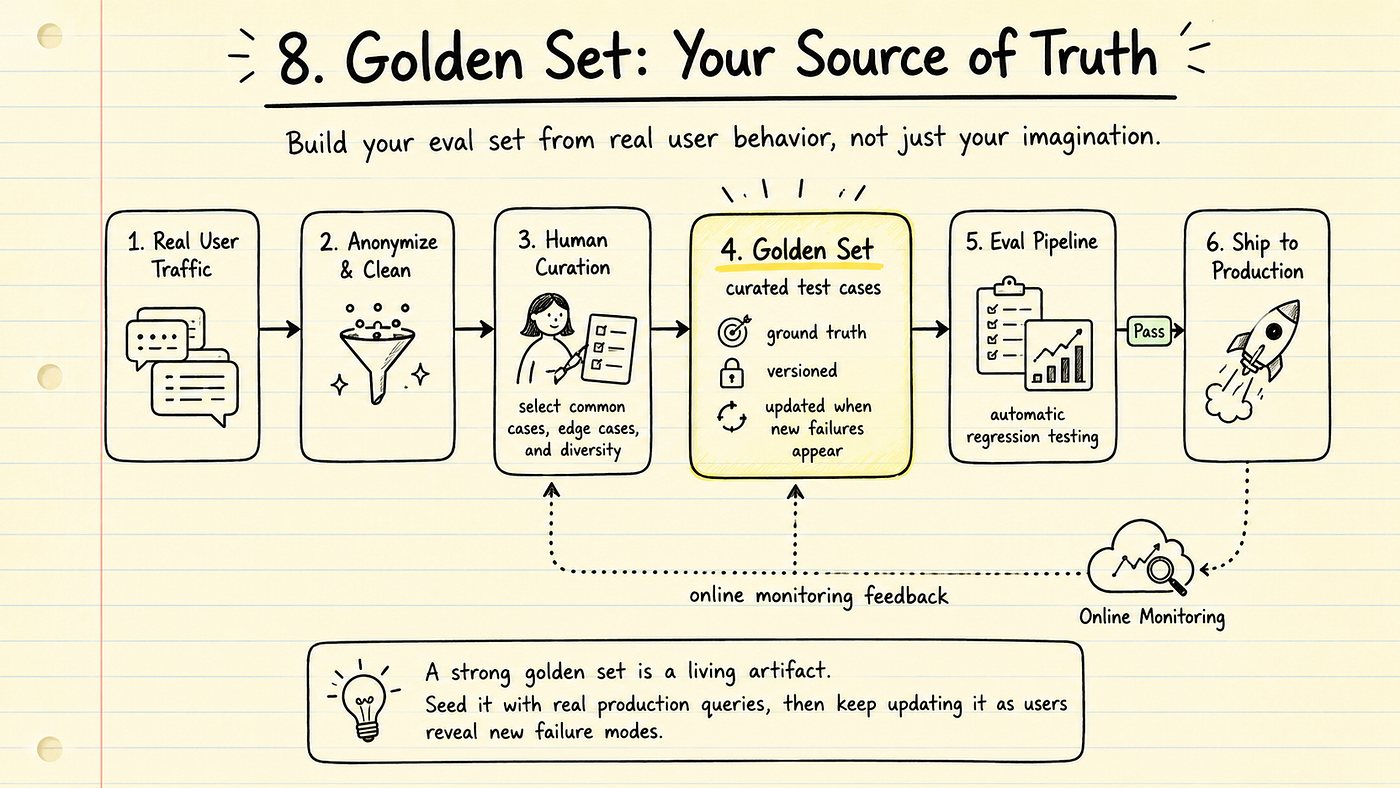
A golden set is a curated collection of high-quality test cases that represents the kinds of tasks your LLM feature is supposed to handle. In simple words, it is the test set you trust most. Whenever you change your prompt, model, retrieval logic, tool flow, or system instructions, you run your eval against this set to see what improved, what got worse, and what stayed the same.
That is why the golden set becomes your ground truth. But building a good golden set is harder than it sounds.
At first, most teams do the obvious thing:
They write example prompts themselves. That is a useful starting point. You think about common use cases. You imagine what users might ask. You create a few good examples.
That helps. But it also has a weakness. Users do not think like the builders of the product. They phrase things differently. They ask incomplete questions. They mix multiple requests together. They create weird edge cases. And sometimes they misuse features in surprisingly creative ways. So if your golden set is built only from your imagination, it mostly reflects your imagination.
Not your users. That is why the best golden sets are seeded with real production data.
- Real user queries.
- Real patterns.
- Real mistakes.
- Real messy inputs.
Of course, this data should be anonymized, cleaned, and reviewed before adding it to the set. The goal is not to copy raw user data blindly. The goal is to build a representative collection of cases that reflects reality.
A strong golden set usually includes:
- Common requests that happen often
- Important workflows your product must handle well
- Known failure cases
- Tricky edge cases
- User behaviors that surprised your team
- Examples from real production traffic
This makes the eval much more trustworthy.
Because now you are not asking:
“Does the model work on examples I invented?”
You are asking:
“Does the model work on the kinds of things real users actually do?”
That is a much better question. Your golden set should also be treated like a real product asset. Not a one-time file you create and forget. As your system evolves, your golden set should evolve too. When you discover a new failure mode, add it. When a user finds a painful edge case, add it. When the product changes, update it. When old cases stop being relevant, retire or revise them. Version it. Maintain it. Improve it. Because a golden set is not just a random dataset. It is the foundation your eval system stands on. If the golden set is weak, your evaluation will be weak. If the golden set is unrealistic, your results will be misleading.
But if the golden set is strong and representative, it becomes one of the most valuable assets in your entire LLM workflow.
So the key idea is simple:
Your golden set is your source of truth. Protect it, improve it, and keep it close to real user behavior.
9. Pass/Fail Threshold: Decide What Is Good Enough
Eval scores are usually not perfectly binary.
Most rubrics do not simply say:
Pass or fail. They usually produce a score.
- Maybe 1 to 5.
- Maybe 0 to 10.
- Maybe a percentage.
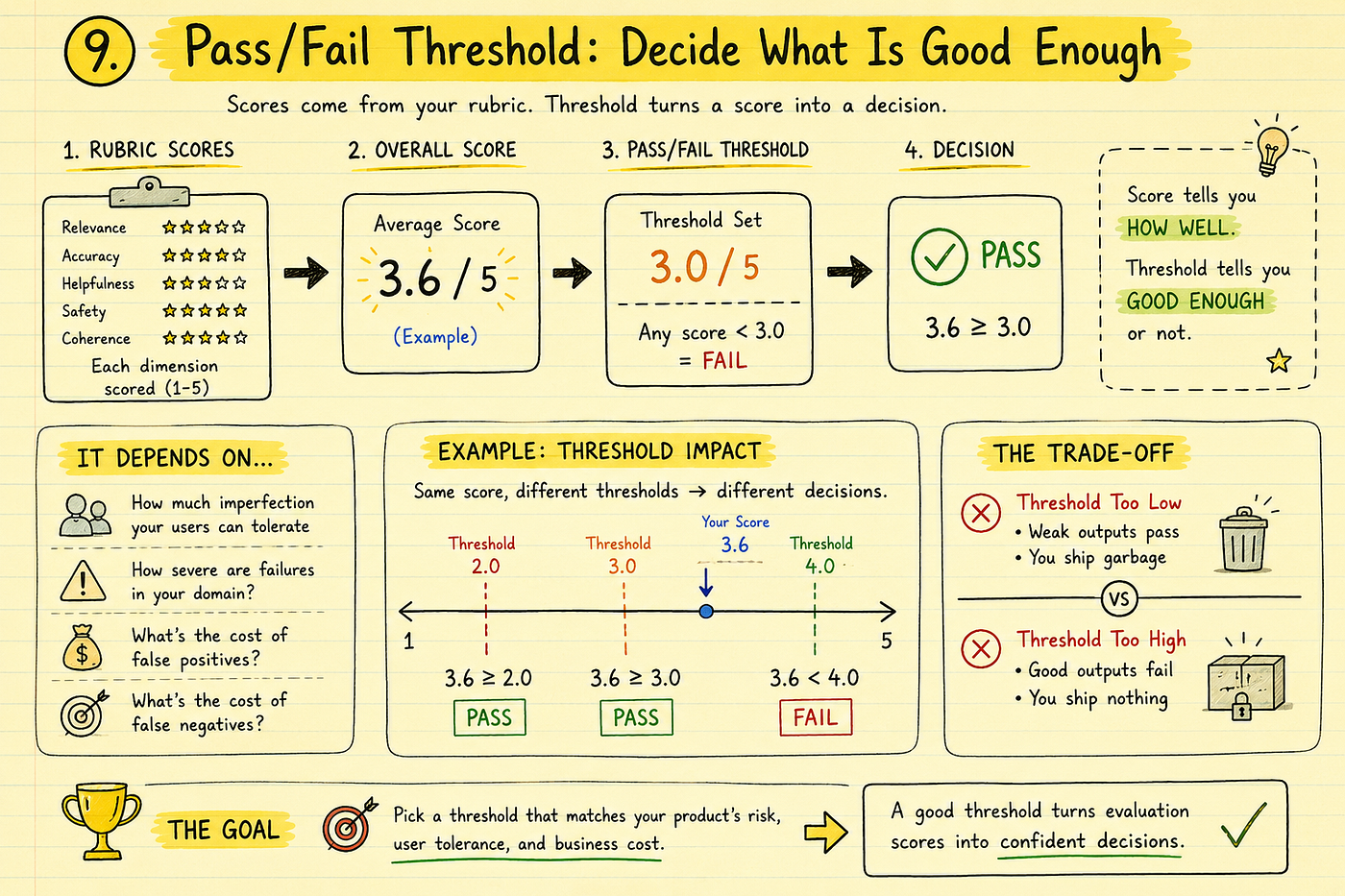
For example, your evaluator may score an answer like this:
- Helpfulness: 4/5
- Accuracy: 5/5
- Tone: 3/5
- Safety: 5/5
But a score alone does not tell you what to do next.
Is 3/5 acceptable? Is 4/5 good enough? Should anything below 90% block a release? That is where the pass/fail threshold comes in. A pass/fail threshold is the line that converts a score into a decision.
For example, if your rubric score goes from 1 to 5 and your threshold is 3, then anything below 3 fails. Simple in theory. Hard in real life. Because setting the right threshold is not just a technical decision. It is a product decision. A casual writing assistant can tolerate small mistakes. A medical, legal, finance, or security-related assistant cannot. A chatbot that recommends movie titles has a very different risk level from an AI system that explains medication instructions. So your threshold depends on the product context.
You need to ask:
- How much imperfection can users tolerate?
- How serious is a wrong answer?
- What happens if the system passes a bad output?
- What happens if the system rejects a good enough output?
- What is the cost of being too strict?
- What is the cost of being too relaxed?
This balance matters. Set your threshold too low, and you start shipping weak outputs. The model may pass even when the answer is incomplete, careless, or risky. Set your threshold too high, and almost nothing passes. Your system becomes slow, blocked, expensive, or frustrating to use. That is the tradeoff. Too low, and you ship garbage. Too high, and you ship nothing. A good threshold should match the level of trust your use case requires. For low-risk tasks, the threshold can be more forgiving. For high-risk tasks, the threshold should be stricter. And in many real systems, you may not use one threshold for everything.
You might allow a lower threshold for tone. But require a very high threshold for factual accuracy or safety.
For example:
- Tone must be at least 3/5.
- Helpfulness must be at least 4/5.
- Safety must be 5/5.
That is much better than treating every dimension equally. The goal is not to create a perfect number. The goal is to create a decision rule your team can trust.
So the key idea is simple:
A score tells you how the output performed. A threshold tells you whether that performance is good enough to accept, reject, retry, review, or block.
10. Eval Coverage: Are You Testing What Users Actually Do?
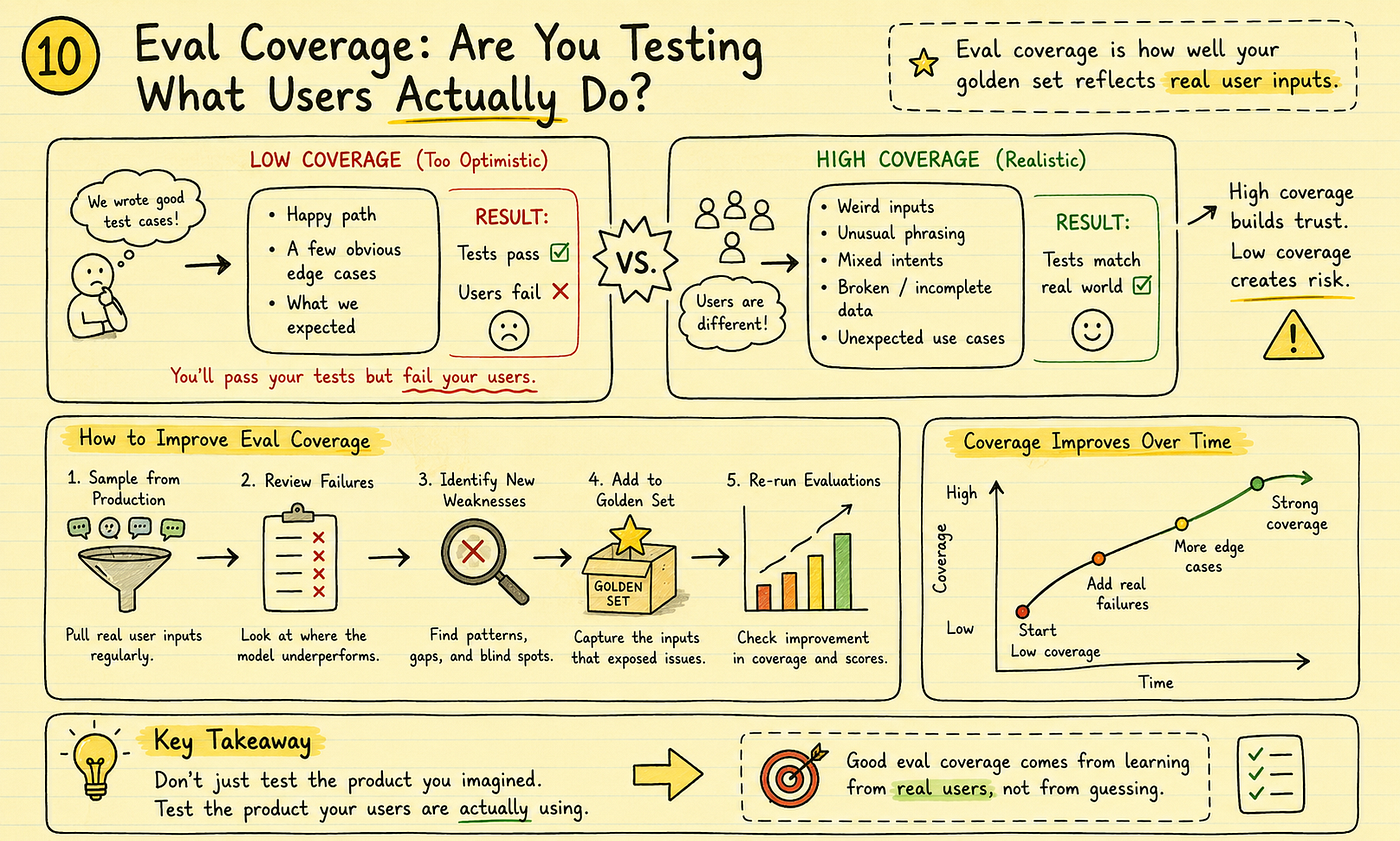
Eval coverage means one simple thing: How well does your golden set represent real user behavior? This matters because your eval is only useful if it tests the kinds of inputs your product actually receives. Most teams have lower eval coverage than they think. At the beginning, they create test cases themselves.
- They write clean prompts.
- They cover the happy path.
- They add a few obvious edge cases.
- They feel prepared.
And honestly, that is a decent start. But then production happens. Real users do not write prompts the way your team writes prompts.
- They ask messy questions.
- They give incomplete context.
- They use strange wording.
- They mix two or three tasks together.
- They paste broken data.
- They misunderstand the feature.
- They try things nobody on the team predicted.
This is where low coverage becomes dangerous.
Your eval suite may say:
“Everything looks good.”
But users may still find failures in places your tests never touched. That means your eval is optimistic. It gives you confidence, but not enough truth. You pass your tests, but fail your users. That is the real coverage problem. The fix is not just sitting in a room and inventing more examples. That helps a little, but it still reflects your imagination. The better approach is to regularly sample from real production traffic. Look at what users are actually asking. Review failed conversations. Find inputs where the model gave weak, unsafe, irrelevant, or confusing answers. Then add those examples to your golden set. Over time, your eval set becomes more realistic.
It starts covering:
- Common user requests
- Messy real-world phrasing
- High-risk edge cases
- Repeated failure patterns
- Inputs that previously caused bad outputs
- New use cases users discovered before your team did
That is how eval coverage improves. Not all at once. Slowly. Every failure teaches your eval something new. A good golden set should grow as your product grows. When users reveal a new weakness, do not just patch the prompt and move on. Capture the input. Add it to the eval. Make sure the same failure does not silently return later. That is how eval coverage turns production pain into future protection.
So the key question is:
Are you testing the product you imagined? Or are you testing the product your users are actually using? Good eval coverage comes from closing that gap.
11. Temperature and Top-p: Control Randomness Before You Evaluate
LLMs do not always produce the same answer every time. One big reason is the model’s sampling settings. Two settings you will hear often are temperature and top-p. Let’s keep them simple. Temperature controls how random or creative the model’s output can be. A low temperature, close to 0, makes the model more predictable.
- Same prompt.
- Similar output.
- Less surprise.
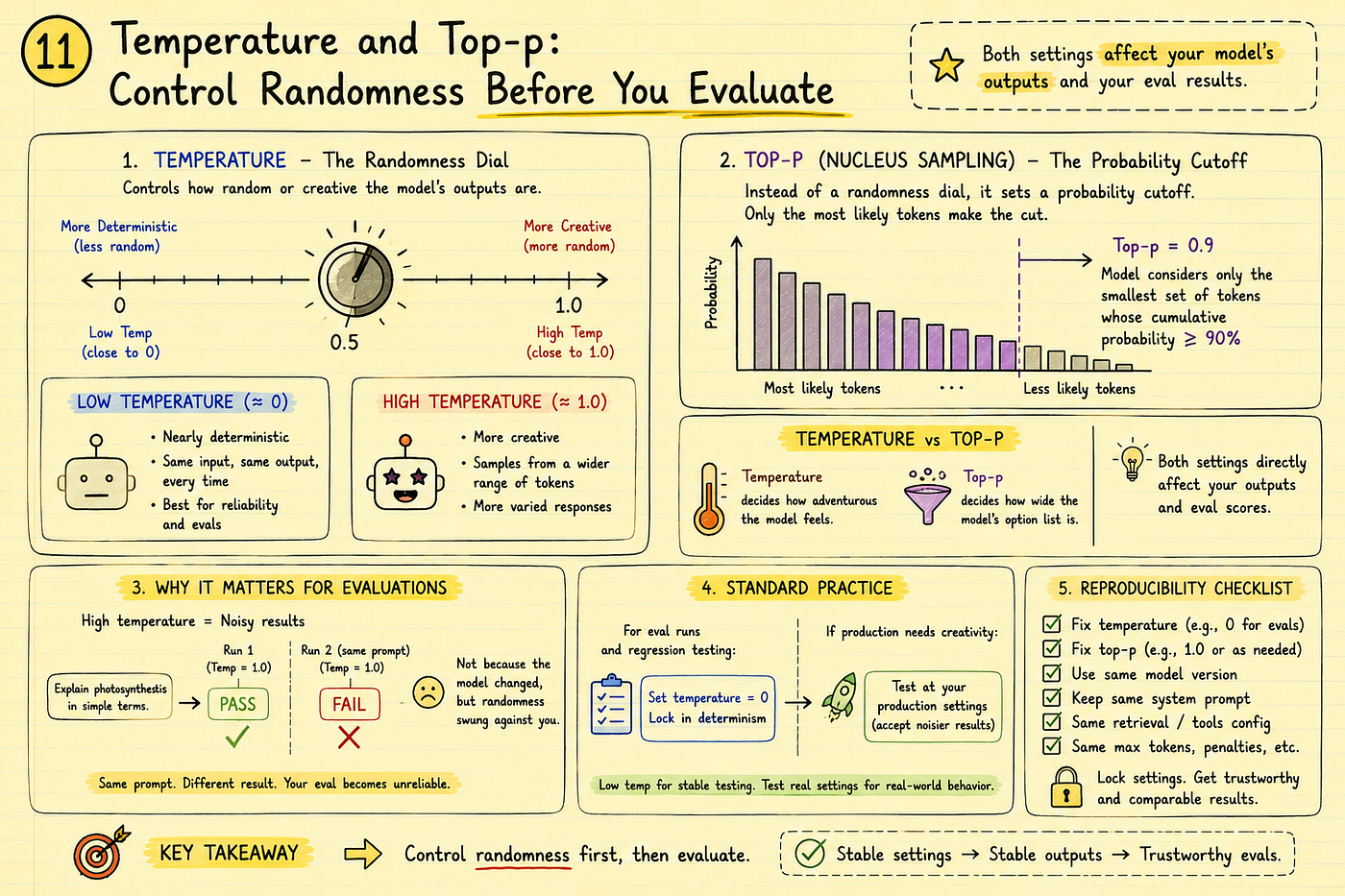
A higher temperature makes the model more flexible and creative. The model starts exploring a wider range of possible words, phrases, and styles. That can be useful for brainstorming, writing, storytelling, or creative tasks. But it can be dangerous for evaluation.
Why?
Because randomness can change your eval results. Imagine you run the same test case today and it passes. Tomorrow, you run the same test again and it fails. The prompt did not change. The model did not change. Your code did not change. But the output changed because the model sampled a different path. That means your eval result became noisy.
Now you are not sure whether the system actually improved or whether randomness just made it look better for one run.
This is why reproducibility matters. Reproducibility means you can run the same eval again and get stable, trustworthy results. If your eval is too random, your scores become harder to trust.
Now let’s talk about top-p. Top-p, also called nucleus sampling, is another way to control randomness. Instead of saying “be more or less creative,” top-p controls which possible next words the model is allowed to consider. For example, if top-p = 0.9, the model only considers the group of most likely next tokens that together make up 90% of the probability.
In simple words: Temperature controls how adventurous the model feels. Top-p controls how wide the model’s option list is. Both affect the final output. And because they affect the output, they also affect your eval score. This is why most teams use stable settings during eval runs.
The common practice is:
Set temperature to 0 when running evaluations. This makes the model as deterministic as possible. It reduces random variation and helps you compare changes more fairly. For example, if you update your prompt and rerun the eval, you want to know whether the new prompt improved quality. You do not want randomness to confuse the result. But there is one important exception.
If your production app uses a higher temperature because the product needs creativity, then you should also test that production setting. For example, a creative writing assistant may run at temperature = 0.8. In that case, evaluating only at temperature = 0 may give you a false sense of stability.
So the practical rule is:
Use low temperature for stable regression testing. But also test at your real production settings if your app depends on creative variation. Just understand the tradeoff. More creativity means more variety. More variety means noisier eval results. So when you run evaluations, always lock your model settings. Do not casually change temperature, top-p, model version, system prompt, or retrieval behavior while comparing results. Otherwise, you will not know what caused the score to change.
The key idea is simple:
If you want trustworthy eval results, control the randomness first.
12. Statistical Rigor: One Eval Score Is Not Enough
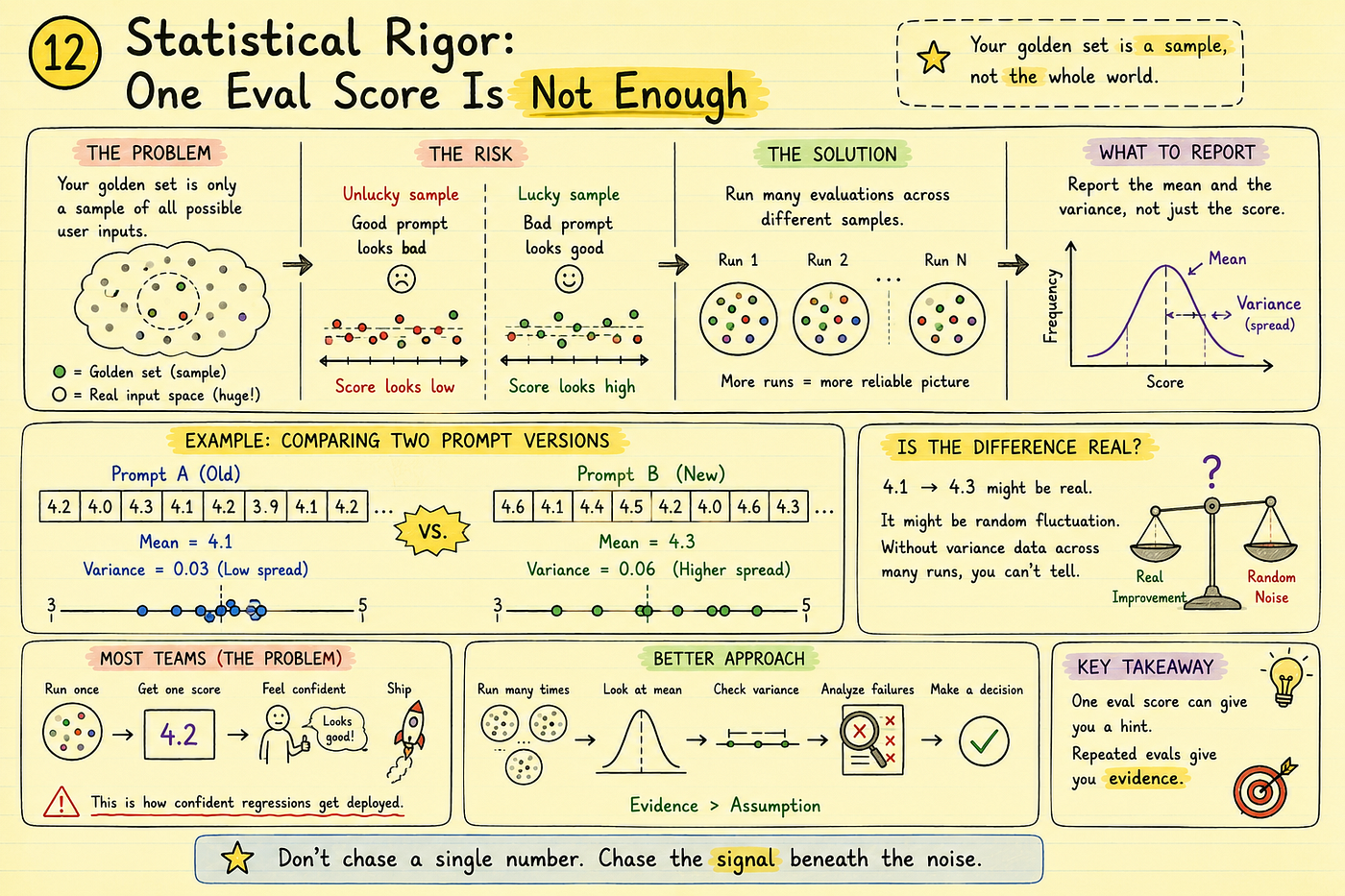
Even if you set temperature to 0, one eval run is still not enough. That sounds strange at first. Because if the model is more stable, shouldn’t one run be enough? Not really. The model may be stable, but your test set is still only a sample of your real input space. Your users can ask thousands of different things in thousands of different ways. Your golden set only captures a small part of that world. And every sample has noise. One unlucky set of examples can make a good prompt look worse than it really is. One lucky set of examples can make a weak prompt look better than it really is. That is why you should not trust one number too quickly.
Imagine you update your prompt.
- Old prompt score:
4.1 / 5 - New prompt score:
4.3 / 5
At first glance, this looks like an improvement. And maybe it is. But maybe not. Maybe the new prompt only looked better because this eval run had easier examples. Maybe the score improved on common cases but became worse on edge cases. Maybe the difference is so small that it is just normal variation. Without more data, you cannot tell. This is where statistical rigor comes in.
Statistical rigor simply means:
Do not treat one eval score like absolute truth. Run evaluations across different samples. Track the average score. Look at the variance. Compare prompt versions carefully. Ask whether the difference is meaningful or just noise.
In simple words:
- The mean tells you the average performance.
- The variance tells you how much the score moves around.
Both matter. A model with an average score of 4.4 but huge variance may be unreliable. It might perform very well on easy cases and fail badly on certain user inputs. Another model with an average score of 4.2 but low variance may be more predictable. And in production, predictable behavior is often more valuable than one impressive number. This is especially important when comparing prompt versions.
Do not only ask:
“Which prompt got the higher score?”
Ask:
“Is the difference large enough to trust?”
If prompt A scores 4.1 and prompt B scores 4.3, that may be a real improvement. But it may also be random fluctuation. If prompt B consistently performs better across many samples, then you can trust it more. If the score jumps up and down every time you rerun the eval, be careful. That is not strong evidence. That is noise wearing a nice suit. Most teams skip this. They run one eval. They get one score. They feel confident. Then they ship. That is how confident regressions reach production. A better approach is to treat eval results like measurements, not magic numbers. Run more than once. Compare averages. Check variance. Look at failure patterns. Then make the decision.
The key idea is simple:
One eval score can give you a hint. Repeated evals give you evidence.
💠 How Do You Score LLM Outputs?
Now we have criteria, rubrics, test cases, and a golden set. But one question remains: who scores the output?
There are three common options. Each has tradeoffs in cost, speed, and trust.
13. Human Evaluation: The Gold Standard
Human evaluation means a real person reviews the LLM output using your rubric and gives it a score.
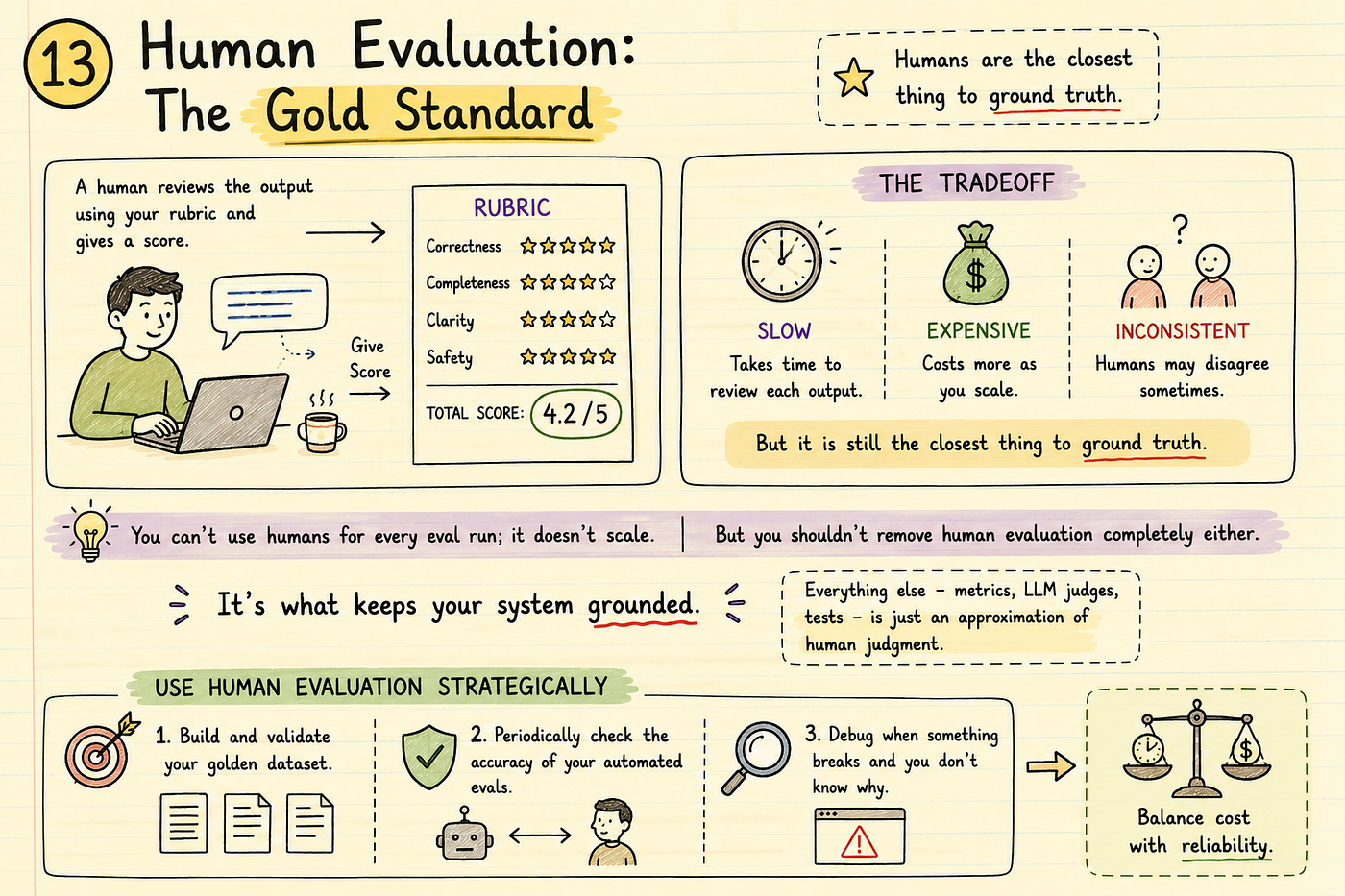
- It is slow.
- It is expensive.
- And yes, humans can be inconsistent too.
But it is still the closest thing we have to ground truth. You cannot use humans for every eval run because it does not scale. But you should not remove humans completely either.
Human review keeps your evaluation system grounded.
Use it strategically:
- To build and validate your golden set.
- To check whether your automated evals are trustworthy.
- To debug confusing failures when scores do not explain the problem.
Everything else — metrics, LLM judges, and code checks — is only an approximation of human judgment.
So the goal is not to replace humans fully. The goal is to use them where they matter most.
14. Heuristic Evaluation: Fast Checks With Code
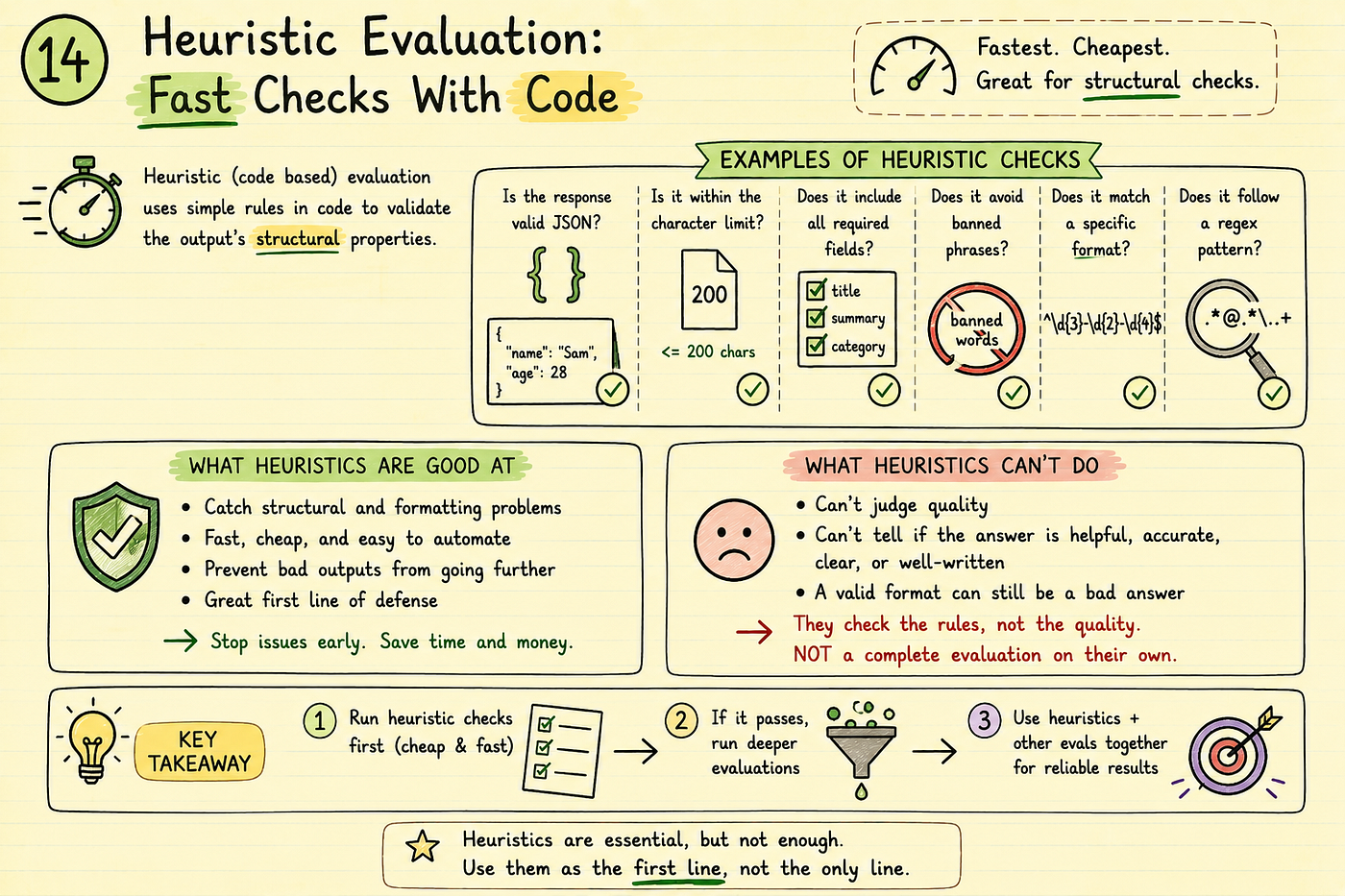
Heuristic evaluation is the fastest and cheapest way to check LLM outputs. Instead of asking a human or another LLM to judge the answer, you use simple code rules.
For example:
- Is the response valid JSON?
- Is it under the character limit?
- Does it include all required fields?
- Does it avoid banned phrases?
- Does it follow a specific format?
- Does it match a regex?
This type of evaluation is great for catching structural problems. If your app expects JSON, the output must be valid JSON. If your UI only supports 200 characters, the output should not be 600 characters. If the response must include title, summary, and category, then those fields must be present. These checks are simple, fast, and reliable. But they have a clear limit. Heuristic checks can tell you whether the output follows rules. They cannot tell you whether the answer is truly helpful, accurate, empathetic, or well-written. A response can be valid JSON and still be useless. A response can match the format and still contain bad advice. A response can stay under the word limit and still miss the user’s actual question.
So think of heuristics as your first line of defense. They catch basic issues before you spend money on more expensive evaluations. They are not enough on their own. But every serious eval system should have them.
15. Semantic Similarity: Match Meaning, Not Words
Sometimes you already have a reference answer. A reference answer is a known-good response that shows what the ideal output should mean. Semantic similarity evaluation compares your model’s output with that reference answer. But it does not compare them word by word. It compares their meaning. This is useful because LLMs can say the same thing in many different ways.
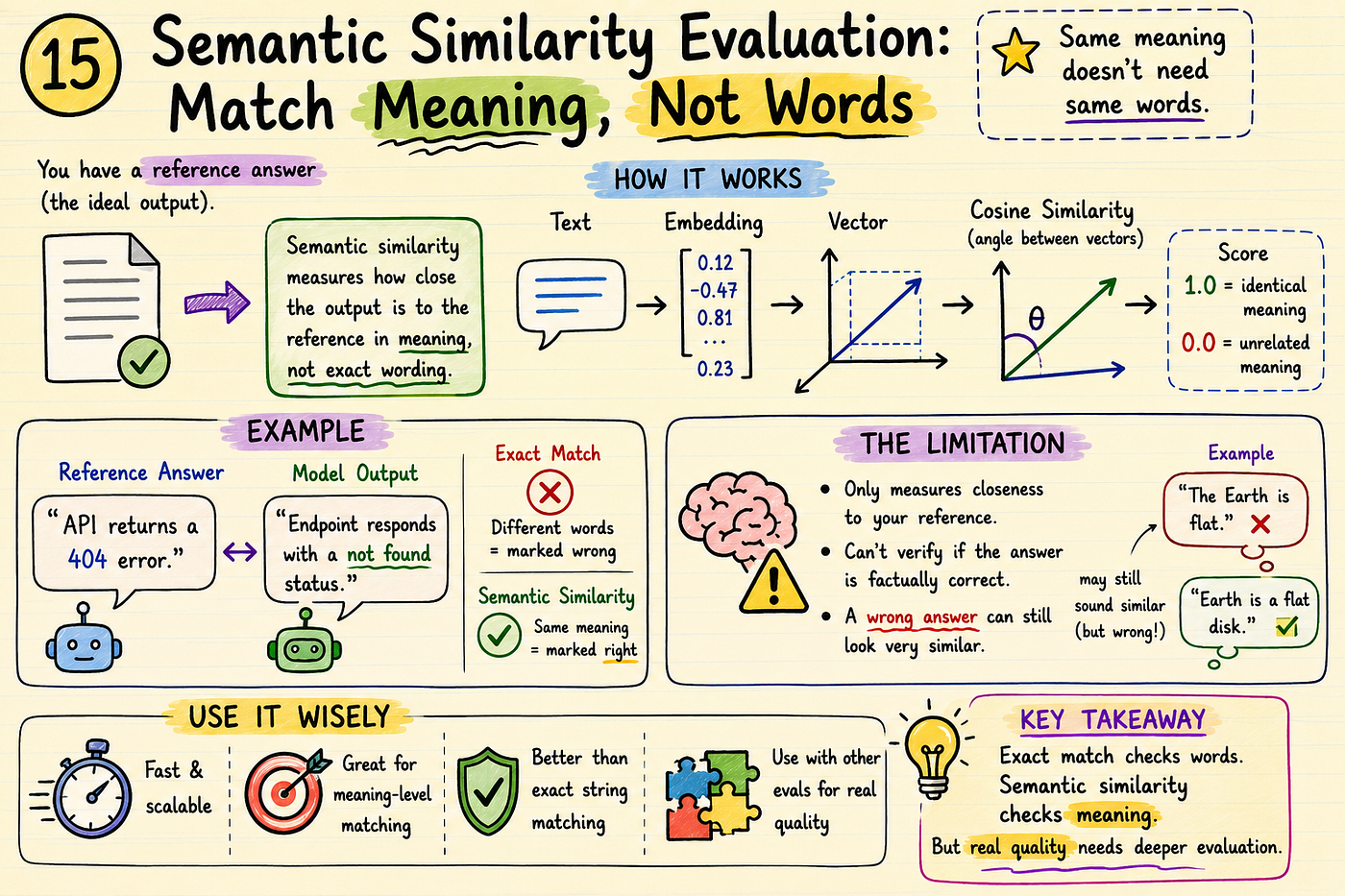
For example:
“API returns a 404 error.”
And:
“The endpoint responds with a not found status.”
These two sentences use different words, but they mean almost the same thing. A strict string match may mark the second answer as wrong. Semantic similarity would understand that the meaning is very close. This is where embeddings help. An embedding turns text into a vector, which is basically a list of numbers that represents the meaning of that text. Texts with similar meanings have vectors that sit close together. Texts with different meanings sit farther apart. Then we use something like cosine similarity to measure how close two vectors are.
A score close to 1.0 means the meanings are very similar.
A score close to 0 means they are mostly unrelated.
This makes semantic similarity fast, scalable, and useful for many eval tasks. But it has a limitation. It only checks how close the model output is to your reference answer. It does not truly understand whether the answer is factually correct, safe, complete, or helpful. A wrong answer can still sound very similar to the reference. A fluent answer can still hide an important mistake. So semantic similarity is useful, but it should not be your only evaluation method. Use it as a fast layer. Use it to catch meaning-level matches better than exact string comparison.
But combine it with rubrics, human review, LLM judges, and code-based checks when quality really matters.
The key idea is simple:
Exact match checks the words. Semantic similarity checks the meaning. But real quality still needs deeper evaluation.
16. Task-Specific Metrics: BLEU, ROUGE, and Execution Checks
Some LLM tasks have well-known metrics built for automated evaluation. These metrics are useful when the task has a clear reference answer or a clear success condition.
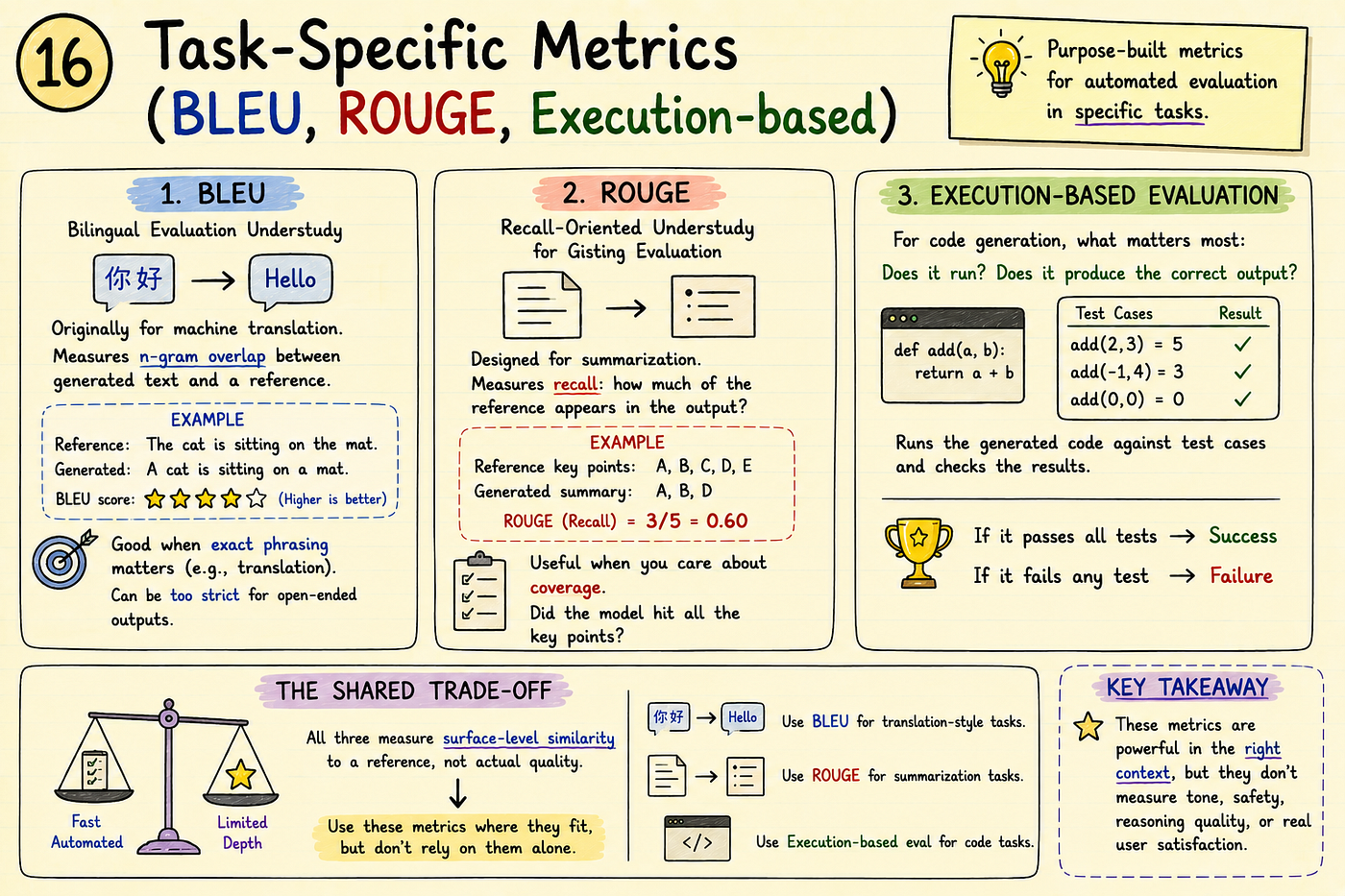
BLEU
BLEU stands for Bilingual Evaluation Understudy. It was originally created for machine translation. In simple words, BLEU checks how much the generated text overlaps with a reference answer. It looks at matching word patterns, also called n-grams. BLEU is useful when exact wording matters. For example, in translation, you may want the output to stay close to a known correct translation. But BLEU can be too strict for open-ended LLM outputs. Two answers can mean the same thing but use different words, and BLEU may still score them poorly.
ROUGE
ROUGE stands for Recall-Oriented Understudy for Gisting Evaluation. It is commonly used for summarization. ROUGE checks how much of the reference answer appears in the model output. So if your reference summary includes five important points, ROUGE helps measure whether the model covered those points. This is useful when coverage matters.
For example:
- Did the summary include the key facts?
- Did it miss an important detail?
- Did it capture the main ideas?
But again, ROUGE mostly checks overlap. It does not fully understand whether the summary is actually useful, well-written, or safe.
Execution-Based Evaluation
For code generation, there is a much stronger evaluation method:
Run the code. If the model writes a function, test it with real test cases.
- Does it compile?
- Does it run?
- Does it return the correct output?
- Does it pass the hidden tests?
This is called execution-based evaluation. And for coding tasks, it is often more useful than text similarity. Because code can look different but still solve the same problem. One function may use a loop. Another may use recursion. Another may use a built-in method. If all of them pass the same tests, they may all be acceptable. That is why execution-based eval is powerful. It checks behavior, not just wording. But these task-specific metrics all have the same warning: They only work well when they match the task. BLEU is useful for translation-style comparison. ROUGE is useful for summary coverage. Execution-based eval is useful for code behavior. But none of them measure the full quality of an LLM response.
They may miss tone, helpfulness, safety, reasoning quality, and real user satisfaction. So use these metrics where they fit. Just do not pretend they tell the whole story.
17. LLM-as-a-Judge: Scalable Quality Review
LLM-as-a-judge is what makes evaluation scalable. Instead of asking a human to review every output, you use a stronger model to score your application’s response.
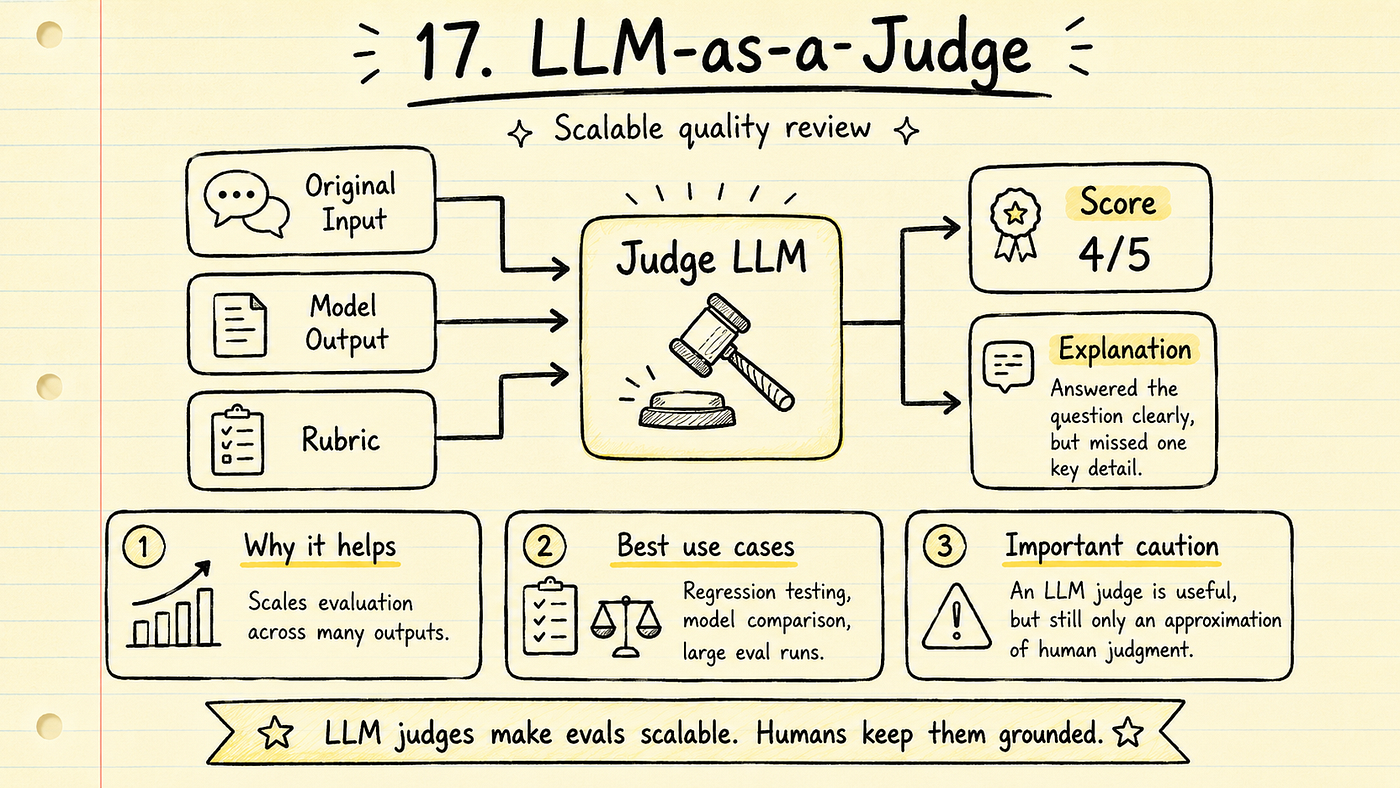
You usually give the judge three things:
- The original user input.
- The output you want to evaluate.
- The rubric you want it to follow.
Then the judge returns a score and a short explanation. Think of it like automated testing, but for output quality. Nobody manually clicks through 10,000 user flows every time they change code. We automate those checks. LLM-as-a-judge does something similar for LLM quality. It lets you run your rubric across hundreds or thousands of outputs without needing hundreds or thousands of human reviews.
This is useful for things like:
- Prompt regression testing.
- Comparing model versions.
- Checking output quality at scale.
- Finding weak examples in your golden set.
You do not need custom training for this. You simply call a capable model through an API and ask it to evaluate the output using your rubric.
But there is one big warning:
LLM judges can be wrong too.
- They can miss subtle issues.
- They can be biased.
- They can overrate fluent answers.
- They can disagree with human reviewers.
So treat LLM-as-a-judge as an approximation of human judgment, not a perfect replacement. It is powerful. It is scalable. But it still needs validation. Use human evaluation to check whether your LLM judge is actually judging well.
The key idea is simple:
LLM judges help you scale evaluation, but humans still keep the system grounded.
18. Pointwise vs Pairwise Evaluation: Score One or Compare Two
There are two common ways to use an LLM judge. The first is pointwise evaluation.
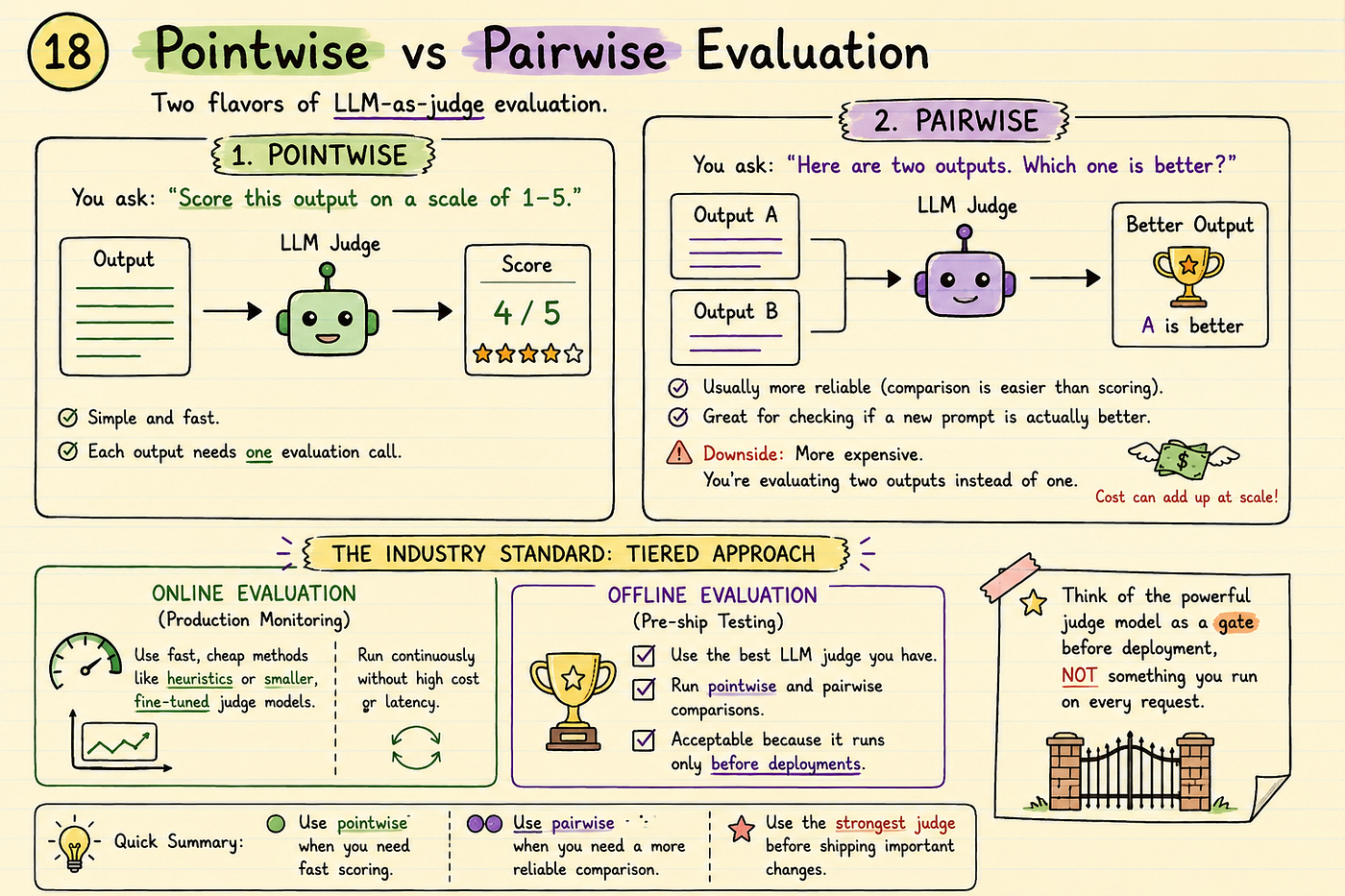
You give the judge one output and ask:
“Score this response from 1 to 5 using this rubric.”
This is simple, fast, and easy to scale. One output usually needs one judge call. The second is pairwise evaluation.
You give the judge two outputs and ask:
“Which response is better, A or B?”
This is often more reliable because comparison is easier than scoring. It is especially useful when you want to know whether a new prompt is actually better than the old one. But pairwise evaluation costs more. You are comparing two outputs instead of scoring one. At small scale, this is fine. At production scale, it can become expensive quickly. That is why many teams use a tiered approach.
For online evaluation, where you monitor production continuously, use fast and cheaper methods like heuristics, lightweight judges, or smaller models.
For offline evaluation, before shipping a prompt or model change, use your strongest judge model and run deeper pointwise or pairwise comparisons.
Think of the powerful judge as a gate before deployment. Not something you run on every user request.
The simple rule is:
Use pointwise when you need fast scoring. Use pairwise when you need a more reliable comparison. Use the strongest judge before shipping important changes.
19. Judge Calibration: Check If Your AI Judge Agrees With Humans
Before you rely on an LLM judge, you need to answer one important question: Does this judge score outputs the same way humans would? That is what judge calibration means.
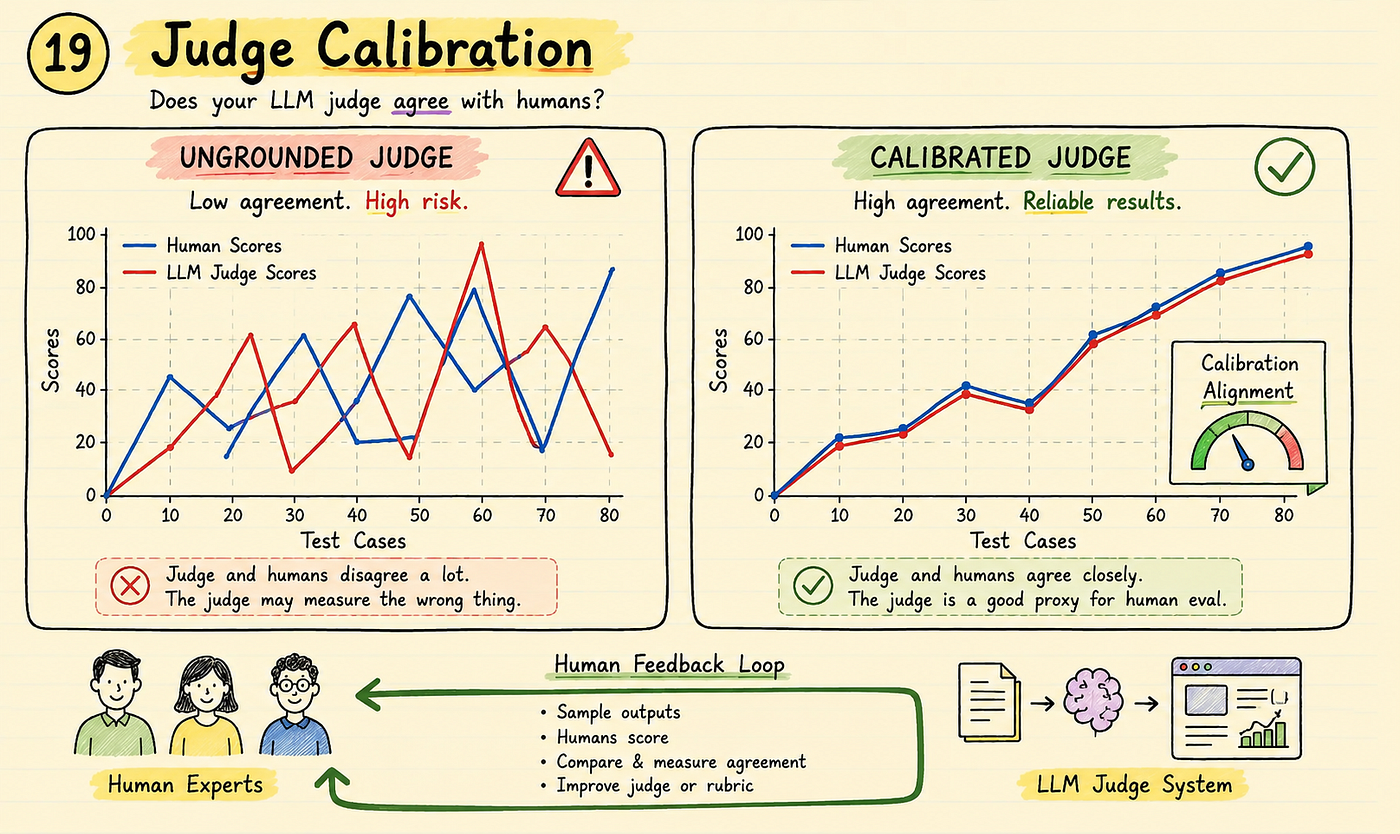
You take a sample of model outputs. Then you ask human reviewers to score them using your rubric. After that, you ask the LLM judge to score the same outputs using the same rubric. Now compare both results. If humans and the judge usually agree, your judge is a good proxy for human evaluation. If they often disagree, the judge may be measuring the wrong thing. This matters because an uncalibrated judge can be dangerous. It may give high scores to outputs humans would reject. It may punish outputs humans would accept. It may make your eval dashboard look confident while the actual product quality is weak.
That is how teams end up trusting the wrong signal. So before using an LLM judge at scale, calibrate it against human review. And do not do this only once.
Recalibrate periodically, especially when you change:
- The judge model.
- The judge prompt.
- The rubric.
- The product behavior.
- The type of user inputs.
A judge is useful only if it stays aligned with the quality your team actually cares about.
The key idea is simple:
Do not just evaluate your model. Evaluate your evaluator too.
💠 RAG System Evaluation
Many LLM apps do not answer from the prompt alone. They use RAG, which means the system first retrieves relevant documents, adds them to the context, and then asks the model to generate an answer from that information. This makes evaluation more complex. Now you are not only checking the final answer. You also need to check whether the system found the right documents, whether those documents were useful, and whether the model stayed faithful to them. So RAG evaluation has its own set of concepts.
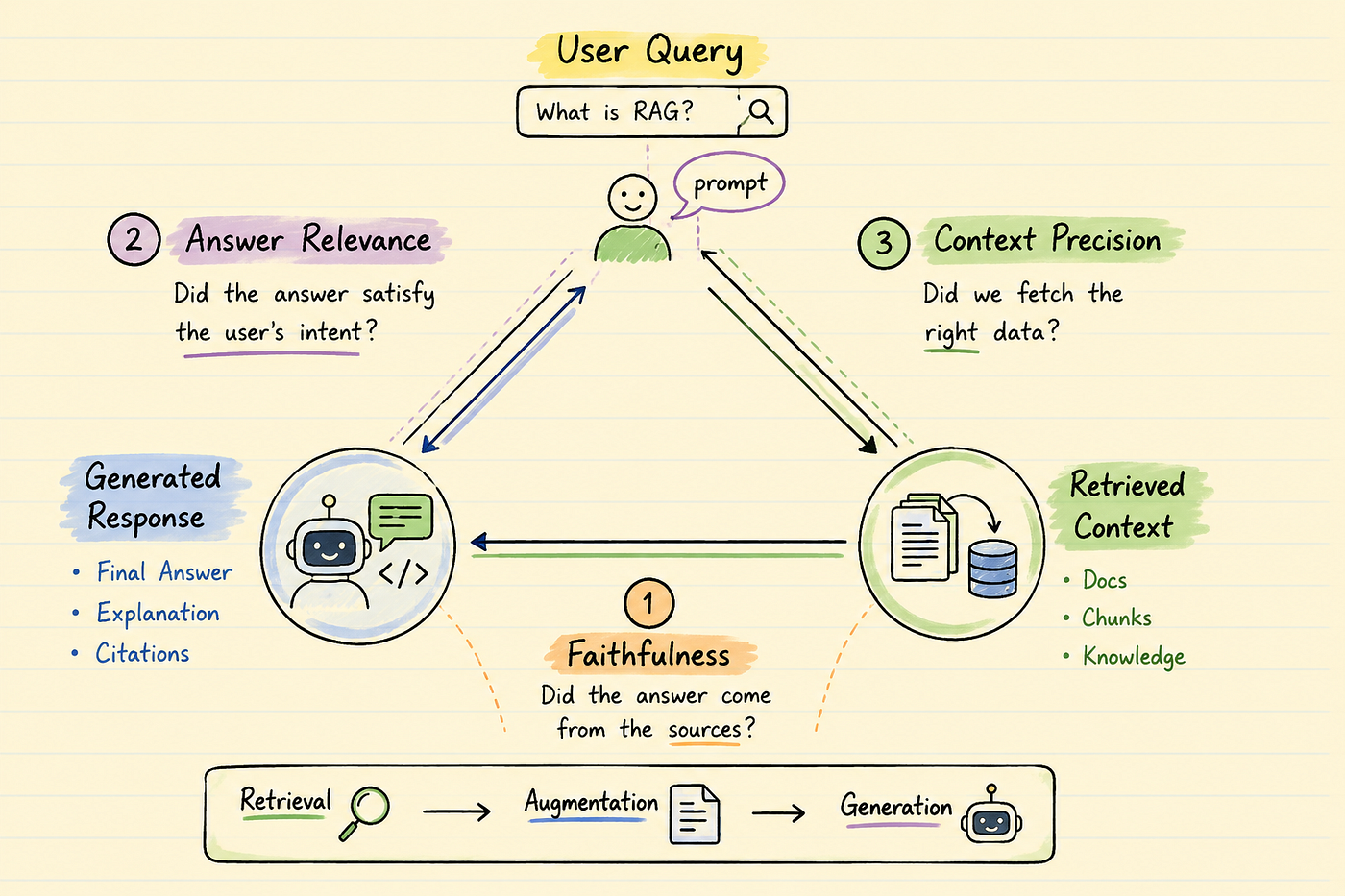
Let’s break them down one by one.
20. RAG Triad: Three Ways a RAG System Can Fail
A RAG system has more moving parts than a normal LLM call.
- It retrieves documents.
- It adds them to the context.
- Then it generates an answer.
Because of this, RAG evaluation usually focuses on three main dimensions. This is often called the RAG triad.
1. Faithfulness
Faithfulness asks:
Did the answer actually come from the retrieved context?
This is important because even if your system retrieves the right documents, the model can still ignore them.
- It may answer from memory.
- It may guess.
- It may add unsupported details.
That is a faithfulness problem. A faithfulness failure looks like a confident answer that is not supported by the provided sources.
In simple words:
It is hallucination with extra steps.
2. Answer Relevance
Answer relevance asks:
Did the response actually answer the user’s question?
A response can be faithful to the retrieved context and still miss the user’s intent. For example, the model may use the right document, but answer a different question. Faithfulness checks whether the answer stayed inside the context. Answer relevance checks whether the answer was useful for the actual user request. Both are different. And both matter.
3. Context Precision
Context precision asks:
Did the retrieval step fetch the right documents?
This checks the quality of the retrieved context. Because even a great model will struggle if you give it weak, noisy, or loosely related documents. If retrieval brings the wrong context, the model may guess. Or it may say it does not know. Or worse, it may build a polished answer from bad evidence. Context precision helps you understand whether your retrieval system is doing its job.
So the RAG triad gives you three questions:
- Did we retrieve the right context?
- Did the model use that context faithfully?
- Did the final answer actually help the user?
Think of it like an observability layer for RAG. If the answer is bad, the triad helps you find where the problem happened.
- Was retrieval weak?
- Was the context good but the model ignored it?
- Was the answer grounded but not relevant?
Once you know where the failure happened, you know what to fix. That is why the RAG triad is one of the most useful mental models in RAG evaluation.
21. RAG Failure Patterns: Where the Pipeline Breaks
Understanding the RAG triad is one thing. Spotting the failure in a real system is another. When a RAG answer is bad, the problem usually comes from one of three places.
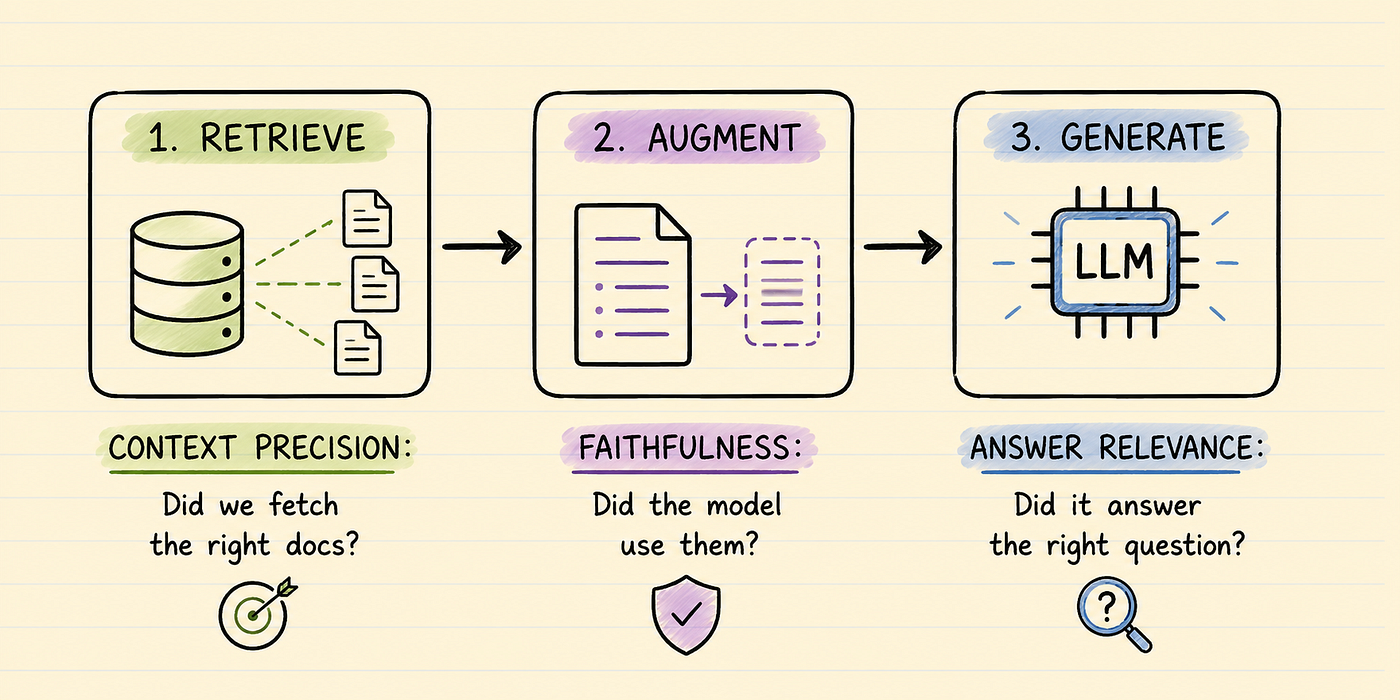
1. Retrieval returns irrelevant chunks
This is a context precision failure. The system searches your knowledge base, but retrieves the wrong documents or loosely related chunks. Now the model has poor context. So it either guesses and hallucinates… or says it does not have enough information. This problem is usually not fixed by changing the final answer prompt. The fix is in the retrieval layer. You may need better embeddings, better chunking, better metadata filters, or a re-ranker.
2. Retrieval is correct, but the model ignores it
This is a faithfulness failure. The right documents were retrieved. But the model does not properly use them.
- It may answer from memory.
- It may add unsupported details.
- It may make claims that are not present in the sources.
This usually means your prompt is not grounding the model strongly enough. The fix is to make the model rely on the provided context. For example, you can instruct it to answer only from the retrieved sources, cite the evidence, and say “I don’t know” when the context is not enough.
3. The answer is grounded but still does not help
This is an answer relevance failure. The answer may be technically correct. It may even be supported by the retrieved documents. But it still does not solve the user’s real problem. This often means the knowledge base itself is missing the right information. In that case, prompt tweaking will not help much. You need better content. Add missing docs. Improve outdated articles. Rewrite confusing knowledge base pages. Cover the real questions users are asking.
That is the important lesson:
- Not every RAG failure is a model problem.
- Sometimes the retriever is weak.
- Sometimes the prompt is weak.
- Sometimes the data is weak.
Good RAG evaluation helps you find which part failed, so you fix the right thing.
💠 Offline vs Online Evaluation
Scoring one output is only one part of the story. The bigger challenge is building an eval system that catches failures before and after deployment.
That is why LLM evaluation usually happens in two places:
- Offline evaluation, before you ship a change.
- Online evaluation, after real users start using it.
Both matter, but they solve different problems.
22. Offline Evaluation: Test Before You Ship
Offline evaluation happens before your change reaches users.
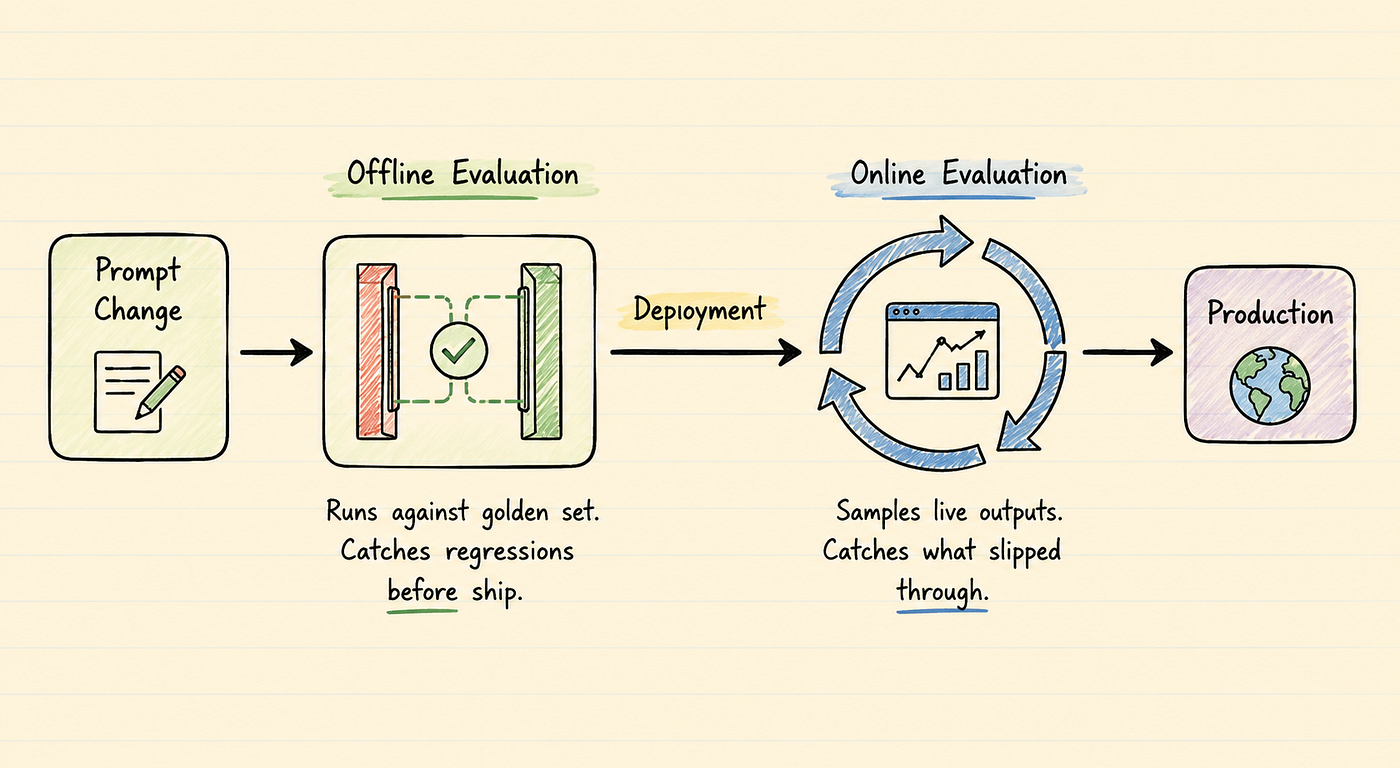
You change something:
- A prompt.
- A model version.
- A retrieval strategy.
- A system instruction.
Before shipping it, you run the new version against your golden set. Then you score the outputs and compare them with your current system. Think of this like CI for LLM quality. In normal software, a code change should not go live if it breaks important tests. In LLM apps, a prompt or model change should not go live if it lowers answer quality. Offline evaluation helps you catch regressions before users see them. This is also where you can use your strongest judge model. Cost matters less here because you are only testing a fixed set of examples. You are not running the expensive judge on every user request. So offline evaluation is your pre-deployment safety gate. If the new version performs better, ship it. If quality drops, fix it before production.
23. Online Evaluation: Monitor Real Users in Production
Online evaluation happens after your LLM feature is live. Instead of testing only on your golden set, you sample real production outputs and score them continuously. The goal is to catch problems that offline evals miss. Because real users bring messy inputs, strange phrasing, edge cases, and unexpected use cases. Think of online evaluation as your monitoring system for LLM quality. It helps you notice issues before users complain.
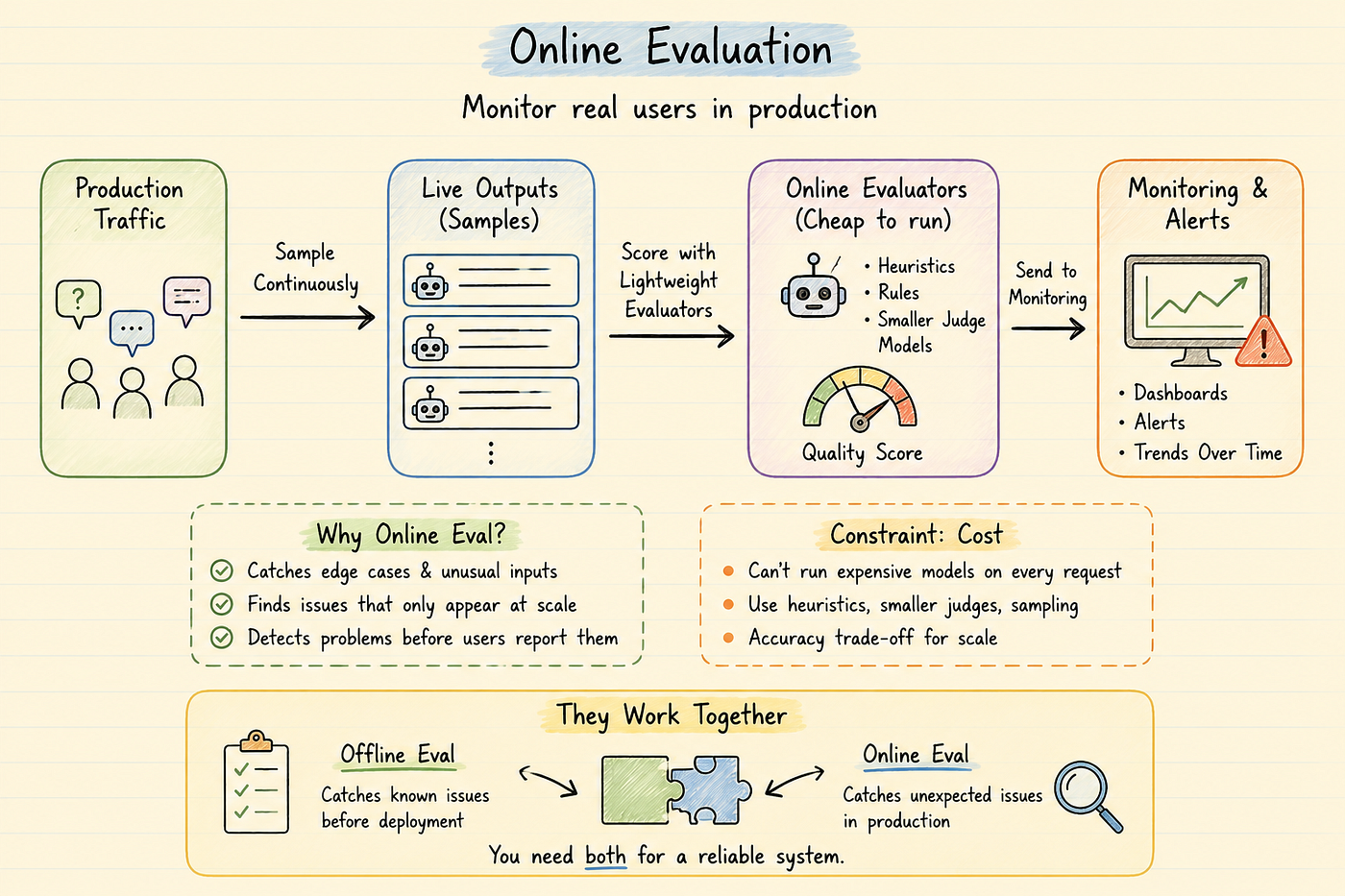
But there is one big constraint:
Cost.
You usually cannot run your most expensive judge model on every production request.
So online evaluation often uses cheaper methods:
- Heuristics.
- Smaller judge models.
- Lightweight safety checks.
- Sampling instead of scoring everything.
This means online eval trades some accuracy for scale. And that is okay. Offline and online evaluation should work together. Offline eval catches known issues before deployment. Online eval catches unexpected issues in production. You need both to build a reliable LLM system.
24. Prompt Versioning: Treat Prompts Like Code
Your prompt is not just text. It is part of your application logic. So treat it like code. Every prompt change should be tracked, versioned, and tested.
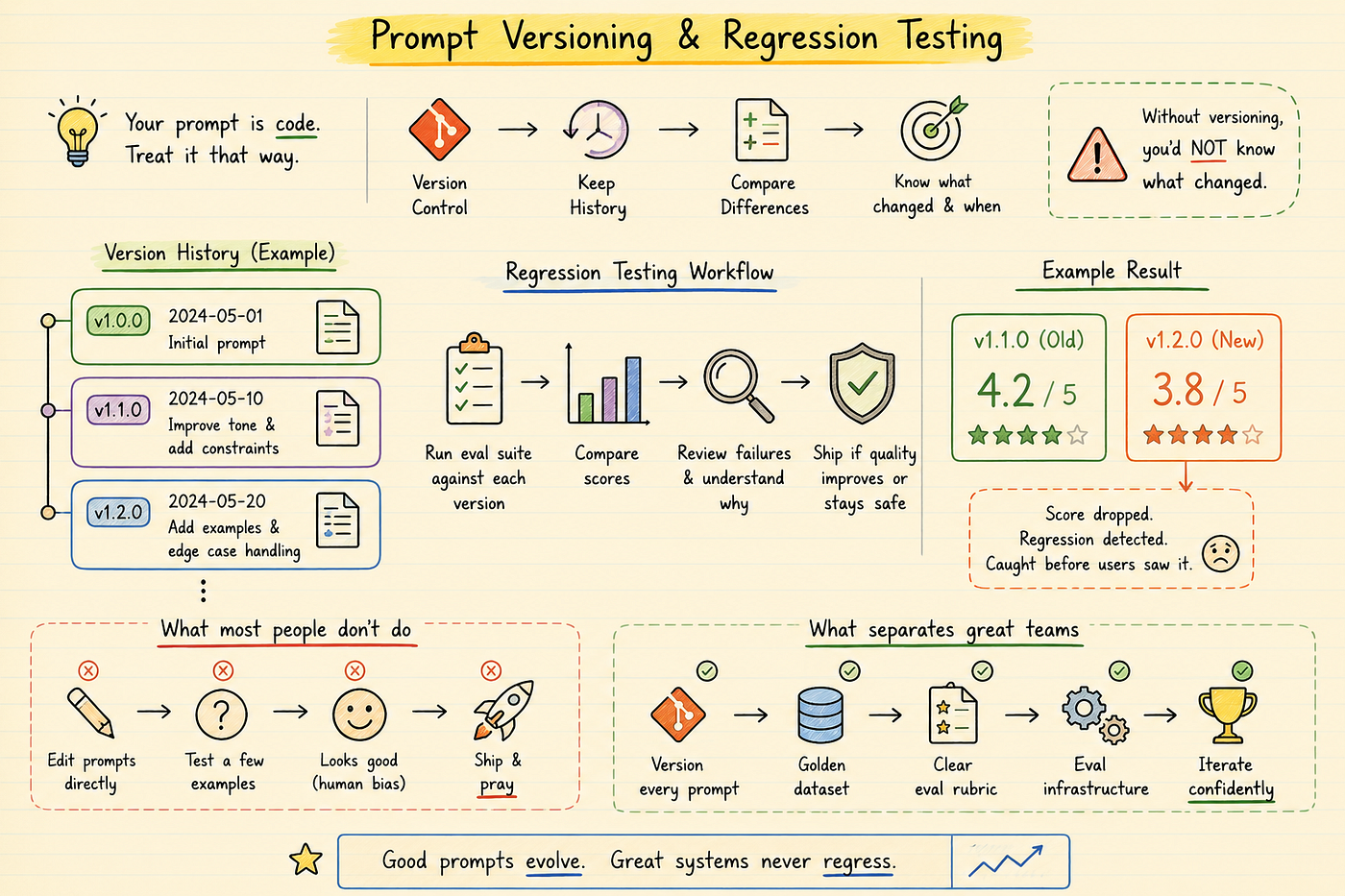
If a prompt update breaks something, you should be able to answer:
- What changed?
- Who changed it?
- When did it change?
- Why was it changed?
Without versioning, prompt debugging becomes guesswork. You may know the output became worse, but you will not know which change caused it. That is where regression testing comes in. Regression testing means running your eval suite against every important prompt version.
For example:
- Old prompt score:
4.2 / 5 - New prompt score:
3.8 / 5
That drop tells you something important:
The new prompt introduced a regression. And because you tested before deployment, users never had to suffer from it. This sounds obvious, but many teams skip it.
- They edit prompts directly.
- They test a few examples manually.
- They feel good.
- They ship.
That is risky.
A better workflow looks like this:
- Version the prompt.
- Run it against the golden set.
- Compare the scores.
- Review the failures.
- Ship only if quality improves or stays safe.
This is what separates confident iteration from “ship and pray.” If prompts affect production behavior, they deserve the same discipline as code.
25. Benchmark Evaluation: Useful, but Not the Whole Truth
Benchmarks are standard tests used to compare LLMs.
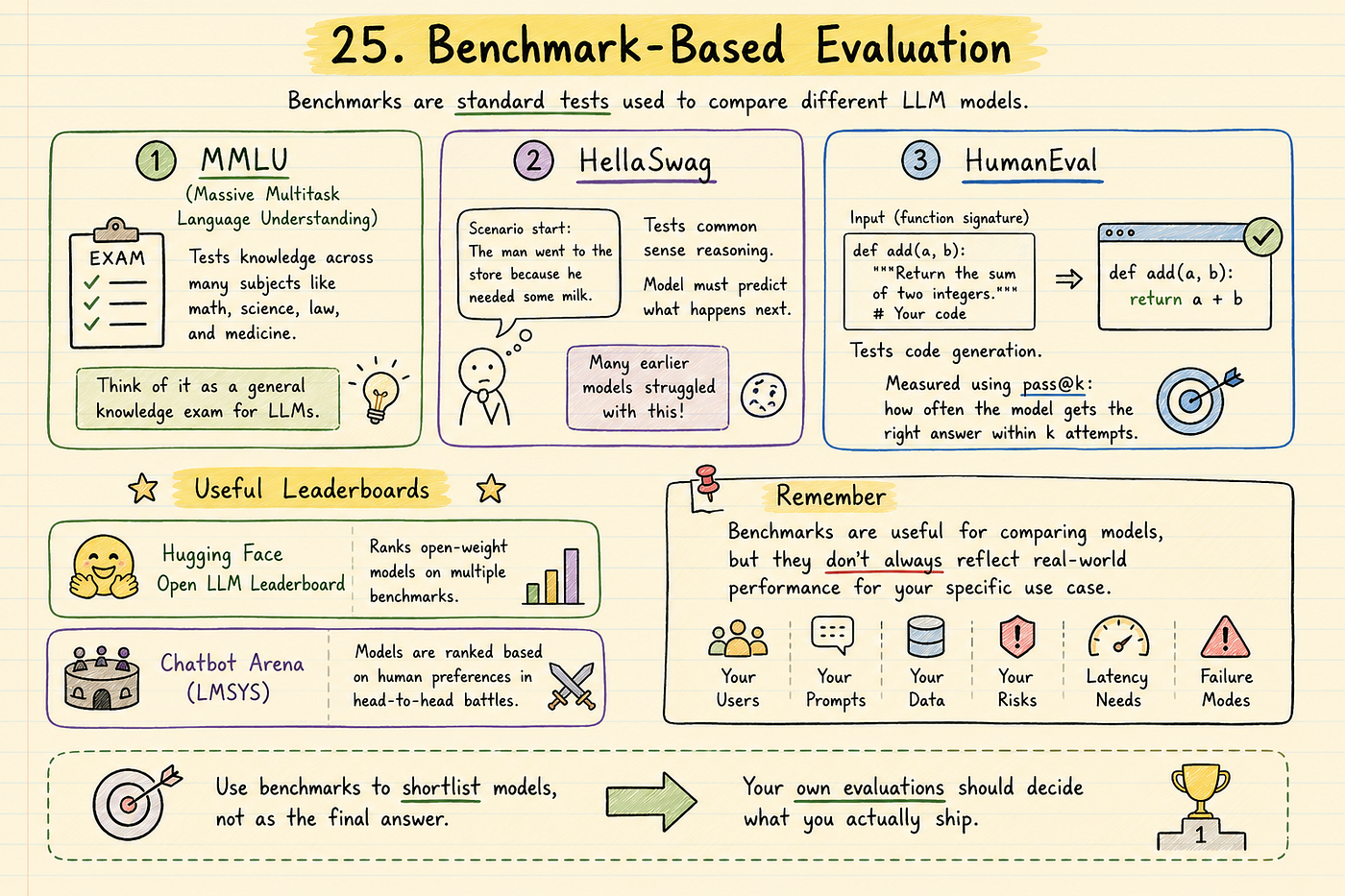
They help answer questions like:
- Which model is better at reasoning?
- Which model knows more general facts?
- Which model writes better code?
- Which model performs better across many tasks?
Here are a few common benchmarks you will hear about.
1. MMLU
MMLU stands for Massive Multitask Language Understanding. Think of it like a big general knowledge exam for LLMs. It tests many subjects, such as math, science, law, medicine, history, and more. A high MMLU score usually means the model has strong broad knowledge.
2. HellaSwag
HellaSwag tests common sense reasoning. The model is given the beginning of a scenario and must choose what is most likely to happen next. This is useful because language models can sound smart but still fail at basic real-world reasoning.
3. HumanEval
HumanEval tests code generation. The model receives a function signature and needs to write the correct implementation. The result is usually measured using pass@k.
That means:
How often does the model produce a correct answer within k attempts? For coding models, HumanEval is a useful signal. There are also public leaderboards that compare models.
Two popular examples are:
- Hugging Face Open LLM Leaderboard for open-weight models.
- Chatbot Arena for ranking models based on human preferences.
These benchmarks are useful. They help you compare models before choosing one.
But they have a big limitation:
A benchmark score does not automatically tell you how well the model will perform in your product. Your app has its own users, prompts, data, risks, tone, latency needs, and failure modes. A model can perform well on a public benchmark and still fail badly in your specific workflow. So use benchmarks as a starting point. Not as the final answer. They can help you shortlist models. But your own evals should decide what you actually ship.
26. Benchmark vs Real-World Tradeoff: Your Use Case Wins
Benchmarks are useful, but they do not tell you everything. A model that scores high on MMLU might still struggle with your domain-specific language. A model that performs well on HumanEval might still generate code that does not match your team’s style, architecture, or security standards. That is because benchmarks measure general capability. But your application needs specific capability.
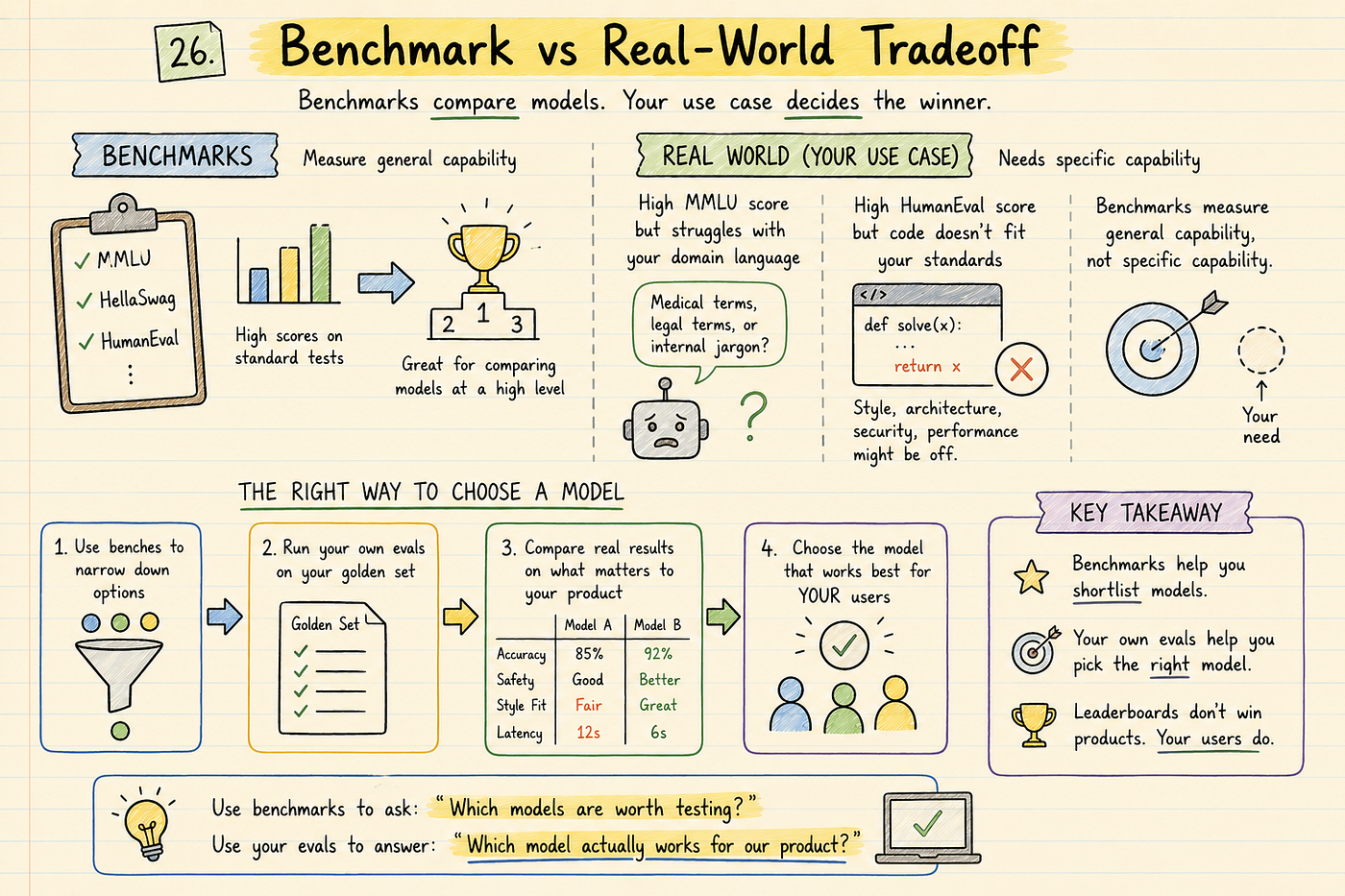
- Your users have their own language.
- Your product has its own workflows.
- Your data has its own messy patterns.
- Your business has its own risks.
So do not choose a model only because it looks good on a leaderboard. Use benchmarks to narrow down your options. Then run your own evaluation on your own golden set. That is what should decide the final model.
Benchmarks help you ask:
“Which models are worth testing?”
Your own evals answer:
“Which model actually works for our product?”
27. Dataset Contamination: When Benchmarks Are Already in the Model’s Memory
There is one benchmark problem many engineers forget:
What if the model has already seen the test?
That is called dataset contamination or data leakage. It happens when evaluation data overlaps with the data used to train the model.
In simple words:
The model may not be solving the problem. It may be remembering the answer. This is risky because the benchmark score can look impressive, but the real capability may be weaker than it appears. For example, if a coding benchmark is publicly available online, and the model saw those problems during training, then a high score may not fully prove coding skill.
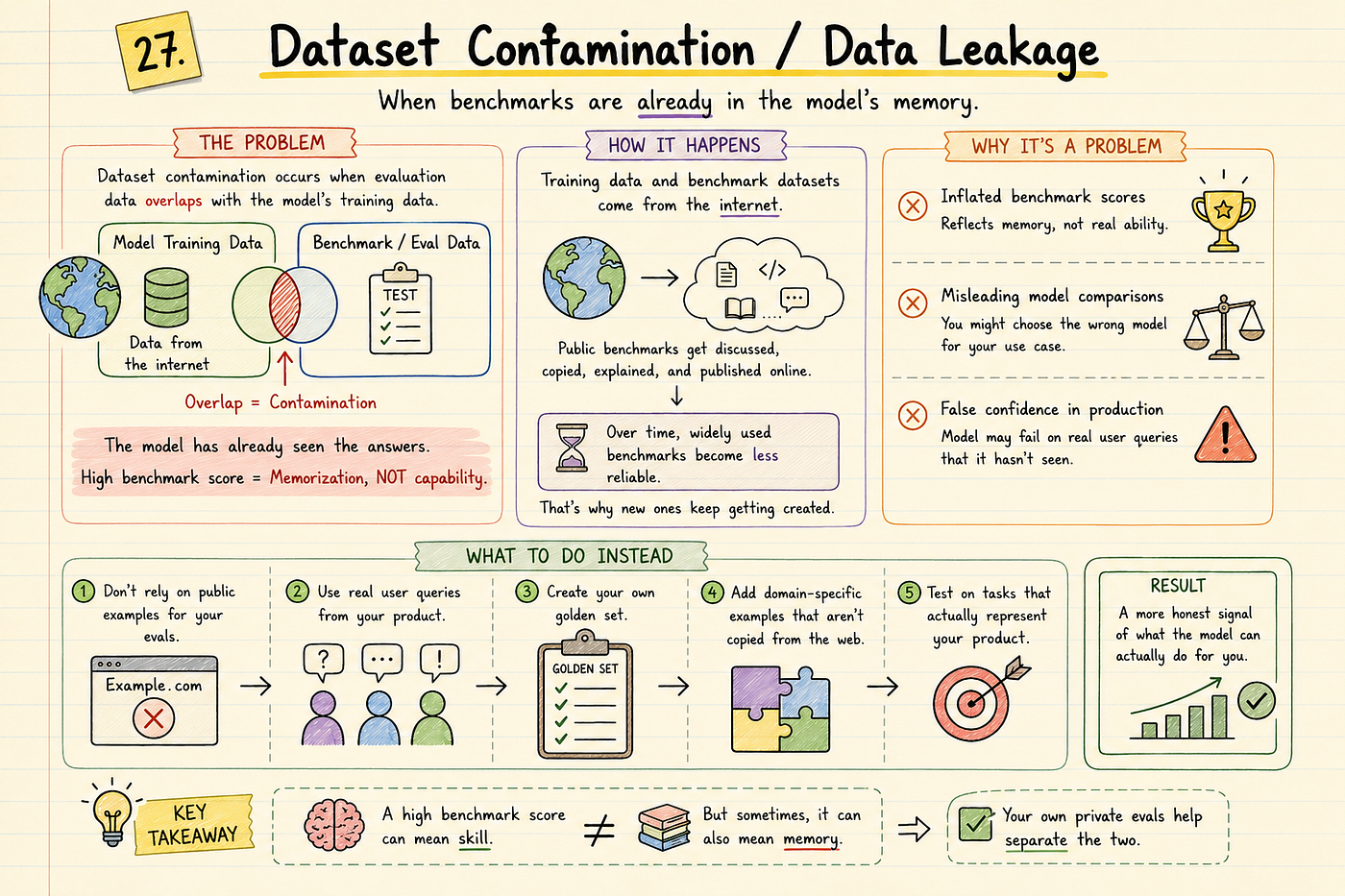
It may partly reflect memorization. This happens because both training data and benchmark data often come from the internet. And once a benchmark becomes popular, people discuss it, copy it, explain it, and publish solutions everywhere. Over time, the benchmark becomes easier for models to accidentally “know.” That is why old public benchmarks become less reliable. And that is also why new benchmarks keep getting created.
So what should engineers do?
Do not rely only on public benchmark examples. Use them to understand general model capability, but not as your final trust signal. For your own product, build private eval datasets. Use real user queries. Create your own golden set. Add domain-specific examples that are not copied from public benchmark data. This gives you a more honest signal. Because your model is now being tested on tasks that actually represent your product, not questions it may have already seen online.
The key idea is simple:
A high benchmark score can mean skill. But sometimes, it can also mean memory. Your own private evals help separate the two.
Failure Modes: What Not to Do
Even with the right tools, you can still build a bad eval system. A weak rubric, a tiny golden set, an uncalibrated judge, or blind trust in benchmark scores can make your results look scientific while still being wrong. So before we finish, let’s look at the common mistakes engineers make when evaluating LLM systems. These are the traps to avoid.
28. Eval Anti-Patterns: Mistakes That Create False Confidence
Even smart teams can build bad eval systems. The danger is that bad evals often look official.
- They have scores.
- They have dashboards.
- They have charts.
- They feel scientific.
But if the setup is weak, the confidence is fake. Here are the common eval anti-patterns to avoid.
1. Vibe-Based Evaluation
This is the classic mistake:
“I tried it a few times, and it looked good.”
Almost every LLM project starts here. And that is okay at the beginning. Manual testing helps you understand the product quickly. But vibes are not an eval system. Trying five prompts manually will not catch edge cases. It will not show performance over time. It will not tell you whether the new prompt is better than the old one. It will not scale beyond one person staring at outputs. Vibes can give you a first impression. But they cannot give you reliable measurement.
2. The Single-Sample Trap
Another common mistake is running the eval once and trusting the number. You run your golden set. You get a score. You report it. You ship. But LLM results can be noisy. A bad prompt might look good on one lucky run. A good prompt might look bad on one unlucky sample. So do not trust one result too much. Run multiple samples. Compare averages. Report variance. Look at the spread, not just the final score. A single score gives you a hint. Repeated evaluation gives you evidence.
3. Goodhart’s Law in Disguise
There is a famous idea called Goodhart’s Law:
“When a measure becomes a target, it stops being a good measure.”
This is very real in LLM evaluation. If you optimize too hard for one metric, the model may learn to satisfy the metric while hurting the actual user experience. Reward confidence, and you may get confident hallucinations. Reward length, and you may get long but low-quality answers. Reward keyword overlap, and you may get outputs that mention the right words but miss the real meaning. Metrics are proxies. They are not the final goal. The final goal is a useful, safe, reliable product. So use metrics carefully. Do not worship them blindly.
4. Eval-Production Mismatch
Your eval set may reflect what your team expects. But production reflects what users actually do. And users are messy.
- They ask vague questions.
- They use strange wording.
- They give incomplete context.
- They misuse features.
- They combine multiple tasks in one request.
If your golden set does not reflect real usage, your eval scores can become misleading. A high pass rate on unrealistic test cases does not mean your product is ready. It only means your product is good at your test cases. That is why production traffic should keep improving your golden set over time.
5. Ignoring Tail Failures
A 92% pass rate sounds good. But what about the remaining 8%? In normal software, some failures are small. In LLM systems, failures can be serious. One unsafe answer can damage trust. One wrong medical, legal, or financial response can create real risk. One hallucinated fact can make the whole product feel unreliable.
So do not only look at averages. Review the worst outputs. Study the failures. Ask what kind of mistakes are hiding inside that 8%. Because the worst outputs usually teach you the most. A good eval system does not just celebrate high scores. It investigates failures deeply. That is how you improve the system instead of just admiring the dashboard.
Decision Framework
There is no single tool that solves LLM evaluation.
A good eval system is layered. Each layer catches a different type of failure.
Heuristics catch format issues. Semantic checks catch meaning-level mismatch. LLM judges scale quality review. Human evaluation keeps everything grounded. Offline eval blocks bad changes before shipping. Online eval catches what real users reveal later. The goal is not to find one perfect metric. The goal is to build enough layers that the system becomes hard to fool.
29. Eval Stack: A Layered System for Reliable LLM Apps
There is no single evaluation method that catches everything. The best approach is to build an eval stack. Each layer catches a different kind of failure.
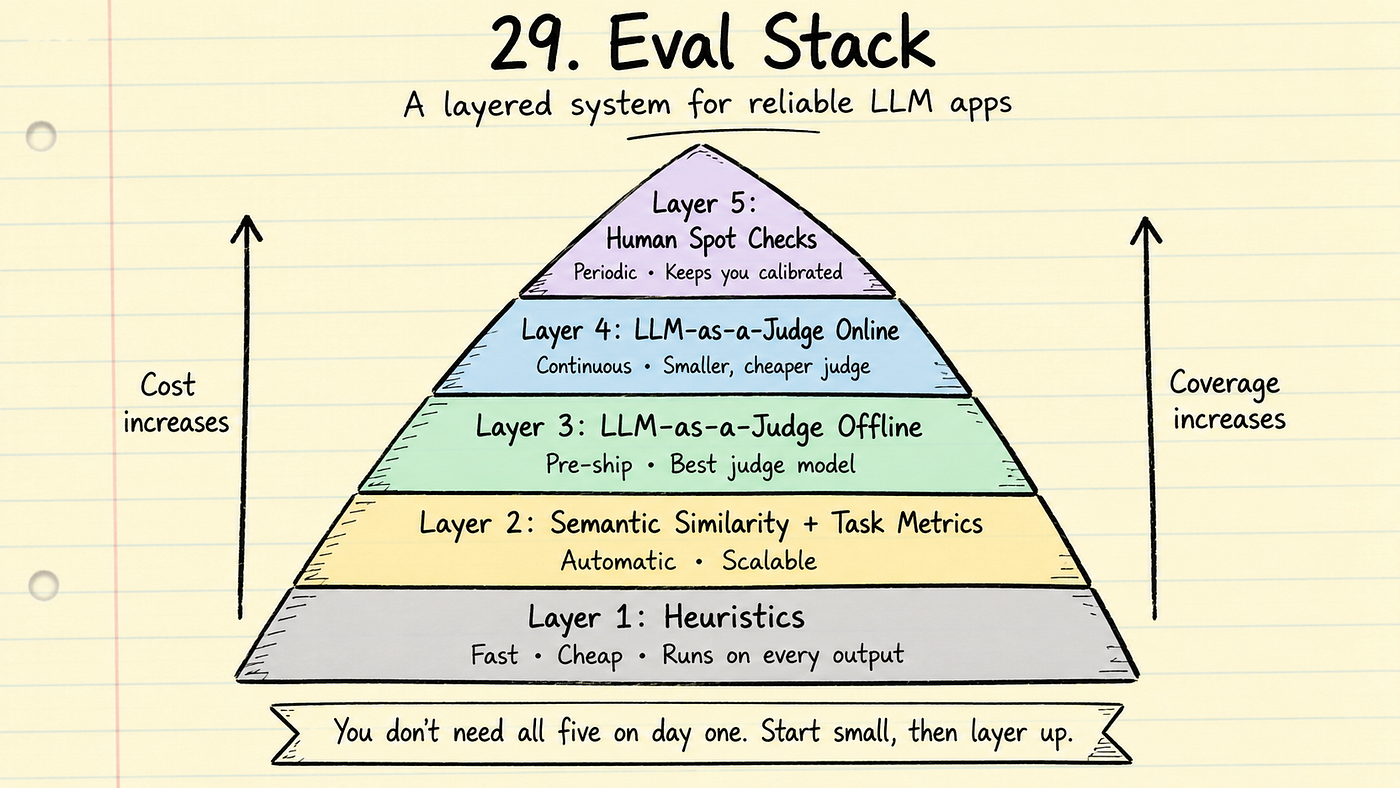
Layer 1: Heuristics
These are fast, deterministic, and cheap. They can run on every output.
Use them to catch structural issues like:
- Invalid format
- Missing fields
- Too many characters
- Banned phrases
- Invalid JSON
Heuristics are your first line of defense.
Layer 2: Semantic Similarity and Task-Specific Metrics
These run automatically against reference answers. They help catch meaning-level failures without using an expensive LLM judge.
For example:
- Semantic similarity checks meaning.
- ROUGE checks summary coverage.
- BLEU checks phrasing overlap.
- Execution-based eval checks whether code actually runs.
This layer is useful, but it still does not measure full quality.
Layer 3: LLM-as-a-Judge Offline
This runs before deployment. Use your best judge model here. Run it against your golden set before shipping a new prompt, model, or retrieval change.
Its job is simple:
Catch quality regressions before users see them.
Layer 4: LLM-as-a-Judge Online
This runs in production on sampled live outputs. Because cost matters in production, use a smaller or cheaper judge model. This layer helps catch failures that offline evals missed. Real users always find weird edge cases. Online eval helps you notice those patterns earlier.
Layer 5: Human Spot Checks
Humans should not score everything. But they should stay in the loop.
Use human review periodically to:
- Calibrate your LLM judge
- Validate automated scores
- Review confusing failures
- Add new failure cases to the golden set
This keeps your eval system grounded. Each layer has a different cost and catches a different type of problem. Eventually, a mature LLM product should have all five. But you do not need everything on day one. If you are starting from scratch, build a simple MVP eval system.
Step 1: Build a Golden Set of 50 Examples
Start with 50 strong examples. Do not write all of them from imagination. Use real user queries if you have them. If not, create:
- 30 normal representative examples
- 20 edge cases
Include common cases, strange phrasing, incomplete inputs, adversarial prompts, and anything users are likely to try. This golden set becomes the foundation of your evaluation system.
Step 2: Add One Deterministic Heuristic
Pick the most important structural rule for your product. Maybe the output must be valid JSON. Maybe it must stay under 200 words. Maybe it must include a required field. Maybe it must avoid certain phrases. Write one simple code check for that. This is quick to build and catches more failures than most people expect.
Step 3: Add One LLM Judge Prompt
Take your rubric and turn it into a judge prompt. Then use a strong model to score outputs on one important quality dimension. Run it on your golden set. Read the scores. Read the explanations. You will almost always find something surprising. That surprise is the point. It shows you where your system is weaker than you thought.
That is your MVP eval system:
- A golden set.
- One heuristic.
- One judge prompt.
Everything else can build on top of it later:
- Pairwise comparison
- Online monitoring
- RAG evaluation
- Regression testing
- Judge calibration
- Human review workflows
Start small. But start with structure. Because even a simple eval stack is better than shipping on vibes.
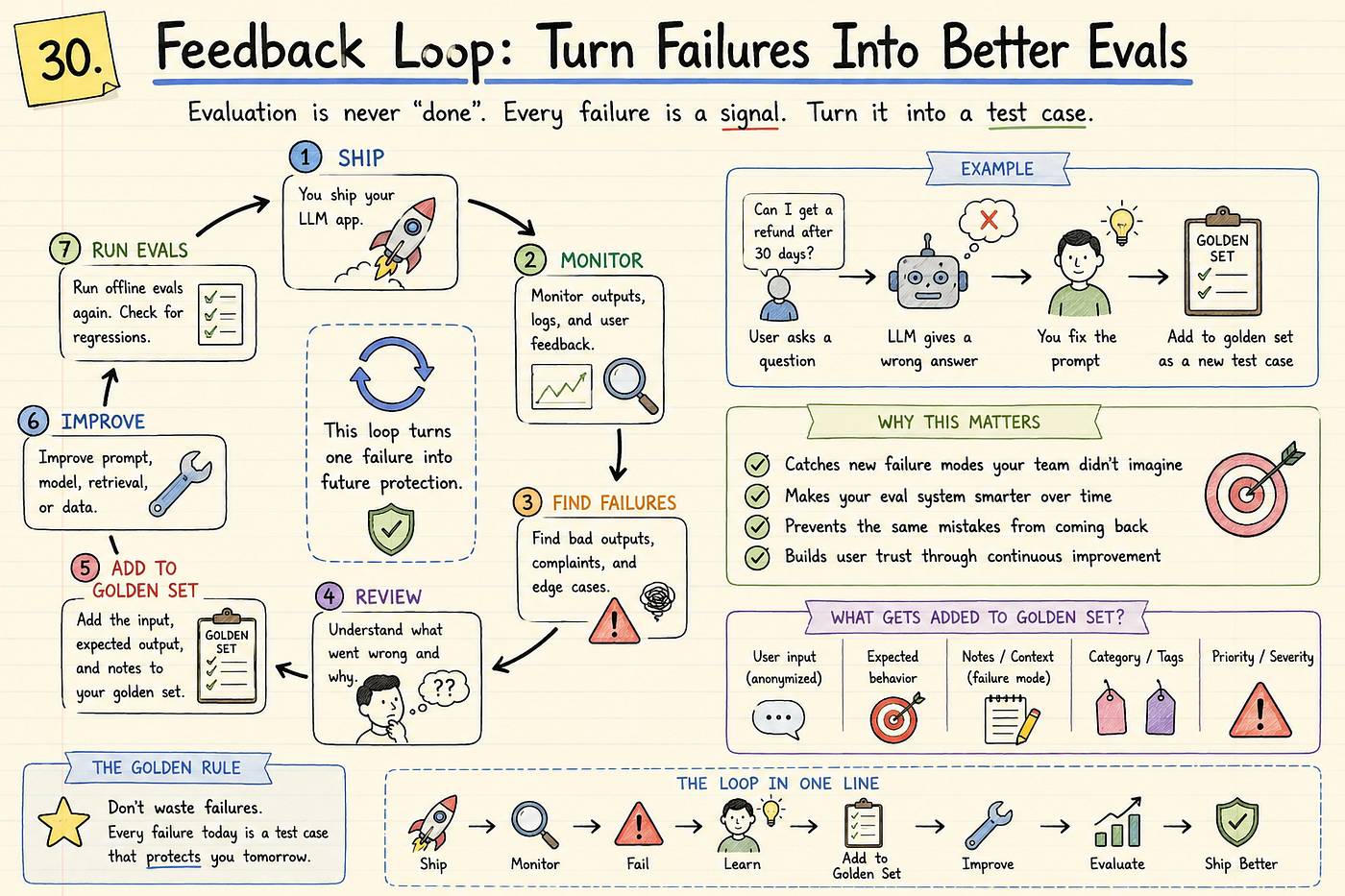
30. Feedback Loop: Turn Failures Into Better Evals
Evaluation is not something you build once and forget. A good eval system keeps improving. Every bad output, every user complaint, every failed edge case, and every weird production issue is a signal. Most teams treat these failures like bugs. They fix the prompt and move on.
But strong teams do something better:
They turn failures into future test cases. That is the feedback loop.
Here is how it works:
A user finds a bad output. Your team reviews what went wrong. You identify the failure mode. Then you add that input to your golden set. After that, every future prompt, model, or retrieval change gets tested against that same failure. So the system learns from its mistakes. Not the model directly. Your evaluation system.
For example, suppose your support bot gives a confident but wrong refund policy.
You fix the prompt. Good. But if you stop there, the same problem may come back later.
A better approach is:
- Save that user query.
- Anonymize it.
- Add it to your golden set.
- Write the expected behavior.
- Run it in future regression tests.
Now that one failure has become permanent protection. This is how eval coverage grows over time. Your first golden set may only have 50 examples. That is fine. But after a few weeks of real usage, your golden set should become smarter. It should include the cases your users actually care about.
The confusing ones. The risky ones. The ones your team did not imagine. The ones that broke production once. That is the real value of online evaluation and human review. They do not just tell you something failed. They give you raw material to improve the eval system.
The loop looks like this:
- Ship.
- Monitor.
- Find failures.
- Review them.
- Add them to the golden set.
- Improve the prompt, model, retrieval, or data.
- Run offline evals again.
- Ship with more confidence.
This loop is what turns LLM evaluation from a checklist into an engineering habit. Because LLM products are never fully done. User behavior changes. Your product changes. Models change. Your knowledge base changes. New failure modes appear. So your eval system must keep changing too.
The key idea is simple:
Do not waste failures. Every failure should make your eval system harder to fool next time. That is how you build LLM apps that actually improve instead of slowly drifting into chaos.
Final Thoughts
LLM evaluation is not about chasing one perfect score. It is about building a system that helps you understand where your AI works, where it fails, and what needs to improve before real users get hurt by bad outputs.
We covered a lot in this story, from rubrics and golden sets to RAG evaluation, LLM judges, online monitoring, and feedback loops.
But evaluation is a fast-moving space. So if I missed any important concept, or if you noticed any mistake, feel free to mention it in the comments. I would genuinely love to learn from your feedback too.
If this story helped you understand LLM evaluation better, please give it a like, repost it, and share it with someone building AI apps. And follow me for more beginner-friendly deep dives like this.
See yaaa in the next one.
If you like beginner-friendly software engineering explanations, I also created a reading list here: Core Software Engineering Concepts Explained in Simple Words. 👇
Editor’s note : This story is based on my learning and understanding of LLM evaluation concepts. I tried to explain the concepts in my own words, in a simple and beginner-friendly way. This article also includes some AI-assisted content, such as visuals, examples, and wording support, mainly to make the ideas easier to understand and communicate better. The goal is not to claim everything here as completely original research, but to share my learning in a clear and useful way for others.
메타데이터
- post_id
- 9bc1273e1d27
- slug
- 30-llm-evaluation-concepts-every-engineer-should-know-before-shipping-ai-apps-9bc1273e1d27
- url
- https://medium.com/lets-code-future/30-llm-evaluation-concepts-every-engineer-should-know-before-shipping-ai-apps-9bc1273e1d27
- canonical_url
- https://medium.com/lets-code-future/30-llm-evaluation-concepts-every-engineer-should-know-before-shipping-ai-apps-9bc1273e1d27
- author_url
- https://medium.com/@Deep-concept
- status
- ok
- fetched_at
- 2026-07-09 09:18:05