How East West Rail’s 2026 Plans Would Gut the Village of Harlton
EastWestRail Comment
How East West Rail’s 2026 Plans Would Gut the Village of Harlton
EastWestRail Comment
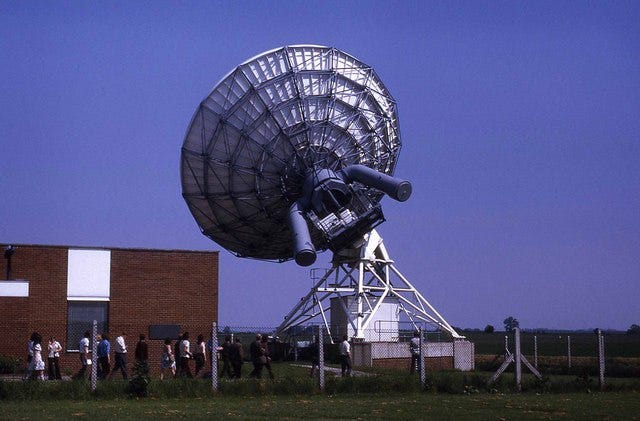
The world-leading telescopes at MRA close to Harlton, Cambridgeshire (https://commons.wikimedia.org/wiki/File:Radio_telescope_at_the_Mullard_Radio_Astronomy_Observatory_-_geograph.org.uk_-_2482664.jpg)
Harlton is a small, historically significant village in Cambridgeshire. It has narrow lanes, ancient pasture, rare wildlife, and a community that has existed quietly for centuries. According to the 2026 East West Rail (EWR) construction plans, more than 50% of the village will be severely affected by a combination of permanent infrastructure and years of intensive industrial activity. The Department for Transport (DfT), which oversees East West Rail, has yet to provide satisfactory answers to the specific concerns residents and parish representatives have raised.
This is not a story about the general inconvenience of living near a big infrastructure project. This is about a village being used as a logistics base for tunnel construction, with consequences that the EWR scoping documents appear to significantly underplay.
HGVs Through a Single-Track Village
The 2026 temporary construction drawings designate a “Secondary EWR construction traffic route” running directly through Harlton village. The roads in question include a single-track access road. Routing thousands of heavy goods vehicle movements through streets that were never designed for them is not a minor operational detail — it is a fundamental failure of route planning.
The knock-on effects are serious. Harlton has one bus service. If HGV congestion regularly blocks that route, children travelling to Comberton Village College and elderly residents who depend on the service to reach Cambridge face effective isolation. EWR’s plans do not appear to include any robust mitigation for this.
To move spoil away from the mined Chapel Hill tunnel, EWR also proposes a conveyor belt running through the fields between Harlton and Haslingfield, connecting the Chapel Hill and Charity Farm construction compounds. The stated intention is to reduce road traffic. What it also does is introduce persistent mechanical noise and dust into a rural landscape for the duration of the construction period — which runs to several years.
The Mullard Radio Astronomy Observatory: An Unresolved Technical Problem
Harlton sits close to the Mullard Radio Astronomy Observatory (MRAO), one of the UK’s most important radio astronomy facilities. The MRAO is extremely sensitive to ground-borne vibration. The 2026 plan calls for 24/7 tunnel mining at Chapel Hill, which generates constant mechanical vibration. How this will be managed in relation to the observatory’s work is not explained in the scoping documents.
The electromagnetic picture is equally unclear. EWR’s plans include two signalling masts between Comberton and Harlton, and the operation of hybrid electric trains brings significant electromagnetic compatibility (EMC) issues. The scoping documents contain no detailed evidence explaining how the MRAO will be protected from that interference. One option under consideration is the construction of Faraday cages around affected sections of track near Harlton — a solution that remains undefined in cost, scale, and feasibility. EWRCo has not made this a central point of public discussion, which raises real questions about transparency.
Permanent Changes to the Physical Landscape
The construction phase ends, but much of what it leaves behind does not. A new Harlton Road overbridge will carry realigned traffic over the rail line — a substantial piece of engineering that permanently changes how the village connects to its surroundings. Washpit Lane, a historical route passing through an area of prehistoric land division and ancient pasture, will be realigned to accommodate the new tracks. Parish representatives have described this land as something that will be “lost forever”, and on the current evidence, it is difficult to argue with that assessment.
The Chapel Hill tunnel portal and associated tunnel services buildings will sit permanently on the rural fringe of the village, introducing an industrial character to a landscape that currently has none.
Wildlife Under Direct Threat
Harlton sits in a critical wildlife corridor. Barbastelle bats — a rare species — commute through the village from the Wimpole and Eversden Woods Special Area of Conservation (SAC). The proposed A603 overbridge and 6-metre-high embankments will cut directly across their established flight paths. Barbastelle bats are known to follow linear features in the landscape, and physical barriers of this height are not a minor inconvenience to them — they are a genuine threat to the integrity of the commuting corridor.
The Chapel Hill main construction compound, on the edge of Haslingfield and a matter of a few hundred meters from Harlton, operating with 24/7 lighting and noise, sits close to habitat used by red kites, badgers, and water voles. The combined effect of light pollution, noise, and habitat fragmentation during a multi-year construction period poses a serious risk to the local ecological network. EWR’s environmental assessments need to be scrutinised carefully on this point.
The project will sever established footpaths and historical routes — known as “desire lines” — that connect Harlton to the Bourn Valley. These are not abstract lines on a map. They represent the way people who live here move through their landscape.
The visual impact assessment uses a Zone of Theoretical Visibility (ZTV) of just 1 kilometre. In a flat fenland landscape, this is inadequate. Lines of sight extend much further across open ground, and the industrial infrastructure EWR is proposing will be visible far beyond the 1km boundary the assessment applies. The result is that the full visual impact on the footpath network, and on the character of the area more broadly, has been structurally underestimated in the official documentation.
What the DfT Needs to Answer
East West Rail is a nationally significant infrastructure project, and there are genuine arguments for improving east-west rail connectivity across England. None of that changes the fact that the 2026 plans, as drawn, ask Harlton to absorb an extraordinary level of disruption and permanent change — with mitigation measures that are either vague, absent, or still undefined.
The DfT has a responsibility to ensure that communities this size are not simply written off as acceptable collateral damage in the delivery of a large infrastructure project. On the current evidence, that responsibility is not being met.
The village of Harlton is being asked to carry costs — to its roads, its wildlife, its landscape, its observatory, and its community — that have not been adequately accounted for in EWR’s 2026 plans.
Find Out More
If you want to understand the full picture of what East West Rail means for Cambridgeshire villages like Harlton, visit eastwestrail.site for detailed analysis, community updates, and background on the 2026 plans. The more people who understand what is actually being proposed, the harder it becomes to push these plans through without proper scrutiny.
Originally published at https://telegra.ph on May 30, 2026.
메타데이터
- post_id
- a42529cf257e
- slug
- how-east-west-rails-2026-plans-would-gut-the-village-of-harlton-a42529cf257e
- url
- https://medium.com/@EastWestRail/how-east-west-rails-2026-plans-would-gut-the-village-of-harlton-a42529cf257e
- canonical_url
- https://medium.com/@EastWestRail/how-east-west-rails-2026-plans-would-gut-the-village-of-harlton-a42529cf257e
- author_url
- https://medium.com/@EastWestRail
- status
- ok
- fetched_at
- 2026-06-27 07:40:21