What the 2012 Nobel Prize Really Changed
Why measuring without destroying coherence may reveal something deeper about the vacuum
What the 2012 Nobel Prize Really Changed
Why measuring without destroying coherence may reveal something deeper about the vacuum
When the Nobel Prize in Physics was awarded in 2012 to Serge Haroche and **David J. Wineland*, it was widely described as a triumph of experimental ingenuity. The official citation praised “ground-breaking experimental methods that enable measuring and manipulation of individual quantum systems.”*
At first glance, this sounds like a story about better tools: Cleaner traps, more precise lasers, finer control. And indeed, it was all of that.
But beneath the technical brilliance lies something deeper. The 2012 Nobel Prize quietly touched the foundations of quantum theory — and perhaps our understanding of what the vacuum itself really is.
Measuring Without Destroying: What They Actually Did
In quantum physics, measurement is famously invasive. Observe a quantum system too strongly, and its fragile superposition collapses. Coherence is lost, interference disappears, and the system becomes classical.
Haroche and Wineland developed complementary methods to push against this limit.
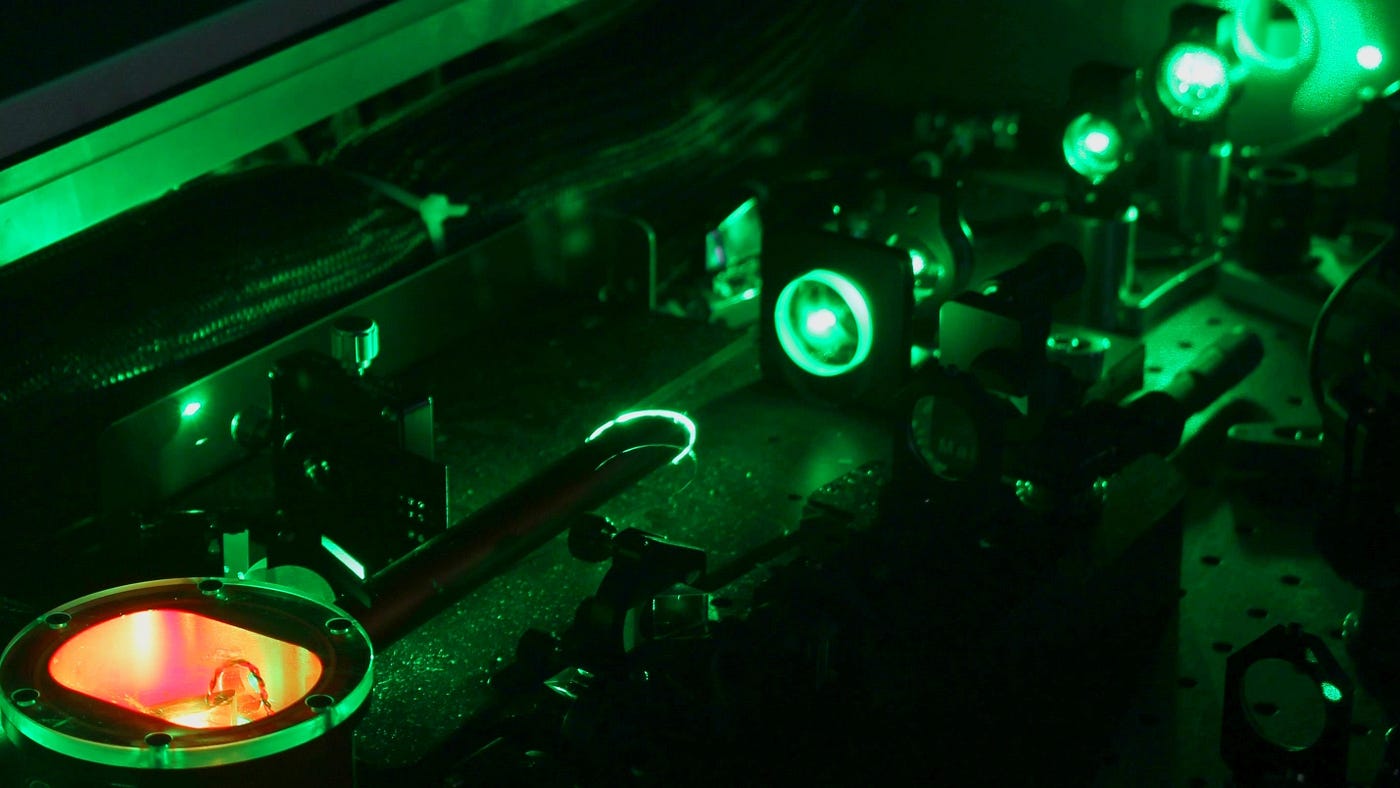
- Wineland used trapped ions, suspended and isolated with extraordinary precision, allowing their quantum states to be manipulated and read out repeatedly.
- Haroche used photons trapped between superconducting mirrors, observing them indirectly without absorbing them — a technique known as quantum non-demolition measurement.
The key achievement was this:
They learned how to measure individual quantum systems while largely preserving their coherence.
This allowed researchers to watch quantum states evolve, decohere, and sometimes recover in real time.
According to NobelPrize.org, these experiments made it possible to “follow the quantum world step by step,” rather than destroying it in the act of observation.
Why This Touches the Foundations
At a technical level, the experiments refined our control over quantum systems. But conceptually, they raised uncomfortable questions.
Why is quantum coherence so fragile in the first place? What exactly does a quantum system interact with when it decoheres? And why does isolation work at all?
In standard interpretations, decoherence is explained as entanglement with an environment, often treated as an abstract collection of degrees of freedom. The environment is mathematically well-defined, but physically vague.
The 2012 experiments force us to confront something important:
If coherence can be preserved, delayed, or redirected, then decoherence is not a mysterious collapse, it is a physical interaction.
And that interaction must be happening somewhere.
A Vacuum That Is Not Empty
This is where alternative perspectives become interesting.
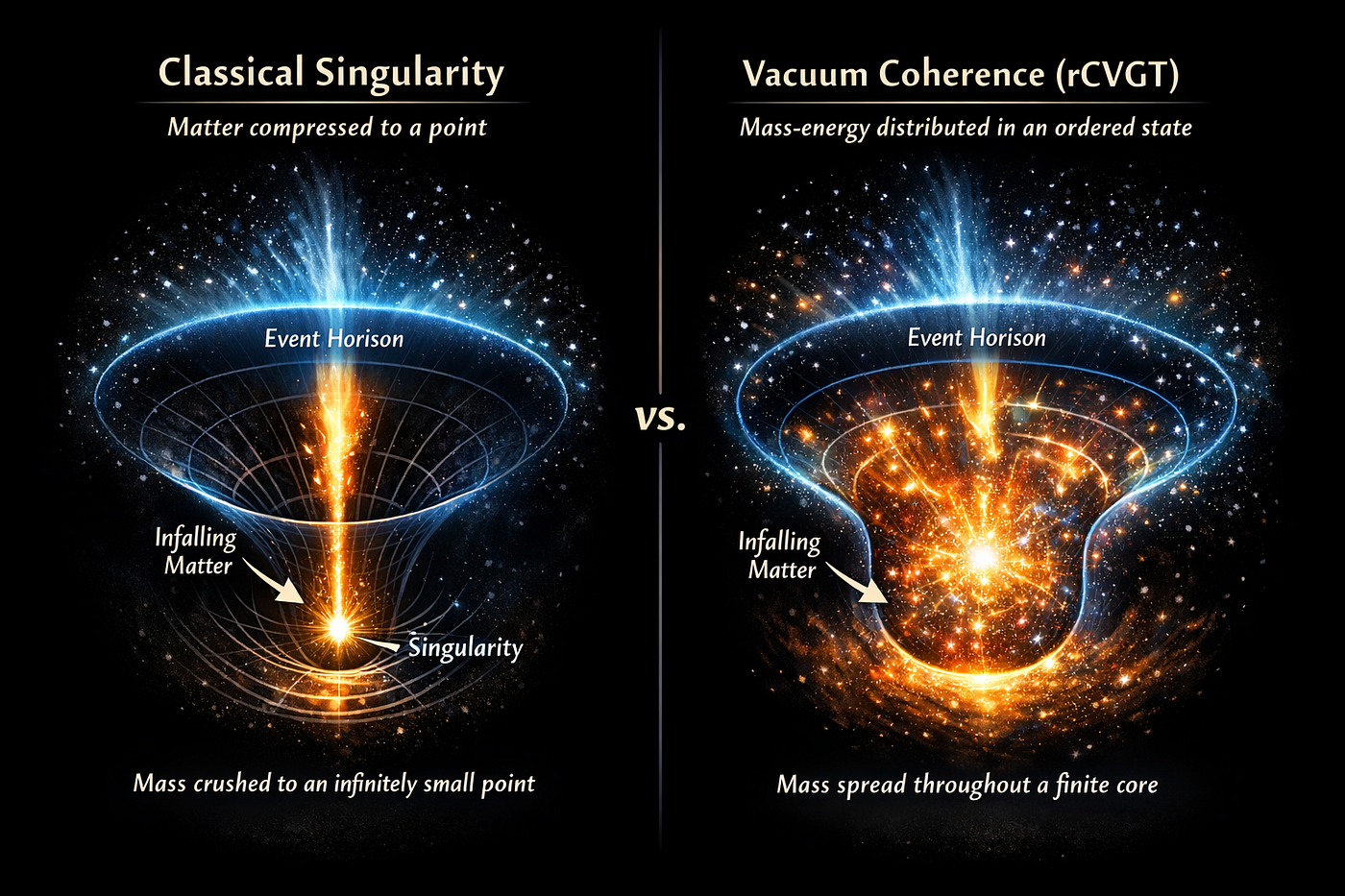
In the **Relativistic Coherent Vacuum Gravity Theory (rCVGT), the vacuum is not a passive stage on which quantum systems act. It is a structured, dynamical medium** characterized by coherence, flow, and a physical time-rate.
From this viewpoint:
- Quantum states are not isolated mathematical objects
- They are coherent excitations of the vacuum
- Decoherence reflects a redistribution of coherence between system and vacuum
Seen this way, the 2012 Nobel experiments did not merely control particles and photons, they controlled how those systems remained in resonance with the vacuum.
The ability to measure without destroying coherence suggests that coherence is not an internal property of particles alone, but a relationship that can be preserved if the vacuum is not violently disturbed.
An Active Vacuum, Not Just an Environment

In rCVGT, the vacuum plays an active role:
- It resists rapid reconfiguration (giving rise to inertia)
- It governs the local rate of physical time
- It mediates the transition between quantum and classical behavior
The Haroche and Wineland experiments can be reinterpreted through this lens as demonstrations of gentle coupling an interactions that extract information without forcing the vacuum into incoherent reorganization.
This does not contradict standard quantum mechanics. All predictions remain unchanged.
What changes is the ontology.
Instead of saying:
“The system decoheres because it interacts with an environment,”
we can say:
“The system decoheres when coherence is transferred into the vacuum.”
The vacuum is no longer a bookkeeping device. It becomes a participant.
Implications: Observation, Time, and Mass
This shift has broader implications.
Observation
Measurement becomes a physical process of vacuum reconfiguration, not an abstract projection.
Time
If coherence affects how quickly physical processes unfold, as proposed in rCVGT, then maintaining coherence may also stabilize the local flow of time at the quantum level.
Mass and inertia
If mass reflects resistance to vacuum reconfiguration, then systems that maintain coherence disturb the vacuum less, an intriguing parallel with how light and nearly massless particles behave.
Quantum states
Quantum states become less like floating vectors in Hilbert space, and more like stable or metastable patterns in a coherent vacuum.
The 2012 Nobel Prize does not prove these ideas. But it makes them harder to dismiss. And they are testable.
Why This Nobel Prize Still Matters
The Nobel Prize in Physics 2012 is often remembered as a milestone on the road toward quantum computing and precision measurement. That alone would justify its importance.
But its deeper significance may lie elsewhere.
It showed us that:
- Quantum coherence is physically real, not just a mathematical abstraction
- Decoherence is dynamical, not instantaneous or mysterious
- Measurement can be gentle, extracting information without destroying the quantum state
In doing so, the prize quietly opened the door to deeper ontological questions — questions that experimental physics is now finally able to approach:
- What is the vacuum actually made of?
- What does it mean, physically, to preserve coherence?
- And how much of reality emerges from how systems interact with this unseen substrate?
From an rCVGT perspective, the 2012 Nobel Prize was not merely about mastering quantum systems. It was about learning how to interact with the vacuum itself without forcing it into incoherence.
Seen this way, the prize also foreshadows later breakthroughs; such as attosecond physics, where we no longer only preserve coherence, but begin to observe how it unfolds in time. Together, these developments suggest a quiet but profound shift: The vacuum is no longer a passive background, but an active participant in physical reality.
The achievement of 2012 was not learning how to make the quantum world speak louder.
It was learning how to listen to it — without forcing the vacuum to shout.
Note: This article draws on concepts developed within the Relativistic Coherent Vacuum Gravity Theory (rCVGT). Discussion and further development are welcome, with appropriate attribution.
메타데이터
- post_id
- a5bb83ff4e9b
- slug
- what-the-2012-nobel-prize-really-changed-a5bb83ff4e9b
- url
- https://medium.com/the-idea-of-reality/what-the-2012-nobel-prize-really-changed-a5bb83ff4e9b
- canonical_url
- https://medium.com/the-idea-of-reality/what-the-2012-nobel-prize-really-changed-a5bb83ff4e9b
- author_url
- https://medium.com/@steen_m_n
- status
- ok
- fetched_at
- 2026-07-10 23:42:37