Rare Earth, Hard Power
The Hidden Elements That Shape Modern Civilization — and the Politics That Control Them
Rare Earth, Hard Power
The Hidden Elements That Shape Modern Civilization — and the Politics That Control Them
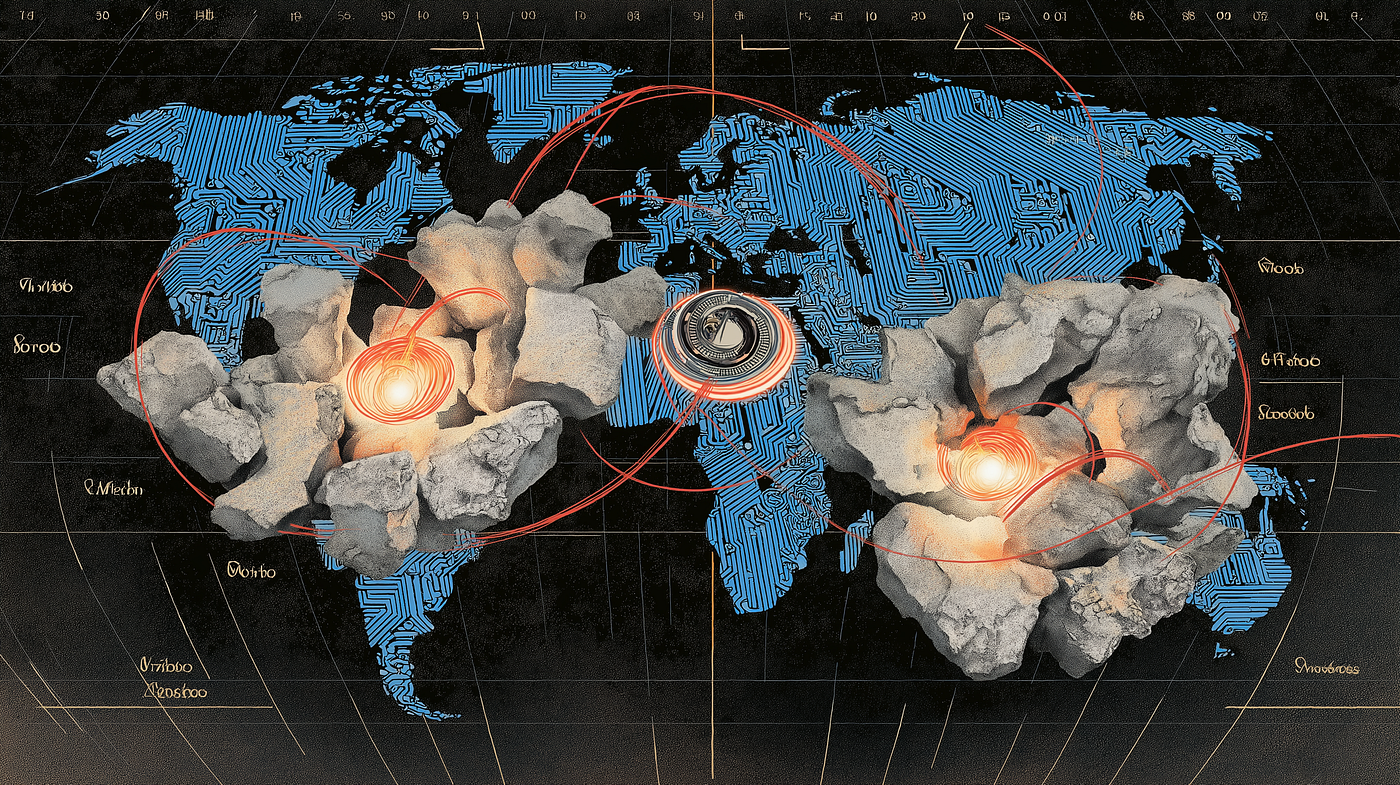
I. The Hidden Pulse of Modern Civilization
Close your eyes and listen: the hum of an MRI scanner in a hospital corridor, the quiet whirr of an electric vehicle accelerating past you on a city street, the crisp treble escaping from someone’s AirPods on the subway. These sounds, so ordinary they fade into the background of modern life, share an invisible common thread. Buried deep within each device, invisible to the user and often unknown even to the engineer who designed the system, are rare earth elements — a collection of seventeen metallic elements whose names most people have never heard and whose properties seem almost magical.
As a physicist who later became a product manager, I’ve spent my career in the uncomfortable space between what’s theoretically possible and what’s practically achievable. I’ve learned that the most important innovations often hide not in the algorithms or the interfaces, but in the materials — in the atomic-level properties that make ‘impossible’ things routine. Progress, I’ve discovered, happens in parts per million, in electron orbitals, in the periodic table itself.
Rare earth elements are the capillaries of our modern world. Like the smallest blood vessels in your body, they’re unseen yet indispensable, carrying the lifeblood of twenty-first-century technology through systems we take for granted. Remove them, and entire industries don’t just slow down — they stop. Your smartphone becomes a brick without the rare earth phosphors that create its vivid display. Wind turbines can’t generate power without rare earth magnets that work in extreme conditions. Fibre-optic networks go dark without erbium-doped amplifiers boosting signals across continents. These aren’t just useful materials with convenient substitutes waiting in the wings. They are, in many applications, irreplaceable.
But here’s where physics meets politics, where the elegant logic of the periodic table collides with the messy reality of geopolitical power. China controls ninety percent of global rare earth processing. Not mining — processing. The crucial step that transforms raw ore into usable materials. And in the escalating trade war between the United States and China, rare earth elements have emerged as perhaps China’s most potent strategic weapon. In December 2024, one day after the US announced expanded semiconductor restrictions targeting Chinese technology companies, China’s Ministry of Commerce banned exports of gallium, germanium, antimony, and superhard materials to the United States. Then, in October 2025, China implemented what it called a Foreign Direct Product Rule for rare earths — a regulatory framework that extends Chinese jurisdiction to any product manufactured anywhere in the world if it contains just 0.1 percent Chinese-origin heavy rare earth content by value.
The question that keeps me awake at night is this: What happens when the materials that make progress possible become the front lines of a trade war? What happens when physics — which promises universal truths available to anyone with the right equipment — becomes subject to export controls, licensing requirements, and political leverage? The answer, I’ve come to believe, will shape not just the next decade of technology, but the next century of human civilization.
II. What Are Rare Earths, Really?
The 4f Electron Story
To understand why rare earth elements matter so much, you need to understand what makes them unique at the atomic level. It’s a story about electrons — specifically, about where electrons live in an atom and how they behave once they get there.
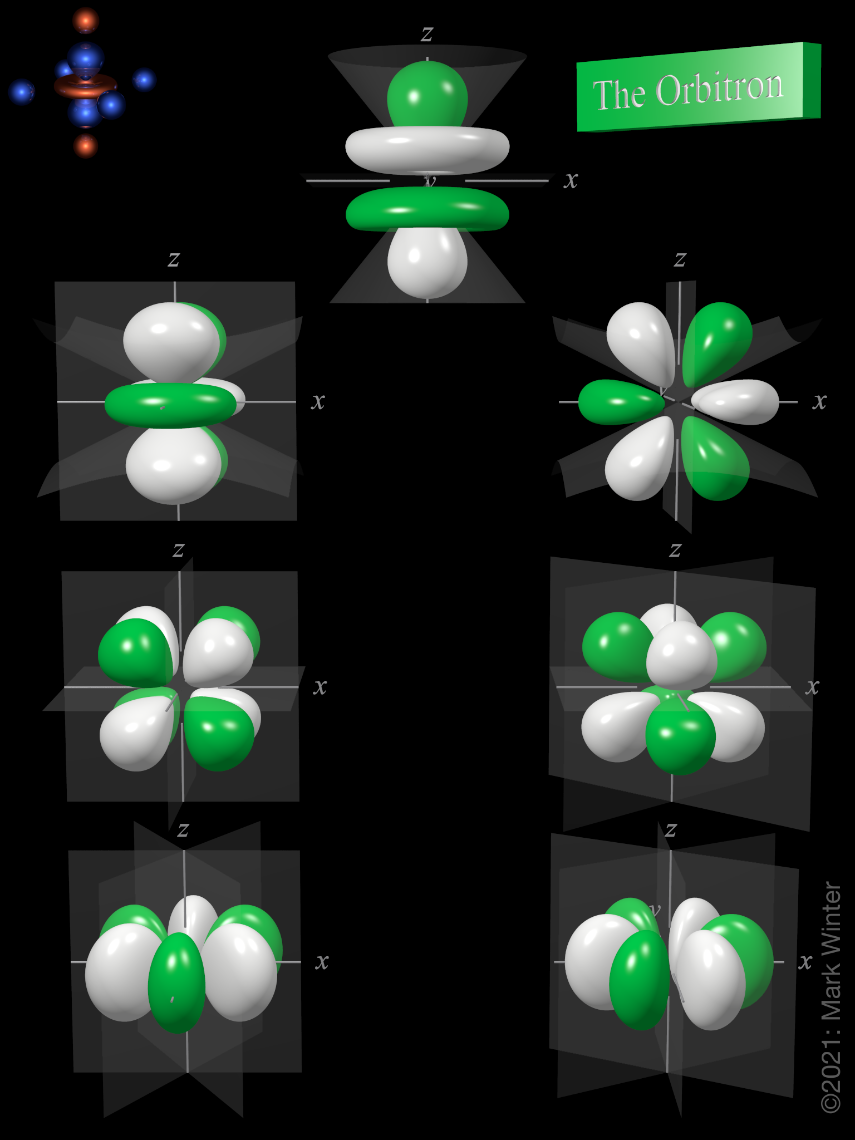
The shape of the seven 4f orbitals (general set). From left to right: (top row) 4fz3, (next to top row) 4fyz2, 4fxz2, (next to bottom row) 4fxyz, and 4fz(x2-y2), (bottom row) 4fy(3x2-y2), 4fx(x2–3y2). For each, the green zones are where the wave functions have positive values and the white zones denote negative values.
In rare earth atoms, electrons occupy what physicists call the 4f orbital. Picture an atom like a high-rise apartment building, with electrons living on different floors. Most elements fill their apartments from the ground up, with each new electron moving into the next available room. But rare earth elements do something strange: they fill up rooms on the fourth floor (the 4f orbital) while leaving the fifth floor (the 5d orbital) mostly empty and using the sixth floor (the 6s orbital) for their outermost electrons.
This peculiar arrangement has profound consequences. The 4f electrons sit deep inside the atom, shielded from the outside world by the outer electrons. They’re like hermits living in interior rooms, rarely interacting with their neighbors. This shielding effect means that when rare earth atoms bond with other atoms to form materials, those buried 4f electrons mostly keep to themselves. They remain localized — stuck in place — rather than spreading out and sharing themselves with neighboring atoms.
The Quantum Uniqueness
This is where rare earths diverge dramatically from their more famous cousins, the transition metals like iron, copper, and nickel. In transition metals, the electrons that give the material its properties live in the outer orbitals, where they’re exposed to the world. These electrons become delocalized, spreading out across the material like a gas, creating the familiar properties of metals: conductivity, malleability, and moderate magnetic behavior.
But rare earth electrons stay put. Because the 4f electrons remain localized, they retain the quantum mechanical properties they had when they were alone in a single atom. This creates behaviors that seem almost like magic if you don’t know the physics behind them. The localized 4f electrons act like tiny, powerful magnets inside the material. When you align them all in the same direction — which is what happens when you make a rare earth magnet — you get magnetic fields that are dramatically stronger than anything possible with transition metals. Neodymium-iron-boron magnets, the strongest permanent magnets we can make, derive their power from these localized 4f electrons in neodymium atoms all pointing the same way.
The same principle explains why rare earths create such pure, sharp colors. When electrons in most materials absorb and emit light, they do so in broad, fuzzy bands because the electrons are interacting with all their neighbors. But localized 4f electrons absorb and emit light at very specific wavelengths, creating spectral lines so sharp they might as well be drawn with a ruler. A single atom of europium added to a phosphor can produce a red so pure and saturated that no other material can match it. This is why the red pixels in your phone screen, your television, and your laptop all depend on europium. There’s simply no substitute that creates that exact shade of red with that exact efficiency.
Everyday Miracles
The physics translates into everyday miracles we no longer think about. Consider neodymium magnets in electric vehicles. A conventional electric motor using regular iron-based magnets would need to be massive to generate enough torque — so large it wouldn’t fit in a car, or so heavy it would cancel out the efficiency gains you’re trying to achieve. But neodymium magnets enable motors that are compact and lightweight while delivering the power needed to accelerate a two-ton vehicle. This isn’t about making things slightly better; it’s about making things possible at all.
Or consider erbium in fiber-optic communications. When you send data down a fiber-optic cable, the light signal gets weaker the farther it travels. Without amplification, you’d need to convert the optical signal back to electricity, amplify it, and convert it back to light every fifty kilometers or so — an expensive, slow process. But erbium-doped fiber amplifiers boost the optical signal directly, without conversion, enabling the high-speed internet backbone that connects continents. Remove erbium from the equation, and global broadband infrastructure collapses back to 1990s speeds and costs.
This is the bridge between physics and politics. Physics explains why these materials are irreplaceable — why their unique electronic structure creates properties that can’t be approximated with other elements. But politics decides who controls access to them, who can build the infrastructure to process them, and ultimately, who can build the technologies that depend on them. And right now, one country has positioned itself as the gatekeeper to this entire class of materials.
III. The Geopolitical Terrain: From Physics to Power
China’s Early Move
China didn’t stumble into rare earth dominance. It built it deliberately over three decades through a combination of geological fortune, environmental pragmatism, and long-term industrial strategy. While rare earth deposits exist all over the world — including substantial reserves in the United States, Australia, and Brazil — China recognized early that the real choke point wasn’t mining, but processing.
Rare earth processing is environmentally intensive. The elements rarely occur in pure form; instead, they’re mixed together in ores that require complex chemical separation processes involving strong acids and generating radioactive waste products. Western countries, constrained by environmental regulations and rising labor costs, gradually abandoned rare earth processing in the 1980s and 1990s. China stepped into that vacuum with lower environmental standards and willingness to accept the pollution burden. By 2024, China was producing around 270,000 tonnes of rare earth materials annually and controlled an astonishing ninety percent of global processing capacity.
But China didn’t stop at the midstream processing that transforms ore into separated rare earth oxides. The country methodically built vertical integration from ore through refining, separation, metal production, and finally into finished components like magnets and phosphors. This means that even if you mine rare earth ore in Australia or the United States, you almost certainly need to send it to China for processing, then perhaps send it back to China again for magnet manufacturing. China doesn’t just control the supply chain — it is the supply chain.
The Western Blind Spot
How did the West allow this to happen? The answer lies in the logic of efficiency that dominated economic thinking from the 1980s onward. Companies optimized for cost, not resilience. If China could process rare earths more cheaply than domestic facilities, the rational decision was to source from China. This made perfect sense in a world of stable trade relationships and free flow of goods. But in outsourcing production, Western countries didn’t just cede manufacturing capacity — they lost the engineering expertise and institutional knowledge needed to build and operate rare earth processing facilities at scale.
The midstream processing stage — separating the mixed rare earth ores into individual, pure elements — remains the true choke point. It’s technically difficult, requiring precise chemical processes and specialized equipment. It’s also unprofitable at small scale, requiring massive capital investment before generating returns. Most critically, it requires engineers who understand the intricate chemistry of rare earth separation, and those engineers have spent the past thirty years working in China. Rebuilding this capability from scratch isn’t impossible, but it’s a multi-year, multi-billion-dollar undertaking that requires sustained political will.
Trade War 2.0: Silicon vs. Lanthanum
The current trade war between the United States and China features two primary technological weapons, each wielded by a different side. The United States controls the most advanced semiconductor manufacturing technology — the ability to produce cutting-edge chips at three-nanometer and five-nanometer process nodes. China controls rare earth processing and, by extension, many of the materials needed for advanced manufacturing, clean energy, and military systems.
In October 2022, the US announced comprehensive export controls preventing China from accessing the most advanced semiconductor manufacturing equipment and electronic design automation software. The goal was explicit: slow China’s progress in artificial intelligence and advanced computing by denying access to the chips these systems require. China’s response came in December 2024, literally one day after the US expanded these semiconductor controls. The Ministry of Commerce banned exports of gallium, germanium, antimony, and superhard materials to the United States.
The October 2025 escalation represented something more sophisticated. China implemented its first-ever Foreign Direct Product Rule for rare earths, directly mirroring the legal mechanism the United States had used for semiconductor export controls. This rule extends Chinese jurisdiction to products manufactured anywhere in the world if they contain merely 0.1 percent Chinese-origin heavy rare earth content by value — an extraordinarily low threshold that captures virtually all downstream manufacturing. The regulation covers twelve of seventeen rare earth elements, including all the critical heavy rare earths like dysprosium, terbium, and europium that have no current Western supply alternatives. Technology transfer provisions bar Chinese nationals from working on overseas rare earth projects and prohibit export of extraction, smelting, separation, and magnet manufacturing technologies.
These aren’t abstract trade measures. Gallium enables gallium nitride power electronics in electric vehicles and five-G infrastructure. Antimony is critical for armor-piercing ammunition, night vision equipment, and flame retardants — prices jumped from $11,300 to $40,000 per metric ton after controls took effect, a 254 percent increase, while US shipments dropped by ninety-seven percent. Dysprosium enables high-temperature magnets in F-35 fighters, submarine propulsion systems, wind turbines, and EV motors, and China controls ninety-nine percent of heavy rare earth processing with zero operational Western alternatives. A single F-35 requires approximately 920 pounds of rare earth materials; Virginia-class submarines need substantially more.

A Subtle Symmetry
There’s an elegant symmetry to this standoff, though the symmetry masks a crucial asymmetry. Semiconductors have become the brain of modern civilization — the central processing units that enable everything from smartphones to artificial intelligence to autonomous vehicles. Rare earths, meanwhile, are the nerves and muscles — the materials that enable motors, sensors, communications infrastructure, and energy systems. The world needs both. But they’re split between rival geopolitical blocs that increasingly refuse to cooperate.
This division maps roughly onto the old Cold War categories, but with a twist. The United States and its allies control the cognitive technologies — the chips and software that do the thinking. China controls the physical substrate — the materials that enable things to move, communicate, and transform energy. Each side can threaten to withhold what the other needs. But as we’ll see, these threats are not equivalent in their impact.
IV. The Two Clocks of Progress
The Semiconductor Clock — Performance Gap
US semiconductor restrictions create what I call a performance gap. China’s most advanced domestic semiconductor foundries can produce seven-nanometer chips — roughly three technology generations behind the cutting edge. This represents a real limitation. Seven-nanometer chips are less power-efficient, generate more heat, and perform measurably worse than three-nanometer chips in benchmark tests.
But here’s what matters in practice: for most applications, seven-nanometer chips are good enough. Your smartphone doesn’t feel noticeably faster when you upgrade from a seven-nanometer to a three-nanometer processor. The difference shows up in synthetic benchmarks, but most users would be hard-pressed to identify which chip is running in their device during normal use. This isn’t to minimize the importance of semiconductor leadership — in cutting-edge applications like training the largest AI models, these performance differences compound and become significant. But for the vast consumer market, the performance gap translates to incremental rather than categorical differences.
Huawei Mate 70
Moreover, performance gaps can be bridged through greater effort and investment. China demonstrated this in 2024 when Huawei released smartphones using seven-nanometer chips manufactured by SMIC, China’s largest foundry, despite US export controls. These chips weren’t as efficient as TSMC’s three-nanometer offerings, and they likely cost significantly more to produce due to lower yields and the need to use older, less efficient manufacturing processes. But they worked. They enabled Huawei to re-enter the premium smartphone market. The timeline for catch-up is measured in years — difficult, expensive years requiring sustained investment and talent, but years nonetheless, not decades.
The Rare Earth Clock — Capability Gap
China’s rare earth controls create something fundamentally different: a capability gap. Western manufacturers cannot obtain heavy rare earths from domestic sources at any price because the processing capacity simply doesn’t exist. Unlike semiconductors, where multiple foundries compete globally and where it’s possible to manufacture degraded chips using older technology, heavy rare earth separation has zero operational Western alternatives as of 2025.
This distinction proves crucial. The United States cannot manufacture F-35 fighters at eighty percent effectiveness using domestic supply chains; it cannot manufacture them at all without Chinese-processed dysprosium and terbium, which enable the high-temperature magnets in the aircraft’s motors and generators. Wind turbines cannot spin fifteen percent slower with inferior magnets; they cannot generate power offshore at all without rare earth permanent magnets because the maintenance access constraints make ferrite alternatives impractical. Electric vehicles might theoretically accept a ten percent range reduction, but smartphones and laptops physically cannot accommodate the 2.4 times heavier ferrite motors that would be needed without rare earth magnets — the devices simply don’t have the space or weight budget.
Performance gaps allow degraded functionality and gradual improvement. Capability gaps represent binary states — present or absent — and require decade-long infrastructure construction to bridge. Remove erbium from fiber-optic networks, and internet traffic doesn’t slow by ten percent; specific long-haul routes become impossible to operate economically. Remove europium from displays, and screens don’t show slightly duller red; they show a different color that users immediately perceive as wrong. Remove neodymium from electric vehicle motors, and EVs don’t accelerate slightly slower; manufacturers need to redesign the powertrain to accommodate fundamentally different motor technology completely.
[embed]
Asymmetry Defined
The fundamental asymmetry crystallizes in the timelines required for technology substitution. China demonstrated seven-nanometer chip production roughly three years after export restrictions began — slower than development would have proceeded without controls, but measured in years of effort, not decades. Western rare earth processing capability, by contrast, requires five to ten years just for facility construction, plus additional years for process optimization. Analysis from Virginia Tech suggests new mines require seventeen years or more from initial discovery to full production. Iron nitride magnets, which offer genuine promise as rare earth alternatives, won’t reach commercial scale until 2027 at the earliest, and even then only at 1,500 tonnes annually — requiring growth to more than 10,000 tonnes in the 2030s to significantly impact global supply chains. Rare-earth-free electric motors have achieved only six percent market share after thirteen years of production by Renault and adoption by BMW.
The West’s semiconductor lead yields bragging rights — the ability to say we have the most advanced chips, the fastest processing, the most power-efficient designs. China’s rare earth control yields something more tangible: dependence rights. The ability to say you need these materials, and we control access to them, and you cannot manufacture alternatives on any timeline that matters for your current defense programs, energy transition goals, or consumer electronics product cycles. In a trade war, bragging rights matter less than leverage.
V. The Divergent Futures
The Virtuous Cycle: China and the Pragmatic Bloc
China’s rare earth dominance exhibits characteristics of what systems thinkers call a virtuous cycle — a self-reinforcing loop where each success enables the next. Reliable production generates global market share. Market share provides the revenue and scale to fund research and development. R&D improvements strengthen the technological lead, which further expands market share. Meanwhile, vertical integration from mining through magnet manufacturing creates compound advantages: each stage of the supply chain benefits from optimization of adjacent stages, and profits at each level can be reinvested in expanding capacity.
This cycle operates on a foundation of what might be called industrial pragmatism — a willingness to accept environmental costs now in service of economic and strategic gains, with environmental remediation treated as a future problem to be solved from a position of strength. Western countries faced with rare earth processing opportunities often balk at the pollution burden. China embraced it, or at least accepted it as the price of industrial leadership. This isn’t meant as praise or criticism but as description of strategic logic: build the capacity, dominate the market, accumulate the resources, then address externalities from a position where you can afford to do so.
The approach extends beyond China’s borders through Belt and Road investments, which totaled $121.8 billion across eighty-seven countries in 2024. These investments systematically secure upstream rare earth resources before Western companies arrive. When rare earth deposits are discovered in Africa, Southeast Asia, or South America, Chinese firms are often first to negotiate mining rights, processing agreements, and infrastructure development. This isn’t resource colonialism in the crude twentieth-century sense; it’s strategic foresight using patient capital and long-term relationships to position yourself as the indispensable partner in global supply chains.
The Vicious Cycle: The Western Democracies
Western countries face the opposite dynamic — what might be termed a vicious cycle, though that phrase unfairly stigmatizes genuine environmental and social concerns. Rare earth processing projects in democratic countries face extensive environmental impact reviews, public opposition from communities near proposed facilities, and complex permitting processes that can stretch for years. The Lynas rare earth processing facility planned for Texas has been delayed repeatedly for permits. The Iluka rare earth refinery in Australia, initially scheduled for 2026, has been pushed to 2027 and may slip further.
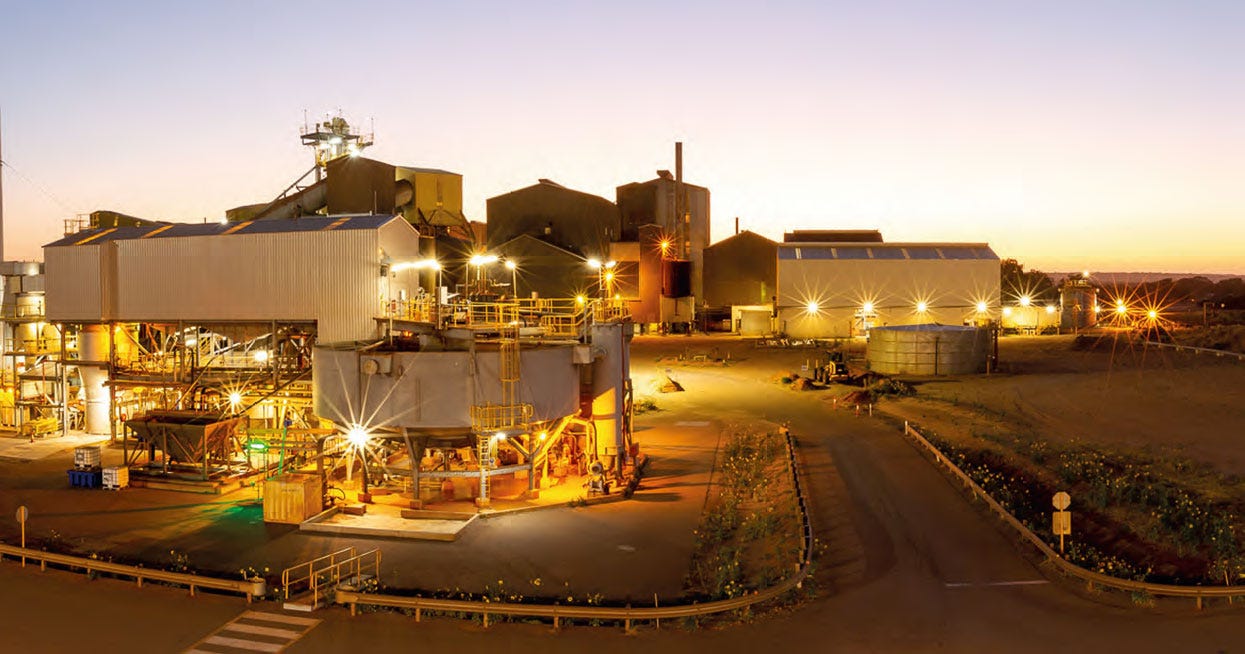
Iluka Refinery in Australia
These delays aren’t simply bureaucratic inefficiency. They reflect genuine tension between competing values. Democratic societies have decided, through extensive political processes, that environmental protection matters, that community input matters, that worker safety matters. These aren’t trivial concerns, and the environmental record of rare earth processing in China — which includes radioactive waste dumps, groundwater contamination, and air pollution affecting nearby communities — demonstrates what can happen when such protections are absent. But these protections come with costs measured in years of delay and billions of dollars in additional expense, while China’s lack of similar constraints becomes a competitive advantage.
Beyond environmental concerns, Western democracies face what might be called ESG paralysis — the overcorrection that occurs when environmental, social, and governance considerations become ends rather than means. Some advocacy in progressive circles has shifted from responsible development to degrowth — the belief that the solution to environmental problems is fundamentally less economic activity, less material consumption, less technological complexity. There’s a romantic appeal to this vision: simpler technology, local production, reduced dependence on global supply chains. But romantic visions don’t keep hospital MRI machines running or maintain the telecommunications infrastructure that millions of people depend on for work and connection.
The cultural shift from move fast and break things to move slow and audit everything represents a fundamental change in societal metabolism. Where the previous generation might have accepted some environmental damage as the price of progress, assuming it could be remediated later from a position of wealth, the current generation demands that everything be perfect before it begins. This perfectionism is morally appealing but strategically challenging when competing against countries operating under different constraints.
The Global Bifurcation
Two distinct models of technological civilization are emerging. The Pragmatic-Industrial Civilization, led by China and including much of the developing world that prioritizes growth over process, operates on principles of efficiency-first development. Build now, optimize later. Accept environmental costs as temporary necessary evils. Prioritize production capacity over perfection. This model scales rapidly and delivers tangible results that populations can see and feel in their daily lives: new infrastructure, rising incomes, improved access to technology.
The Sustainable-Minimalist Civilization, centered in Western democracies, operates on fundamentally different principles: ethics-first development. Perfect the process before scaling. Front-load environmental protection even if it slows deployment. Prioritize resilience and sustainability over raw growth. This model optimizes for long-term stability and minimizes negative externalities, but it adapts slowly and requires populations to accept delayed gratification in service of future benefits they may never directly experience.
This bifurcation creates a sorting mechanism for the rest of the world. Countries and regions that prioritize rapid development increasingly align with the Pragmatic-Industrial model because it delivers faster results. Countries that have already achieved high levels of development and seek to consolidate those gains align with the Sustainable-Minimalist model because they can afford to prioritize quality over quantity. The uncomfortable reality is that the first model is more attractive to the four billion people still working toward basic prosperity, while the second model primarily appeals to the one billion who have already achieved it.
One civilization scales; the other justifies. And in a world where rare earth production determines who can build electric vehicles, wind turbines, advanced weapons systems, and telecommunications infrastructure, the civilization that scales may simply outcompete the civilization that agonizes over whether scaling is morally justified.
VI. The Human Dimension
Abstract discussions of trade wars and technological competition risk obscuring the human consequences. Real people experience these shifts not as grand historical forces but as concrete changes in daily life, career prospects, and national aspirations.
For consumers in Western countries, the trade war manifests as the slow fade of the expectation that technology improves every year. The smartphone in your pocket today is marginally better than the one you bought three years ago, but the improvement no longer feels transformative. The defining experience of technology consumption for millennials and Gen Z — that everything gets faster, lighter, cheaper, and more capable with each product cycle — is quietly ending. The new normal is replaced when broken, not upgraded because something dramatically better exists. This shift is already causing companies to rethink product cycles, marketing strategies, and R&D investment priorities. In economic terms, we’re witnessing the slowdown of consumer electronics as a growth engine, with uncertain implications for the innovation ecosystem that depended on rapid hardware turnover.
For non-aligned countries — the majority of the world’s population — the bifurcation creates a stark choice disguised as a technical decision. When you’re building telecommunications infrastructure, do you buy equipment from Western suppliers who may be cutting-edge but require navigating US export controls and complex geopolitical alignments? Or do you buy from Chinese suppliers who offer comparable performance, faster delivery, better financing terms, and don’t impose political conditions? When you’re developing electric vehicle manufacturing capacity, do you source rare earth magnets from the limited Western supply chain that’s still being built, or from established Chinese suppliers with proven reliability?
These countries are forming what might be called a new Bandung moment — a reference to the 1955 conference where newly independent nations sought to chart a path independent of Cold War alignments. But unlike the original Bandung Conference, which emphasized political neutrality, the new non-aligned movement is defined by technological pragmatism. Countries are choosing not based on ideological affinity but on what works, what arrives on time, what doesn’t come with impossible preconditions. And increasingly, that points toward China and the Pragmatic-Industrial ecosystem.
The values dimension cuts deep. Physics once promised universality — that the laws of nature were available to anyone with the right equipment and training, that scientific knowledge transcended politics and borders. The periodic table was the same in Beijing and Boston, the same in Moscow and Mumbai. But when rare earth elements become subject to export controls, when the ability to access certain materials depends on your government’s relationship with another government thousands of miles away, that universality erodes. Scientific knowledge may transcend borders, but scientific capability increasingly does not.
This represents a kind of betrayal of the Enlightenment promise that knowledge would make humanity one. We’re learning that even when everyone knows the physics, even when the blueprints are public, even when the science is settled, access to materials can create insurmountable barriers. Progress becomes contingent not just on what you know but on who you know, not just on your technical sophistication but on your geopolitical alignment. For young scientists and engineers in smaller countries, this is profoundly demoralizing. The dream that talent and dedication could overcome any obstacle confronts the reality that some obstacles are institutional and political rather than technical.
VII. Systems Thinking: Lessons Beyond Materials
Feedback Loops and Delays
My transition from physics to product management taught me that complex systems don’t respond immediately to interventions. There’s always a delay between action and consequence, between decision and outcome. In physics, we call this lag time or response time. In systems thinking, it’s called a feedback delay. And feedback delays are where good intentions go to die.
The rare earth trade war perfectly illustrates this principle. When the US announced semiconductor export controls in October 2022, the immediate effect was to restrict China’s access to the most advanced chip manufacturing equipment. But the delayed effect — China’s race to develop indigenous alternatives — took years to manifest. By the time Huawei demonstrated seven-nanometer chips in 2024, the strategic calculus had changed. What appeared in 2022 like an insurmountable barrier proved to be an expensive inconvenience that China could work around through greater effort and investment.
Similarly, Western efforts to rebuild rare earth supply chains look impressive when announced but will take years or decades to yield results. MP Materials in California received $400 million in Department of Defense funding to build heavy rare earth separation capacity, but that facility won’t be operational until 2027 at the earliest. The Iluka refinery in Australia won’t reach commercial production until 2027 or later. New mining projects require seventeen years from discovery to production. These aren’t failures of execution; they’re the reality of building physical infrastructure in democratic societies with environmental protections. But in a fast-moving geopolitical competition, decade-long projects can become obsolete before they’re completed.
The patience asymmetry explains much of the current dynamic. China operates on timelines measured in decades and five-year plans that actually span five years. The country can make decisions that won’t pay off for ten or fifteen years because the political system rewards long-term positioning over quarterly results. Western democracies operate on electoral cycles, shareholder expectations, and quarterly earnings reports. This creates systematic underinvestment in decade-scale infrastructure and overreaction to near-term crises.
Leverage Points
Systems thinker Donella Meadows identified places to intervene in a system — what she called leverage points — where small shifts in one thing can produce big changes in everything. Not all parts of a system are equally important. Some elements, if you can control them, give you disproportionate influence over the whole.
Rare earth midstream processing is precisely such a leverage point. It’s not the most visible part of the supply chain — mining operations are more dramatic, and finished products like magnets and displays are what consumers actually see. But midstream processing is the bottleneck through which everything must flow. Control that stage, and you effectively control downstream manufacturing regardless of who owns the mines or the factories.
China recognized this three decades ago and systematically built capacity at that leverage point while other countries focused on more visible aspects of the technology sector. It’s a case study in strategic patience and understanding system dynamics. By dominating the least glamorous part of the value chain, China gained control over the entire value chain. Western countries are now paying the price for failing to recognize where the true leverage lay.
The lesson extends beyond rare earths. In technology competition, the critical capabilities are rarely the most visible ones. They’re often unsexy: supply chain logistics, materials processing, manufacturing yield optimization, technician training programs. These are areas where sustained investment over decades builds advantages that are hard to overcome because they require not just money but also institutional knowledge, supplier relationships, and trained workforces. You can copy a chip design, but you can’t copy a supply chain ecosystem.
Emergent Behavior
Complex systems exhibit emergent behavior — patterns that arise from the interaction of many parts but can’t be predicted by examining those parts in isolation. The rare earth trade war is producing emergent behavior that neither side fully anticipated or intended.
One such emergent pattern is the crystallization of parallel technological ecosystems that increasingly don’t interoperate. We’re watching the formation of a Chinese technology stack — from semiconductors through operating systems through cloud services through applications — that functions independently of Western technology, and vice versa. This wasn’t the goal of either side’s policy, but it’s the emergent result of escalating restrictions and counter-restrictions.
Once bifurcation stabilizes, switching between ecosystems becomes exponentially harder. It’s like a platform war in consumer technology: once your data, your apps, your trained habits, and your social connections are locked into one ecosystem, the friction of switching becomes nearly insurmountable even if the alternative ecosystem is objectively better in some ways. The same principle applies at the civilizational scale. Countries that build their telecommunications infrastructure using Chinese equipment, their electric vehicles using Chinese magnets, their renewable energy using Chinese wind turbines will find it economically and technically difficult to switch to Western alternatives even if those alternatives eventually become available.
The end state looks less like one side winning and more like two parallel systems serving different markets, with the unaligned world forced to choose which system to integrate with based more on timing and availability than on technological superiority or values alignment. This is the real long-term consequence of the trade war: not victory for either side but the fracturing of global technology into incompatible regional blocs.
VIII. The Periodic Table of Power
On my workroom wall hangs a periodic table of elements. It’s the same one that hangs in classrooms, laboratories, and lecture halls around the world — a testament to universal order, to the idea that nature’s building blocks transcend human divisions. Hydrogen behaves the same in Beijing as in Boston. Oxygen’s electronegativity doesn’t change based on the political system extracting it. The periodic table promised universality.
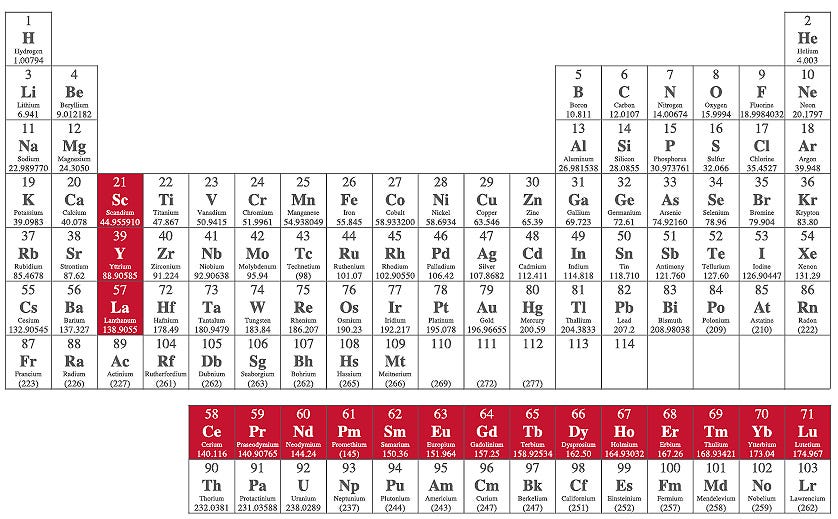
Rare-earth metals (Lanthanide) in the Periodic Table
But when I look at that periodic table now, I see something different. Seventeen elements highlighted in a small box at the bottom — the lanthanides, the rare earths — have become flashpoints in a global competition that may define the twenty-first century as much as the Space Race or the nuclear arms race defined the twentieth. These elements, whose names most people can’t pronounce and whose purposes most people don’t understand, have become instruments of geopolitical power.
The trade war between the United States and China is usually framed in terms of semiconductors and artificial intelligence, the glamorous technologies that capture headlines and imagination. But the deeper story is about materials — about who controls access to the physical substrates that make modern technology possible. China’s escalating rare earth export controls throughout 2024 and 2025, culminating in the October 2025 Foreign Direct Product Rule, represent perhaps the most sophisticated use of materials as a geopolitical weapon in modern history.
The asymmetry is stark and consequential. US semiconductor restrictions create performance gaps that slow Chinese technology development but don’t stop it — China demonstrated seven-nanometer chip production within years of facing export controls. Chinese rare earth restrictions create capability gaps that eliminate specific Western functionalities entirely until decade-long infrastructure buildouts complete. The United States cannot manufacture F-35 fighters, Virginia-class submarines, or wind turbines at scale without Chinese-processed heavy rare earths. There are no interim solutions, no eighty-percent alternatives, no clever workarounds using older technology. There is only binary dependence: access or no access, capability or no capability.
Western responses mobilized impressive resources. The US-Australia framework commits $8.5 billion. MP Materials received $400 million in DOD equity. Australia backed Iluka with AU$1.65 billion. Canada achieved genuine breakthrough with commercial rare earth metal production in 2024. Projects in Australia, Brazil, South Africa, and Vietnam collectively promise to reduce China’s processing market share from ninety percent to seventy-five percent by 2028 if they all succeed on schedule.
But structural vulnerability persists. China’s processing market share increased from eighty-two percent in 2020 to eighty-six percent in 2024 despite years of diversification rhetoric. Heavy rare earth separation maintains ninety-nine percent Chinese control with zero Western alternatives operational. Magnet manufacturing shows ninety to ninety-four percent Chinese concentration. Facility construction requires eight or more years on average, new mines require seventeen or more years, and iron nitride alternatives won’t reach commercial relevance until the 2030s at best. Economic viability depends on sustained pricing above $60 per kilogram for neodymium-praseodymium when 2024 saw lows of $50 to $52, threatening half of non-Chinese projects.
The fundamental lesson transcends rare earths. Control over enabling materials creates leverage exceeding control over end products. The capacity to manufacture inferior products exceeds the capacity to manufacture advanced products from unavailable materials. This is what China understood thirty years ago and what the West is relearning at considerable cost: in technology competition, unglamorous midstream processing capacity can matter more than cutting-edge design capabilities.
The periodic table still represents universal order. The physics remains true everywhere. But access to those elements, the capacity to process them, the ability to transform them into useful materials — those capabilities are profoundly local, historically contingent, and increasingly politicized. We’ve learned that even when everyone knows the science, some can do the engineering while others can only watch and wait.
I keep that periodic table on my wall as a reminder that the most important competitions often hide in the most ordinary places. We used to think progress was measured in gigahertz and nanometers, in artificial intelligence benchmark scores and screen resolutions. Perhaps the next century will be measured differently — in parts per million of dysprosium and terbium, in metric tons of separated neodymium oxide, in the years required to build a processing facility or open a new mine. Perhaps progress will be measured not in how fast our computers run but in who controls the materials that make the computers run at all.
Until Western processing capacity for heavy rare earths reaches commercial scale in the late 2020s or early 2030s — if it reaches commercial scale — China retains the ability to disable Western defense production, electric vehicle manufacturing, and clean energy deployment with export license denials. This is power that can’t be innovated around on policy-relevant timelines. It’s power rooted in physical infrastructure, trained workforces, and decades of accumulated expertise. It’s the periodic table turned into a geopolitical weapon.
And the question that keeps me awake at night remains unanswered: In a world where the elements themselves have become instruments of power, what does universality mean? What does progress mean? What does it mean to be a physicist in an age when physics is subject to export controls and the periodic table has become a map of geopolitical vulnerability?
The elements are still there, arranged in their orderly rows on my wall. But the world they represent has changed. And I’m not sure we’ve fully reckoned with what that means.
메타데이터
- post_id
- a608f558e734
- slug
- rare-earth-hard-power-a608f558e734
- url
- https://medium.com/@darwingosal/rare-earth-hard-power-a608f558e734
- canonical_url
- https://medium.com/@darwingosal/rare-earth-hard-power-a608f558e734
- author_url
- https://medium.com/@darwingosal
- status
- ok
- fetched_at
- 2026-06-23 17:05:31