The Ghost of Alan Turing: How a Forgotten 1950s Computer Can Save AI
AI’s future may depend less on more power and more on lessons from the earliest days of computing.
The Ghost of Alan Turing: How a Forgotten 1950s Computer Can Save AI
AI’s future may depend less on more power and more on lessons from the earliest days of computing.
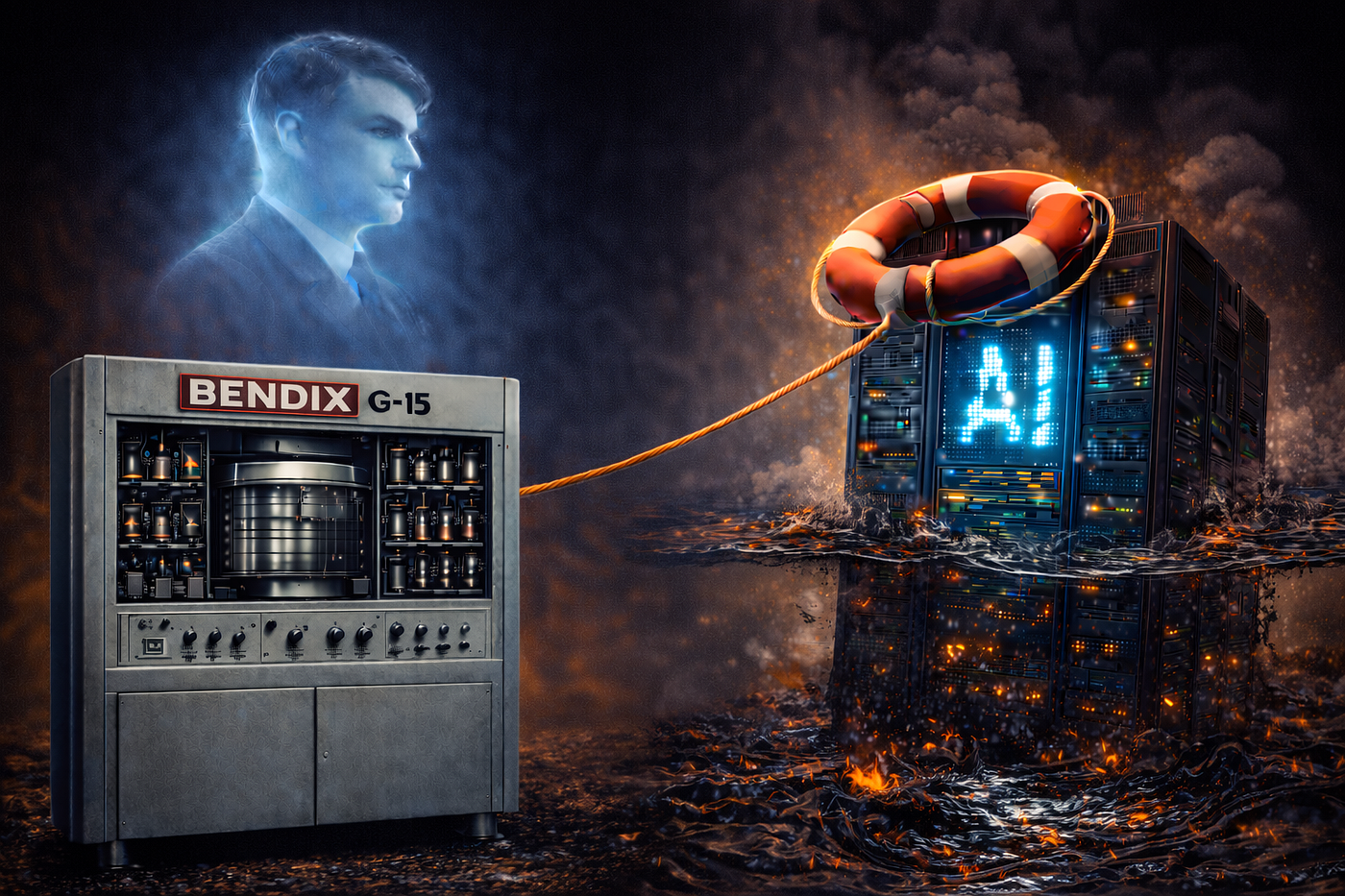
We are told that to “Save AI” we need a new generation of nuclear power plants. But what if we don’t need more power? What if we just need to stop paying the Von Neumann Tax? To find the answer, we have to follow the ghost of Alan Turing back to 1956, to a forgotten refrigerator-sized computer called the Bendix G-15.
Author’s note: A few months ago, I came across a vacuum-tube-based Write Amplifier card from a 1950s Bendix G-15 computer. As I looked at the elegance of the G-15’s bit-serial design, I recognized I wasn’t just looking at a relic — I was looking at a map for the future of AI.
In the high-stakes race for artificial intelligence, we have become obsessed with scale — more data, more chips, more heat. We treat the energy crisis as an inevitable law of physics, but it is actually a historical hangover. We are currently trying to power the 21st century using a 1940s philosophy of hardware. To find a way out, we have to look at the fundamental design philosophical difference between the two pioneers who helped shape the foundations of modern computing.
Two Computer Architectures: Bit-Serial vs. Bit-Parallel
To understand how we got to the power crisis we face, we have to look at the two giants who birthed the computer age.
Alan Turing was the British mathematician who broke the Enigma code and effectively invented the theoretical concept of the computer in 1936. His “Turing Machine” is a model that defines the very limits of what can be computed. He imagined a machine that operated like a high-speed tape, processing bits one-by-one in a continuous bit-serial stream. One of Turing’s most famous ideas is the “Turing Test,” originally described as the “Imitation Game,” a method for determining whether a machine can exhibit behavior indistinguishable from that of a human.
Where Turing imagined a machine processing a stream of bits, John von Neumann imagined a machine organized around memory. Both the program and the data would live together in the same place, ready to be fetched and processed. This simple idea — now known as the “von Neumann architecture” — made computers far easier to design, program, and generalize across many kinds of problems.
Over time, this led to a memory-centric, bit-parallel style of computing that worked with information in larger and larger parallel chunks. As memory grew, so did the scale of the data being moved back and forth between memory and processor.
Today, even our personal computers carry gigabytes of memory, constantly moving blocks of data as they work. This approach became the defining model of the 20th century. Every iPhone, laptop, and supercomputer today is essentially a von Neumann machine, and for most everyday computing needs, that architecture will continue to dominate.
The Hidden Cost of Von Neumann Architecture
But the power of von Neumann computing comes with a hidden tax. Moving blocks of parallel data requires massive amounts of energy. Today, as AI tries to move millions of these blocks every second, that tax has become a debt we can no longer afford to pay.
As we hit this energy wall, Turing’s bit-serial ghost is returning to show us a more efficient way. Harry Huskey, who had worked side-by-side with Turing, understood there was a simpler path. In 1956, he designed the Bendix G-15 to be a “Turing Machine” for the real world. It was a bit-serial masterpiece.
Harry Huskey & The G-15
The G-15 was a marvel of mid-century minimalism. While its contemporaries were room-filling giants like UNIVAC computers — which required thousands of heat-spewing vacuum tubes and massive dedicated power sources — the G-15 was roughly the size of a large refrigerator. Because of its bit-serial design, it functioned on just 450 vacuum tubes, a tiny fraction of the hardware used by the “Big Iron” machines of the day.
This efficiency allowed the G-15 to be plugged into a standard wall outlet and operated by a single person, making it arguably the world’s first personal computer, with a much lower price and operating costs than the big machines. Its memory was a high-speed magnetic drum, a spinning physical realization of Turing’s “tape” that proved a machine could be both compact and much more reliable than the big bit-parallel computers. It didn’t need a cooling plant or a small army of technicians; it just needed a clever programmer who understood the rhythm of its serial heart.
Why the Ghost is Returning
The reason the G-15’s ghost is returning today is that AI has changed the rules. Until very recently, training has dominated the computing power required, which led to the construction of huge, power hungry data centers across the world. But now, inference has become the dominant process used by AI computers. Inference is a predictable, repetitive stream of math. It is a perfect fit for the bit-serial choreography of the G-15.
If a von Neumann machine is a warehouse, where energy is wasted moving boxes from shelves to the loading dock, the G-15 is a conveyor belt.

In the age of AI, we increasingly need the belt more than the warehouse. We are no longer constrained by power-hungry parallel blocks of a von Neumann computer; we need the machine-efficient Turing stream.
The Shift Toward Bit-Serial Thinking
We are now seeing a structural shift in how chips are designed. For decades, “more parallel” was the only answer. But the industry is beginning to move toward specialized Inference Engines that look less like a von Neumann city and more like a Turing stream.
This movement is a fundamental pivot in hardware philosophy. Even Nvidia, the undisputed king of parallel GPUs, has begun emphasizing pipeline and dataflow oriented execution into its designs. Their latest “Tensor Cores” are increasingly focused on managing the precise flow of data through specialized pipelines to reduce the data-movement “tax” that drains so much power.
Other pioneers are going even further. Companies like Groq and SambaNova are championing “Dataflow” architectures. These chips ditch the complex management logic of traditional processors in favor of a “Deterministic” model. Like the Bendix G-15, these chips don’t have to guess where data is or manage traffic on the fly. Instead, a smart compiler choreographs the movement of every bit before the chip even turns on. The result is a machine where the math and the memory are perfectly in sync, eliminating the “wait time” and heat of traditional GPUs.
The Return of the Bit
Training AI models still need bit-parallel computation to build the models, but most of the AI access to models is to use inference to create answers. Perhaps the most “Turing-esque” development is the rise of Low-Precision Computing for model data. Instead of moving data in massive 32-bit or 64-bit chunks — a luxury our power grid can no longer afford — we can use a smaller, more efficient bit-stream.
Researchers at Microsoft and elsewhere are now proving that AI can run on “1-bit” models (such as BitNet). If an AI model only needs to know if a value is a “1” or a “-1,” we can return to the purest form of Harry Huskey’s vision: a bit-serial stream. Processing information one bit at a time is far more efficient. It allows us to shrink the hardware, lower the heat, and reduce the energy required for bit-parallel data hauling.
The Future is a Stream
We don’t need to rebuild our energy grid to fit our 1940s computer architecture. We need to rebuild our architecture to fit the reality of the 21st century. The Bendix G-15 was a map to a future we weren’t yet ready to inhabit. As someone who began my career when these ‘ghosts’ were still warm to the touch, I see the current power crisis not as a dead end, but as a long-overdue reunion with the elegant efficiency we abandoned decades ago.

This story is published on Generative AI. Connect with us on LinkedIn and follow Zeniteq to stay in the loop with the latest AI stories.
Subscribe to our newsletter and YouTube channel to stay updated with the latest news and updates on generative AI. Let’s shape the future of AI together!

메타데이터
- post_id
- a6c5d3d6428c
- slug
- the-ghost-of-alan-turing-how-a-forgotten-1950s-computer-can-save-ai-a6c5d3d6428c
- url
- https://generativeai.pub/the-ghost-of-alan-turing-how-a-forgotten-1950s-computer-can-save-ai-a6c5d3d6428c
- canonical_url
- https://generativeai.pub/the-ghost-of-alan-turing-how-a-forgotten-1950s-computer-can-save-ai-a6c5d3d6428c
- author_url
- https://medium.com/@bruce_wampler
- status
- ok
- fetched_at
- 2026-06-27 07:40:21