The Cowboy Comes Home
America is still haunted by the violent protector it pretends to have outgrown
Opinion
The Cowboy Comes Home
America is still haunted by the violent protector it pretends to have outgrown
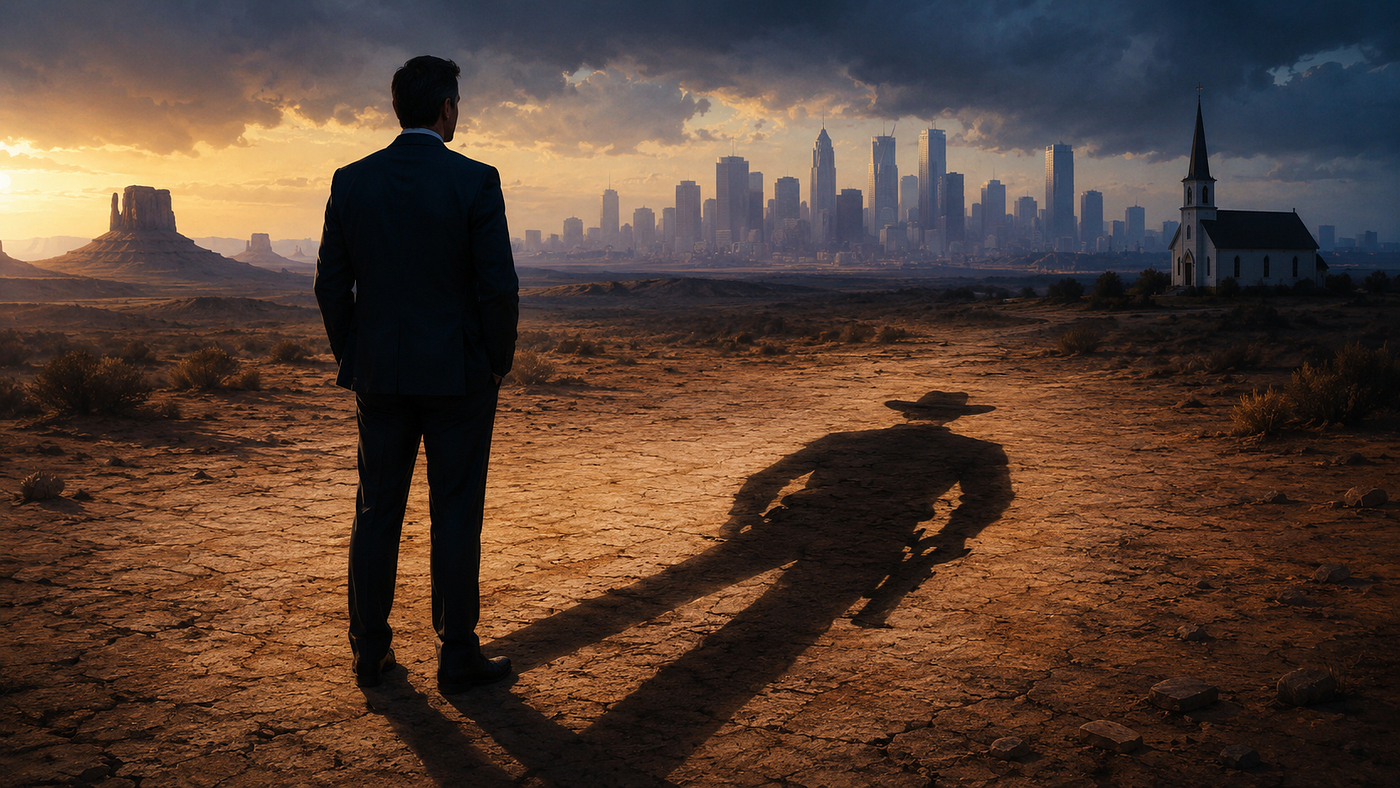
Cowboys
I had my mind blown by a TikTok today. In it, the creator dissected one of the central myths of the American psyche: that of the Cowboy. The lone drifter. The man beyond the law. The man society doesn’t fully allow into its community but keeps nearby in case violence becomes useful.
Remember those covered caravans moving across the Western frontier? Families, wagons, livestock, children, hunger, hope and fear all rolling into land already occupied by other people.
In the story America prefers to tell about itself, these settlers needed protection. So the cowboy/gunslinger appeared as their violent guardian. He did the dirty deeds. He killed, cleared the way, and made their path possible.
Our cowboy wasn’t just brave, he was useful. He carried out violence on behalf of people who still wanted to think of themselves as decent. He existed outside of the social order while acting in its interest.
These men were often deeply flawed — capable of homicide and eventually genocide; they could not have had much of a conscience. It meant their brutality and violence molded their operating systems and little prevented them from acting on their most base instincts.
Yet we celebrated them. Isn’t that curious?
I can’t tell you the number of times I cheered for Terrence Hill or Bud Spencer as they shot their way into my childhood memories — no matter how many people they took out along the way. As far as I knew, they only killed bad guys and that was enough to ignore the mountain of bodies. Ah Clint Eastwood, to my Caribbean eyes, you were everything in The Good, The Bad and The Ugly.
Who doesn’t remember John Wayne as ‘The Duke’, fighting on the frontiers of the West. I watched more than a few of his movies back in the day. I’ll be willing to bet few of us remember what he said about Native Americans to justify the actions of his character in the movies:
WAYNE: I don’t feel we did wrong in taking this great country away from them [Native Americans], if that’s what you’re asking. Our so-called stealing of this country from them was just a matter of survival. There were great numbers of people who needed new land, and the Indians were selfishly trying to keep it for themselves.
It’s that mentality — of allowing a select few of us to do what they want, as long as it’s in our interest — that constructs much of the American psyche.
We admire the figure who stands outside the rules and then pretend we still believe in rules. We say we want civilization but we keep making room for people who can violate civilization on our behalf.
It’s Batman turning grief into vigilantism to protect Gotham. It’s Walter White hiding behind his family to become a villain we cheer. It’s the Punisher channeling trauma with weapons. It’s coked out Sherlock Holmes. It’s the emotionally dead James Bond. It’s needy, narcissistic Homelander discovering that you don’t have to be good if you’re strong.
These characters are not identical but they circle the same wagon (if you will allow me 🙃) — they allow us to imagine that power used to inflict damage and death can be excused if it’s aimed in the right direction. That’s how we leave fiction and transition into politics.
Politics
Once you recognize the outsider acting in the interest of the in-group, modern politics becomes easier to understand.
What does it mean when a politician can say:
“I could stand in the middle of Fifth Avenue and shoot somebody, and I wouldn’t lose any voters, OK?”
It means he understands the archetype. It means he is presenting himself as the person who can do what the polite, procedural rule-bound people cannot do. He is telling us if his supporters believe he is fighting for them, then the normal standards will not apply.
That’s the modern day equivalent of a cowboy wearing a politician’s suit and patent leather shoes. He does not need to be kind. He does not need to be honest. He does not need to be faithful, humble, disciplined or decent. In fact he does not need to display any of the virtues for which we have a word (to paraphrase Sam Harris).
All he needs to do is convince his people that he stands between them and the enemy. Once that happens, scandal changes shape. It no longer proves unfitness. It can become evidence that he is rough enough for the job. Cruelty becomes authenticity. Vulgarity becomes courage. Lawlessness becomes proof he is not captured by the system.
Do you see the shadow of the cowboy in the psyche of our politicians? I can’t unsee it now.
Farther afield, the archetype again appears in foreign policy. If ‘those people’ in that part of the world have something we want, our modern gunslingers will take it. (They’re selfishly keeping it for themselves right John Wayne?)
If civilians are destroyed in the process, we’ll find a way to justify their deaths. It was regrettable. It was necessary. It was for security. It was for us.
But who is ‘us’?
That’s the real question isn’t it? Most ordinary people do not benefit from the violence carried out in their name. They inherit the shame, the blowback, and the taxes while the real benefits flow upward and inward toward the people who benefit from conquest.
The cowboy isn’t protecting society, he’s protecting a particular arrangement of power. It’s impossible to hide any longer.
Religion
Viewed through this lens, the current struggle over Christianity starts to look less confusing.
What kind of Jesus does a cowboy culture want? Does it want the Jesus who feeds the hungry, blesses the poor, welcomes the stranger, forgives enemies and condemns the rich?
Or does it want a harder figure? A tribal God. A punishing God. A God who loves the in-group, hates the out-group and blesses domination as righteousness.
The answer of course depends on what people think religion is for. If faith is a call to conscience, then mercy is central. The poor matter. The stranger matters. The prisoner matters. The sick matter. The enemy still retains humanity.
But if faith becomes a border wall around the in-group, then mercy starts to look suspicious. Compassion becomes weakness. Justice becomes a liberal slogan. And any teaching that restrains domination can be dismissed as softness.
This is how a movement can claim Jesus while working against the teachings most associated with him.
Aren’t we seeing this today?
Some political-religious movements have begun to treat mercy as weakness, even as they repackage wrath, punishment, hierarchy and national purification as divine strength. They do not need a God of love as much as a God of authorization. They want heaven to sign the permission slip for what they already wish to do.
It’s easy to spot these folks, they actively work to undercut the teachings of Jesus himself. They casually abuse the poor, callously harm the strangers among us, cynically worship wealth and celebrate the abuse of others. Their ideology embraces hatred, bigotry, misogyny, patriarchy and retribution, neatly wrapped in the flag and draped with a wooden cross.
And what do their supporters do? They turn blind eyes to their ersatz leaders, which further encourages them to lose restraint. Unbound by the law and by morality itself, there is no limit to their actions, no line they won’t cross, no crime they can’t commit.
They are in effect, untouchable. This is the old frontier cowboy once again resurrected in religious robes and three piece suits, taking action on our behalf. Even if it spills an ocean of innocent blood.
Our cowboy doesn’t need clean hands if he’s killing the right enemies and the God attached to this kind of politics does not need mercy when wrath is more useful.
The Mutation
The story of the cowboy in the American psyche isn’t dying. It’s mutating.
The archetype does not belong to any one party, one ideology or one historical period, it reappears whenever people believe institutions have failed and normal channels no longer protect them.
When people feel abandoned, some begin to romanticize acts of violence as justice. The public reaction to Luigi Mangione showed how quickly the cowboy myth can migrate from one political direction to another.
The point is not that such violence be celebrated, but that we should be alert to the fantasy of the righteous outsider particularly when people believe that the official systems and institutions no longer support them.
One generation gets the gunslinger. Another gets the vigilante. Still another gets the strongman. The details change but the structure remains the same.
We get hurt, we cannot find justice in the legal system/s so we look for a savior: someone who does not care about the rules.
And once very group begins searching for its own cowboy, society stops being a society and becomes a battlefield of competing grievances. Everyone will want a champion; someone who cannot be restrained. They will encourage people to seek justice without process, victory without mercy and protection without accountability.
We’re seeing all of this today. All of it. But the days of the cowboy are numbered. People no longer accept the price (paid in blood) for their salvation. (Yet another interesting parallel to Christianity no?)
Coming Home
So what replaces the cowboy?
In New York today we may be seeing a new myth being born. Mayor Mamdani has managed to bring together the most diverse city in America. It was never more evident than in the final moments of watching the Knicks take game 4 by a fingertip with 1 second to spare.
It literally brought me to tears. It felt like an emotional release.
That’s the energy shaping New York right now. Unity. Hope. Celebration. Community. It’s the one thing our cowboy could never find as he drifted across the plains.
Our cowboy is lonely by design. He rides in, solves the problem with force then he rides out again. He doesn’t really belong the the world he protects. But a city is the opposite of that myth.
A city requires co-existence. It requires strangers sharing trains, sidewalks, parks, schools, hospitals, restaurants, arguments, victories and grief. It requires people to remain in relationship after the adrenaline fades.
This is the energy I find more interesting today: the crowd that decides it still belongs to itself. Not the fantasy of purification but the ordinary adventure of pluralism. Not the violent outsider but the challenging work of living together without needing someone to destroy an enemy on our behalf.
A cowboy can win a shootout. He cannot build a community. And as we increasingly face challenges in our brave new world, it’s apparent only community can protect us. Our cowboy is slowly becoming obsolete.
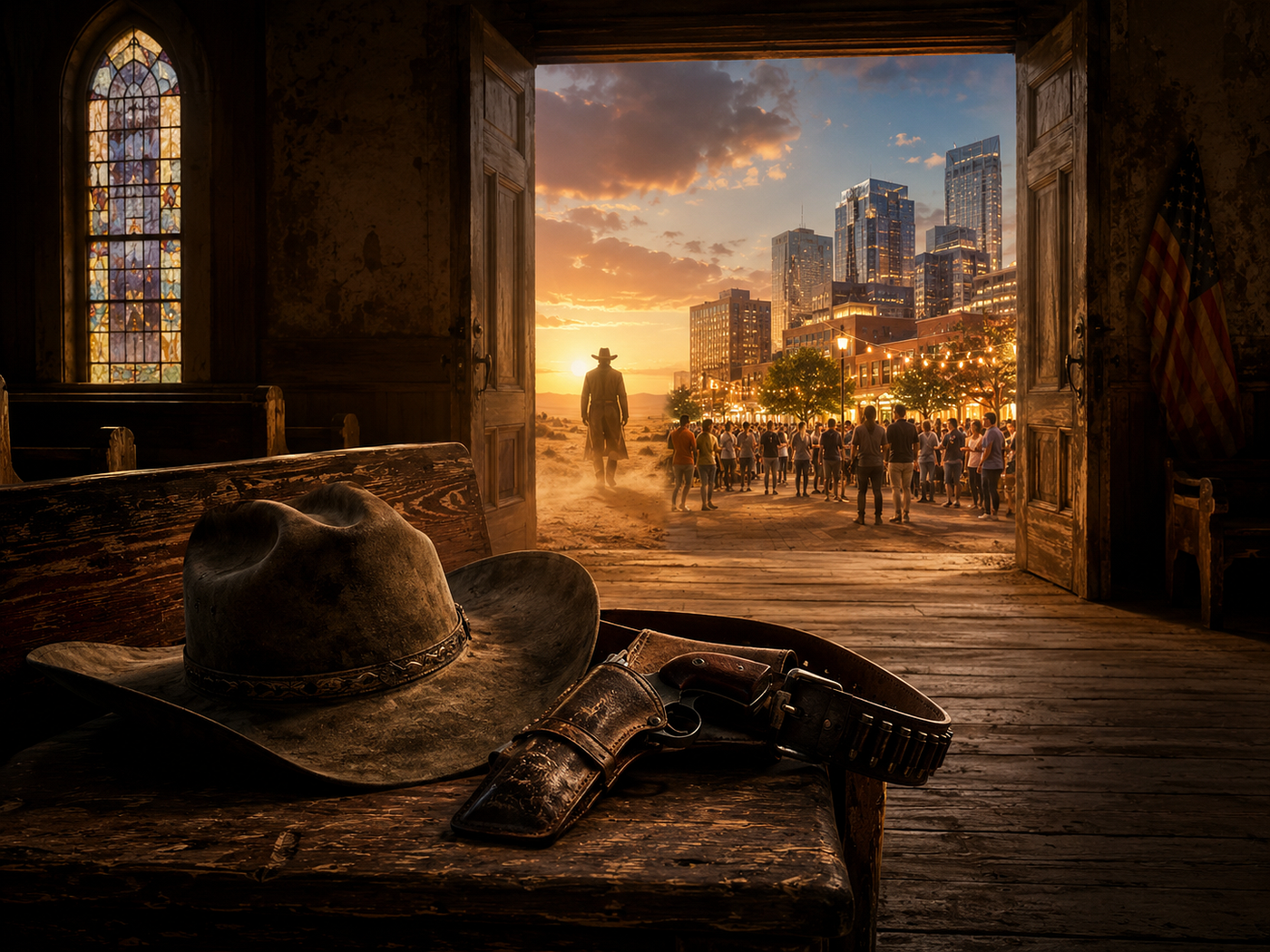
It’s time for him to come home and retire his guns. Not because the world is safe. Not because injustice has disappeared. Not because there are no predators left.
But because a society that can only imagine protection through violence has missed the greater lesson that we are stronger together than we are apart. That there are tools in the toolkit other than bloodshed and savagery. And that we can create better laws than submitting to the law of the jungle.
The cowboy belongs in the past. Let him hang up his weapons. Let him sit on the porch and tell his stories. We cannot let him govern. We cannot let him preach. We must not let him become our God. All he speaks is the language of violence and there are better ways to get things done.
Just my two cents. As always, Walk Good. Mitch.
p.s. Knicks in 5!!!!! If they take it, New York will have a meltdown. I wish I could be there to vibe in that energy. It. Will. Be. Epic.
메타데이터
- post_id
- a72d2220f983
- slug
- the-cowboy-comes-home-a72d2220f983
- url
- https://medium.com/open-microphone/the-cowboy-comes-home-a72d2220f983
- canonical_url
- https://medium.com/open-microphone/the-cowboy-comes-home-a72d2220f983
- author_url
- https://medium.com/@sacredkarailee
- status
- ok
- fetched_at
- 2026-06-16 19:09:56