Osuwa-don
A restless spirit. A new wife. A mysterious voice calling out in the dark. Is it jealousy from beyond the grave, or something else?
Osuwa-don
A restless spirit. A new wife. A mysterious voice calling out in the dark. Is it jealousy from beyond the grave, or something else?
Not a Medium member? You can read this post for free here: 👉 Read without login
Brief Cultural Background
The Mourning Period (喪中 / Mochū)
In traditional Japanese culture, when a close family member passes away, the bereaved observe a one-year mourning period known as mochū (喪中).
During this time, it is customary to refrain from participating in celebrations or happy occasions, including weddings, festivals, or even sending New Year’s cards.
This practice is rooted in the desire to honor the spirit of the departed and to allow space for quiet reflection and remembrance.
The protagonist in this tale follows this custom with sincerity and restraint.
While remarrying sooner was legally permitted, doing so would have been seen as hasty or even spiritually disrespectful.
A Happy Couple in Edo
In Asakusa Abekawachō in Edo, there was a kimono shop called Jōshūya. The shop owner was Tokusaburō. His close friends and relatives would affectionately call him Toku-san. His wife’s name was O-someh. They were known as a deeply loving couple, and everyone around them admired their close bond with a smile.
One day, O-someh fell ill and took to her bed. At first, they thought it was just a cold, but her condition steadily worsened. They brought in every famous doctor in Edo, but none could cure her.
After being bedridden for a while, O-someh spoke to Tokusaburō, who had been faithfully watching over her bedside.
“I feel the angels will come to take me to heaven soon… You and everyone at the shop were so kind to me. I’ve lived a blessed life. I have no regrets.
After I’m gone, you’ll probably remarry. I don’t resent that. I only hope your new wife will be kind-hearted and devoted. But if she isn’t… if she fails to treat you well… that’s the only thing that worries me.”
Three days later, O-someh passed away.
Tokusaburō was heartbroken at losing his beloved wife, but held himself together with dignity as the head of a well-established household. He carried out the year-long mourning period with sincere devotion.
After the first anniversary memorial service had passed, his relatives gathered at his home.
“Toku-san, now that the mourning is over, don’t you think it’s time to consider a second marriage?”
“Just before she died, O-someh told me something… her words still echo in my ears. I don’t feel ready yet to take a new wife.”
“We understand, but if you keep on living in loneliness, wouldn’t that only make O-someh sad too? If you find a good woman and start a new, happy life, we’re sure she would be glad for you.”
They continued to urge him gently.
“By the way, do you remember Osuwa, the maid who used to work at your shop? She was hardworking and good-natured, and O-someh really adored her. They got along so well that people thought they looked like sisters despite the age gap. We’re certain that O-someh wouldn’t have held a grudge even if Osuwa became your second wife.”
Pressed on all sides, Tokusaburō finally said,
“Very well. If that would also bring peace to O-someh’s spirit, I’ll leave the matter in your hands. Please take care of everything.”
The arrangement went smoothly, and Tokusaburō married Osuwa. She was diligent, kind to the shop workers, devoted to her husband, and never two-faced. Their marriage was harmonious, and everyone was relieved.
A Strange Sound Disturbs the Night
About three months after their marriage, Tokusaburō stood up at night to use the toilet. Just as he returned to his room, he heard a strange sound coming from outside,
“Pat-a-pat, pat-a-pat… O-su-wa-don… O-su-wa-don…”
“Who’s there? Did someone just call Osuwa’s name? …Just an illusion?”
The next night, at around the same time,
“Pat-a-pat, pat-a-pat… O-su-wa-don… O-su-wa-don…”
This strange occurrence repeated night after night, until the shop apprentices began to whisper,
“It must be O-someh’s ghost! She’s jealous of how close the master and Osuwa have become!”
The rumor eventually reached Osuwa’s ears and began to trouble her. She grew increasingly anxious and began to waste away. Tokusaburō became concerned and called his head clerk, Seizō, for advice.
“Seizō, you’ve heard it too. Someone’s been calling Osuwa’s name at night. I want you to find out who it is.”
“Shall we ask that rōnin who lives in a rowhouse behind the shop? He might be able to help.”
“A rōnin? Ah, yes, I believe his name was Mr. Hasegawa.”
“That’s right. They say he’s a master swordsman. If it’s a monster or spirit, I bet he could cut it down in a single stroke.”
Encouraged by this, Tokusaburō visited Hasegawa the next day with Seizō. Bowing deeply, he explained the situation and offered three ryō in gold. Hasegawa accepted, and the deal was struck.
That night, Hasegawa seated himself squarely in the courtyard of Tokusaburō’s home, waiting for the one calling Osuwa’s name.
As the night grew late…
“Pat-a-pat, pat-a-pat… O-su-wa-don… O-su-wa-don…”
The moment the sound echoed from beyond the wall, Hasegawa leapt out,
“Wait! Stop right there!”
A man immediately threw himself to the ground.
The soba vendor begs for mercy as a ronin draws his sword.
“P-please, have mercy! I’m not a suspicious person! Spare my life!”
“Not suspicious? Then why have you been calling the lady of this house by name every night?”
“I swear, I haven’t! You must be mistaken!”
“Don’t lie! I just heard you say ‘Osuwa-don’!”
“No, sir! I didn’t say that! As you can see, I’m a soba vendor. What I said was ‘Soba! Udon!’ It’s just how I call out to sell my noodles!”
“Then what about the pat-a-pat noise?”
“That was me fanning my brazier with this uchiwa to boil water!”
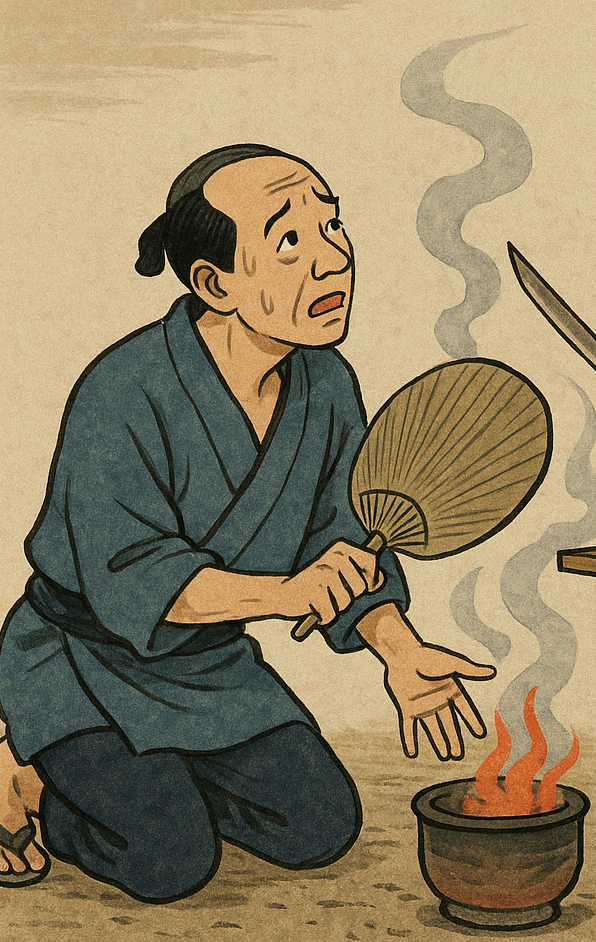
The vendor’s uchiwa, the innocent culprit behind the ‘pat-a-pat’.
Hasegawa was dumbfounded.
“So the pat-a-pat was your fan, and the ‘Osuwa-don’ was really ‘Soba! Udon!’ …Hmm. I see. That all makes sense now. Still, there’s a problem. You see, the master of this house hired me to slay a monster, and I’ve already taken the reward. I can’t go back empty-handed. To prove the job’s done… I’ll need to take your head as a testimonial scapegoat!”
“Wh-what?! Please have mercy! I’m just trying to make an honest living by pushing this cart at night! But… I also understand your position. If you need something to show, let me offer you a substitute!”
“A substitute? What do you mean?”
“Here, I have some soba flour. Please take this instead!”
“You’re offering soba flour as a substitute for your head?”
“Yes! You said you need a scapegoat. So knead it as you please!”
🎧 Prefer to listen instead?
👉 Click here for an audio overview of this post Audio overview created with Google’s NotebookLM
☕ If today’s tale brought a smile, you can support future stories here: https://www.buymeacoffee.com/akisasayama
These posts carry echoes of old Rakugo, comic tales retold, gently polished with care. Behind each laugh, a slow book is taking shape, on the quiet spirit within words.
Thank you. One story at a time. One ripple at a time. 🙏
메타데이터
- post_id
- a7600bfc205b
- slug
- osuwa-don-a7600bfc205b
- url
- https://medium.com/the-silent-ink/osuwa-don-a7600bfc205b
- canonical_url
- https://medium.com/the-silent-ink/osuwa-don-a7600bfc205b
- author_url
- https://medium.com/@akiliteracian
- status
- ok
- fetched_at
- 2026-07-19 08:56:17