How the Major Civil Rights Acts of the 1960s Started with a Bang and Ended with a Whimper
How America Let Its Strongest Civil Rights Laws Wither into Symbols
How the Major Civil Rights Acts of the 1960s Started with a Bang and Ended with a Whimper
How America Let Its Strongest Civil Rights Laws Wither into Symbols
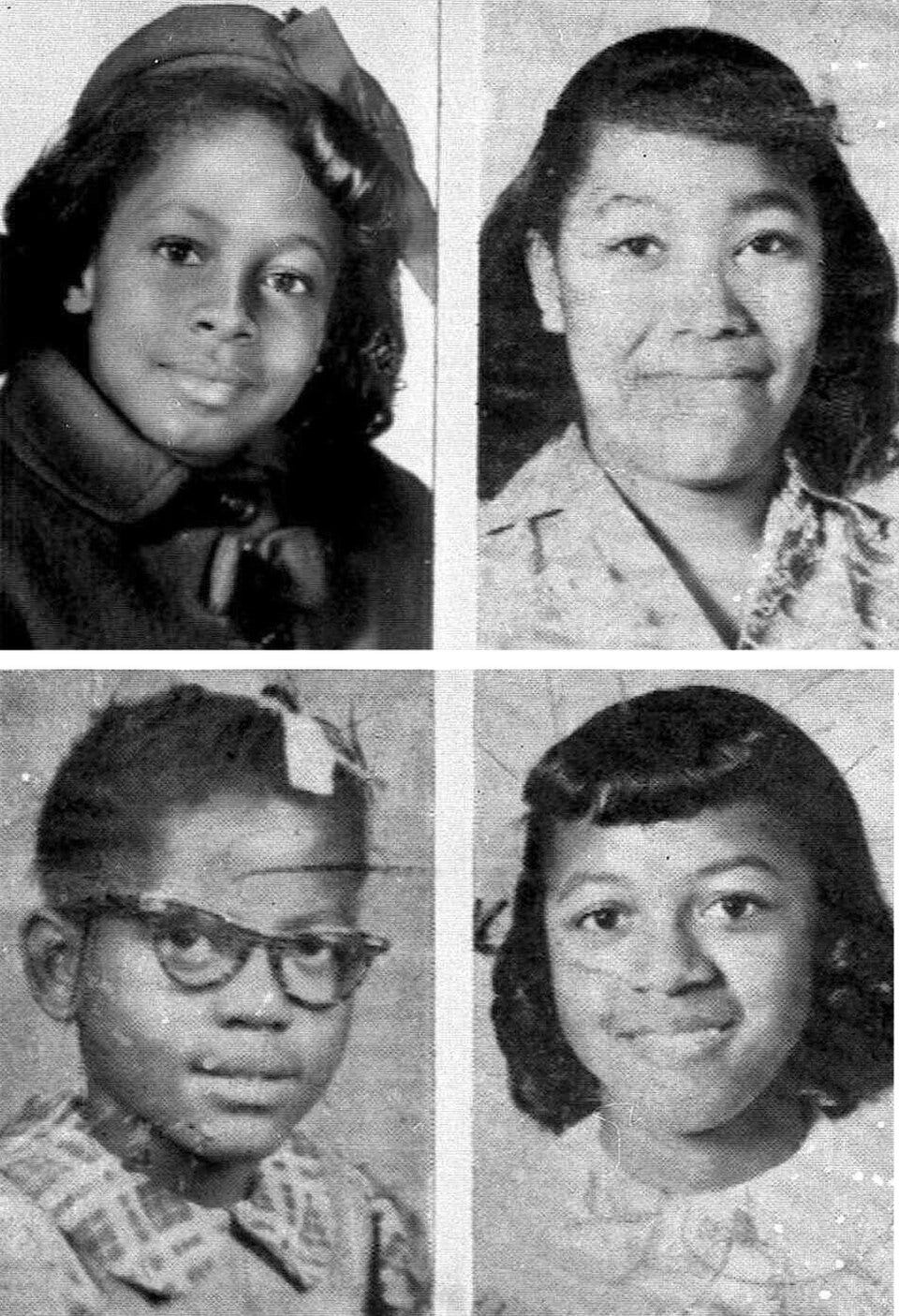
16th Street Bombing Victims Public domain, via Wikimedia Commons
I was a child during the 1960s, which was considered the high point of the civil rights movement. I wasn’t aware of the inseparable ties between protests and violence and the ultimate passage of the three major legislative Acts. None of them simply occurred.
The Civil Rights Act of 1964 was preceded by years of nationally recognized violence against Black people and civil rights protests. These included the murder of Emmett Till, the Montgomery Bus Boycott, the forced desegregation of schools, including Little Rock Central, and the Sit-In Movement. Drafting of the Civil Rights Act began in 1963 after the Birmingham Campaign, initiated by Fred Shuttlesworth of the Alabama Christian Movement for Human Rights and joined by Martin Luther King, Jr, and James Bevel of the SCLC. It was then that King wrote his “Letter from a Birmingham Jail,” in response to 8 white pastors urging an end to the protests and the use of the courts instead. Bevel initiated the Children's Crusade, a mass nonviolent protest led by Black schoolchildren, designed to overwhelm Birmingham’s jails and break the political stalemate after weeks of adult-led demonstrations had stalled.
Public Safety Commissioner Bull Connor responded by attacking the children with high‑pressure fire hoses, police dogs, and making mass arrests. Television cameras captured children being knocked down by hoses and attacked by dogs. These images shocked the nation and the world. The Ku Klux Klan stepped up bombings targeting Black leaders and churches. Subsequent riots forced Kennedy to send federal troops to restore order. This crisis accelerated the administration’s decision to send a comprehensive civil rights bill to Congress on June 19, 1963.
Southern legislators immediately stalled the bill until four little girls were killed in the bombing of a Birmingham church on September 15, 1963. It happened early on a Sunday morning, just before the church’s Youth Day service. The victims were:
- Addie Mae Collins (14)
- Denise McNair (11)
- Carole Robertson (14)
- Cynthia Wesley (14)
The Ku Klux Klan attack became one of the most galvanizing acts of racial terror in the civil‑rights era, helping build national support for what would become the Civil Rights Act of 1964. The murder of four Black girls shocked the legislative process in Washington back to life. The bombing came less than a month after the massive March on Washington for Jobs and Freedom. With an estimated 250,000 participants, the March on Washington was the largest political demonstration the United States had ever seen and the largest civil rights protest in American history at that point. The Civil Rights Act of 1964 did not just happen. It was the response to years of protests and violence. The beating and killing of Black children, which was shown on national television, was enough to force Congress to act.
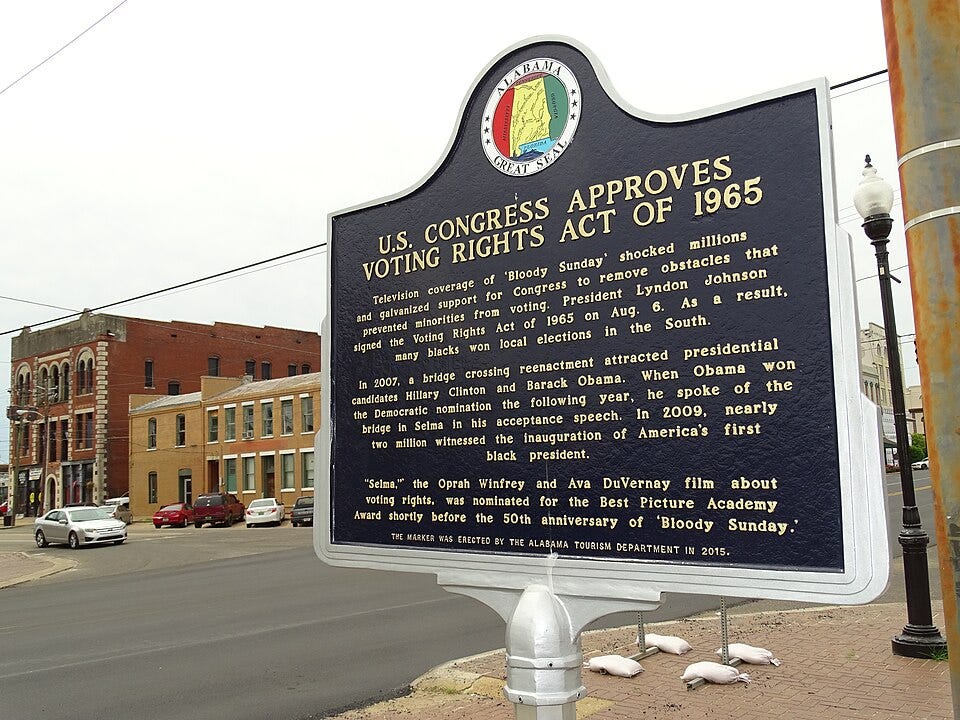
The pattern repeated itself with the Voting Rights Act of 1965. After the Civil Rights Act of 1964 passed, President Lyndon Johnson told civil rights leaders he supported voting rights “eventually,” but not yet. Congressional leaders warned him that Southern Democrats would filibuster, and Northern Democrats were exhausted from the 1964 civil rights fight. Republicans were divided, and the bill would be “politically impossible.” Johnson delayed sending a bill, and no voting rights bill was moved in 1964.
In February 1965, Johnson’s team began drafting a bill, but Congress was not moving. Attorney General Nicholas Katzenbach and the Justice Department began preparing a strong bill with Federal examiners, preclearance, and automatic coverage formulas. Still, Congress had not taken up the issue. Southern Democrats were preparing a filibuster. Northern Democrats were hesitant. Republicans wanted a weaker bill.
On Sunday, March 7, 1965, about 600 Black citizens of Selma, Alabama, began a peaceful march to Montgomery to demand what the 15th Amendment had promised, but Alabama had denied for nearly a century: the right to vote.
The march was organized because Sheriff Jim Clark’s deputies had beaten and arrested Black residents trying to register. Only 2% of eligible Black adults in Dallas County were registered to vote. An Alabama state trooper had killed Jimmie Lee Jackson during a voting‑rights protest two weeks earlier.
Led by John Lewis and Hosea Williams, the marchers crossed Selma’s downtown and approached the Edmund Pettus Bridge, named for a Confederate general and Ku Klux Klan leader. At the crest of the bridge, they saw a line of Alabama state troopers, Dallas County sheriff’s posse, and mounted officers.
Major John Cloud ordered the marchers to disperse. Before they could respond, troopers advanced. What followed was a state‑sanctioned assault on unarmed citizens. Troopers charged with clubs, mounted officers rode into the crowd, and tear gas filled the air. Dozens were injured, including John Lewis, who suffered a fractured skull. All that wouldn’t have mattered, except that the violence was broadcast on national television that night, forever to be known as Bloody Sunday. Americans saw Black citizens beaten for attempting to walk to their state capital to demand the right to vote. That’s what it took to pass the Voting Rights Act of 1965.
Work on the Fair Housing Act began in Congress in 1966, two full years before it finally passed in April 1968. President Lyndon B. Johnson, fresh off the Voting Rights Act victory, pushed Congress to take up open housing as the next major civil‑rights priority. The bill was introduced in 1966 as part of Johnson’s “Great Society” agenda. It aimed to ban discrimination in the sale, rental, and financing of housing, but immediately faced fierce opposition from Southern Democrats, Northern and Western suburban Democrats, Republicans, and real estate and landlord lobbies. The 1966 bill died in the Senate after a filibuster threat. Congress tries again, but the bill stalls.
A revised version was introduced in 1967, but House committees refused to move it, and Senate opponents again threatened a filibuster. Suburban lawmakers feared backlash from white homeowners, and Johnson lacked the leverage he had in 1964–65. Too much time had passed from Bloody Sunday, and memories were short.
By March 1968, the bill had been pending for two years and was going nowhere. Johnson was frustrated and publicly blamed Congress for inaction. Fair housing was considered the least popular of all civil rights proposals.
On April 4, 1968, Martin Luther King, Jr., was assassinated. King’s murder triggered uprisings in more than 100 cities. The national crisis changed the political calculus overnight. After two years of obstruction, Congress moved in a matter of days.
To quickly summarize the relative strengths of the three bills. The Civil Rights Act and Voting Rights Act were unusually strong because they had federal enforcement. Unlike Brown v. Board, which supposedly ended segregation but was to be carried out by the meaningless “with all deliberate speed.” Integration took over twenty years to be taken seriously in much of the nation because Brown v. Board had no teeth.
Civil Rights Act of 1964 (CRA)
Its strength came from institutional enforcement, not just moral language.
- Title II (public accommodations): Gave the Justice Department authority to sue segregated businesses.
- Title VI: Allowed the federal government to cut off funding to discriminatory programs — a massive leverage tool.
- Title VII: Created the EEOC, a permanent federal agency empowered to investigate employment discrimination.
Why this mattered: For the first time, civil‑rights protections did not depend on individual victims filing lawsuits. The federal government itself could act.
Voting Rights Act of 1965 (VRA)
The VRA’s strength was even more dramatic.
- Section 5 preclearance: Jurisdictions with histories of discrimination had to get federal approval before changing voting laws.
- Section 4(b) coverage formula: Automatically identified those jurisdictions.
- Federal examiners: Could register voters directly when local officials refused.
- Suspension of literacy tests: Eliminated the main tool of Jim Crow disenfranchisement.
Why this mattered: The VRA did not wait for discrimination to happen; it prevented it.
The VRA was once widely considered the most effective civil‑rights law in U.S. history.
Both laws developed (through courts and regulations) a disparate‑impact standard, meaning:
- Plaintiffs did not need to prove racist intent.
- They only needed to show that a policy had discriminatory effects.
This made enforcement far more realistic because intent is almost impossible to prove.
Fair Housing Act of 1968
The Fair Housing Act created… HUD complaint procedures.
HUD could:
- Mediate
- Conciliate
- Refer cases
But it could not:
- Issue binding orders
- Impose penalties
- Launch systemic investigations with teeth
Result: Enforcement depended on individual victims filing complaints — the weakest possible model.
An example of how the Fair Housing Act worked is how it affected Realtors. Realtors were generally required to include an addendum to contracts, signed by the buyer and seller, promising not to discriminate. The addendum protects the Realtor and their broker, but has little impact on activity. Agents still showed properties where the buyers wanted to go and didn’t show homes they were unlikely to buy, which is illegal under the law.
The Fair Housing Act
Before 1968, it was perfectly legal to refuse to sell or rent to someone because they were Black, Latino, Jewish, Asian, or Native. The FHA ended that era on paper, but not always in reality.
- On October 15, 1973, the DOJ sued Fred Trump, Donald Trump, and Trump Management, Inc. in the U.S. District Court for the Eastern District of New York.
- The complaint alleged systemic racial discrimination across 39 buildings with more than 14,000 apartments, including:
- Steering Black and Puerto Rican applicants away from certain buildings
- Telling Black applicants that no units were available while offering units to white applicants
- Using codes on applications to mark race (C for Colored)
These allegations were supported by “tester” evidence — paired Black and white applicants who received different treatment.
- The case ended in a consent decree in 1975, which:
- Prohibited discriminatory rental practices
- Required the Trumps to familiarize themselves with the Fair Housing Act
- Included a standard “no admission of liability” clause
The DOJ sued the Trump Organization again in 1978 because investigators concluded the company was not following the 1975 consent decree.
The government alleged that Trump Management:
- Continued discouraging Black applicants
- Failed to submit required reports
- Did not advertise to minority communities as required
- Maintained discriminatory rental patterns
This second case was essentially a “you didn’t do what you promised” enforcement action.
- The Trumps entered into a new agreement in 1979.
- It extended federal oversight and required additional compliance measures.
- Again, the settlement included no admission of wrongdoing, but it reaffirmed the government’s findings.
The Fair Housing Act had no teeth, and unscrupulous people throughout the real estate industry tended to ignore it.
The three major civil rights statutes of the 1960s were not weakened in the same way. Each was undermined through a different combination of judicial narrowing, congressional inaction, administrative rollback, and local resistance. Together, these forces eroded the enforcement architecture that once made them transformative.
1. Civil Rights Act of 1964 — weakened through judicial narrowing and regulatory retreat
A. Courts narrowed what counts as discrimination
Over time, federal courts:
- Raised the burden of proof for employment discrimination
- Limited class‑action suits
- Restricted disparate‑impact claims
- Expanded employer defenses
This shifted the CRA from a group‑protection law to a case‑by‑case litigation model, which is far weaker.
B. Congress never updated the statute
Unlike the VRA (which Congress renewed repeatedly until 2006), the CRA has never been modernized to address:
- Algorithmic discrimination
- Gig‑economy employment
- Modern workplace retaliation structures
C. Administrative enforcement has fluctuated
Different administrations have:
- Reduced EEOC staffing
- Narrowed enforcement priorities
- Limited pattern‑or‑practice investigations
- The current administration has almost exclusively focused on protecting the civil rights of white people, who need protection the least.
Result: The CRA still matters, but its structural power has been diluted.
2. Voting Rights Act of 1965 — weakened primarily by the Supreme Court
The VRA is the clearest example of judicial dismantling of a once‑powerful law.
A. Shelby County v. Holder (2013)
Struck down the Section 4(b) coverage formula, disabling Section 5 preclearance. This removed the VRA’s strongest tool — the ability to stop discriminatory laws before they took effect.
B. Brnovich v. DNC (2021)
Narrowed Section 2, making it harder to challenge discriminatory voting rules even after they cause harm.
C. Congressional inaction
Congress has not restored preclearance despite multiple attempts.
D. State‑level countermeasures
After Shelby, states enacted:
- Voter‑ID laws
- Polling‑place closures
- Purges of voter rolls
- Restrictions on mail voting
- Redistricting maps that dilute minority voting power
Result: The VRA went from the strongest civil‑rights law in U.S. history to a weakened statute that now operates mostly through slow, reactive litigation.
E. Louisiana v. Callais
The Supreme Court has finished the job it started in 2013 and killed the Voting Rights Act of 1965. Several states had acted in anticipation of the SCOTUS decision, and others are already reacting. What was once the strongest of the Civil Rights Acts is now dead. Damn, Damn, Damn, as Florida Evans once said.
3. Fair Housing Act of 1968 — weakened from the start, then further eroded
The FHA was born weak and only grew weaker.
A. Weak enforcement architecture (1968–present)
HUD lacked:
- Binding enforcement power
- Penalties
- Systemic investigative authority
The law relied on individual complaints, which cannot address structural segregation.
B. Courts limited disparate‑impact protections
Although disparate impact was eventually recognized, courts:
- Raised evidentiary burdens
- Expanded defenses for landlords and lenders
- Limited remedies
C. Local zoning became the new segregation tool
Because the FHA did not override local zoning, cities used:
- Single‑family zoning
- Density bans
- Minimum lot sizes
- Exclusionary permitting
These tools preserved segregation without violating the letter of the law.
D. Administrative rollbacks
Different administrations weakened:
- Affirmatively Furthering Fair Housing (AFFH) rules
- Data collection
- Enforcement priorities
Result: The FHA outlawed discrimination but never dismantled the systems that produce it.
For all practical purposes, the great civil rights statutes of the 1960s now function more as historical landmarks than living protections. The Civil Rights Act, the Voting Rights Act, and the Fair Housing Act still exist on paper, but the enforcement architecture that once made them transformative has been hollowed out by decades of judicial narrowing, congressional inaction, administrative retreat, and local resistance. What remains is a set of rights that are theoretically available yet structurally inaccessible — protections that depend on individual lawsuits rather than the federal machinery that once acted automatically on behalf of entire communities.
The Voting Rights Act offers the clearest example. After Shelby County v. Holder and Brnovich v. DNC, the core mechanisms that prevented discrimination before it occurred were dismantled. The Civil Rights Act has been chipped away through higher burdens of proof, limits on class actions, and shrinking federal enforcement capacity. The Fair Housing Act, already the weakest of the three, has been unable to overcome the zoning regimes and market structures that maintain segregation. Together, these laws have been weakened to the point where their practical power no longer matches their symbolic weight.
The aftermath of the George Floyd protests made this erosion unmistakable. In 2020, the country witnessed the largest civil rights mobilization in modern history. For a moment, it appeared that Congress might respond with structural reform, including the John Lewis Voting Rights Advancement Act, which would have restored the VRA’s preclearance system. Instead, the legislative window closed, and the only federal action that emerged was the establishment of Juneteenth as a national holiday. Symbolically meaningful, yes. Structurally transformative, no.
The pattern is now clear: when confronted with demands for substantive civil‑rights protections, the political system increasingly substitutes commemoration for enforcement. The result is a civil rights framework that honors the past while leaving the present largely unprotected. It took 100 years for America to get serious about civil rights after the Civil War; the following sixty years have been spent making America great again by restoring the previous norms. The remaining question is, where do we go from here? The gains of the 1960s came at an extreme cost, including the cracked skull of John Lewis, the death of four young girls on Youth Sunday, and the assassination of MLK. We cannot let it go to waste.
메타데이터
- post_id
- ab380e39cc63
- slug
- how-the-major-civil-rights-acts-of-the-1960s-started-with-a-bang-and-ended-with-a-whimper-ab380e39cc63
- url
- https://medium.com/afrosapiophile/how-the-major-civil-rights-acts-of-the-1960s-started-with-a-bang-and-ended-with-a-whimper-ab380e39cc63
- canonical_url
- https://medium.com/afrosapiophile/how-the-major-civil-rights-acts-of-the-1960s-started-with-a-bang-and-ended-with-a-whimper-ab380e39cc63
- author_url
- https://medium.com/@williamspivey
- status
- ok
- fetched_at
- 2026-06-12 18:14:10