Custom CRM Development Mistakes Businesses Should Avoid
Custom CRM development offers a great deal of possibilities, a system perfectly tailored to your own sales process rather than following…
Custom CRM Development Mistakes Businesses Should Avoid
Custom CRM development offers a great deal of possibilities, a system perfectly tailored to your own sales process rather than following someone else’s template. This promise is valid only if the project is able to steer clear of a number of mistakes which are recurrent not only in different industries but also in all company sizes. In fact, the majority of them do not pertain to the quality of the code at all. Rather, they are choices made either too early or too late, or not made at all. Here is what typically gets messed up, and the best ways to prevent it from getting to you.
Why Do Custom CRM Projects Fail?
The CRM market has crossed $126 billion in 2026, and 91% of companies with ten or more employees now run one. Adoption clearly isn’t the problem. Yet industry research still puts CRM failure rates anywhere between 20% and 70%. What’s telling is where the blame lands: over 60% of failed implementations trace back to people and process issues, not the software. Only 6–10% come down to a genuinely bad platform. Most CRM failures are self-inflicted, and avoidable.
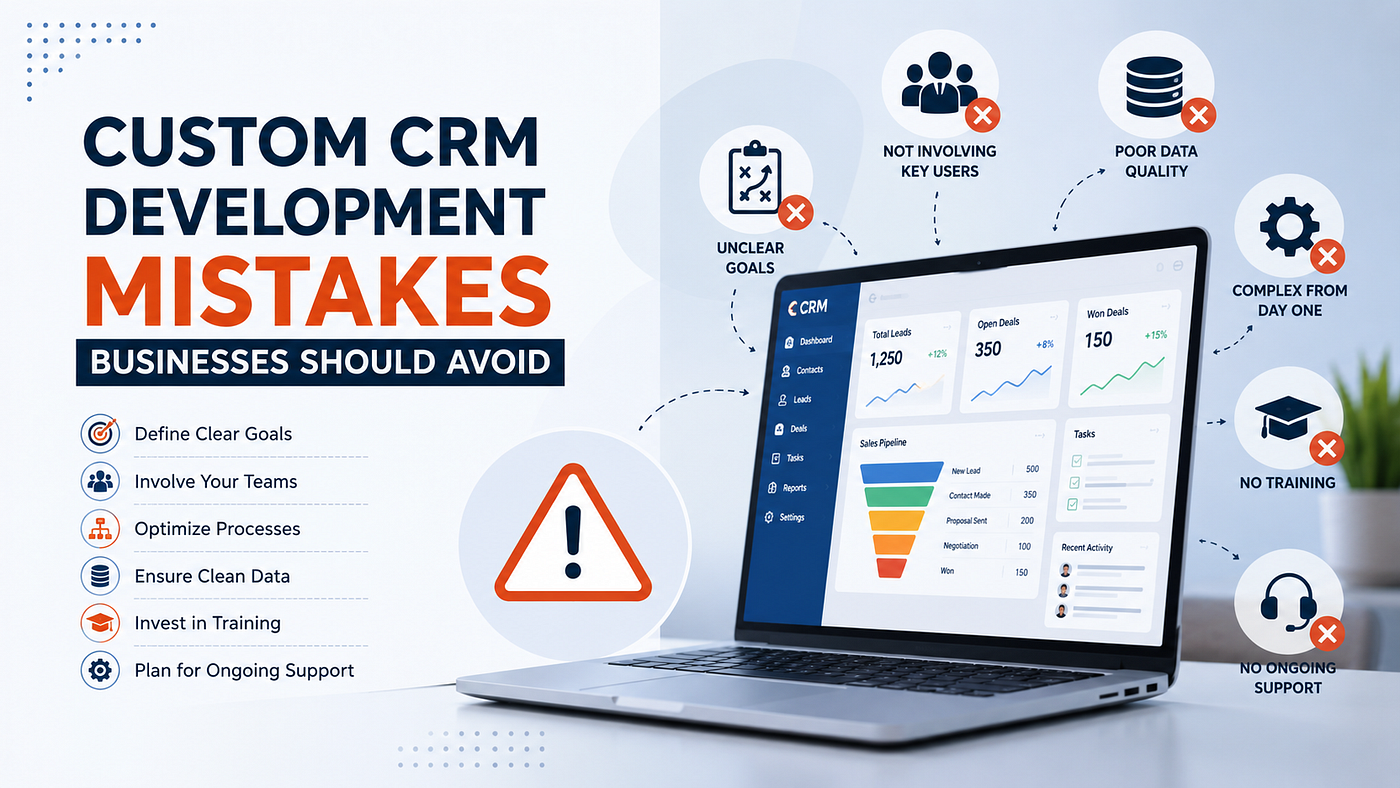
7 Common Mistakes Businesses Make with Custom CRM Development
Here are the mistakes that show up most often once you dig into why a CRM project didn’t deliver.
1. Buying or Building Before Defining Business Goals
Plenty of businesses decide “we need a CRM” without pinning down what problem it solves. Lost leads? Slow follow-ups? Sales and support working off separate spreadsheets? Without a clear answer, the finished system logs activity but doesn’t move any real number. Close to 4 in 10 CRM users admit they use only half or fewer of the features available, usually because nobody defined success before development started.
2. Leaving Sales and Support Teams Out of the Planning Process
Leadership selects the CRM, the IT department develops it and the people who will be using it on a daily basis only learn about the new system at the launch meeting. Those individuals are already aware of the customers’ problems since they are the ones getting the calls and inquiries. If you neglect their feedback, there is a risk of creating a tool which is a perfect theoretical solution but in fact, people hardly use it. The average CRM adoption rate across different sectors is approximately 26% and the reason for this gap is commonly a system being implemented without involving end users in the planning stage.
3. Replicating Inefficient Business Processes
A new CRM doesn’t fix a messy sales process, it just gives the mess a nicer interface. If lead qualification is inconsistent, or pipeline stages mean different things to different reps, a custom build will faithfully copy that confusion into a database. Projects that deliver real value use the build phase to fix the workflow first, then shape the software around it.
4. Trying to Build Every Feature in the First Version
Ambition turns into a six-month build nobody can test properly. Companies often cram sales, marketing automation, support tickets, inventory sync, and custom reporting into a single “version one” launch. It always takes longer and costs more than planned, and by the time it ships, half the original requirements have changed. A phased rollout beats an all-at-once one almost every time.
5. Ignoring Data Quality and CRM Migration
Duplicates in contacts, old data fields, and inconsistent formats are not issues that vanish when you switch to a new CRM, rather they move and you. About 23% of CRM users report that they have to deal manually with doing data entry and untidy records on a daily basis. A CRM can only be as good as the data it contains, Because of this the migration process should be planned with its own timeline and budget, not a rushed weekend before go-live.
6. Skipping User Training and Change Management
Software never explains itself to the one who didn’t build it. Training is usually the first item to be removed when a project exceeds the budget, but it remains a fact that 22% of salespeople say they are still not using their CRM at its full potential. That is more a training issue than a talent issue. The teams who stay with a CRM for a long time generally have continuous support, i.e. a champion in each team, refresher sessions, a person to whom you can refer when something doesn’t work.
7. Treating CRM Launch as the End of the Project
Rather than being a single purchase, a CRM is more like an active component of the business. Customers’ requirements change, new people are added to the team, and a system that is not checked every few months will gradually become less aligned with the actual business processes. Often the very companies that consider post-launch support as non-essential are the ones who end up revamping their CRM completely a few years down the line.
How to Avoid These Custom CRM Mistakes
Fixing most of this starts before development begins. Define what the CRM needs to achieve in plain business terms, not feature checklists. Bring sales, support, and marketing into the planning conversation early, since they’ll spot process gaps a project manager won’t. Launch with a smaller, working version instead of a fully loaded one, and treat data migration as its own workstream with its own timeline. Budget for training from day one, and put a review cycle in place so the CRM keeps pace with the business instead of falling behind it. If the in-house bandwidth isn’t there, experienced **custom CRM services** providers usually have this checklist built into their process already, which is often the bigger reason to bring one in, not just the coding.
Top 5 Custom CRM Development Companies in 2026
If you’re evaluating a development partner, these five consistently come up for custom CRM work in 2026:
**1. Dotsquares**
Over two decades of experience and 15,000+ businesses served across the UK, USA, and Australia, covering data migration, Salesforce/Zoho customisation, and ground-up custom builds, along with the training and post-launch support most projects skip.
2. Cynoteck Technology Solutions
A Microsoft Solutions Partner and Salesforce Consulting Partner known for enterprise-grade Dynamics 365 and Salesforce work.
3. ValueCoders
A large offshore team known for cost-effective, customisable CRM builds for small and mid-sized businesses.
4. Intellectsoft
Custom CRM app development as part of broader digital transformation projects for mid-market and enterprise clients.
5. OpenXcell
Flexible CRM systems with strong analytics and reporting built in from the start.
Conclusion
Most of the time a CRM doesn’t meet expectations. Not much depends on the decision of the platform. The major issues are neglecting clear goals, getting the teams involved, cleaning data, providing proper training, and planning the post-launch activities. Give these a priority, and a basic in-house CRM could be better than a pricey one that was put together without a plan.
메타데이터
- post_id
- b04fd2dfcf8b
- slug
- custom-crm-development-mistakes-businesses-should-avoid-b04fd2dfcf8b
- url
- https://medium.com/@namanbagwan30/custom-crm-development-mistakes-businesses-should-avoid-b04fd2dfcf8b
- canonical_url
- https://medium.com/@namanbagwan30/custom-crm-development-mistakes-businesses-should-avoid-b04fd2dfcf8b
- author_url
- https://medium.com/@namanbagwan30
- status
- ok
- fetched_at
- 2026-07-26 21:44:25