The Scariest Room Is the One You Already Know
There is a specific kind of dread that has nothing to do with darkness or blood or things that chase you.
The Scariest Room Is the One You Already Know
There is a specific kind of dread that has nothing to do with darkness or blood or things that chase you.
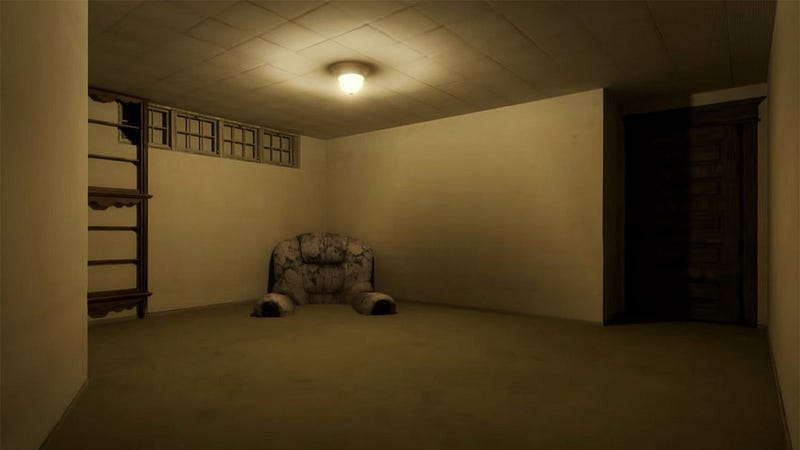
It is the dread of a place that is almost right. A hotel corridor at 3 am when everyone else is asleep. A school hallway during summer. A parking garage that should have other cars in it but doesn’t. Familiar geometry, familiar lighting, familiar materials, and yet something in your body says: you are not supposed to be here.
You have felt this. And you have never quite been able to explain why.
Backrooms (2026), directed by 20-year-old Kane Parsons and released through A24, does not invent this feeling. It excavates it.
What the Film Is Actually About
Clark is a furniture store owner whose life has quietly collapsed. His marriage is over. His architectural ambitions never materialized. He runs a failing pirate-themed store called Cap’n Clark’s Ottoman Empire, which is exactly as sad as it sounds.
When he discovers an impossible doorway in the store’s basement, he enters a dimension that looks like an office space designed by someone who has only ever read descriptions of office spaces. Endless corridors. Yellow-tinted fluorescent light. Carpet that buzzes under the light in a way that makes your teeth ache. No windows. No exits. No reason.
He becomes obsessed. He goes back. He brings people with him. His therapist, Dr. Mary Kline, enters the Backrooms to find him, and the film becomes about two people trying to navigate a maze that may be less about geography and more about what they have been avoiding in themselves.
The horror is real. But the architecture is the metaphor.
Why Empty Rooms Are Scarier Than Monsters
There is a concept in environmental psychology called place attachment, the emotional bond humans form with spaces based on the social meaning those spaces carry. A childhood bedroom. A grandmother’s kitchen. The particular hallway of a school you attended for six years.
These spaces are not neutral. They are saturated with implied presence. They mean something because of who was supposed to be in them.
Liminal spaces, corridors, waiting rooms, and transitional zones occupy a specific category in the system. They are spaces designed to be passed through, not inhabited. Their entire architectural purpose is movement. When you are in them at the wrong time, when they are empty in a way they should never be empty, your brain registers a mismatch between what the space signals and what it contains.
The signal says: other people were here, other people should be here. The reality says: there is no one.
That gap is where the dread lives. Not in darkness. Not in monsters. In the wrongness of familiar space stripped of its social meaning.
Backrooms understands this in a way most horror films do not. The threat is not what is in the rooms. The threat is the rooms themselves, the relentless implication of a world designed for human presence that has been emptied of it entirely.
The Character Who Chooses to Stay
What makes the film stranger and more honest than standard horror is Clark’s arc.
He does not simply get lost. He chooses to remain.
The Backrooms offer him something the real world stopped offering: a place where his obsession has purpose, where his need to understand and document and map feels meaningful rather than pathetic. The maze becomes the first environment in years that matches the interior architecture of his mind, endless, recursive, without a clear exit.
His therapist enters not just to rescue him but because, as the film gradually reveals, she has her own version of this. Her own internal space where shelter became confinement. The film’s real subject is not liminal horror. It is the terror of people who have mistaken their oops for homes.
The Backrooms are not a metaphor for hell. They are a metaphor for the psychic structure we build around grief and stalled identity, the inner corridors we keep walking because we have forgotten we built the walls ourselves.
From a Single Image to A24
What is easy to miss in the cultural moment around this film is how it got here.
The Backrooms began as one photograph posted anonymously on 4chan in 2019. Yellow carpet. Fluorescent light. No context. One caption. Internet forums treated it like evidence of something real, something that existed just outside the boundary of documented space.
Kane Parsons, then a teenager, made a nine-minute found footage short about it in 2022. It accumulated over 190 million views, not because it was technically extraordinary, but because it named something people already felt. The comments were not “this is scary.” They were “I have been here before.”
That is the rarest thing a piece of horror can do. Do not create a new fear. Articulate one that already exists without language.
The A24 film is the latest iteration of that articulation. Whether it fully earns its premise is a matter of debate among critics. What is not debatable is why the premise resonates at the scale it does.
The Question the Film Leaves Open
Think about the spaces in your life that feel almost right but not quite. The job that looks fine from the outside. The relationship that has all the correct features.
The version of yourself you present in rooms full of people who expect a particular performance.
Familiarity without meaning. The geometry is correct; the presence is missing.
The Backrooms went viral because millions of people saw that photograph and recognized it immediately, not as a place they had visited but as a feeling they lived in.
The film asks: what would it take for you to leave?
Canon — language, culture, and the ideas underneath both.
메타데이터
- post_id
- b2f436e1a306
- slug
- the-scariest-room-is-the-one-you-already-know-b2f436e1a306
- url
- https://medium.com/@rizkyandhira76/the-scariest-room-is-the-one-you-already-know-b2f436e1a306
- canonical_url
- https://medium.com/@rizkyandhira76/the-scariest-room-is-the-one-you-already-know-b2f436e1a306
- author_url
- https://medium.com/@rizkyandhira76
- status
- ok
- fetched_at
- 2026-06-10 08:17:25





