JavaScript Proxies: Hidden Power You Probably Ignore
How to bend JavaScript objects to your will with Proxies.
JavaScript Proxies: Hidden Power You Probably Ignore
How to bend JavaScript objects to your will with Proxies.

JavaScript Proxies are underrated. Learn how they work, real-world use cases like validation, security, caching, debugging, and why they’re the hidden superpower of modern JS.
Introduction
Most JavaScript developers reach for objects, arrays, and classes when building features. But very few reach for Proxies — a feature added in ES6 that lets you intercept and redefine fundamental operations on objects.
Proxies are like a spellbook: you can watch every read/write, enforce rules, debug state, or even create entire frameworks (Vue 3’s reactivity system is built on them).
And yet… most developers ignore them.
In this post, I’ll show you why Proxies are one of JavaScript’s hidden powers, how they work, and when you should (and shouldn’t) use them.
What is a Proxy in JavaScript?
At its core:
const proxy = new Proxy(target, handler);- target → the original object (or function) you’re wrapping
- handler → an object with “traps” (functions) that intercept operations
Example:
const user = { name: "Alice" };

const proxy = new Proxy(user, {
  get(target, prop) {
    console.log(`Getting ${prop}`);
    return target[prop];
  },
  set(target, prop, value) {
    console.log(`Setting ${prop} = ${value}`);
    target[prop] = value;
    return true;
  },
});
console.log(proxy.name);     // Getting name → "Alice"
proxy.age = 30;              // Setting age = 30
👉 With just a few lines, you can monitor all property access and assignments.
Why Proxies Matter
Traditional objects are passive: they store data and return values.
Proxies make objects active: every interaction can trigger logic, security checks, transformations, or logging.
This makes them perfect for:
- Data validation
- Security hardening
- Reactive state (Vue, MobX)
- Lazy evaluation and caching
- Debugging
Hidden Powers: Real-World Use Cases
Here’s where Proxies shine in real projects.
🔒 1. Runtime Validation
Instead of writing separate validators, embed rules directly:
function createValidatedUser(user) {
  return new Proxy(user, {
    set(target, prop, value) {
      if (prop === "age" && typeof value !== "number") {
        throw new TypeError("Age must be a number");
      }
      target[prop] = value;
      return true;
    },
  });
}

const user = createValidatedUser({});
user.age = 25;  // ✅
user.age = "old"; // ❌ Throws TypeError
👉 This is a dynamic schema enforcement tool — handy in APIs or forms.
🕵️ 2. Access Control (Security)
You can prevent access to sensitive fields:
const safeConfig = new Proxy(
  { apiKey: "SECRET", debug: true },
  {
    get(target, prop) {
      if (prop === "apiKey") {
        throw new Error("Access denied!");
      }
      return target[prop];
    },
  }
);

console.log(safeConfig.debug);   // true
console.log(safeConfig.apiKey);  // ❌ Error
Perfect for hiding secrets from untrusted code or plugins.
⚡ 3. Caching and Lazy Evaluation
Imagine you’re computing expensive results:
function lazy(obj) {
  const cache = {};
  return new Proxy(obj, {
    get(target, prop) {
      if (!(prop in cache)) {
        console.log(`Computing ${prop}...`);
        cache[prop] = target[prop]();
      }
      return cache[prop];
    },
  });
}

const math = lazy({
  bigNumber: () => 2 ** 50,
  random: () => Math.random(),
});
console.log(math.bigNumber); // Computing... then cached
console.log(math.bigNumber); // Instant
👉 This mimics memoization, but applied at the object level.
🔄 4. Debugging and Monitoring
Sometimes you want to know who’s mutating your objects:
function debugProxy(obj) {
  return new Proxy(obj, {
    set(target, prop, value) {
      console.log(`[DEBUG] ${prop} → ${value}`);
      target[prop] = value;
      return true;
    },
  });
}

const state = debugProxy({ count: 0 });
state.count++;
state.count = 42;
In large apps, this helps track rogue state changes.
🪄 5. Building Reactive State (Vue 3 Example)
Vue 3 ditched Object.defineProperty and rebuilt reactivity with Proxies.
Simplified version:
function reactive(obj) {
  const subscribers = new Set();
  return new Proxy(obj, {
    get(target, prop) {
      subscribers.add(prop);
      return target[prop];
    },
    set(target, prop, value) {
      target[prop] = value;
      console.log(`Trigger update for: ${prop}`);
      return true;
    },
  });
}

const state = reactive({ count: 0 });
console.log(state.count);  // Tracks "count"
state.count++;             // Triggers update
This observer pattern is the foundation of modern front-end frameworks.
🌀 6. Virtualization (Fake Objects)
You can make objects behave as if they contain infinite properties:
const infiniteArray = new Proxy(
  {},
  {
    get: (_, prop) => `Value at index ${prop}`,
  }
);

console.log(infiniteArray[0]);    // Value at index 0
console.log(infiniteArray[999]);  // Value at index 999
Useful for virtual lists and data generators.
Caveats and Performance Costs
While powerful, Proxies come with trade-offs:
- Performance overhead → Every
get/setis wrapped. In hot loops, this adds up. - Incompatibility with some optimizations → JS engines like V8 can’t optimize proxy-heavy code as well.
- Debug complexity → Proxies can make stack traces confusing if traps misbehave.
👉 Use them where they add clarity, security, or control, not everywhere.
When to Use Proxies vs Alternatives
- ✅ Great fit: security wrappers, runtime validation, framework internals, caching layers, debugging tools.
- ❌ Bad fit: simple data models, hot paths where raw speed matters.
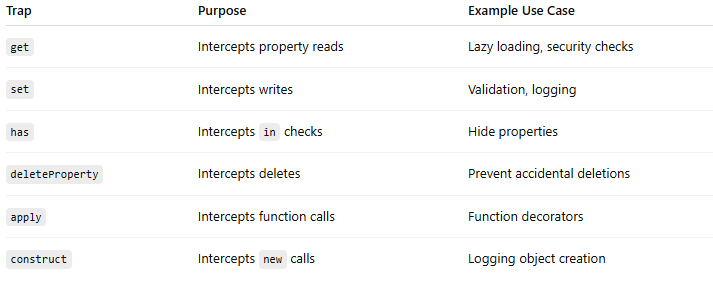
Quick Reference: Common Proxy Traps
Conclusion
JavaScript Proxies are one of those features that separate beginners from advanced devs.
While most of us rarely need them in everyday CRUD apps, they become indispensable when you’re building frameworks, devtools, or secure runtimes.
The next time you need to validate, secure, cache, or monitor objects, consider reaching for a Proxy — you might unlock hidden power in your codebase.
메타데이터
- post_id
- b4791c36c927
- slug
- javascript-proxies-hidden-power-you-probably-ignore-b4791c36c927
- url
- https://medium.com/@kaushalsinh73/javascript-proxies-hidden-power-you-probably-ignore-b4791c36c927
- canonical_url
- https://medium.com/@kaushalsinh73/javascript-proxies-hidden-power-you-probably-ignore-b4791c36c927
- author_url
- https://medium.com/@kaushalsinh73
- status
- ok
- fetched_at
- 2026-06-29 22:44:20





