From Black Box to Kanban Board: How Hermes Agent Is Redefining Multi-Agent Visibility
From Black Box to Kanban Board: How Hermes Agent Is Redefining Multi-Agent Visibility
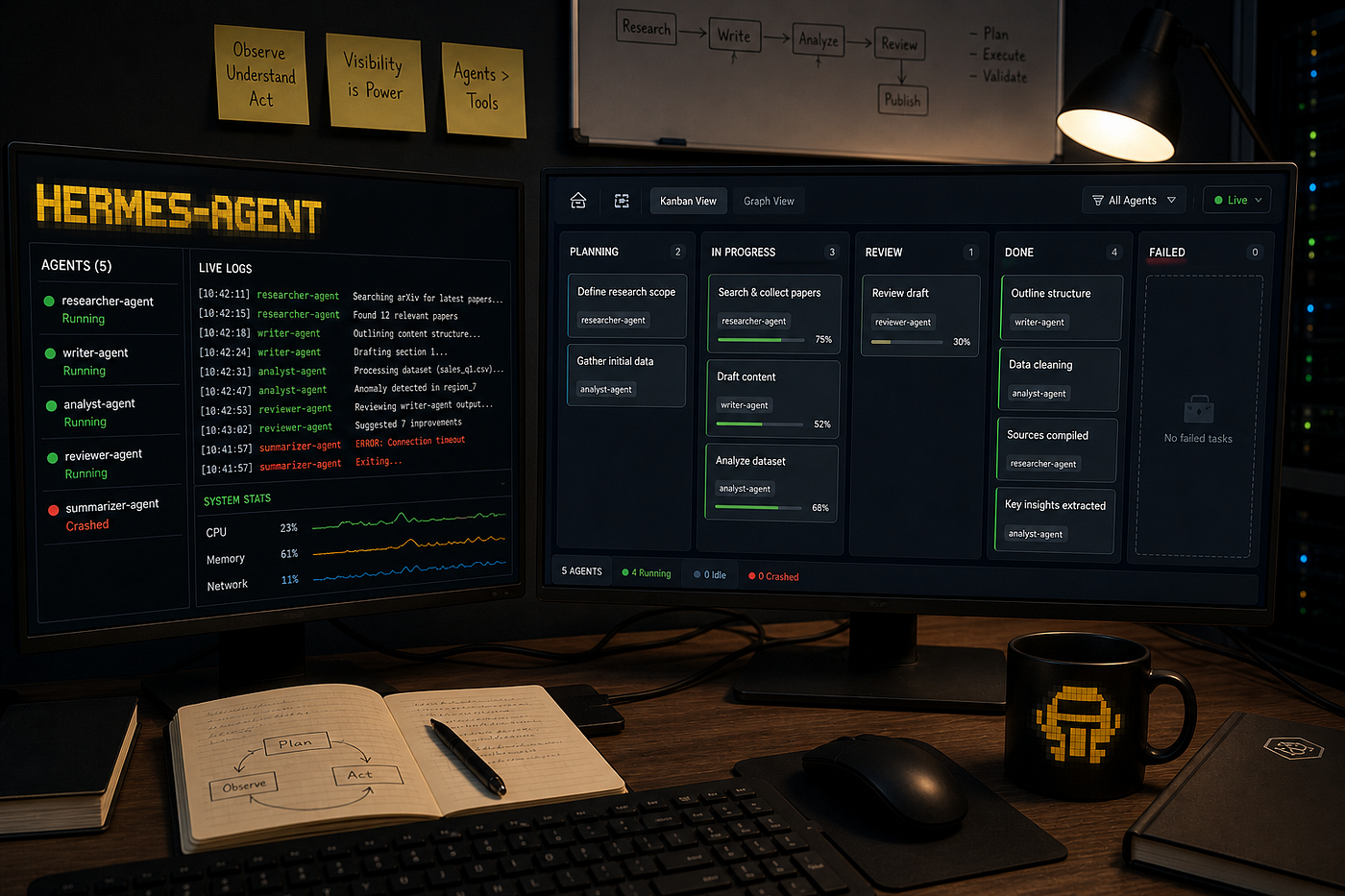
Picture this scenario. Five AI agents are running simultaneously across five separate terminal windows. One is researching a topic. Another is writing content. A third is analyzing data. The fourth is reviewing outputs. The fifth may have silently crashed three minutes ago, and nobody noticed.
This is the reality of most multi-agent deployments today. The agents are capable, the frameworks are powerful, and the underlying models are increasingly sophisticated. But the operational layer, the actual human experience of managing agents working in parallel, has remained remarkably primitive. Engineers have been squinting at log files and refreshing terminals, trying to piece together a coherent picture of what their digital workforce is actually doing at any given moment.
The industry had a name for this, even if it rarely said it out loud: the Multi-Agent Visibility Problem. And it was quietly making agentic systems harder to trust, harder to scale, and harder to hand off to non-technical team members who needed to understand what was happening without deciphering raw logs.
Nous Research, the organization behind the Hermes Agent framework, decided this was the problem worth solving next.
What Hermes Agent v0.12.0 Actually Represents
Released on April 30, 2026, Hermes Agent v0.12.0 is not a routine feature update. The release encompasses 1,096 commits, 550 merged pull requests, and contributions from 213 community members. By any measure of open-source engineering effort, this is a substantial coordinated release that reflects months of accumulated direction rather than a single engineering sprint.
The headline feature is the Kanban Multi-Agent Board, a visual orchestration layer that fundamentally changes how humans interact with agents running in parallel. But to understand why it matters, it helps to understand what came before it.
The Terminal Era of Multi-Agent Management
In the conventional approach to running multiple agents, each agent occupies its own process, its own context, and effectively its own universe. An orchestrator might spin up a researcher agent, a writer agent, an analyst agent, and a reviewer agent, then wait. The outputs eventually arrive, hopefully in the right order, hopefully without one agent blocking another, hopefully without silent failures going undetected for long stretches of time.
The feedback loop was essentially: launch, wait, check logs, guess, restart. This is not a workflow that scales gracefully. It is also not a workflow that a product manager, a team lead, or a non-technical stakeholder can meaningfully participate in. The agentic layer was effectively invisible to everyone except the engineer who built it.
When something went wrong, the debugging process resembled archaeology more than software engineering. What did the agent do three steps ago? Why did the handoff fail? Which agent is currently holding the task? The answers required digging through logs, cross-referencing timestamps, and reconstructing a narrative from fragments.
The Kanban Approach: Making Agents Legible
The Kanban Multi-Agent Board in Hermes v0.12.0 introduces a shared workspace model that changes the fundamental dynamic of multi-agent coordination. Instead of each agent operating in isolation with its own private context, all agents draw from and contribute to a common board.
The mechanics work as follows. Each agent claims a task from the shared board when it has capacity to work on it. Multiple agents progress through different tasks simultaneously, with their status visible in real time. When an agent encounters a blocker, it can trigger a handoff to another agent or surface a request for human intervention, and that escalation appears immediately on the shared board rather than disappearing into a log file. The entire workflow is observable from a single interface.
The orchestrator pattern that underlies this system operates with a deliberate separation between planning and execution. The orchestrator analyzes the goal of a given task and distributes work to specialist agents, which might include a researcher, a writer, an analyst, a backend engineer, a reviewer, and an operations agent depending on the workflow requirements. Once the distribution is complete, the orchestrator steps back. It does not micromanage execution. It waits, monitors, and intervenes only when the board signals that intervention is needed.
This separation matters enormously for practical deployments. An orchestrator that constantly interferes with specialist agents creates bottlenecks and negates much of the performance benefit of parallel execution. An orchestrator that delegates clearly and then observes creates the conditions for genuine parallel progress.
The visual result is something that any team lead can understand at a glance. Tasks move across the board. Agents claim them, work them, complete them, or flag them. The state of the entire multi-agent system is visible as a pipeline rather than a collection of opaque processes.
It is worth noting an important caveat for early adopters: the Kanban feature shipped with this release but was subsequently pulled from the default configuration temporarily while certain design details undergo rework. It remains accessible through the external Hermes Workspace environment until that rework is complete.
The Autonomous Curator: An Agent That Maintains Itself
The second major capability introduced in v0.12.0 addresses a different kind of technical debt: the gradual decay of an agent’s own skill library over time.
As agent frameworks accumulate capabilities, they also accumulate dead weight. Skills that were added for a specific project but never generalized. Overlapping capabilities that do slightly different versions of the same thing. Definitions that were accurate when written but have since drifted out of alignment with how the agent actually operates. In most frameworks, this accumulation is managed manually, which means it is rarely managed at all.
The Autonomous Curator in Hermes v0.12.0 changes this. Every seven days, the Curator runs automatically and reviews the entire skill library. It identifies skills that are no longer being used, removes them to reduce noise and overhead, and merges skills that have become functionally redundant. The agent maintains its own operational hygiene without requiring a human to schedule, configure, or oversee the process.
This represents something genuinely novel in agent framework design. Self-maintenance at the skill level has been discussed as a theoretical capability, but Hermes v0.12.0 is the first framework to implement it as a default, scheduled, autonomous behavior. The implication for long-running deployments is significant. An agent system that has been running for six months should be more refined than one that has been running for a week, not more cluttered.
Performance and Integration Improvements
Beyond the two headline capabilities, v0.12.0 delivers a set of infrastructure improvements that compound the practical value of the release.
The TUI cold start time, the delay between launching the agent interface and having it ready for interaction, has been reduced by 57 percent. For developers who interact with the terminal user interface regularly throughout a working day, this is a meaningful quality-of-life improvement that adds up over hundreds of launches.
Four new inference providers have been integrated, expanding the range of language models that can power Hermes agents without requiring custom adapter code. This matters for teams that want to route different types of tasks to different models based on cost, capability, or latency requirements.
Nineteen new messaging platform integrations have been added, extending the channels through which agents can receive tasks, report status, and escalate to human reviewers. Whether a team operates primarily through Slack, Discord, email, or any number of other communication tools, the agent system can now fit into existing workflows rather than requiring workflows to adapt around the agent system.
Why Visual Orchestration Changes the Conversation About Agentic AI
The CTO perspective on multi-agent systems has always carried a tension. The capability case is compelling: agents that can work in parallel, specialize in domains, hand off between each other, and run continuously represent a genuinely different kind of workforce than a single model answering sequential questions. But the operational case has been harder to make.
Showing a board of directors or a senior leadership team a terminal window full of log output and explaining that this represents the company’s AI workforce is not a convincing demonstration of mature technology. It looks, accurately, like something that requires constant expert supervision to keep running.
A visual pipeline that shows tasks moving from intake to research to writing to review to completion, with agents visibly claiming and completing work, with escalations surfacing clearly when they occur, is a fundamentally different kind of demonstration. It is something that a team lead can monitor without a computer science background. It is something that a product manager can use to understand where a workflow is bottlenecking. It is something that a client can be shown as evidence that a delivery process is structured and observable.
The shift from terminal-based agent management to visual orchestration is not just a user experience improvement. It changes who can meaningfully engage with agentic systems, which changes who can make decisions about deploying them, which changes how quickly organizations can actually move from experimentation to production.
The Growth Signal
Hermes Agent reached 110,000 GitHub stars within ten weeks of its public availability in 2026, making it the fastest-growing agent framework by that metric during that period. Growth at that rate in the open-source AI tooling space reflects something beyond curiosity. It reflects practitioners finding the tool genuinely useful in their day-to-day work and recommending it to colleagues.
The 213 contributors who participated in the v0.12.0 release represent a community of practitioners actively shaping the direction of the framework rather than passively consuming it. This distribution of contribution matters for the long-term health of an open-source project. A framework that a single organization controls entirely moves at the pace that organization can sustain. A framework with hundreds of active contributors moves at the pace of an entire community’s collective capacity and accumulated domain expertise.
The Broader Shift in How Digital Workforces Are Managed
The framing of AI agents as a digital workforce is not metaphorical. It is increasingly operational. Organizations are deploying agents that run continuously, hand off between each other, operate across time zones without breaks, and produce outputs that feed directly into production systems. The management challenge this creates is genuinely new.
Traditional software systems are managed through monitoring dashboards, alerting systems, and runbooks. Traditional human teams are managed through project management tools, communication platforms, and organizational structure. Agentic AI sits in between these two paradigms. Agents are not purely software in the traditional sense because their behavior is probabilistic and context-dependent in ways that static software is not. But they are not human workers either, because they do not communicate ambiguity in the same ways or require the same kinds of feedback loops.
The Kanban board approach attempts to apply a well-understood human management metaphor to this new category. Kanban boards work for human teams because they make work visible, limit work in progress, and surface blockers before they become crises. These are exactly the properties that multi-agent systems need. The innovation in Hermes v0.12.0 is recognizing that the solution to a new operational problem might be found by adapting a management approach that human teams have already validated over decades.
Speed of shipping in 2026 is not purely a function of engineering skill. It is increasingly a function of how effectively a team can coordinate its digital workforce alongside its human workforce. Visibility is the prerequisite for coordination. Without it, parallel agents are parallel guesses.
Conclusion
**Hermes Agent** v0.12.0 addresses two of the most persistent structural weaknesses in production multi-agent deployments: the inability to see what a system of agents is actually doing in real time, and the inevitable decay of an agent’s capabilities as its skill library grows unchecked.
The Kanban Multi-Agent Board brings visual clarity to a domain that has been defined by opacity since its inception. The Autonomous Curator introduces self-maintenance as a first-class behavior rather than an afterthought. Together, these capabilities represent a meaningful step toward multi-agent systems that can be managed by teams rather than requiring dedicated agent-whisperers to keep them operational.
The question for teams still managing agents through individual terminal sessions is not whether visual orchestration is better. It is how long it makes sense to operate without it.
메타데이터
- post_id
- b5cffd2659d6
- slug
- from-black-box-to-kanban-board-how-hermes-agent-is-redefining-multi-agent-visibility-b5cffd2659d6
- url
- https://medium.com/ai-mindset/from-black-box-to-kanban-board-how-hermes-agent-is-redefining-multi-agent-visibility-b5cffd2659d6
- canonical_url
- https://medium.com/ai-mindset/from-black-box-to-kanban-board-how-hermes-agent-is-redefining-multi-agent-visibility-b5cffd2659d6
- author_url
- https://medium.com/@eng.fadishaar
- status
- ok
- fetched_at
- 2026-06-09 15:37:30