How Automated Palletizing Improves Warehouse Efficiency and Safety?
As supply chain demands continue to grow, warehouses are turning to automated palletizing systems to meet production goals while minimizing…
How Automated Palletizing Improves Warehouse Efficiency and Safety?
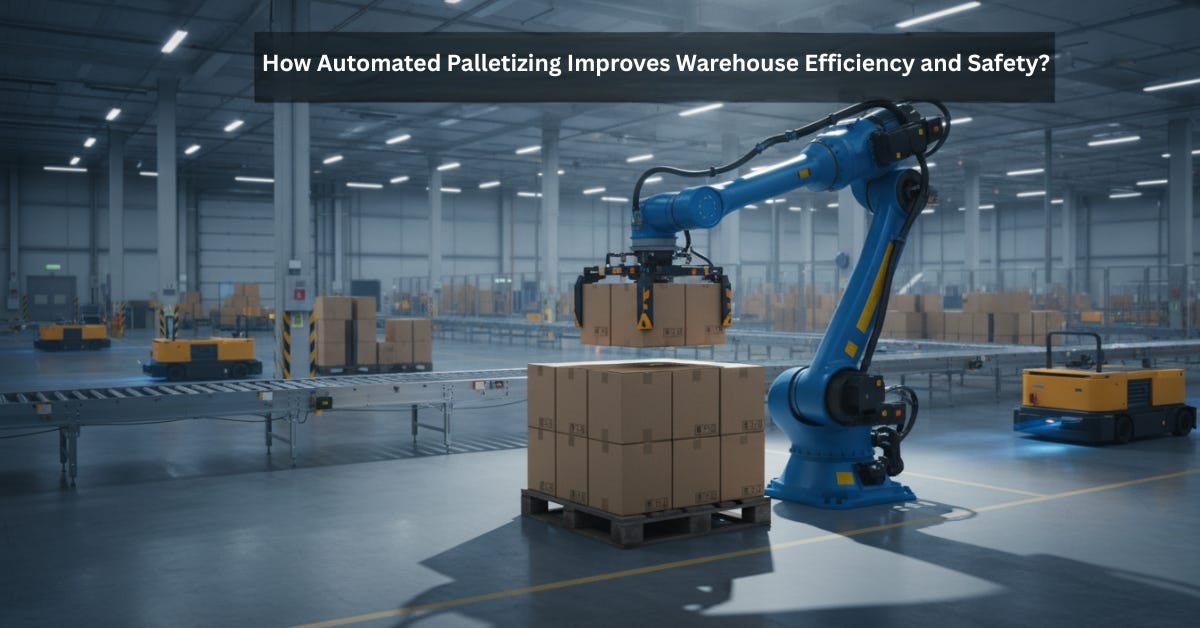
As supply chain demands continue to grow, warehouses are turning to automated palletizing systems to meet production goals while minimizing risks. Automated palletizing has revolutionized material handling by streamlining operations, reducing manual labor, and ensuring a safer, more consistent workflow.
Let’s explore how automated palletizing enhances warehouse efficiency, productivity, and safety while offering a solid return on investment.
What Is Automated Palletizing?
Automated palletizing refers to the use of robotic or mechanical systems to stack and arrange products onto pallets for storage or shipment. Unlike manual palletizing, where workers physically lift and place boxes, automated systems handle the process using robotics, conveyors, and sensors.
There are various types of automated palletizers, including:
- Conventional (Layer) Palletizers: Stack products in layers using mechanical arms.
- Robotic Palletizers: Use robotic arms with programmable movements for precision stacking.
- Hybrid Systems: Combine both technologies for maximum flexibility and throughput.
These systems can handle different product sizes, shapes, and weights — ideal for industries like food & beverage, pharmaceuticals, FMCG, and e-commerce.
1. Enhances Warehouse Efficiency
a. Faster Throughput and Consistent Output
Automated palletizing systems can operate 24/7 with minimal supervision. They eliminate the delays caused by worker fatigue or shift changes, maintaining a consistent production rate. Advanced robots can handle hundreds of cases per hour — far exceeding manual capacity — ensuring faster turnaround times for shipping and inventory management.
b. Improved Space Utilization
Modern palletizing solutions optimize stacking patterns to maximize pallet stability and space efficiency. With precise algorithms, these systems minimize wasted space, allowing warehouses to store more goods in less area — ultimately lowering storage costs.
c. Reduced Downtime and Maintenance
Unlike manual operations prone to errors and injuries, automated palletizers deliver steady performance with minimal maintenance requirements. Predictive maintenance software also helps monitor system health and schedule timely servicing, reducing unplanned downtime.
2. Boosts Productivity and ROI
a. Streamlined Workflow
Automated palletizing seamlessly integrates with conveyor belts, packaging machines, and warehouse management systems (WMS), ensuring a smooth end-of-line process. This automation eliminates bottlenecks and manual handling errors, allowing for uninterrupted product flow.
b. Labor Optimization
While automation doesn’t necessarily replace the workforce, it allows staff to focus on high-value tasks like quality control, logistics planning, and equipment monitoring — rather than repetitive, physically demanding work. This results in better workforce utilization and increased overall productivity.
c. Long-Term Cost Savings
Though initial investment in an automated palletizing system may seem high, the long-term benefits — reduced labor costs, fewer product damages, and improved efficiency — lead to significant ROI within a few years. Many companies report cost savings of up to 30–40% after full automation implementation.
3. Improves Workplace Safety
a. Reduces Risk of Injuries
Manual palletizing is one of the most physically demanding tasks in a warehouse. Workers often lift, twist, and bend repeatedly, leading to back strains, muscle fatigue, and long-term injuries. Automated palletizers remove the need for heavy lifting, significantly reducing workplace injuries and absenteeism.
b. Minimizes Human Error
Human error during manual stacking can lead to unstable pallets, damaged products, and potential accidents. Automation ensures precise, repeatable stacking patterns, improving both pallet stability and safety during transport.
c. Creates a Safer Work Environment
With fewer workers handling heavy goods, warehouse floors remain less congested and safer. Robots are designed with built-in safety sensors and collision avoidance systems to prevent accidents during operation.
4. Enhances Quality and Consistency
Automated palletizers ensure uniform stacking, correct orientation, and proper alignment of products every single time. Consistency is especially important in high-volume industries where product presentation, labeling, and packaging accuracy affect customer satisfaction and brand reputation.
By using vision systems and smart sensors, automated palletizers detect defective packages or misaligned boxes, automatically correcting errors before they cause larger issues. This leads to higher-quality outputs and reduced product wastage.
5. Scalability and Flexibility
As businesses grow, demand for faster production and varied packaging configurations increases. Automated palletizing systems offer easy scalability — you can upgrade capacity or reprogram robotic arms for new products without major infrastructure changes.
Modern robotic palletizers are also designed for multi-line operations, meaning they can manage multiple packaging lines simultaneously, adapting to changing production needs in real time.
6. Sustainability Benefits
Automated systems promote sustainability by:
- Reducing material waste through accurate stacking and minimal product damage.
- Lowering energy consumption due to efficient operations.
- Optimizing packaging for better space utilization during shipping.
This not only helps reduce the carbon footprint but also supports green logistics initiatives, which are increasingly valued by modern consumers and partners.
Why Automated Palletizing Is the Future of Warehousing?
Automation is no longer a luxury — it’s a necessity for competitive warehousing and manufacturing operations. Automated palletizing systems enhance efficiency, improve safety, and ensure consistent output, all while reducing operational costs in the long run.
By embracing palletizing automation, warehouses can achieve higher productivity, safer working conditions, and stronger ROI, setting a solid foundation for future growth. If your business handles high volumes of products daily, now is the time to explore **Palletizing Solutions in Australia** and experience the transformation they bring to your warehouse operations.
메타데이터
- post_id
- bbca69ccfbc9
- slug
- how-automated-palletizing-improves-warehouse-efficiency-and-safety-bbca69ccfbc9
- url
- https://medium.com/@wordzpower/how-automated-palletizing-improves-warehouse-efficiency-and-safety-bbca69ccfbc9
- canonical_url
- https://medium.com/@wordzpower/how-automated-palletizing-improves-warehouse-efficiency-and-safety-bbca69ccfbc9
- author_url
- https://medium.com/@wordzpower
- status
- ok
- fetched_at
- 2026-07-26 20:54:42