Bridging the “Spatial Blindness” Gap: How VEGA-3D Leverages Video Generation for 3D Understanding
Modern Multi-modal Large Language Models (MLLMs) are surprisingly adept at “chatting” with images, yet they often hit a wall when faced…
Bridging the “Spatial Blindness” Gap: How VEGA-3D Leverages Video Generation for 3D Understanding
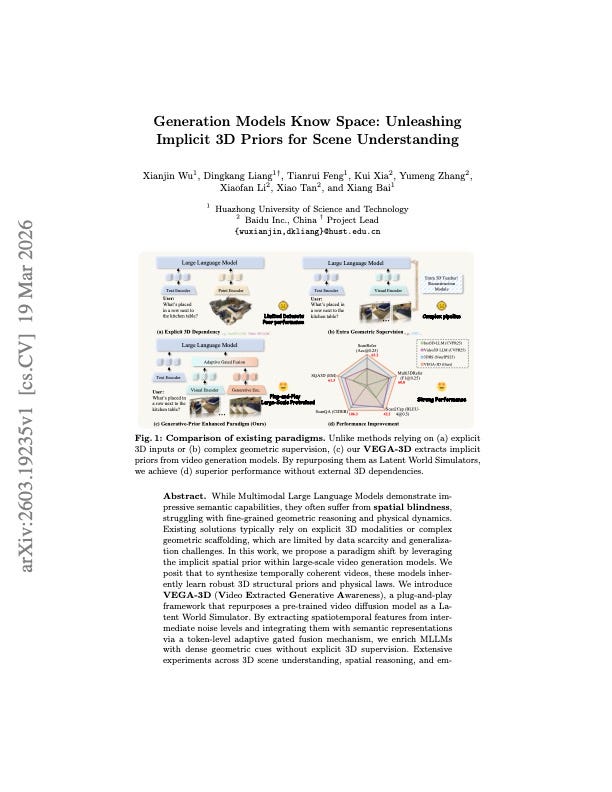
Modern Multi-modal Large Language Models (MLLMs) are surprisingly adept at “chatting” with images, yet they often hit a wall when faced with geometric reasoning. Whether it’s determining which side of a table an object is on, handling complex occlusions, or understanding how a scene shifts with camera movement, MLLMs frequently suffer from what researchers call “spatial blindness.”
A recent paper landing on arXiv, VEGA-3D — a collaborative effort between Huazhong University of Science and Technology (HUST) and Baidu — proposes a clever workaround for this bottleneck.
The Core Thesis: Can Video Models See in 3D?
The conventional route to solving spatial blindness usually involves “hard” 3D data like point clouds and depth maps, or complex processes like 3D reconstruction and knowledge distillation. These methods are undeniably effective but come with massive data and engineering overhead.
VEGA-3D takes a more intuitive path. Think about it: to maintain temporal continuity, a video generation model must inherently learn how objects move, how they are occluded, and how pixels shift when the viewpoint changes. This suggests that these models have already mastered implicit 3D and physical structures. The authors asked: Can we simply extract these “generative” features and plug them into discriminative 3D understanding?
The Analysis: Hunting for the Best Geometric Source
Before building the model, the authors conducted a deep dive to identify which networks serve as the best geometric feature sources. Using multi-view RGB sequences from the ScanNet test split (complete with poses and depth), they measured multi-view consistency scores.
A high score indicates that the representation of a physical point remains consistent across different viewpoints — a property crucial for the “grounding” needed in 3D tasks. Their findings revealed two key insights:
- Consistency Equals Performance: There is a strong positive correlation between cross-view alignment and downstream task performance (quantified as a comprehensive “NOS” score).
- Architecture Matters: DiT-based (Diffusion Transformer) video models significantly outperformed traditional UNet-based models in this specific metric.
Architecture: The Dual-Stream Approach
Building on these insights, the VEGA-3D framework utilizes a dual-stream vision encoding strategy that feeds into a single LLM:
- The Semantic Branch: This stream uses a discriminative vision encoder (like SigLIP) to extract visual tokens for each frame, providing the necessary high-level “what is in the image” context.
- The Generative Branch: This stream takes the same video sequence and passes it through the VAE from Wan2.1, extracting latent variables that carry those hard-earned geometric priors.
The Fusion Challenge: Since generative features and semantic features reside in different representation spaces, you can’t just add them together. VEGA-3D introduces token-level adaptive gated fusion. The model learns a specific weight for every spatial position, dynamically deciding whether to rely more on the “semantic” or the “generative/geometric” feature at that specific coordinate. Interestingly, experiments showed that if you drop the semantic branch and rely solely on the generative one, performance collapses — proving these two streams are truly complementary.
Does it Work?
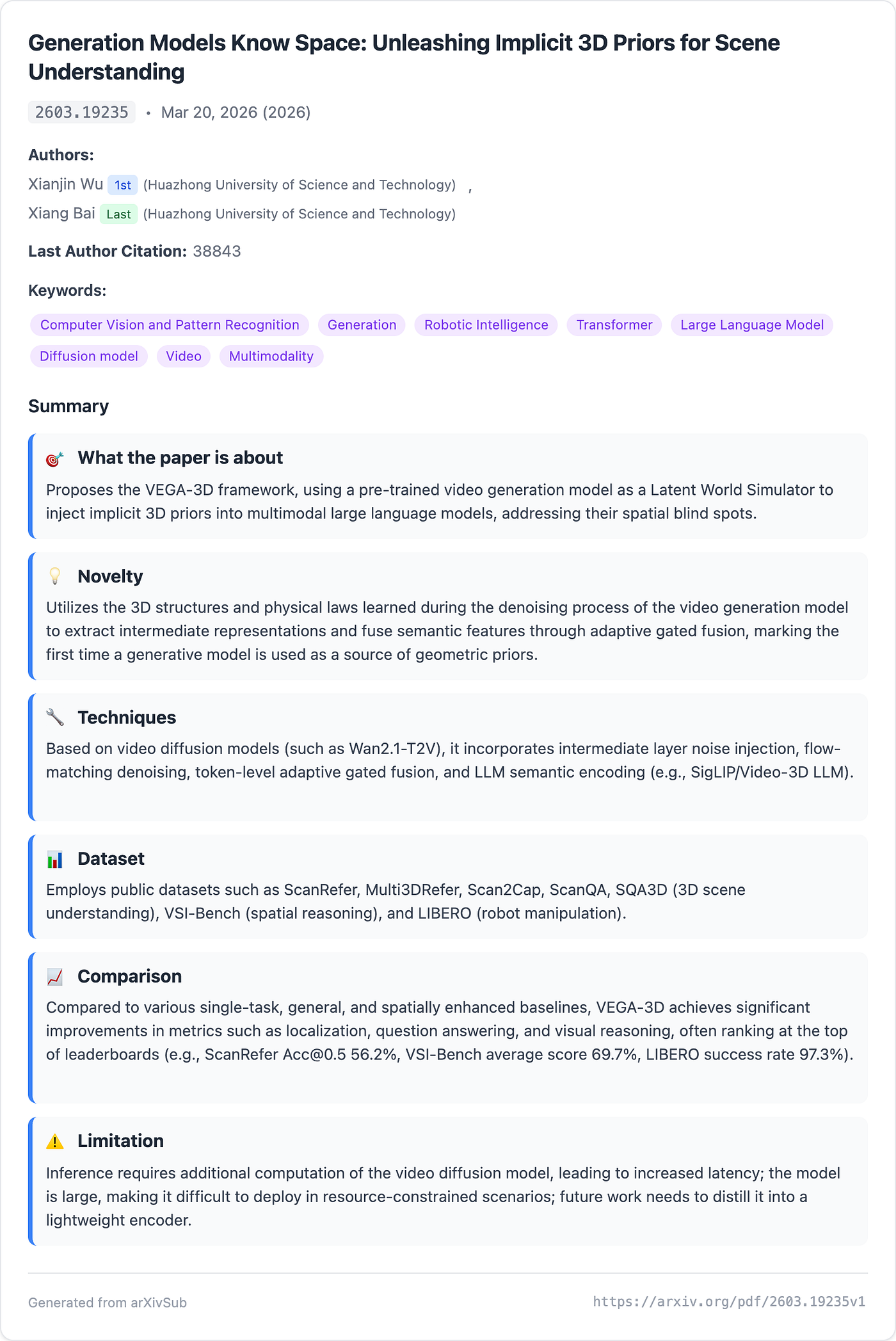
The team tested VEGA-3D across three main experimental lines, sticking to established data protocols for fair comparison. The results are promising:
- ScanRefer: Significant accuracy gains compared to the Video-3D LLM baseline.
- SQA3D: Notable improvements in Exact Match (EM) scores.
The Takeaway
VEGA-3D demonstrates that video generation models, having been trained on massive scales for spatio-temporal consistency, can serve as powerful “geometric prompts” for MLLMs. By translating generative representations into a format usable for discriminative 3D understanding, the model overcomes spatial blindness without needing explicit 3D data.
While this approach demands more computational power and memory, it offers a sophisticated trade-off for achieving high-tier 3D intelligence in an era where data remains a primary constraint.
| Find papers faster on arXivSub with AI summary (CVPR/ICCV/ICML/ICLR/NeurIPS/AAAI/MICCAI)
메타데이터
- post_id
- c1732fd4cab5
- slug
- bridging-the-spatial-blindness-gap-how-vega-3d-leverages-video-generation-for-3d-understanding-c1732fd4cab5
- url
- https://medium.com/@zljdanceholic/bridging-the-spatial-blindness-gap-how-vega-3d-leverages-video-generation-for-3d-understanding-c1732fd4cab5
- canonical_url
- https://medium.com/@zljdanceholic/bridging-the-spatial-blindness-gap-how-vega-3d-leverages-video-generation-for-3d-understanding-c1732fd4cab5
- author_url
- https://medium.com/@zljdanceholic
- status
- ok
- fetched_at
- 2026-06-20 20:29:01