WERO Wallet: Europe’s Unified Digital Payment Solution
The European Payments Initiative (EPI) has launched WERO, a groundbreaking digital wallet designed to transform the European payments…
WERO Wallet: Europe’s Unified Digital Payment Solution
The European Payments Initiative (EPI) has launched WERO, a groundbreaking digital wallet designed to transform the European payments landscape. This comprehensive learning material explores WERO’s innovative features, technical architecture, security framework, and strategic importance for European financial sovereignty. WERO represents a pivotal shift towards a unified, instant payment ecosystem that reduces Europe’s dependence on non-European payment providers while offering consumers and merchants a seamless, secure, and efficient payment experience across the continent.

What is WERO?
WERO is a digital wallet and instant payment solution developed by the European Payments Initiative, a consortium of 16 major European banks and payment service providers. The name combines the English pronoun “we” with “Euro,” symbolizing collective European identity, while also drawing from the Italian word “vero” meaning “true”. This digital wallet operates as an account-to-account payment system, enabling real-time transfers directly between bank accounts without the need for intermediary card networks.
The platform leverages the SEPA Instant Credit Transfer (SCT Inst) infrastructure to process payments within 10 seconds, available 24 hours a day, 365 days a year. Unlike traditional digital wallets, WERO does not maintain separate user balances but connects directly to users’ existing bank accounts, ensuring transparency and immediate access to funds.
European Financial Sovereignty Initiative
WERO addresses a critical strategic challenge facing Europe: the dominance of non-European payment providers in the digital payments market. Currently, American companies like Visa, Mastercard, and PayPal, along with tech giants such as Apple and Google, control significant portions of Europe’s payment infrastructure. This dependency creates vulnerabilities in terms of data sovereignty, pricing control, and strategic autonomy.
The European Commission and European Central Bank actively support initiatives like WERO as part of a broader digital sovereignty strategy. This aligns with other European initiatives such as GAIA-X for cloud infrastructure and the digital euro project, collectively working towards reducing reliance on external digital service providers.
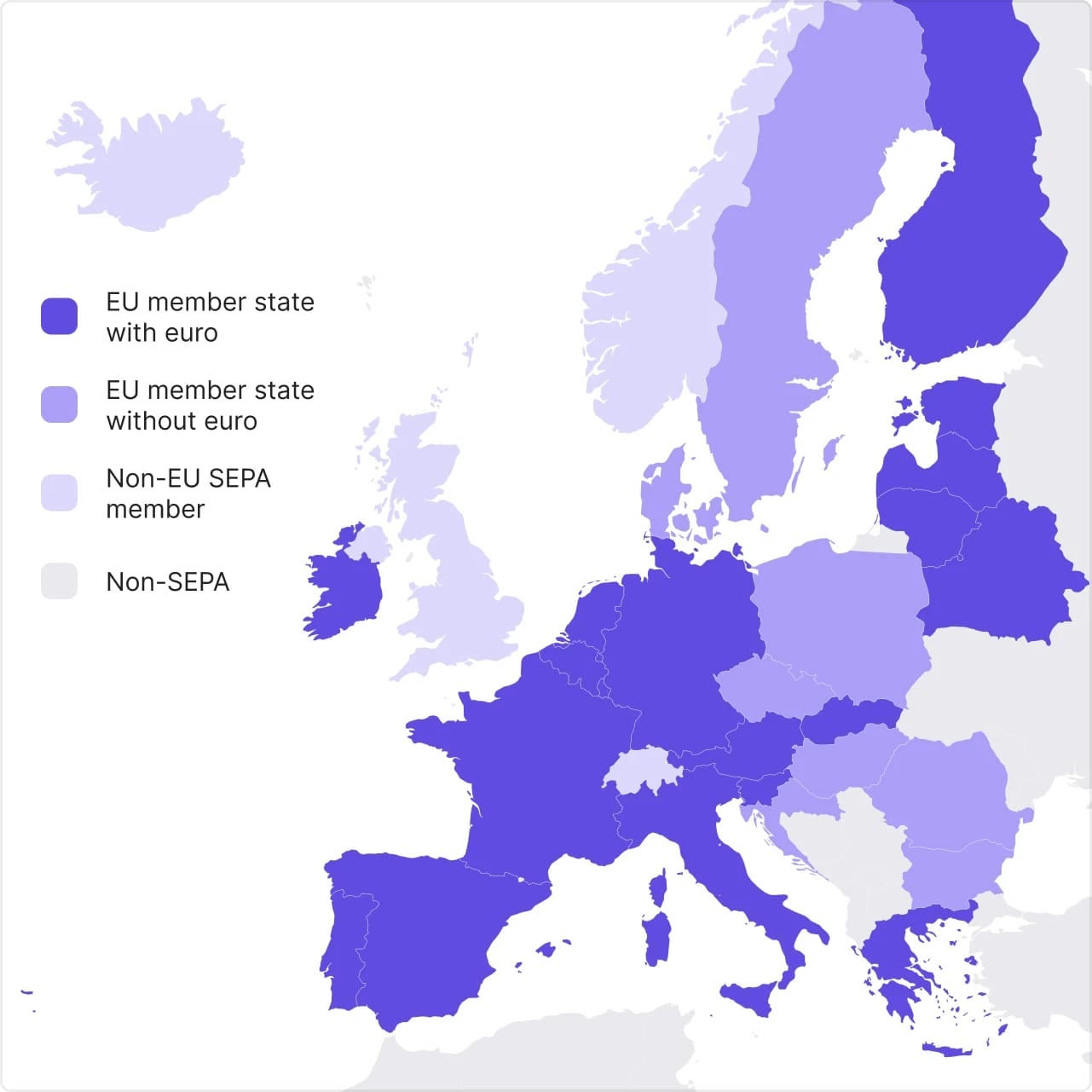
Map showing European countries’ SEPA membership and euro usage for understanding payment zones
Current Features and Capabilities
- Peer-to-Peer Payments WERO’s core functionality centers on peer-to-peer (P2P) payments, allowing users to send and receive money instantly using phone numbers or email addresses. Users can associate up to three phone numbers with their bank account, enabling seamless transfers within their contact network. Payment requests represent another key P2P feature, enabling users to request money from contacts with automatic notifications and 30-day expiration periods. This functionality proves particularly useful for shared expenses, bill splitting, and social payments among friends and family.
- QR Code Technology WERO incorporates QR code generation and scanning capabilities for contactless payments. Users can create dynamic QR codes specifying payment amounts, which others can scan to initiate instant transfers. The QR code system operates without requiring users to disclose personal phone numbers, providing privacy protection during transactions with unfamiliar parties. This feature supports both merchant and peer-to-peer payment scenarios, offering flexibility in payment initiation methods.
- Bank Integration and User Experience WERO operates through two primary interfaces: integration within existing banking applications of member banks and a standalone mobile application available on iOS and Android platforms. This dual approach accommodates different user preferences and banking relationships while maintaining consistent functionality across platforms. The integrated approach allows customers of participating banks to access WERO features directly through their familiar banking interfaces, reducing adoption barriers and leveraging existing security protocols. The standalone app serves customers whose banks have not yet integrated WERO or users preferring dedicated payment applications.
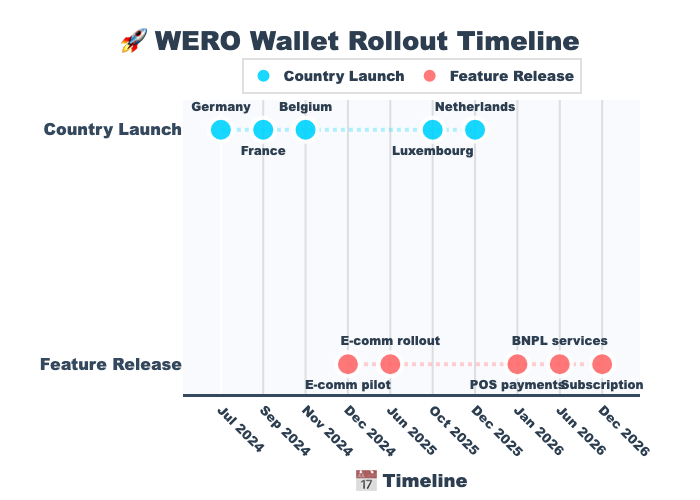
WERO Rollout Timelines
Future Roadmap and Development Plans
- E-commerce Integration Timeline WERO’s development roadmap includes comprehensive e-commerce capabilities scheduled for rollout throughout 2025. The first e-commerce transaction was successfully completed in a pilot setting in December 2024, validating the technical infrastructure for online merchant payments. Payment processors including Nexi, Worldline, and PPRO have announced integration partnerships to facilitate merchant adoption. E-commerce functionality will initially launch in Germany during summer 2025, followed by Belgium in October 2025 and France in early 2026. This staggered approach allows for technical refinement and merchant onboarding optimization before full-scale deployment across all markets.
- Point-of-Sale and Advanced Features Point-of-sale (POS) payments represent a significant milestone in WERO’s evolution, scheduled for 2026 implementation. This capability will enable NFC-based contactless payments at physical merchants, competing directly with established card networks and mobile wallets. The POS functionality will support various transaction types including one-off payments, subscriptions, installments, and reservation systems. Advanced features planned for future releases include Buy Now, Pay Later (BNPL) services backed by participating banks, digital identity verification, and merchant loyalty program integration. Subscription management capabilities will allow users to control recurring payments directly through the WERO interface, providing unprecedented transparency and control over automatic charges.
- Value-Added Services and Innovation WERO’s long-term vision extends beyond basic payment functionality to encompass a comprehensive financial services platform. Planned value-added services include responsible financing options, digital identity features, and seamless integration with merchant loyalty programs. The platform aims to become a single point of control for all consumer payment needs across Europe. Innovation initiatives include “Scan&Go” technology for retail environments, enabling contactless shopping experiences and service access. This technology could revolutionize various sectors including transportation, retail, and hospitality by providing unified payment and access control through a single European platform.
European Payments Initiative Structure
- Shareholder Composition and Governance The European Payments Initiative comprises 16 founding shareholders representing major European banking institutions and payment service providers. Key shareholders include BNP Paribas, Deutsche Bank, ING, Société Générale, Crédit Agricole, BPCE Group, and La Banque Postale, among others. This diverse ownership structure ensures broad European representation and reduces single-country dependency. Recent additions to the shareholder base include Dutch banks ABN Amro and Rabobank, Belgian institution Belfius, and German cooperative bank DZ Bank. The inclusion of payment processors Worldline and Nexi as shareholders strengthens the initiative’s merchant acquisition capabilities and technical infrastructure.
- Member Bank Network Beyond the core shareholders, EPI has expanded its member network to include additional banks across participating countries. In Belgium, recent additions include Argenta, Bank Van Breda, Beobank, Crelan, and vdk Bank, enhancing coverage in the Belgian market. This expansion strategy aims to achieve comprehensive banking coverage within each target market before expanding to new countries.
Current Market Presence and Performance
- Launch Statistics and User Adoption Since its initial launch in Germany in July 2024, WERO has achieved significant user adoption milestones. As of November 2024, the platform has registered 14 million users across its three active markets and processed 8 million transactions. This rapid growth demonstrates strong market acceptance and effective integration with participating banks’ customer bases. The user base leverages existing payment infrastructure, particularly in France where WERO builds upon Paylib’s 35 million registered users. This transition strategy provides immediate scale and reduces customer acquisition costs while familiarizing users with the European payment solution before discontinuing legacy services.
- Geographic Coverage and Expansion WERO currently operates in Germany, France, and Belgium, representing more than half of non-cash retail payments in the eurozone. The phased rollout strategy prioritizes markets with existing instant payment infrastructure and strong digital banking adoption. Cross-border functionality enables users in different countries to send and receive payments seamlessly, demonstrating the platform’s pan-European capabilities. Luxembourg and the Netherlands represent the next expansion targets, with rollout planned for 2025. Additional European markets will follow based on regulatory approval, banking partner availability, and technical infrastructure readiness. The expansion strategy balances rapid growth with operational stability and regulatory compliance.
Technical Architecture and Infrastructure
- SEPA Instant Credit Transfer Foundation WERO’s technical foundation rests on the SEPA Instant Credit Transfer scheme, launched by the European Payments Council in 2017. This infrastructure enables the transfer of up to €100,000 per transaction within the eurozone in less than 10 seconds. The system operates continuously, providing businesses and consumers with immediate liquidity and transaction confirmation. The SCT Inst protocol utilizes ISO 20022 messaging standards, ensuring standardization across all participating banks and payment service providers. This standardization simplifies integration processes and reduces operational complexity for financial institutions while maintaining high security and compliance standards.
- Security Framework and Data Protection WERO implements comprehensive security measures aligned with European regulatory standards. The system incorporates Strong Customer Authentication (SCA) as required by the Payment Services Directive 2 (PSD2), ensuring multi-factor authentication for all transactions. All data processing complies with the General Data Protection Regulation (GDPR), with user data stored and processed exclusively within the European Economic Area. The platform employs end-to-end encryption for all communications and transactions. Fraud prevention mechanisms include real-time transaction monitoring, risk scoring algorithms, and behavioral analysis to detect suspicious activities. Users can enable biometric authentication through their mobile devices’ fingerprint or facial recognition systems, adding an additional security layer without WERO collecting or storing biometric data.
- Privacy and Data Governance WERO’s privacy policy demonstrates strict adherence to European data protection standards. The platform processes personal data only for specific purposes including app enrollment, payment processing, fraud prevention, and customer support. Data retention periods are clearly defined, with transaction data stored for 13 months and fraud-related information maintained for up to 24 months for proven cases. Users maintain full control over their personal information with rights to access, rectify, erase, or restrict processing of their data as guaranteed under GDPR. The platform operates with a “data minimization” principle, collecting only information necessary for service operation.
Security Considerations and Best Practices
- Multi-Layer Security Architecture WERO implements comprehensive security measures addressing multiple threat vectors. The platform encourages users to enable biometric authentication on their mobile devices, including fingerprint recognition and facial identification systems. These biometric features provide convenient yet secure access control without requiring WERO to collect or store biometric data. PIN security represents a critical vulnerability that WERO addresses through user education and technical safeguards. The platform recommends using complex, non-predictable PINs and advises users to protect PIN entry from “shoulder surfing” attacks in public environments. Six-digit PINs offer significantly enhanced security compared to traditional four-digit codes.
- Fraud Prevention and User Protection WERO operates sophisticated fraud detection systems that monitor transaction patterns and user behavior to identify suspicious activities. The platform processes fraud-related data for up to 24 months to improve detection algorithms and prevent repeat incidents. Users receive real-time notifications for all transactions, enabling immediate fraud reporting and account protection. Consumer protection mechanisms include structured dispute resolution processes and chargeback procedures aligned with European banking regulations. While specific details remain confidential, EPI has committed to implementing state-of-the-art consumer protection standards that exceed traditional payment method protections.
- Communication Security and Phishing Protection WERO maintains strict communication protocols to protect users from phishing and social engineering attacks. The platform never requests personal information, banking details, or payment credentials through SMS, email, or phone calls. All legitimate transaction notifications are delivered exclusively through the WERO app or users’ banking applications. Users are educated to recognize fraudulent communications claiming WERO payment receipts via email or text message. The platform emphasizes the “Stop. Think. Don’t click” principle and encourages immediate reporting of suspicious communications to users’ banks.
Future Market Impact and Transformation
- Payments Industry Evolution WERO’s success could catalyze broader transformation within the European payments industry, encouraging innovation and competition among existing providers while establishing new standards for consumer protection and service quality. The integration of advanced features such as subscription management and buy-now-pay-later services could redefine consumer expectations for payment platform capabilities. This evolution positions WERO not merely as a payment processor but as a comprehensive financial services platform addressing diverse consumer needs.
- Cross-Border Economic Integration WERO’s pan-European functionality supports deeper economic integration by reducing friction in cross-border transactions and enabling seamless commerce across national boundaries. This capability particularly benefits small and medium enterprises seeking to expand their market reach without investing in complex payment infrastructure. The platform’s eventual expansion beyond current markets could create the first truly unified European payment experience, supporting the European Union’s single market objectives while fostering innovation and competition in financial services. This comprehensive examination of WERO demonstrates its potential to transform European digital payments through innovative technology, strategic cooperation, and unwavering commitment to European values of privacy, security, and consumer protection. As the platform continues its rollout and feature development, it represents a pivotal moment in Europe’s journey towards digital sovereignty and economic independence in the critical payments infrastructure sector.
References
메타데이터
- post_id
- c19e3d90e4c8
- slug
- wero-wallet-europes-unified-digital-payment-solution-c19e3d90e4c8
- url
- https://levelup.gitconnected.com/wero-wallet-europes-unified-digital-payment-solution-c19e3d90e4c8
- canonical_url
- https://levelup.gitconnected.com/wero-wallet-europes-unified-digital-payment-solution-c19e3d90e4c8
- author_url
- https://medium.com/@jindalarpit
- status
- ok
- fetched_at
- 2026-06-24 23:31:39