How AI Can Help Achieve the UN SDGs
Focus on Health and Sustainability
How AI Can Help Achieve the UN SDGs
Focus on Health and Sustainability
“The biggest challenge of our time — climate change, pandemics, inequality — won’t be solved by just governments or corporations. It’ll be solved when intelligence, both human and artificial, come together for a better world.”
The United Nations Sustainable Development Goals (SDGs) are an ambitious blueprint to create a more equitable and livable world by 2030. But here’s the catch — time is running out, and the complexity of these goals is massive.
Enter Artificial Intelligence — a technology that’s not just about building smart assistants or predicting the next viral meme. When pointed in the right direction, AI has the power to transform human development. Especially in health and sustainability.
Let’s dive deep into how
1. AI in Healthcare: From Diagnosis to Last-Mile Delivery
SDG 3: Good Health and Well-Being
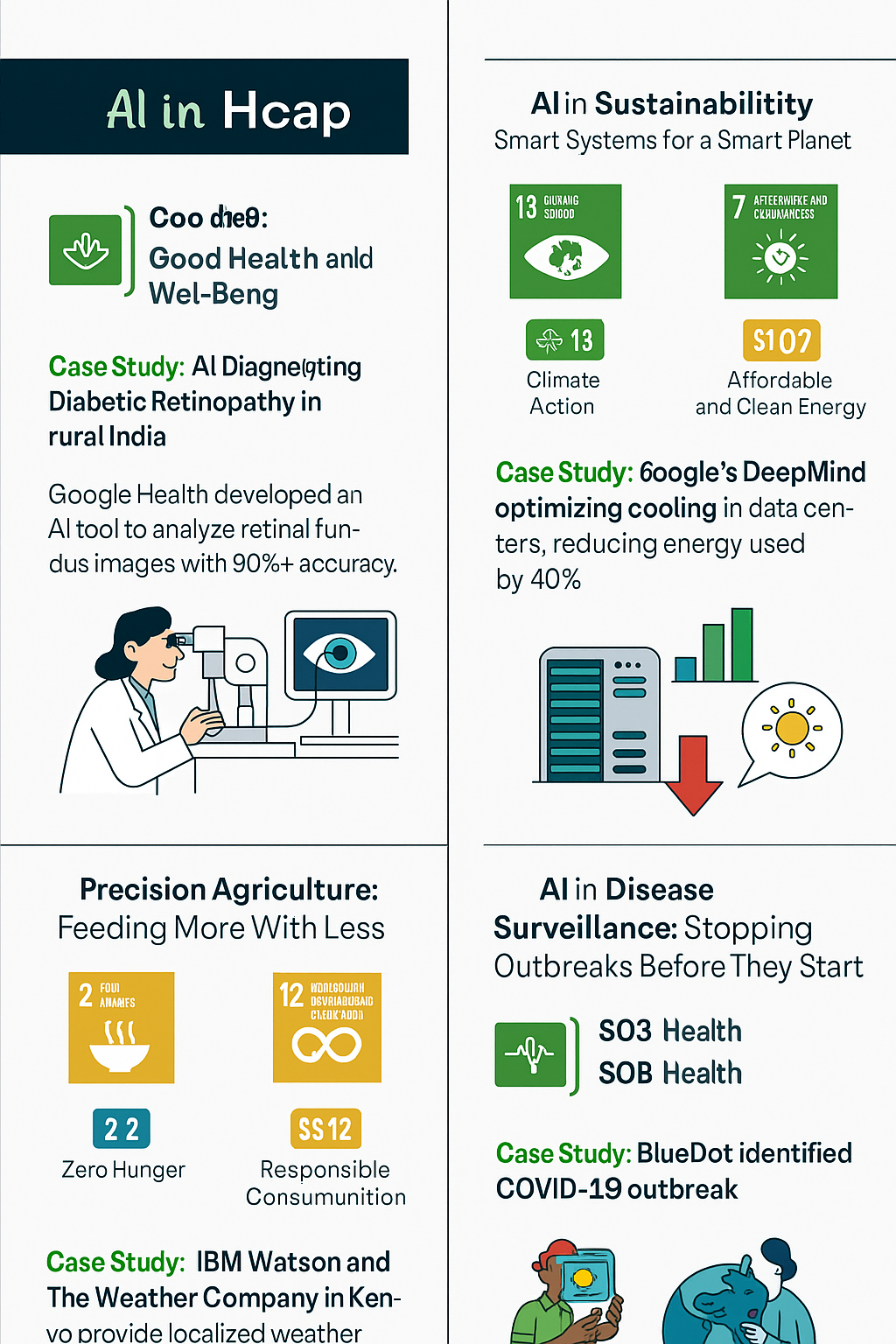
Case Study: AI Diagnosing Diabetic Retinopathy in Rural India
In rural Tamil Nadu, thousands of patients were going blind due to diabetic retinopathy, a condition easily preventable if caught early. The problem? Lack of trained ophthalmologists.
Google Health developed an AI tool that could analyze retinal fundus images and flag early signs of the disease with 90%+ accuracy.
Result: AI was deployed in Aravind Eye Hospitals, allowing technicians to scan patients in remote areas and get instant results. Lives were saved, blindness was prevented — all thanks to deep learning.
“What if every village had AI-powered diagnostics that worked offline? This is no longer sci-fi. It’s real, and it’s happening.”
2. AI in Sustainability: Smart Systems for a Smart Planet
SDG 13: Climate Action
SDG 7: Affordable and Clean Energy
Case Study: Google’s DeepMind and Data Center Cooling
Data centers consume 1% of the world’s electricity, and cooling them is expensive and environmentally unfriendly.
Google applied its DeepMind AI to optimize cooling systems in their data centers. The AI reduced energy used for cooling by 40%, simply by making smarter real-time decisions about fans and airflow.
Imagine: If every industrial plant used similar AI, we could cut emissions by millions of tons each year.
3. Precision Agriculture: Feeding More With Less
SDG 2: Zero Hunger
SDG 12: Responsible Consumption and Production
Case Study: IBM Watson and The Weather Company in Kenya
Small farmers in Kenya struggle with unpredictable rainfall and crop disease. IBM’s AI-driven platform gives localized weather forecasts and farming advice in Swahili via SMS.
📌 Impact: Increased crop yields by up to 30%, reduced water wastage, and empowered farmers to become climate-resilient.
“AI isn’t replacing farmers — it’s empowering them.”
🧬 4. AI in Disease Surveillance: Stopping Outbreaks Before They Start
SDG 3: Good Health
SDG 11: Sustainable Cities and Communities
Case Study: BlueDot and COVID-19
A Canadian startup called BlueDot used AI to scan thousands of global news articles, airline data, and animal disease reports. In December 2019, it flagged an unusual pneumonia outbreak in Wuhan days before the WHO made an announcement.
Why It Matters: Early warnings mean faster responses, which saves lives and billions of dollars.
What’s Holding Us Back?
While AI is powerful, it’s not a silver bullet. There are challenges:
- Bias in data can lead to unfair outcomes
- Lack of infrastructure in low-income regions
- Ethical concerns around privacy and surveillance
But these are problems to be solved, not reasons to stop.
A Call to Action for Innovators Like Us
You’re not just a student or an engineer — you’re a potential changemaker.
- Build AI tools that can run offline for rural health centers.
- Create dashboards that visualize climate data for NGOs.
- Train a model to detect malnutrition from photos.
- Collaborate with bioengineers to detect glaucoma, like the project I’m working on.
- The AI revolution is already happening. The question is: will you be a passive user — or an active architect of change?
My Final Thoughts
AI is not just about automation or profit. When aligned with the SDGs, it becomes a force multiplier for humanity.
So the next time you train a neural net, run a simulation, or visualize a dataset, remember this: you might be coding the solution to one of the world’s biggest problems.
“We cannot solve our problems with the same thinking we used when we created them.” — Albert Einstein
메타데이터
- post_id
- c6e56edcb740
- slug
- how-ai-can-help-achieve-the-un-sdgs-c6e56edcb740
- url
- https://medium.com/@joevkadavan/how-ai-can-help-achieve-the-un-sdgs-c6e56edcb740
- canonical_url
- https://medium.com/@joevkadavan/how-ai-can-help-achieve-the-un-sdgs-c6e56edcb740
- author_url
- https://medium.com/@joevkadavan
- status
- ok
- fetched_at
- 2026-07-19 19:41:23