What are the best tools for building ETL pipelines?
In today’s data‑driven world, businesses rely on large volumes of information to make informed decisions. Whether you’re analyzing customer…
What are the best tools for building ETL pipelines?
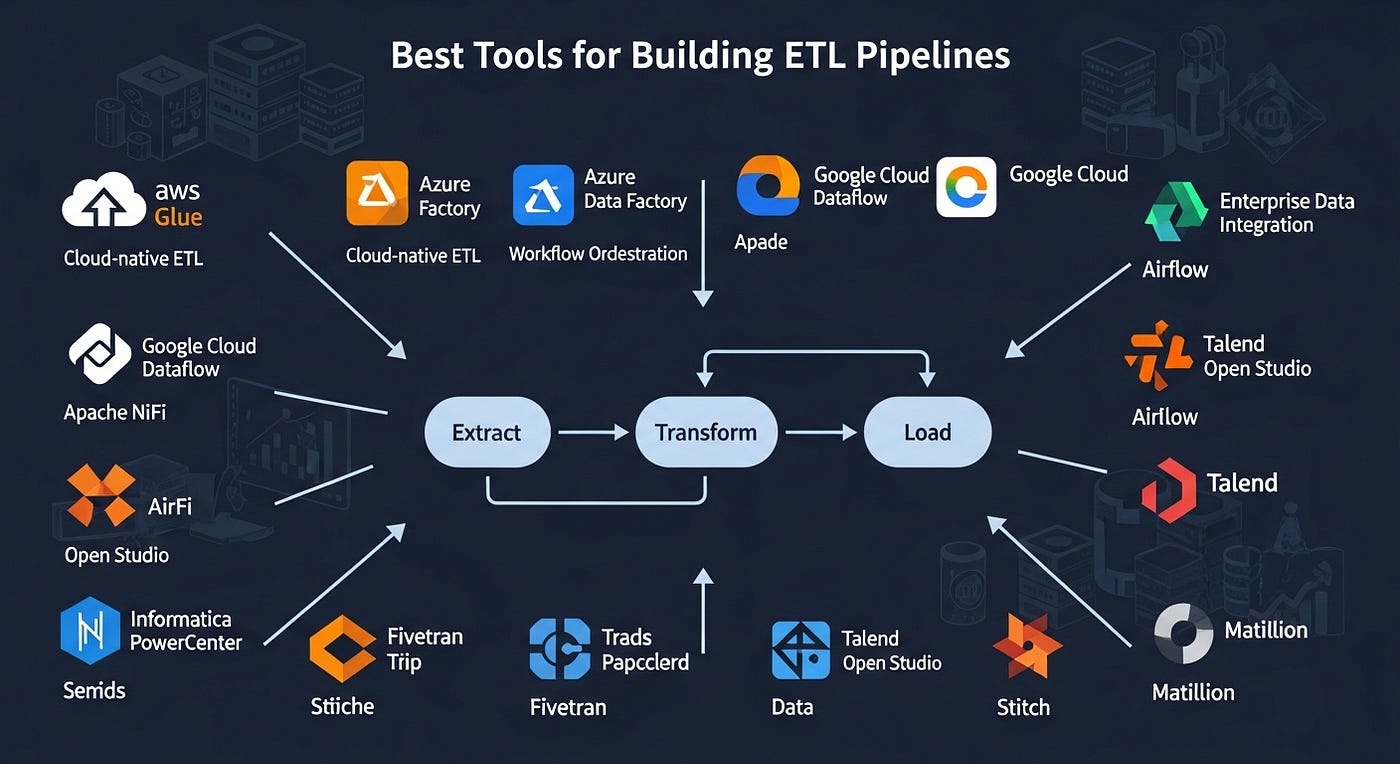
In today’s data‑driven world, businesses rely on large volumes of information to make informed decisions. Whether you’re analyzing customer behavior, forecasting revenue, or optimizing operations, the ability to move and transform data efficiently is crucial. This is where ETL pipelines — Extract, Transform, and Load — play a key role.
These pipelines collect data from multiple sources, shape it into a usable format, and deliver it into a database or warehouse for analysis. But with so many tools available, choosing the best one for your needs can be overwhelming. Let’s explore what ETL pipelines are, why they matter, and which tools stand out in 2026.
Understanding ETL Pipelines
ETL stands for Extract, Transform, Load:
- Extract: Pull data from various sources — databases, APIs, files, or streaming systems.
- Transform: Clean, filter, and format data to ensure consistency and usability.
- Load: Move the processed data into destination systems such as data warehouses, data lakes, or analytics platforms.
Modern ETL pipelines often go beyond the traditional model. They integrate with real‑time data streams, cloud services, and advanced orchestration workflows, ensuring that teams always have fresh, accurate data ready for analysis.
Why ETL Pipelines Matter
ETL pipelines form the backbone of reliable data infrastructure. Well‑designed pipelines:
- •Ensure data quality: By cleansing and validating data automatically.
- •Improve efficiency: Automate repetitive tasks and reduce manual processing.
- •Enable better insights: Deliver trustworthy data to business intelligence (BI) and analytics tools.
- •Support scalability: Handle growing data demands across sources and departments.
- •Reduce errors: Streamline integration between systems and minimize human error.
In short, ETL pipelines transform raw, scattered data into valuable, decision‑ready information.
The Best Tools for Building ETL Pipelines
The right ETL tool depends on your specific use case — data size, team skillset, budget, and whether your ecosystem is cloud‑based or on‑premise. Below are some of the best ETL pipeline tools available today, categorized by needs and capabilities.
1. Apache Airflow
Best for: Workflow orchestration and custom ETL development.
Overview: Apache Airflow is an open-source platform that helps engineers programmatically author, schedule, and monitor ETL workflows. It’s ideal for complex data engineering tasks that require fine‑grained control.
Pros:
- Highly customizable; supports Python scripts.
- Strong community and extensive integrations.
- Great for orchestrating multi‑step workflows.
Cons:
- Requires technical setup and maintenance.
- Steeper learning curve for beginners.
Ideal use case: Teams with engineering expertise who want open-source flexibility and control over scheduling and monitoring data pipelines.
2. Talend Data Fabric
Best for: Enterprise-level data integration with comprehensive governance.
Overview: Talend offers a unified data integration and management suite that simplifies ETL processes. It connects to hundreds of data sources and supports cloud and on-premise systems.
Pros:
- Visual design interface for building pipelines.
- Built‑in data quality, security, and governance tools.
- Scalable to enterprise needs.
Cons:
- License-based pricing can be high for startups.
- May require additional configuration for advanced ETL logic.
Ideal use case: Businesses needing robust, enterprise-grade data integration and governance.
3. AWS Glue
Best for: Cloud-native ETL automation on Amazon Web Services.
Overview: AWS Glue is a fully managed ETL service that automatically discovers data, generates transformation code, and scales on demand. It integrates seamlessly with other AWS tools such as S3, Redshift, and Athena.
Pros:
- Serverless and fully managed — no infrastructure maintenance.
- Supports both batch and streaming ETL workloads.
- Tight AWS ecosystem integration.
Cons:
- Limited outside the AWS environment.
- Can be costly for high-volume data processing.
Ideal use case: Businesses already invested in the AWS ecosystem seeking automated, scalable ETL processes.
4. Google Cloud Dataflow
Best for: Stream and batch data processing on Google Cloud.
Overview: Google Cloud Dataflow is a fully managed service for real-time and batch processing. Using Apache Beam, it allows one pipeline to handle both processing modes efficiently.
Pros:
- Real-time and batch processing in one framework.
- Managed scaling and performance optimization.
- Strong integration with BigQuery and other Google Cloud tools.
Cons:
- Limited appeal outside of Google Cloud.
- Requires understanding of Apache Beam concepts.
Ideal use case: Teams leveraging Google Cloud for analytics and machine learning.
5. Fivetran
Best for: Low‑code, plug‑and‑play ETL for fast setup.
Overview: Fivetran automates data integration by providing prebuilt connectors to hundreds of data sources — from CRMs to cloud storage. It focuses on ELT (Extract, Load, Transform), transforming data after loading into your warehouse.
Pros:
- Minimal configuration required.
- Automated schema management and updates.
- Fast deployment for analytics teams.
Cons:
- Limited custom transformation flexibility.
- Ongoing subscription costs can grow.
Ideal use case: Companies that need quick, no‑code integrations and focus primarily on analytics insights.
6. Microsoft Azure Data Factory
Best for: Hybrid data integration in Azure and beyond.
Overview: Azure Data Factory (ADF) allows users to build ETL pipelines visually or with code, connecting cloud and on‑prem sources. Its drag‑and‑drop interface helps non‑developers design workflows easily.
Pros:
- Hybrid cloud and on‑premise support.
- Built‑in data movement and transformation components.
- Scalable pay‑as‑you‑go pricing.
Cons:
- Can get complex for advanced custom logic.
- Learning curve for orchestration settings.
Ideal use case: Organizations operating within the Microsoft ecosystem looking for an integrated ETL solution.
7. Apache NiFi
Best for: Real-time, event-driven ETL data flows.
Overview: Apache NiFi, another open-source project, enables real‑time data movement. It’s often used for IoT, logs, and edge computing data streams.
Pros:
- Visual drag‑and‑drop interface.
- Excellent for stream-based and IoT data.
- Built-in security and data provenance tracking.
Cons:
- Managing large clusters can require tuning.
- Less suited for complex transformations.
Ideal use case: Organizations needing real-time ETL for streaming or IoT data.
8. Hevo Data
Best for: Fully managed, no-code ETL for modern data warehouses.
Overview: Hevo Data simplifies pipeline setup with 150+ prebuilt connectors and automated schema mapping. It focuses on reliability and minimal maintenance.
Pros:
- User-friendly, low-code platform.
- Real-time data replication.
- Excellent monitoring dashboard.
Cons:
- Limited for niche or highly customized data logic.
- Subscription-based pricing.
Ideal use case: Analytics teams needing reliable, automated ETL without coding.
9. Informatica PowerCenter
Best for: Large-scale enterprise ETL use cases.
Overview: Informatica PowerCenter is one of the oldest and most trusted ETL tools. It offers advanced data integration features for complex enterprise environments.
Pros:
- Mature, feature-rich platform.
- Handles large data volumes with strong performance.
- Supports data governance and metadata management.
Cons:
- High licensing and maintenance costs.
- Complex setup process.
Ideal use case: Large organizations with big data ecosystems and strict compliance needs.
How to Choose the Right ETL Tool
Selecting the right ETL tool depends on the intersection of business goals, technical expertise, and infrastructure. Ask yourself:
- Where is your data hosted? (Cloud, on‑prem, hybrid)
- What’s your team’s technical skill level?
- How real‑time do your insights need to be?
- What’s your data volume and complexity?
- How important are governance and compliance?
For example, start‑ups often choose Fivetran or Hevo for simplicity, while enterprises use Talend, Informatica, or Airflow for control and scalability.
The Future of ETL Pipelines
ETL pipelines are evolving toward more automation, real-time processing, and AI-assisted transformations. The traditional ETL process is now merging with ELT and data orchestration, where transformations happen post‑load in powerful cloud warehouses.
Future trends include:
- AI‑driven data prep: Tools that automatically detect errors or anomalies.
- Universal connectors: Easier integration across platforms.
- DataOps practices: Treating data pipelines like software — versioned, tested, and continuously improved.
As data ecosystems grow more complex, ETL pipelines will remain the backbone of business intelligence — just smarter, faster, and more autonomous.
Conclusion
ETL pipelines are the silent enablers of modern analytics, ensuring data moves smoothly, accurately, and reliably from source to insight. The best ETL pipeline tools differ for every organization, from open‑source flexibility (Airflow, NiFi) to managed simplicity (Fivetran, Hevo) to enterprise robustness (Talend, Informatica).
Understanding your workflow, infrastructure, and goals helps narrow your choices and unlock the full potential of your data. Whether you’re processing millions of records or streaming real-time events, there’s an ETL solution built for your needs — empowering you to turn raw data into actionable insight.
메타데이터
- post_id
- cc3d2bdb7d8a
- slug
- what-are-the-best-tools-for-building-etl-pipelines-cc3d2bdb7d8a
- url
- https://medium.com/@tarun.singh_49264/what-are-the-best-tools-for-building-etl-pipelines-cc3d2bdb7d8a
- canonical_url
- https://medium.com/@tarun.singh_49264/what-are-the-best-tools-for-building-etl-pipelines-cc3d2bdb7d8a
- author_url
- https://medium.com/@tarun.singh_49264
- status
- ok
- fetched_at
- 2026-08-04 09:53:20