What Does AI Orchestration Actually Do That Connectivity Doesn’t?
This is Part 1 of 4 in the Enterprise AI Orchestration series.
What Does AI Orchestration Actually Do That Connectivity Doesn’t?
This is Part 1 of 4 in the Enterprise AI Orchestration series.
Here’s something I’ve noticed across almost every enterprise AI conversation I have.
The engineering team has built the agents. They’ve connected them to the right data sources, given them the right tools, and run enough test cases to feel confident. The demo works. The pilot looks good. Leadership is excited.
And then someone asks: “What happens when agent two gets a bad output from agent one?”
This shows us that “Thinking about it” and “designing for it” are two entirely different things. And most multi-agent architectures (even well-resourced ones) are built to handle the happy path.
That gap is what this series is about.
Why Isn’t Connecting AI Agents the Same as Orchestration?
Let me start with what I mean by "orchestration," because the word is used loosely.
There’s a version of “agent orchestration” that means: several AI agents running, each doing something, outputs flowing between them. That’s connectivity. It’s coordination in a loose sense. But it is not orchestration.
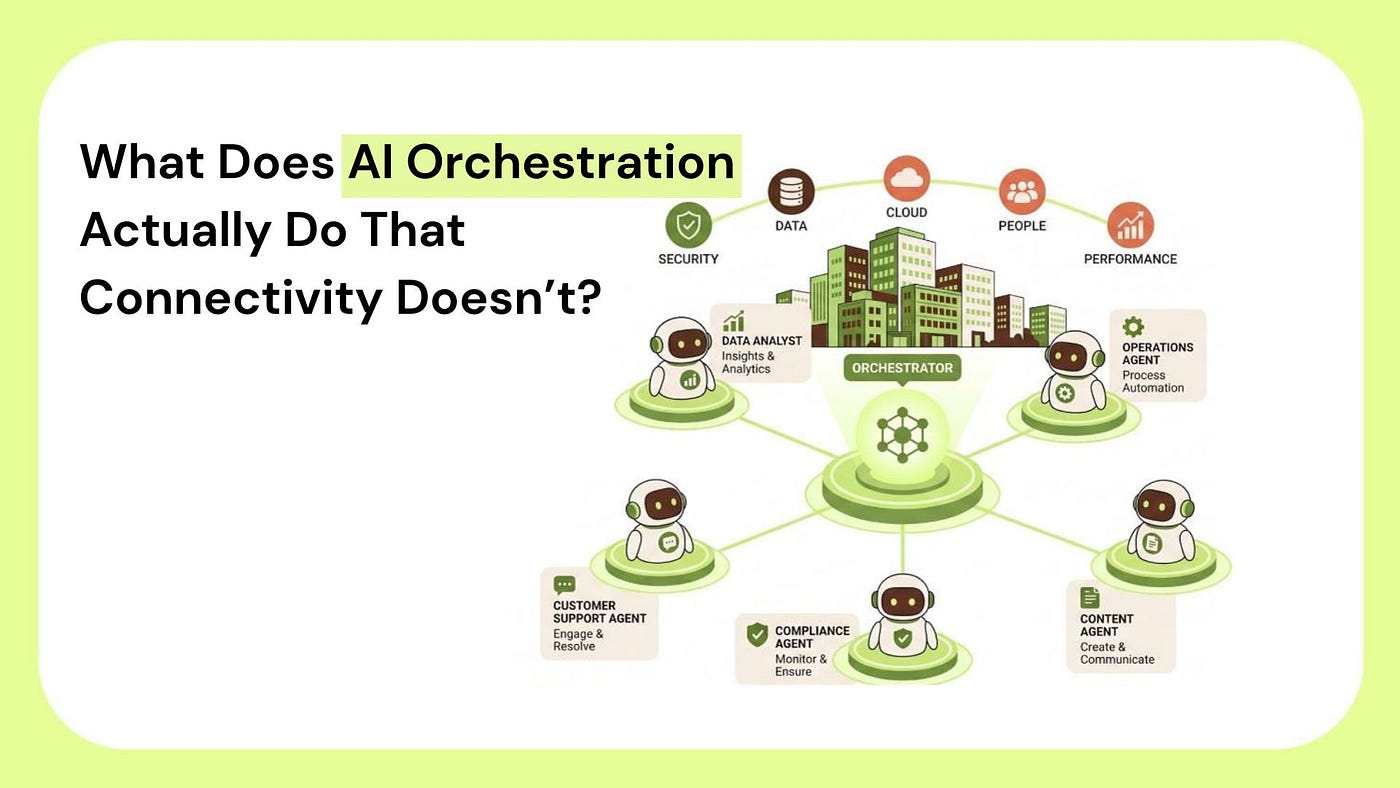
AI Orchestration is the system that manages what happens between agents. Who decides what each agent gets as input? Who checks what each agent returns before that output becomes the next agent’s starting point? Who handles the case where an agent returns something technically valid but functionally wrong?
Photo by Andrea Zanenga on Unsplash
That role (the coordinator) is where orchestration actually lives. And it’s where almost every multi-agent system I’ve seen either has a gap or a fragile assumption.
The difference between automation and orchestration comes down to one question: does the system know when something is off? Automation moves things forward. Orchestration moves things forward only when it should.
What Happens When Probabilistic Outputs Start Stacking?
Every LLM-based agent is, at its core, a probabilistic system. It doesn’t give a definitive answer. It gives the statistically most likely answer for the input it received. And critically — it has no awareness of when it’s uncertain.
In a single-agent system, that’s workable. You wrap guardrails around the output. You check it before it reaches a downstream system or a real user. The risk is contained to one surface.
In a multi-agent system, the math changes entirely. Each agent’s output becomes the next agent’s input. Probabilistic outputs stack on top of each other at every step. And by the time you reach the end of the pipeline, the final output can be confidently, coherently wrong with no agent having made an obvious error.
Let me give you a concrete example. It’s from financial services, but the pattern applies everywhere.
How Can Four Successful Agents Produce the Wrong Decision?
Imagine a loan underwriting workflow with four agents working in sequence.
Agent 1 — Application Fetch Agent retrieves the applicant’s file from the core banking system. It returns: “Retrieved application file. Document appears complete. All expected fields present.” Confidence: 96%.
What the system doesn’t know: page 3 of the scanned income certificate failed to upload. The agent retrieved what was available. It has no mechanism to verify completeness. Nothing flagged.
Agent 2 — Document Parsing Agent extracts structured fields from the income certificates and bank statements. It returns: “Successfully extracted: Name, Address, Bank Account, Income (partial). Structured data ready for scoring.” Confidence: 94%.
What actually happened: the income field is incomplete because the missing page contained year-end bonuses. The agent extracted what it could find and marked the field as present. No flag raised.
Agent 3 — Risk Scoring Agent evaluates the application against credit criteria. It returns: “Credit score: 680. Debt-to-income ratio: 42%. Risk category: Moderate. Recommend manual review.” Confidence: 91%.
What’s wrong: the risk score was calculated on incomplete income data. The actual income is 28% higher. That would change the debt-to-income ratio to 33% and shift the risk category from Moderate to Low. The decision just changed — but the system doesn’t know that.
Agent 4 — Memo Creation Agent drafts the underwriting summary for a human reviewer. It returns: “Generated comprehensive underwriting memo. All sections complete. References income data, credit score, and debt ratios. Formatted for review queue.” Confidence: 95%.
The memo reads perfectly. It has all the expected fields. It tells a coherent narrative. Nothing in the document signals that it was built on incomplete data. A human reviewer who hasn’t been told to look for missing income pages will read it as reliable.
This is what I mean by stacked probabilistic outputs. Each agent performed within its own expected range. No individual agent made a catastrophic error. But the system as a whole produced an incorrect outcome — and it was designed with nothing to catch it.
Who Is Responsible When AI Agents Pass Along Bad Information?
Here’s an insight: in most failed or underperforming multi-agent deployments, the problem isn’t the sub-agents. Sub-agents fail in predictable, bounded ways. The problem is the coordinator.
The coordinator’s job isn’t just to route tasks. It’s to:
- Validate each sub-agent’s output before passing it downstream
- Catch completeness problems before the next step runs
- Know when an output that looks plausible is actually outside acceptable parameters
- Decide when to stop the workflow and route to a human
Most architectures I’ve seen treat the coordinator as a router. A smart dispatcher. That’s not enough.
A coordinator that routes is doing automation. A coordinator that validates, flags, and escalates — with defined logic for each decision — is orchestrating.
The distinction sounds subtle. The production implications are not.
What Does Enterprise-Grade AI Orchestration Look Like?
Enterprises are moving fast on AI agents. The pressure to show results is real, and pilots are relatively forgiving environments — inputs are controlled, volumes are low, and teams are watching closely. Production is none of those things.
At Gyde, we build what we call Specific Intelligence Systems (SIS) — production-grade AI systems that treat orchestration, governance, and validation as a single architectural decision rather than separate layers bolted on later. The coordinator logic isn’t an afterthought. It’s where we start.
Because the question isn’t whether your agents can complete individual tasks. It’s whether the system knows what to do when they return something that sounds right but isn’t.
Most multi-agent architectures aren’t designed to answer that question. That’s the gap worth solving.
Next in this series: Part 2 covers the five challenges enterprise teams almost always underestimate before deploying multi-agent AI — and what each one actually costs in production.
Disclaimer: This piece is Part 1 of an ongoing series on enterprise AI orchestration. The original, full-length version of this content (including interactive diagrams and framework comparisons) is published on the Gyde blog.
메타데이터
- post_id
- cd64aea8e1ba
- slug
- what-does-ai-orchestration-actually-do-that-connectivity-doesnt-cd64aea8e1ba
- url
- https://medium.com/@prasannavaidya/what-does-ai-orchestration-actually-do-that-connectivity-doesnt-cd64aea8e1ba
- canonical_url
- https://medium.com/@prasannavaidya/what-does-ai-orchestration-actually-do-that-connectivity-doesnt-cd64aea8e1ba
- author_url
- https://medium.com/@prasannavaidya
- status
- ok
- fetched_at
- 2026-06-22 08:06:21