Microbial Fuel Cells: Turning Waste into Watts
Written by Ryan Kumar
Microbial Fuel Cells: Turning Waste into Watts
Written by Ryan Kumar
Rethinking Waste as a Resource Most of us think of sewage as waste to dispose of, not as a source of energy.
However, a growing field of research is challenging this conventional wisdom. Electrogenic bacteria can release electrons from their cells as they digest organic waste, effectively generating a small but continuous flow of electricity. By turning waste into a useful energy resource, these microscopic organisms could reduce energy costs for sewage treatment, provide electricity in off-grid regions, and cut greenhouse gas emissions (Dakal et al., 2025).
How Microbial Fuel Cells Work A microbial fuel cell (MFC) is a bio-electrochemical device that uses bacteria in an anode chamber to convert the chemical energy in organic waste into electricity while also treating wastewater. Inside the low-oxygen anode chamber, microbes digest organic matter and release electrons and protons as part of their metabolism.
The anode is the conductive material (electrode) that collects these electrons, and the cathode is the second electrode where the electrons end up after travelling through an external circuit (Clifford, n.d.). At the cathode, the electrons are consumed in a chemical reaction, usually combining with oxygen or another electron acceptor. This keeps the electrons from the bacteria flowing through the circuit, generating electric current (Douglas, 2010).
Although the output of electricity is usually small, it is continuous and can be harnessed as long as the microbes continue digesting organic matter. Scientists have found that Geobacter sulfurreducens and Shewanella oneidensis are among the best-suited microorganisms for transferring electrons outside their cells specifically for power generation (Jiang et al., 2010).
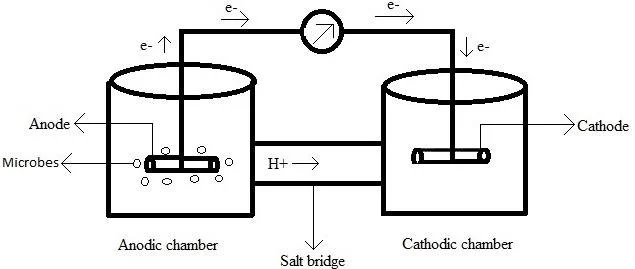
Schematic diagram of a microbial fuel cell (Aswin et al., 2017).
Why This Matters Wastewater treatment is an expensive, energy-intensive process because it involves high infrastructure maintenance, power use, and the continuous removal of complex pollutants to meet strict environmental regulations. In fact, the International Water Association estimates that wastewater treatment consumes around 1% to 3% of global energy output (International Water Association, n.d.).
Additionally, wastewater plants produce 2.5% of U.S. methane emissions and 8.1% of nitrous oxide emissions (Sullivan, 2025). This is where MFCs enter the scene. MFCs could help lower the operating costs and greenhouse gas emissions associated with modern wastewater treatment plants by using microorganisms to convert organic pollutants directly into electricity rather than releasing methane.
Current Progress and Limitations MFCs have shown promising results in laboratory and pilot studies, including wastewater treatment, energy recovery, and sensing applications (Capodaglio et al., 2013). For instance, a research team in Switzerland has created a 1,000-liter MFC consisting of 64 MFC units that can both treat wastewater and generate electricity. The system maintained an energy efficiency of 5.8% to 12.1%, producing 0.015 kilowatt-hours of energy per cubic meter of wastewater treated.
Simultaneously, this large-scale MFC system has also eliminated up to 68% of organic micropollutants and 48% of ammonia, meeting legal requirements for water purification (Research Features, 2023).
However, MFCs still produce relatively low power compared with conventional energy systems, and their performance and cost-effectiveness often drop at larger scales. The monetary investment required for these devices remains a major barrier to widespread implementation because electrodes, proton exchange membranes, and other specialized materials are very costly (Hassan et al., 2023).
To help address these issues, researchers are working on enhanced electrode materials and stronger biofilms that allow microbes to transfer electrons more efficiently (Suleiman et al., 2026).
Another practical goal in this field of research is integrating MFC systems with existing, conventional water infrastructure. This hybrid approach may be the most realistic path to making this technology useful in the long-term, working as part of real treatment plants rather than only as laboratory devices (Álvarez-Ley et al., 2025).
Conclusion Instead of treating waste only as a problem, microbial fuel cells treat it as a resource. MFCs are gradually progressing toward the goal of real-world implementation through larger pilot systems, more effective materials, and ongoing research and development that make wastewater treatment both cleaner and more energy-efficient (Dakal et al., 2025).
As the field continues to advance, sewage could become more than something to dispose of, serving as a small but meaningful source of energy powering sustainable wastewater treatment in the near future.
References:
- Álvarez-Ley, J. E., Méndez-Novelo, R. I., Giácoman-Vallejos, G., Paniagua Solar, L. A., & San-Pedro, L. (2025). Microbial fuel cells for power generation and wastewater treatment: A review of components, performance and sustainability. International Journal of Hydrogen Energy, 137, 429–447. https://doi.org/10.1016/j.ijhydene.2025.05.140
- Aswin, T., Begum S, S., & Yacin Sikkandar, M. (2017). Schematic diagram of microbial fuel cell. Optimization of Microbial Fuel Cell for Treating Industrial Wastewater and Simultaneous Power Generation. International Journal of Chemical Sciences. https://doi.org/https://www.researchgate.net/figure/Schematic-diagram-of-microbial-fuel-cell_fig1_321161651
- Capodaglio, A. G., Molognoni, D., Dallago, E., Liberale, A., Cella, R., Longoni, P., & Pantaleoni, L. (2013). Microbial fuel cells for direct electrical energy recovery from urban wastewaters. TheScientificWorldJournal, 2013, 634738. https://doi.org/10.1155/2013/634738
- Clifford, C. B. (n.d.). 11.3 Microbial fuel cells. EGEE 439: Alternative Fuels from Biomass Sources. Retrieved April 2, 2026, from https://courses.ems.psu.edu/egee439/node/729
- Dakal, T. C., Singh, N., Kaur, A., Dhillon, P. K., Bhatankar, J., Meena, R., Sharma, R. K., Gadi, B. R., Sahu, B. S., Patel, A., Singh, B., & Kumari, K. (2025). New horizons in microbial fuel cell technology: Applications, challenges, and prospects. Biotechnology for Biofuels and Bioproducts, 18(1), 79. https://doi.org/10.1186/s13068-025-02649-y
- Douglas, M. (2010, May 4). Microbial fuel cells: Generating power from waste — USC Viterbi School of Engineering. USC Viterbi School of Engineering — USC Viterbi School of Engineering. https://illumin.usc.edu/microbial-fuel-cells-generating-power-from-waste/
- Hassan, M., Kanwal, S., Sarup Singh, R., Ali SA, M., Anwar, M., & Zhao, C. (2023). Current challenges and future perspectives associated with configuration of microbial fuel cell for simultaneous energy generation and wastewater treatment. International Journal of Hydrogen Energy, 50, 323–350. https://doi.org/10.1016/j.ijhydene.2023.08.134
- International Water Association. (n.d.). Circular economy: tapping the power of wastewater. International Water Association. Retrieved April 2, 2026, from https://www.iwa-network.org/learn/circular-economy-tapping-the-power-of-wastewater
- Jiang, X., Hu, J., Fitzgerald, L. A., Biffinger, J. C., Xie, P., Ringeisen, B. R., & Lieber, C. M. (2010). Probing electron transfer mechanisms in Shewanella oneidensis MR-1 using a nanoelectrode platform and single-cell imaging. Proceedings of the National Academy of Sciences, 107(39), 16806–16810. https://doi.org/10.1073/pnas.1011699107
- Research Features. (2023, February 23). Scaling up MFCs to clean wastewater and produce electricity. Research Features. https://researchfeatures.com/scaling-microbial-fuel-cells-mfcs-clean-wastewater-produce-electricity/
- Suleiman, A. I., Opisa, A. N., Idris, M. O., Sule-Otu, M. O., Otuoze, A. O., Jatto, A., Zakari, D. A., Audu, G. A., & Olasupo, A. (2026). Bioelectrochemical energy conversion and wastewater treatment in microbial fuel cells: A review of progress, limitations, and future developments. Bioresource Technology, 443, 133903. https://doi.org/10.1016/j.biortech.2025.133903
- Sullivan, J. (2025, October 8). Wastewater plants produce twice as much greenhouse gas as estimated. Princeton Engineering. https://engineering.princeton.edu/news/2025/10/08/wastewater-plants-produce-twice-much-greenhouse-gas-estimated
메타데이터
- post_id
- d2a543dbf6c5
- slug
- microbial-fuel-cells-turning-waste-into-watts-d2a543dbf6c5
- url
- https://medium.com/@harvardmicrosociety/microbial-fuel-cells-turning-waste-into-watts-d2a543dbf6c5
- canonical_url
- https://medium.com/@harvardmicrosociety/microbial-fuel-cells-turning-waste-into-watts-d2a543dbf6c5
- author_url
- https://medium.com/@harvardmicrosociety
- status
- ok
- fetched_at
- 2026-06-13 09:11:36