Imaginary numbers in quantum mechanics may point to a deeper reality
Niels Bohr, one of the fathers of quantum mechanics, upon being confronted with the equations for the new quantum mechanics, argued that…
Imaginary numbers in quantum mechanics may point to a deeper reality
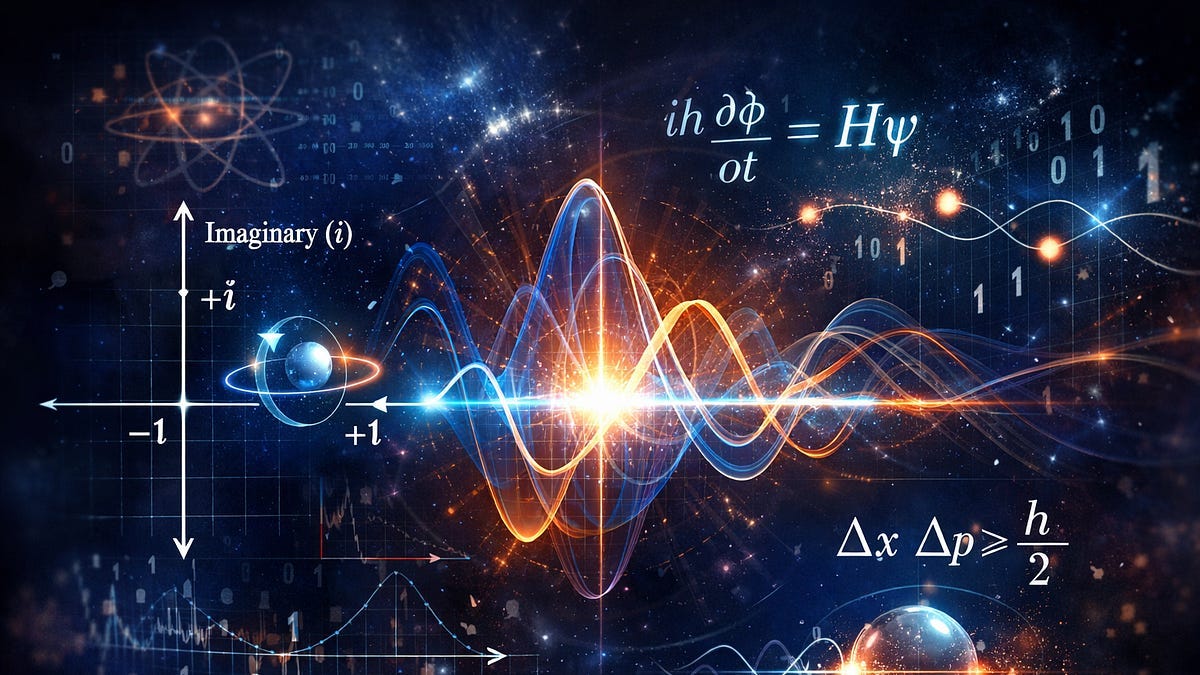
Niels Bohr, one of the fathers of quantum mechanics, upon being confronted with the equations for the new quantum mechanics, argued that they could only be symbolic and not represent anything real. Part of his reasoning was that Schrodinger’s equation equated momentum with an imaginary quantity, meaning a number times the square root of negative one.
Bohr’s opinion is surprising given that in classical electrodynamics, one can represent waves very conveniently as complex numbers, meaning a real number added to an imaginary one. This is because waves, which are solutions to Maxwell’s equations, consist of three quantities in relation to one another: amplitude, frequency, and phase. If you represent a complex number in polar coordinates within the complex plane, the magnitude is the amplitude, while the phase appears as the direction. Frequency is simply how quickly that direction moves in angle as it sweeps around the plane, like a line on a radar screen.
If you want to compare two waves, it is easy to do so by looking at how they move in the complex plane in this way. Thus, one should not be confused by the word “imaginary” when talking about these numbers. They are anything but.
In fact, any kind of digital signal processor will, typically, convert signals it receives into imaginary numbers. It does this by sampling the signal it receives twice for every wavelength. The first sample is the real part, and the second sample is the imaginary. Thus, the physically measurable, an electromagnetic wave, is converted into imaginary numbers.
Was Bohr ignorant of these facts?
Not at all.
What is confusing about quantum mechanics is that, although it is about waves, it also seems to be telling us that a real-valued position gives us an imaginary-valued momentum for a particle. Meanwhile, an imaginary valued position gives a real valued momentum. They are related by a scale of i (the square root of negative one) times Planck’s reduced constant, also typically called “h-bar” because of the way the symbol is represented.
How can you visualize this?
In classical physics, any physical system is defined on something called its phase space. This is a plot, essentially, of its position and momentum together. Different kinds of systems make different shapes in phase space. For example, a one-dimensional spring will make an oval or circle in phase space as its displacement from neutral position changes with its speed. I have a whole article on phase space visualization.
From a physics perspective, the position and momentum, which are related by something called the Hamiltonian, are a complete description of the system. This depends on the position and momentum, both being real, measurable quantities.
Thus, Bohr was noticing that the phase space for a quantum particle existed not in the intersection of two real lines but in the intersection of a real line and an imaginary line, i.e., the complex plane.
But what did it mean physically for phase space to be so defined? How could you visualize a particle with an imaginary velocity?
One other difference between quantum theory and classical theory is that momentum is defined not as a number but as an operation, the derivative with respect to position. This operation is carried out on the wavefunction, a mysterious function that defines the particle’s probable locations.
This might solve the problem, since the wavefunction itself, if it contains an imaginary number (as it often does), might cancel out the factor of i and produce a real value for the momentum.
The problem then, however, is that the wave itself has a different character from the position.
In fact, if you have more than one particle, the wave no longer appears to be a wave in the ordinary sense at all because it appears to propagate in a higher-dimensional space made up of the positions of all the particles. This further suggests it might not be a physical entity at all.
Bohr explicitly connected the idea that, because these quantities cannot be visualized, they must have some symbolic representation that is unreal.
Bohr was on to something, it turns out, because recent research into quantum information theory has shown that imaginary numbers have a much deeper role in quantum behavior than they do for waves in classical physics.
Firstly, the role of imaginary numbers in quantum mechanics is irreducible, meaning that they aren’t merely a convenience as in classical electromagnetism. We could, after all, represent electromagnetic waves purely using real numbers if we wanted to. The reason we don’t is that complex numbers have properties that make them well-suited to manipulating representations of waves.
If you don’t believe me, consider that quaternions, which are a generalization of complex numbers to higher dimensions, are uniquely well-suited to representing objects that can rotate in three-dimensional space. I guarantee you that many aircraft and drones use quaternions internally to represent their orientation in space. Complex numbers can be seen as simply a special case of quaternions in a lower-dimensional space where things only rotate in one plane.
This is exactly how waves are modeled, as things rotating in a plane. In the end, you take the real part and throw away the imaginary.
Schrodinger’s equation, unlike the classical wave equation, contains an imaginary factor explicitly. The imaginary factor keeps the evolution of probability conserved rather than dissipating over time.
Recently, a real-valued version of quantum mechanics was published, but honestly, it just simulates the complex numbers of quantum physics using real numbers. Thus, it simply hides the deeply embedded concept.
There are also other ways to formulate quantum mechanics in real spaces, such as Kähler spaces, which have geometric features that simulate the complex numbers.
This means that you can formulate QM over real numbers, but only by smuggling in complex numbers using other structures.
While in classical physics, intuitive, real-valued fields and trajectories can also be visualized, quantum mechanics lives in the complex world.
The reason why is that in quantum mechanics, everything has a phase, which is something that only really exists for some things in the classical world. Phase is what allows wavefunctions to interfere with one another, something that classical mechanics cannot do. In classical mechanics, it is like the phase is always zero, so it can always be ignored.
Phase makes perfect sense when you think about an electromagnetic wave. It is like a little dial on an oscilloscope. You can tune the phase left or right.
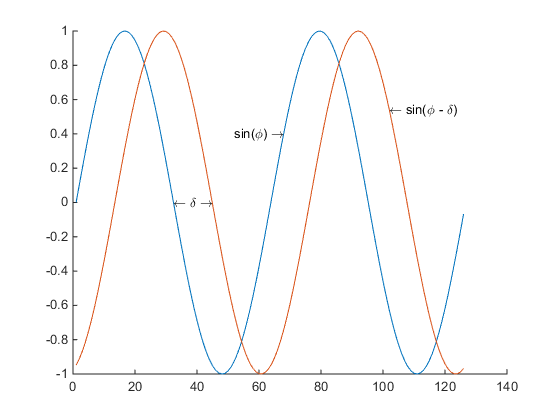
Or you can compare two waves with different phases.
But when you are talking about billiard balls, planets, or rocket ships, talking about their phase makes no sense. That is why you can visualize things so easily.
The introduction of phase into everything that exists, however, makes it exceptionally hard to visualize. You can’t throw out the phase until you measure. Experiments like the double slit, where you have individual particles appearing to interfere with themselves (because of overlapping phase), to entanglement, to mysterious interactions like the Aharonov-Bohm effect, everything depends on what the relative phase is.
In the Aharonov-Bohm effect, where electrons interact with electromagnetic potentials even where there is no electric or magnetic field, electrons accumulate phase as they travel. What this means is that even though no force acted on the electron at all, because there was no electromagnetic field, because of the phase accumulation, the electron’s wave pattern is shifted, and we can measure this effect directly. In fact, it is the basis for SQUIDs, which are the most sensitive magnetic flux measurement devices ever developed.
Wavefunctions have something called U(1) symmetry, which is the freedom to rotate the phase. Electromagnetism also has this symmetry, which is why there are parallels. Complex numbers naturally represent U(1) symmetry well.
An interesting feature of this symmetry is that the global phase of a quantum system is unobservable. That is why it is a symmetry. It is as if I rotated a circle; it would look the same. Only relative phases matter, much like only relative velocities matter in relativity.
This means that, like states of motion, phase is fundamental but also relational.
Complex numbers are fundamental to quantum mechanics in much the same way that spacetime vectors are fundamental to relativity. One must describe the trajectory of a relativistic rocket not merely as a spatial location moving through time but as a spacetime location moving in a four-dimensional spacetime. Phase shifts applied to wavefunctions are much the same as spacetime boosts and rotations applied to trajectories. And what matters in quantum mechanics is relative phase, just as relative velocity matters to relativistic rockets.
As wavefunctions evolve in time, they are not moved, stretched, or spread out but rotated. This preserves probability.
Thus, the fundamental principle of reality should be that everything evolves by rotation, not translation or scaling. And complex numbers are the natural description of rotation in a single plane.
While you don’t have to use complex numbers for this, you do have to capture this phase rotation description one way or another.
Getting back to Bohr, now, we can ask whether this is something that is merely a symbolic representation of reality or something that we can, in fact, visualize.
Yes and no. On the one hand, it is easy enough to visualize a wave and to imagine waves interfering because of their relative phase. On the other hand, we don’t measure waves. We measure particles. Therefore, it seems difficult to do so at all.
The best we can do is perhaps use something like the Bloch sphere.
Imagine something representing a single qubit, meaning a unit of quantum information. On the Bloch sphere, the north pole is, say, 0, and the south pole is 1. A pure quantum state will be somewhere between 0 and 1, and we can represent that superposition of states as a position on the sphere.
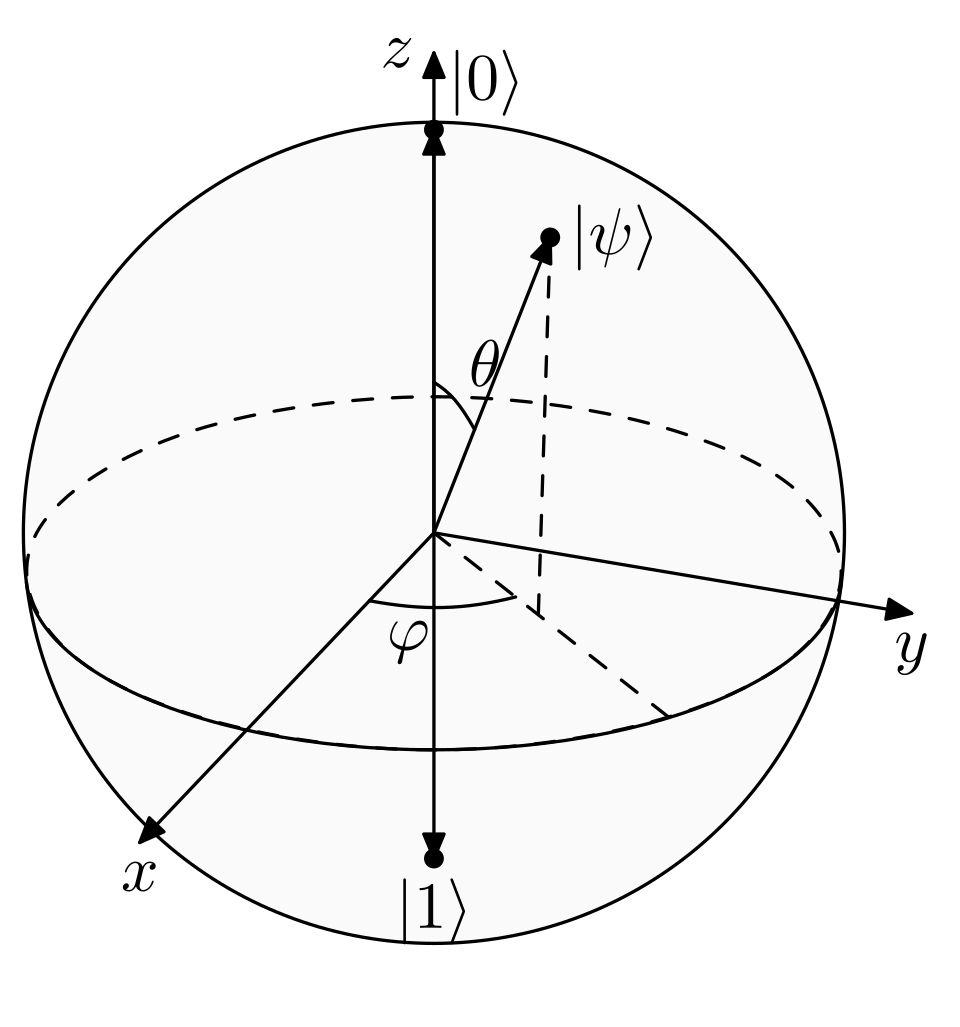
In this case, the azimuthal angle is the phase between the two states, and the polar angle is the amount of each state present in the probability. That means that if something is more likely to be 0, it will point to a spot closer to 0.
Intuitively, the polar angle aspect is easy enough to understand. We can visualize relative amounts of things. The azimuthal angle, on the other hand, may be less intuitive because it includes this concept of phase that is part of quantum mechanics, but only appears in classical physics when we are dealing with waves. We just have to accept that as part of the visualization.
As time evolves, the pointer rotates smoothly around some axis.
Now, when we make a measurement of the qubit, something mysterious happens. The pointing direction on the sphere snaps immediately to either the north or south pole. It is either 0 or 1.
Since the north and south poles have no phase, the measurement has destroyed it. The imaginary numbers have vanished.
Thus, we have a smooth rotation of the wavefunction under time evolution and a sudden snap when a measurement is made. One rotates the phase while the other destroys it. And there is no way to rotate continuously on the sphere to pass through a pole. These are two very different forms of evolution.
At best, this can visualize the measurement problem, but depending on your interpretation of quantum mechanics, you may have a different resolution.
In the Copenhagen Interpretation, the smooth rotation and sudden snap to the pole are physically real. Observation somehow causes the collapse of the wavefunction, and we have two different kinds of time evolution, one smooth before observation and the other discontinuous when observation occurs.
In the Many Worlds Interpretation, the smooth rotation never stops. What really happens is that interaction with a detector causes the illusion of snapping to a pole.
In QBism, the smooth rotation is something of an illusion. It is merely how my estimate of the probability evolves. The sudden snap to the pole happens when I update my probability matrix with more information.
In any case, classical intuition has to go out the window, and no visualization can easily represent the gap between the pre- and post-measurement states.
Dieks, Dennis. “Niels Bohr and the formalism of quantum mechanics.” Niels Bohr and the philosophy of physics (2017): 303–333.
Volovich, Igor. “Real quantum mechanics in a Kahler space.” arXiv preprint arXiv:2504.16838 (2025).
Originally published at https://timandersen.substack.com.
메타데이터
- post_id
- d399c67caed7
- slug
- imaginary-numbers-in-quantum-mechanics-may-point-to-a-deeper-reality-d399c67caed7
- url
- https://medium.com/the-infinite-universe/imaginary-numbers-in-quantum-mechanics-may-point-to-a-deeper-reality-d399c67caed7
- canonical_url
- https://medium.com/the-infinite-universe/imaginary-numbers-in-quantum-mechanics-may-point-to-a-deeper-reality-d399c67caed7
- author_url
- https://medium.com/@andersentda
- status
- ok
- fetched_at
- 2026-06-15 20:49:13