Google Just Solved AI’s Memory Problem — Here’s What Changes Now
Two new research breakthroughs reveal how artificial intelligence can finally remember like humans do
Google Just Solved AI’s Memory Problem — Here’s What Changes Now
Two new research breakthroughs reveal how artificial intelligence can finally remember like humans do
Estimated reading time: 15minutes →(Titans + MIRAS: Helping AI have long-term memory)
Every conversation you’ve ever had with ChatGPT has a fatal flaw.
It’s not the hallucinations. It’s not the occasional wrong answer. It’s something more fundamental: the AI is slowly forgetting everything you said at the beginning of your conversation.
Try asking ChatGPT to read an entire novel and then answer questions about a character mentioned in chapter one. By the time it reaches chapter forty, that character has become a ghost — vaguely familiar but stripped of crucial details. The AI’s memory has decayed, not because of poor design, but because of an architectural limitation that’s plagued every major language model since their inception.
Until now.
Google’s DeepMind has published two research papers that fundamentally reimagine how AI handles memory. Titans and MIRAS aren’t incremental improvements — they represent a paradigm shift in how machines can retain, organize, and retrieve information across contexts that span millions of words. We’re talking about AI that can hold multiple entire books in active memory while maintaining perfect recall of details from page one to page five hundred.

In this deep dive, you’ll discover how these breakthroughs work, why they matter for practical applications, and what this means for the race toward artificial general intelligence. More importantly, you’ll understand the elegant simplicity underlying what might seem like complex innovation — because the secret lies in copying something we’ve had all along: the human brain’s memory architecture.
The Problem Every AI Developer Has Been Avoiding
The limitation isn’t a bug — it’s a feature of the technology itself.
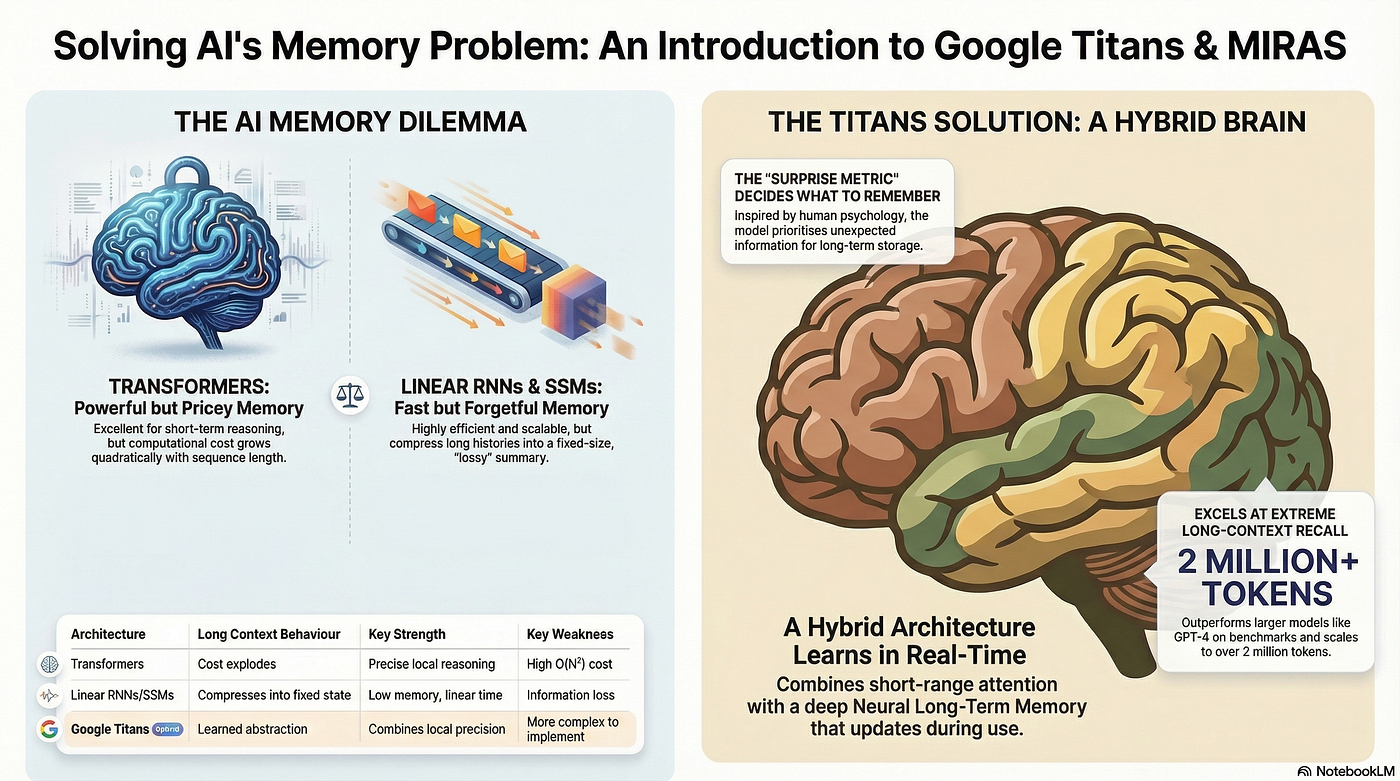
Modern AI models are built on an architecture called Transformers, which revolutionized natural language processing when introduced in 2017. Transformers excel at understanding relationships between words, but they have an Achilles heel: their computational cost grows exponentially with context length.
This isn’t just a technical limitation — it’s a fundamental constraint that affects every AI assistant you’ve ever used. As Richardson Gunde aptly describes, conversing with current AI often feels like “talking to a goldfish” — it listens momentarily, then forgets everything once you move to the next topic.
Think about it mathematically. When a Transformer processes text, it must compare every word to every other word to understand relationships. For a sentence with 10 words, that’s 100 comparisons. For 100 words, it’s 10,000 comparisons. For an entire book of 100,000 words? That’s 10 billion comparisons. The memory requirements and processing time don’t just increase — they explode.
This is why you’ll notice ChatGPT, Claude, and Gemini starting to lose coherence during extended conversations. They’re not actually “forgetting” in the way humans do — they’re hitting hard computational limits. The models must either truncate earlier context or spend exponentially more resources maintaining it.
Previous attempts to solve this fell into two camps: models that compressed everything into fixed-size memory (losing critical details), or models that tried to brute-force longer contexts (requiring massive computational resources). Neither approach addressed the fundamental issue.

The real question wasn’t how to store more information. It was how to store information intelligently.
How Titans Copies Your Brain’s Memory System
Here’s what makes Titans revolutionary: it doesn’t just store more — it organizes memory the way biological brains actually do.
Neuroscientists have understood for decades that human memory isn’t monolithic. We don’t have one giant hard drive recording everything equally. Instead, we have specialized memory systems that handle different cognitive tasks. Working memory holds immediate information. Long-term memory stores important patterns and knowledge. Procedural memory handles skills and instincts.
Titans implements this three-layer architecture with stunning precision.
The Long-Term Memory Module: Your AI Librarian
The top layer handles what researchers call “contextual memory” — the system responsible for learning and retaining information over extended sequences.
Previous AI models stored memories as simple vector matrices, essentially lists of numbers with no inherent structure or understanding. Titans replaces this with something far more sophisticated: a multi-layer perceptron, which is essentially a neural network within the neural network. Think of it as hiring a specialized librarian whose entire job is organizing and understanding the knowledge base.
This long-term memory doesn’t passively record like a security camera. It actively learns patterns, identifies themes, and creates connections between information that might be separated by thousands of words. When you mention “Bob” on page one and refer to “the tall man with the distinctive laugh” on page 500, Titans’ long-term memory connects these as the same entity.
The magic lies in what researchers call the “surprise metric” — an attention mechanism that prioritizes unexpected, important information while filtering routine content. Just like your brain remembers the unusual conversation you had this morning but forgets the mundane elevator ride, Titans focuses its memory resources on what actually matters.
The Core Attention Layer: Immediate Context Processing
The middle layer handles in-context learning using the same attention mechanism that made Transformers famous. This is the system’s short-term memory — precise, fast, and focused on the immediate context.
When someone asks “What was the last word I said?” this layer delivers the answer instantly. It excels at questions requiring exact recall of recent information. The system maintains sharp focus on what’s happening right now without getting lost in the vast archive of past context.

The brilliance emerges in how these layers collaborate. The long-term memory continuously generates compressed “summary reports” of everything important from the past. The attention layer can then choose: should I consult this historical summary, or is the immediate context sufficient to answer this question?
This selective consultation prevents the exponential computational cost that cripples traditional Transformers. The model only processes what it needs, when it needs it.
The Persistent Memory Layer: Foundational Knowledge
The bottom layer contains the model’s base intelligence — the knowledge baked in during training that doesn’t change during conversations. This includes fundamental understanding of grammar, semantic relationships, common sense reasoning, and domain knowledge.
Think of this as instinctual knowledge. You don’t actively “remember” that fire is hot or that dogs and puppies are related concepts — these are foundational truths that inform all higher-level reasoning.
When all three layers operate in concert, you get something remarkable: an AI system that combines instinctual knowledge, learned patterns from long contexts, and sharp attention to immediate details. It’s the computational equivalent of how your own memory works right now as you read this article.
The MIRAS Framework: Unifying Every AI Memory System

While Titans is the practical implementation, MIRAS represents the theoretical breakthrough that makes it possible.


MIRAS isn’t software you can download. It’s a discovery — a mathematical framework revealing that every major advance in sequence modeling has been secretly solving the same problem with different approaches. As outlined in the MIRAS research paper, this framework reconceptualizes neural architectures as associative memory modules.
The Elegant Unification
Imagine if someone discovered that every vehicle ever invented — bicycles, cars, helicopters, submarines — all function through the same four fundamental principles, just implemented differently. That’s what MIRAS does for AI architectures.
The framework reveals that Transformers, Recurrent Neural Networks, Mamba, and other competing architectures are all building “associative memory” systems that connect inputs to outputs. They’re all solving the same mathematical problem with different design choices.
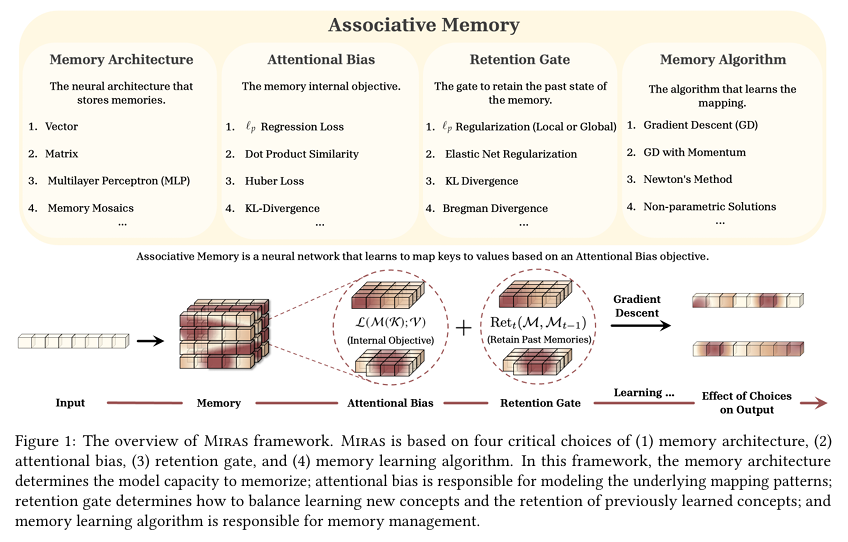
MIRAS identifies four critical dimensions where these systems differ:

Memory Architecture determines the physical structure. Should memory be a simple vector (a list), a matrix (a grid), or something more complex like a deep neural network? This choice fundamentally constrains how much information can be stored and how flexibly it can be organized.
Attentional Bias controls what the model prioritizes. When new information arrives, the system must decide: Is this important enough to remember? Different models optimize different objectives, which is why they behave distinctly on identical inputs.
Retention Gate manages the forgetting mechanism. This might surprise you: forgetting is just as critical as remembering. If your brain captured every sensory detail of every moment, you’d be cognitively paralyzed. Effective memory systems must filter aggressively, keeping signal and discarding noise.
Memory Algorithm defines the mathematical process for incorporating new information into existing memory. Different algorithms balance speed, accuracy, and stability differently.
The Breakthrough Insight
Almost every successful AI model to date has used Mean Squared Error (MSE) for both attention and retention decisions. MSE measures the distance between expected and actual outputs, then squares the difference.
It works. But it’s sensitive to outliers — one unusual data point can disproportionately influence the entire system.
MIRAS opened the door to experimentation. Using this unified framework, researchers created three experimental models exploring alternatives:
YAAD uses Huber Loss instead of MSE, making it more robust to errors. A single typo won’t derail the entire memory system.
Moneta explores stricter mathematical rules (generalized norms) to investigate whether more disciplined constraints lead to better stability.
Memora forces memory updates to behave like probability distributions, guaranteeing balanced and controlled updates that prevent chaotic memory states.
The practical implication is profound: MIRAS provides a principled way to design and optimize memory systems instead of relying on trial and error. This represents what researchers call “test-time training” or “test-time adaptation” — the ability of models to learn and update their parameters during inference, not just during the initial training phase.
The Performance Numbers That Changed Everything
Let’s talk about what happens when theory meets reality.
The research team tested Titans against existing models on tasks designed to torture AI memory systems. The results weren’t close — they were devastating for the competition.

The Depth Advantage
One crucial experiment measured perplexity (how confused the model is) across different sequence lengths. Lower perplexity means better understanding and more accurate predictions.
As sequence length increased, Mamba — a popular existing model — showed increasing confusion. Its perplexity climbed as it processed longer text, meaning it made progressively more mistakes. This makes sense: Mamba compresses everything into fixed-size memory, so longer sequences mean more information loss.
Titans maintained flat, low perplexity even as sequences extended dramatically. At both 360 million and 760 million parameters, the pattern held: deeper memory architectures preserve performance across longer contexts.
Why does depth matter so much? Consider the difference between summarizing a book in one sentence versus writing a comprehensive book report with character analysis, plot summary, thematic exploration, and critical commentary. Shallow memory captures what happened. Deep memory captures why it matters and how everything connects.
The BabaLong Benchmark Massacre
Perhaps the most impressive result came from BabaLong, a benchmark specifically designed to test long-context understanding. The task hides facts throughout documents exceeding 2 million tokens (multiple entire books), then asks questions requiring the AI to find and connect those buried details.
GPT-4, one of the world’s most powerful and expensive models, crashed hard. As document length increased, accuracy plummeted from decent to essentially useless. This isn’t a minor model — GPT-4 cost billions to train and represents the pinnacle of traditional architecture.
Mamba and other baselines also failed as context extended.
Titans maintained strong performance even at extreme lengths where everything else collapsed. According to the original research paper, Titans achieved superior results across needle-in-haystack tasks with sequences extending beyond 2 million tokens. And here’s the remarkable part: Titans is substantially smaller than GPT-4, with a fraction of the parameters and training cost. It achieves superior results through architectural innovation rather than brute computational force.

What This Actually Means for Real Applications
The implications extend far beyond academic benchmarks.
Legal technology deals with contracts and case files spanning hundreds of pages with cross-references, precedents, and complex argumentation. Lawyers need AI that can truly understand the full context, not just keyword-match isolated sections.
Medical systems must process complete patient histories spanning decades, understanding how early diagnoses, treatments, and life events influence current health status. Missing crucial details from ten years ago could lead to dangerous misdiagnoses.
Scientific research requires understanding how current work builds on previous studies. Comprehending a field’s state-of-the-art means processing massive amounts of technical literature, tracking how concepts evolved, and identifying contradictions or gaps.
Software development involves navigating large codebases where functions defined in one file influence behavior in dozens of others. Understanding the full system architecture is impossible without genuine long-context memory.
Personal AI assistants become genuinely useful when they remember months of conversation history, understanding your preferences, projects, and communication style without requiring constant re-explanation.

These applications were theoretically possible but practically infeasible with previous architectures. Titans doesn’t just improve performance on these tasks — it makes them viable for the first time.
The Path Toward Human-Level AI
Memory isn’t just a feature — it’s fundamental to intelligence itself.
Human cognition depends on our ability to form coherent narratives from experience, connect disparate concepts, learn from long-term patterns, and maintain consistent understanding across extended contexts. Any system aspiring to human-level intelligence must solve the memory problem.
Previous AI development focused on scaling model size and training data. The implicit assumption was that bigger would be better — more parameters, more compute, more training tokens. This brute-force approach hit diminishing returns and astronomical costs.
Titans and MIRAS represent a different philosophy: architectural innovation over raw scaling. By fundamentally rethinking how models organize and access memory, Google achieved superior performance with smaller, more efficient systems.
This matters for AGI (Artificial General Intelligence) development because human-level intelligence isn’t just about solving individual tasks well — it’s about maintaining coherent understanding across domains, times, and contexts. Memory architecture is the scaffolding supporting everything else.

The ability to learn continuously during inference — what researchers call continual learning or lifelong learning — addresses one of AI’s most persistent challenges: catastrophic forgetting. Traditional neural networks, when trained on new tasks, tend to overwrite previously learned information. Titans’ architecture, with its separate memory modules and adaptive retention mechanisms, provides a pathway to overcome this limitation.
Beyond Titans: The Hope Architecture and Nested Learning
Google’s breakthrough opens immediate research directions, but the story doesn’t end with Titans.
The MIRAS framework provides a principled foundation for designing new memory systems. Researchers can now systematically explore the vast design space of memory architectures, attention mechanisms, and retention strategies instead of making educated guesses.
The three experimental models (YAAD, Moneta, Memora) hint at promising directions. Loss functions beyond Mean Squared Error may offer better robustness. Stricter mathematical constraints might improve stability. Probabilistic memory updates could prevent chaotic states.
But there’s a limitation. While Titans enables learning from data streams, it’s constrained to what researchers call “first-order in-context learning” — it has only two levels of parameter updates (the attention core and the long-term memory module).
Enter Hope: Learning How to Learn:-
This limitation led Google Research to develop an even more ambitious paradigm called **Nested Learning**, with Hope as its proof-of-concept architecture.
Hope is a self-modifying variant of Titans that fundamentally reimagines what learning means inside a neural network. Instead of treating the model architecture and optimization algorithm as separate entities, Nested Learning views them as a unified system of interconnected optimization problems operating at different levels and speeds.

The key innovation is the Continuum Memory System (CMS) — rather than just two memory levels (short-term and long-term), Hope creates a spectrum of memory modules, each updating at different frequencies:
- Fast-updating modules: Adapt to immediate context and recent patterns
- Medium-speed modules: Consolidate intermediate knowledge over sessions
- Slow-updating modules: Preserve fundamental capabilities and stable knowledge
This mirrors how the human brain actually works. Neuroscientists have discovered that long-term memory formation involves two complementary processes: rapid “online” synaptic consolidation that happens during wakefulness, and slower “offline” systems consolidation that occurs during sleep and integrates new memories with existing knowledge.
Hope can optimize its own memory through a self-referential process, creating an architecture with theoretically unbounded levels of in-context learning. It doesn’t just learn — it learns how to learn, continuously refining its own update rules.
Where We Go From Here
Google’s breakthrough opens immediate research directions.
The MIRAS framework provides a principled foundation for designing new memory systems. Researchers can now systematically explore the vast design space of memory architectures, attention mechanisms, and retention strategies instead of making educated guesses.
The three experimental models (YAAD, Moneta, Memora) hint at promising directions. Loss functions beyond Mean Squared Error may offer better robustness. Stricter mathematical constraints might improve stability. Probabilistic memory updates could prevent chaotic states.
We’ll likely see hybrid approaches combining insights from multiple systems. Perhaps attention mechanisms from one model, retention strategies from another, and memory architectures from a third, all unified under the MIRAS framework.
The practical deployment challenges remain substantial. While Titans dramatically reduces computational cost compared to naive Transformer scaling, implementing these systems in production environments requires solving engineering problems around inference optimization, memory management, and deployment architecture.
But the conceptual breakthrough is undeniable. The path toward AI with genuine long-term memory is now clear. As Google Research notes in their official blog post, this represents a meaningful shift toward real-time adaptation — models that can actively learn and update their core knowledge as data streams in, rather than remaining static after pretraining.
The Results Speak Volumes
On language modeling and common-sense reasoning benchmarks, Hope demonstrates lower perplexity and higher accuracy compared to both standard Transformers and modern recurrent models like Samba. More importantly, it shows superior performance on continual learning tasks — the ability to learn new information without catastrophically forgetting previous knowledge.
This is the holy grail problem that has plagued AI for decades. When you fine-tune a model on legal contracts, it typically forgets how to write casual conversational text. Hope’s multi-speed memory system solves this: fast layers adapt to legal terminology while slow layers preserve general language understanding. Over time, both integrate seamlessly.
The practical deployment challenges remain substantial. While Titans dramatically reduces computational cost compared to naive Transformer scaling, implementing these systems in production environments requires solving engineering problems around inference optimization, memory management, and deployment architecture.
But the conceptual breakthrough is undeniable. As Google Research notes in their official blog post, this represents a meaningful shift toward real-time adaptation — models that can actively learn and update their core knowledge as data streams in, rather than remaining static after pretraining. With Hope, we’re seeing the first steps toward truly self-improving AI systems.
Your Next Steps
If you’re building with AI or following its development closely:
For developers: Start thinking about which applications in your domain could benefit from true long-context understanding. Legal doc analysis? Medical record processing? Codebase comprehension? Position yourself to leverage these capabilities as they become available in production systems. If you’re building agentic AI systems, check out Richardson Gunde’s practical guide on implementing memory frameworks using LangChain and other tools.
For researchers: Dive into both the MIRAS framework and the Nested Learning paradigm. MIRAS provides a unified lens for understanding sequence models, while Nested Learning offers a path toward self-improving AI. The Hope architecture demonstrates that treating models as nested optimization problems can yield superior continual learning performance. Google’s approach to continual test-time adaptation represents a paradigm shift worth exploring.
For product leaders: Reconsider what’s possible. Applications previously infeasible due to context limitations may now be viable. More importantly, think beyond static models — the future belongs to systems that can adapt continuously without costly retraining. The competitive landscape is shifting — winners will be those who identify and execute on newly-possible use cases. As discussed in VentureBeat’s analysis, Titans enables models to find and store information during inference without exploding memory and compute costs.
The memory problem isn’t completely solved — we’re still early in exploring what these architectures can do. But for the first time, we have both the theoretical framework (MIRAS and Nested Learning) and practical implementations (Titans and Hope) proving that AI memory can scale intelligently without hitting computational walls.
Titans showed us how to build memory systems that learn during inference. Hope demonstrated that systems can learn how to learn, continuously optimizing their own memory processes. Together, they represent a fundamental shift from static, frozen models to dynamic, evolving intelligence.
The question isn’t whether AI will develop human-like memory systems — Google has already demonstrated multiple approaches that work. The question is what we’ll build once every AI has the ability to truly remember, adapt, and continuously improve from every interaction.
As Andrej Karpathy recently noted, the path to AGI requires solving continual learning — building systems that constantly learn and improve like a feedback loop. With Nested Learning and Hope, Google has planted the seeds for that future.

What applications would you build if AI could perfectly remember millions of words of context? Share your thoughts in the comments.
Enjoyed this deep dive? Follow for more analysis of breakthrough AI research and its practical implications.
Related Reading:
- **Giving Your AI a Mind: Exploring Memory Frameworks for Agentic Language Models** by Richardson Gunde — A practical guide to implementing working, episodic, semantic, and procedural memory in AI agents using LangChain
Key Quotes for Highlighting
“The real question wasn’t how to store more information. It was how to store information intelligently.”
“Titans maintained strong performance even at extreme lengths where everything else collapsed.”
“Hope can optimize its own memory through a self-referential process — it learns how to learn.”
“Memory isn’t just a feature — it’s fundamental to intelligence itself.”

This story is published on Generative AI. Connect with us on LinkedIn and follow Zeniteq to stay in the loop with the latest AI stories.
Subscribe to our newsletter and YouTube channel to stay updated with the latest news and updates on generative AI. Let’s shape the future of AI together!

메타데이터
- post_id
- d52bc7fac3f9
- slug
- google-just-solved-ais-memory-problem-here-s-what-changes-now-d52bc7fac3f9
- url
- https://generativeai.pub/google-just-solved-ais-memory-problem-here-s-what-changes-now-d52bc7fac3f9
- canonical_url
- https://generativeai.pub/google-just-solved-ais-memory-problem-here-s-what-changes-now-d52bc7fac3f9
- author_url
- https://medium.com/@honeyricky1m3
- status
- ok
- fetched_at
- 2026-08-18 02:16:25